Once Upon a Time in the Vest

Wednesday, February 15, 2017

V 7 N.9 Clifford F. Johnson, U of Oregon 1949

In recognizing Black History Month we choose to celebrate a U. of Oregon Track and Field athlete whom you more than likely have never heard of in track history.    Clifford Johnson is one of those men.  Below is his story as reported in the special collections of the Knight Library on the campus of the University of Oregon.  Clifford Johnson is not one of those men who should be remembered for their athletic exploits so much as their academic achievement and groundbreaking work in the enlightnment of our society.   Our hats off to the memory of Mr. Johnson and to Herman L. Brame whose research opened up this story to the public.  Mr. Brame was also a track athlete on the Eugene campus in the late 1960s.     George, Roy, Steve


CLIFFORD F. JOHNSON: GROUNDBREAKING MASTER’S THESIS ON RACIAL BIAS IN NEWSPAPER REPORTING


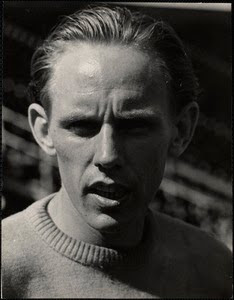
clifford f johnson cropped oregana 1947 pg 155
Clifford F. Johnson 1946 UO Track Oregana 1947

Clifford F. Johnson is our third feature in our series honoring Black History Month that highlights the work of historian Herman L. Brame. Johnson was raised in Illinois and decided to join the US army after graduating from high school. While in the army, Johnson served at Fort Lewis, Washington during World War II. During his time there, he faced racial segregation. Recreational facilities and the chapel were segregated and he, along with a large number of other African Americans, felt restricted while at Fort Lewis. However, in 1945, a basketball team comprised of Johnson and other African Americans beat the visiting Harlem Globetrotters in two out of their three games. In 1946, Johnson was honorably discharged as a chief warrant officer and became an undergraduate student at the University of Oregon in the same year. There he would have a successful academic career that would land him national attention.
After World War II, Johnson was one of a small but growing population of African American students in higher education institutions in Oregon. Johnson was a dedicated athlete and student at the University of Oregon. He was a broad jumper for the 1946 UO track team and was a journalism student when the University of Oregon School of Journalism was gaining national attention as one of the most prestigious journalism schools in the United States. Johnson was also a member of the Sigma Delta Chi journalism fraternity and eventually graduated with a bachelor of arts in journalism with honors in 1948.


Clifford F. Johnson 1946 UO Track Team Oregana 1947
Clifford F. Johnson
1946 UO Track Team (Johnson seated front row, far left. Seated next to Coach Bill Hayward)
Oregana 1947

Johnson continued his academic career as a graduate student in the School of Journalism in 1949. As a confident journalism student, he wanted to test his writing ability and so competed in a national journalism contest that was sponsored by the American Newspaper Publisher’s Association. Johnson placed second in the competition and attracted national attention. He was the first “negro” winner the competition had seen in its six years of existence. It was also likely that he was the first winner from Oregon.
In addition to his success in the journalism competition, Johnson also earned further praise for his graduation in the same year. 1949 was a year of an all-time high in African American graduates from Oregon colleges, and the NAACP and freelance writer Kathryn Bogle from The Oregonian paid particular attention to Johnson and a few other African American graduates in a featured newspaper article. Johnson’s praised thesis titled, “An Analysis of Negro News and Non-News Matter Appearing in Four Oregon Daily Newspapers during the years 1931, 1936, 1941, 1945, and 1948” was one of the first systematic studies on media bias. It has been and continues to be cited by various publications including: “Blacks in the State of Oregon 1788-1971,” by Lenwood G. Davis, 1971, “Protest at the Post, Coverage of Blacks in the Washington Post Magazine,” by Thom Lieb, 1988, and “History of Portland and Oregon,” City of Portland Planning Bureau, rev. 2015.
Although limited information is known about Clifford Johnson’s professional career after graduation, we do know that he continued seeking opportunities to exercise his talented writing abilities. Johnson was also a member of Sigma Delta Pi, a national Spanish honorary fraternity, and showed interest working in South American journalism in Argentina and Brazil. Furthermore, in 1949, he was also the managing editor for the “Bulletin of the U.S. Army Medical Department, Combat Psychiatry,” which was a monthly publication of the Office of Medical History. Through determination and his passion for journalism, Clifford F. Johnson became a national leader in the study of racial bias in media reporting in the United States.

Information for this article was collected from the following source:

Tuesday, February 7, 2017

V. 7 N. 8 An Oral History of American Long Distance Running

For several years I've been privileged to read Gary Corbitt's website and blog on historical events in American long distance running with particular emphasis on African American runners.  As most of you are aware, Gary's father  Ted Corbitt is lovingly referred to as the father of American Long Distance Running by his peers.  For most of his life Ted was a competitor attending and running for the University of Cincinnati  and represented the US at the 1952 Olympics.  After that he spent the rest of his life working in New York City as a physiotherapist and ran to work each day nearly 20 miles round trip.  His service to running involved developing accurate measuring of road courses, organizing, and many other activities too numerous to mention but all important in the promotion of the sport.  Not only these things but even more important, Ted was a person willing to listen and respond to folks seeking advice on training, on treating their injuries, and creating a correspondence over the years that has provided Gary a life's task of sifting through all that data and putting it together for posterity.

In his youth, Gary often witnessed his father competing in races and grew to have an intimate knowledge of the sport and the runners as few have had.  In the past year Gary has organized several conference calls between some of those folks who ran the big races in the 1950s and 60s and a conference call between some of the early female competitors in the sport.   He now has those  calls available to listen to on his website.  If you are a real student of the history of running in mid 20th century America, it will be worth your effort to visit his site, pull up a comfortable chair, a warm drink or a cold beer and listen to some of these conversations.   They are listed by subject   The Yonkers Marathon 1964 and Mt. Holyoke 1967 are the two races discussed by the men, and the women discuss their struggles to gain a place on the distance running stage.   He also has an index to show who is talking in each time period of the recording so that you can advance to a particular speaker if you so choose.

Here is Gary's brief description of the site and the link to listen to those calls.
George

Running History Conference Calls

I coordinated these three running history conference calls in 2016. The timing for each of the panelist is listed so you can listen in segments. The calls last around 90 minutes. These were the two most historic marathons in U.S. running history that I witnessed. I hope you take a listen and hear from some of the participants.
The Women Ultramarathon call is part of series and was dedicated to Ruth Anderson, and featured the late Eileen Waters Connolly.

*1964 Yonkers Marathon
*1967 Holyoke Marathon
*Women Running Pioneers of Ultramarathons – Part 2

Best Wishes!
Gary Corbitt
Curator: Ted Corbitt Archives

Tuesday, January 31, 2017

V 7 N. 7 The First Sub 4 at Hayward Field


Down the Homestretch
Dyrol Burleson and Ernie Cunliffe in Hayward Field's First Sub 4 Minute Mile
Burleson appears to be wearing some of Bill Bowerman's early experimental shoes.


U Oregon Stanford dual meet 1960   (clik here to view film)


A few weeks ago I was looking through the online archives of the U of Oregon's Knight library archives for old  track and field footage.  One of their uploaded to Youtube clips was of Oregon's early sub 4 minute milers including  Jim Grelle, Jim Bailey, Dyrol Burleson, Wade Bell, Keith Foreman, Arnie Kvalheim and others.  Brief clips of each of those men running is found on that particular piece.  In it I was intrigued to find Burleson running the first sub 4 minute mile at Hayward Field.  I had also known a bit about this race, because the man who did all the work to get Burleson to the line under four minutes is one of our regular readers, Ernie Cunliffe, who ran for Stanford and represented the US in the 800 meters at Rome in 1960.  I had known Ernie's sister in Ohio for many years before knowing she was related to Ernie.  When that connection finally came up, I was astounded that I was talking to someone whose brother was a boyhood idol of mine when I was in high school.   Ernie and I met a few years later on a visit Ernie made to Ohio, and we talked for a long time about track and field.  He remembered every split of every race he ran.  And he could fill in details of meets and happenings from that era that few ever knew about.  This was before Once Upon a Time in the Vest was even a dream, but it may well have been a seed that was planted in my brain.

 Ernie has mentioned that Oregon race several times, because it was his best mile (4:00.4), and on today's synthetic tracks no one can dispute that his time would have been under 4:00.  The original clip of the group of Oregon runners was black and white and showed only the backstretch of lap one and the last 50 yards of the race.    I wrote to the library last week asking them if there might be more of the race in their archives.  Elizabeth Peterson was assigned the task to dig it out and she graciously did so and uploaded the film onto Youtube and granted us permission to use it on our blog.  The upside is the film is now available in color.  The downside is that we don't see more of the race.  However there is a bit of footage of Burleson and Ernie after the race.  Ernie looks extremely disappointed, I'm sure because,  one,  he was passed at the end , but also that he was so close to breaking 4 minutes.    The film is almost five minutes long.  It shows how the old dual meets looked.  There were often 'walk ons' competing.  The pole vault on metal poles is looking about 12 or 13 feet by some of the vaulters.  There's a low hurdles race.  Note there are no throwing cages and officals, spectators, and contestants are standing dangerously close to the discus throwers.

     Ms. Peterson also attached a clipping from the Eugene Register Guard  describing the race, and in the story, Burleson was very gracious toward Ernie  for carrying the pace in that race.  This is the link to that story.   Classic Mile by Bob Mullin    If you are clever, you will be able to scroll that front page over to page 7 and get a full run down of the race and the meet which was won by Oregon 87-44.   Both Burleson and Cunliffe were scheduled to run again in the 880, which was a post race concern to both of them, especially after both had run two of the fastest miles in US history.  That was dual meet strategy in those days.  Fortunately both were relieved of that necessity by Bowerman and Jordan.  However Ernie ran a leg in the mile relay.  You can see his exchange on the film clip.  Their splits in the mile were   62, 60, 59, and Burleson 57.6, Cunliffe 59.4 on the last lap.  Third place was Oregon's Norm Lloyd in 4:28.  The box score of all events is also there and a lot more pictures of Burleson and Cunliffe.  Also note that three other track meets are reported in the paper.  This was not uncommon in the 1960s.

Knight Library track archives link   This link will get you into the ballpark on track archives at the library.   You won't find everything you want here, but there is still a nice selection of film from the 60s and 70s and 80s of some of the big meets that have been held at Hayward Field.

Some Comments:

"Well George you certainly did a lot of work to get the extra video of the race, in color no less.   I appreciate it and enjoyed viewing some other bits of the Oregon vs Stanford dual meet.   Oregon seemed to win most of the events although Norman Lloyd won the 880. "   Ernie Cunliffe

"What a treat !  Besides the mile, a lot of field event coverage.......     1960....The year I graduated from HS."    Steve Price,  Piqua, Ohio


"Dear George and Roy.:

I love this story, ....because , like you, George, I got to know Ernie Cunlife on a trip too.

Yours in Ohio and mine in New Zealand, where we roomed together throughout our 2 1/2 week tour.
We even got to go out salmon and trout fishing there and caught a couple of nice fish. Ernie's best race
was probably in the Wanganui world record mile which he and Bruce Tulloch helped set up for Peter.

Mine was a 1:48.5 at Hamilton, in coming second to Snell to his 1:47.6, or so.
My best only only winning effort during the N.Z. trip was also at Wanganui, where I was able to best
the former, NZ record holder,  Gary Philpott and Jim Dupree. in a time of 1:49.2.
I considered these to be good times since my last workout in Oxford Ohio before getting on the plane to
NZ consisted of 24 x 220 in the snow behind Withrow Court where I beat down a path to run the intervals in.

If it hadn't been for Once upon a Time in the vest., I might not have met up with Ernie again.
So,, thank you."


John Bork    CA

George,
  "I love it.   all my track friends down here that know the legend of Hayward field really got a kick out of the 64’ NCAA’s from Hayward field.  It looked like a high school track ( with the grass) that needed a lot of work.  LOL! "  Mike Waters Corvallis , OR

 Good articles from the Eugene Register.  When IU went there for a dual meet in 1979, there were also about 5,500 in the stands, all very knowledgeable T&F people.  It was a great meet going down to the mile relay which Oregon won by a few steps.  At that time they also had articles about the meet in advance and also after the meet which was really nice.  Those other 1960 articles were very good and helpful.  What a big sports section!  This was in 1960 and I noticed the Pirates beat the Braves, beginning their drive toward the Bill Mazeroski World Series.  The Reds were one year away, 1961 NL pennant.
   It is fun to read old papers to get history first hand.  Looking back on current events puts things in a better perspective.     Bill Schnier     Cincinnati, OH

George,
Thanks for the Oregon-Stanford link. Visited Oregon Knight Library during "08 Trials. Great archives.
14-6 pv was excellent with metal pole. Still running 220 low hurdles. 14.2 HH by Edstrom, Ore great mark, as well as 187' discus school record, and 221' jav.
Register Guard had front page article on U. of Oregon fighting discrimination (racial and religious - how timely !). Of course noticed there were no black athletes competing. Tangentally, I attended Florida HS Track and Field Hall of Fame banquet in Daytona Beach Jan. 6 (Gainesville friend Rick Quintana was being recognized for his contributions- announcing, video making, list making, coaching, writing). Host of the weekend was Ron Coleman, U. of Florida track athlete, and first black scholarship athlete at the school and SEC.
Bruce Kritzler     Sea Island, GA?


Saturday, January 21, 2017

V 7 N. 6 Ray Wyatt R.I.P. Kansas Jayhawk


                                                               Ray Wyatt  R.I.P.


Ray Wyatt leading the pack at the Big 8 Indoor 195?
Ray Wyatt passed away on October 16, 2016.   Ray was a stalwart (long sprints) on the U. of Kansas track team in the 1950s.  He was teammate and friend of Wes Santee and spent a lot of time with Wes during Wes' final days.  Ray also was a great friend of KU track alumni and hosted several gatherings of that illustrious group.  His website can be seen at  Ray Wyatt.   This website has a lot of interesting things about Kansas track in the 50s and also some things about Ray's hobbies with big Corvettes and collecting relics at archeological sites in the Lawrence area.  He contributed information about KU to this blog and also to Racing Past written by my friend John Cobley.  John did a nice piece about Wes Santee with Ray's assistance.    I only learned of Ray's passing when his emails failed to be delivered when we sent notices of new posts on Once Upon a Time in the Vest.   Ray and I never talked directly except by email, but he was generous with his time and his answers about track at Lawrence.  
George Brose


Ray Wyatt left us October 6, 2016. Born May 11, 1936 in Topeka, KS, to Ralph and Maryetta Wyatt, he distinguished himself by record-breaking high school track performances that led to scholarships at The University of Kansas. Upon graduation, he served in the Army and National Guard 1959-1969. He was known in Wichita for his influential management at Boeing, his love of speed and Corvettes, and long-lasting friendships. Memorial contributions in his honor are welcomed for the "Ralph E. and Ray C. Wyatt Fund For Athletics" at The University of Kansas, 1651 Naismith Drive, Lawrence, KS 66045, to provide student scholarships for participants in non-revenue producing sports. He was a proud Jayhawk.
Published in The Wichita Eagle on Oct. 14, 2016

V7 N. 5 Frank Murphy R.I.P. Jim Murphy USAFA HOF


Frank Murphy  R.I.P.

Frank Murphy the Villanova University  880 and miler of the 1960s passed away this week of Parkinson's disease at the age of 69.  

The two-time Olympian for Ireland (1968 and 1972) was on NCAA cross country winning teams in 1966, 67 and 68. In track, he was a member of 8 Penn Relays title teams and is in the Penn Relays Wall of Fame. At NCAAs, he anchored Villanova to DMR titles in 1968 and 1969. Individually, he won the NCAA 880 indoor title in 1969 - the same year he won the IC4a 1k crown. 
Frank Murphy seen here in third place on the cinders in Ireland

Murphy also represented Ireland at the 1968 and 1972 Olympics and was a medalist at the European Championships.

A nice review of Murphy's life written well before he died is at the following link written by Ian o'Riordan of the Irish Times  from Nov. 29, 2014

Distance Runners Contemplate the Price of Pushing Pain Barriers


Jim Murphy into USAFA Hall of Fame

The second Murphy making news this week is Jim Murphy former US Air Force Academy great who was recently put into the USAFA Hall of Fame.


Jim Murphy is a 1965 Academy graduate and was the school’s first NCAA champion, winning the 5,000-meter run at the 1964 NCAA Division I Outdoor Track and Field Championships. He also finished third in the 1964 NCAA cross country championships. Murphy was the track and field and cross country program’s first All-American in each sport. He remains ranked among the program’s top-10 in the outdoor 5,000-meter run, ranking eighth with a 14:06.60. Murphy was named the USAFA Most Valuable Athlete in 1965 and was a recipient of an NCAA post-graduate scholarship.  

Of note:  Murphy's 1964 NCAA title was shared with Bill Straub of Army. The two finished in a dead heat at Eugene.   Film of that race as well as the whole meet is available at the U. of Oregon archives.  
Use this link to the 1964 NCAA meet.  The 5000 meters race can be found at aprroximately 4:32 into the clip.
1964 NCAA Meet U. of Oregon


Wednesday, January 18, 2017

V 7 N. 4 Running Through Hell with Peter Sagal

Keep Going


Host Peter Sagal on Wait, Wait....Don't Tell Me!

This is an oral presentation by Peter Sagal of National Public Radio and the "Wait, Wait Don't Tell Me" series.  If you click on the link above "Keep Going"  you will be connected to a 15 minute monologue by Sagal recounting his running the Boston Marathon accompanying Will Greer, a blind runner.  The story caught my son's ear and he suggested I look up this presentation.  In the opening Sagal recounts that early in the New Year the family would sit around the table and recount the most important thing that happened to each member during the past year.  When Sagal said his most important event was setting a PR on his marathon time, his wife responded, "What could possibly be important about that?"  At that point Sagal surmised that his marriage was over, and it was.
Greer (19984) and Sagal (Guide)  side by side at Boston
.
He continues in a very humorous and then poignant way to talk about his run at Boston with Greer and how  the event  was possibly a turning point in his life.  I think even the most hardened curmugeon will be moved by the story.  For the curious, Sagal's PR in the marathon is 3:09.25 set at the Philadelphia Marathon in 2011.   His Boston time in the picture was about 3:27.

George Roy Steve.

Tuesday, January 17, 2017

V 7 N. 4 When a Canadian Woman Was World's Best Marathoner


                 How Could a Thirteen Year Old Girl Set a World's Best in the Marathon in 1967?
Maureen Wilton  May 6, 1967

One of the youngest ever world running record holders, Maureen Wilton  of Willowdale, Ontario was a 13 year old Canadian girl who put all of two weeks of rather questionable training  into running  her first marathon.  She was not new to the sport of running but to long distance she was  a neophyte.  A member of the  North York Track Club in 1967, she  had been training since the age of nine.  But nothing prior to her effort on May 6, 1967 gave much indication that a world's best time was about to be recorded.  Women were still fighting for a place on the roads with men, and I'm not referring to being allowed to drive cars in Saudi Arabia, but to compete in races of the same distance that men ran every weekend.  Today even with the  majority of marathoners being women, the under 60 age crowd are probably not even aware that this was an issue fifty years ago.  Now it's rare that we  see a man on the cover of a running magazine.  I won't go into that in this piece.   Never the less women were not welcome on the roads in 1967.  Less than a month earlier, Kathryn Switzer had been able against the will of the organizers to run in and complete the Boston Marathon.  Jock Semple, race director and  never one to mince words or actions, tried to 'man handle'  Kathryn off the course, but in that famous photo, the men around her kept Jock at bay and Kathryn on course.  Bobbi Gibb won that race at Boston in 3:27.17 as well as 1966 and 68,  and Switzer was second in 4:20.02.
Bobbi Gibb winning Boston in 1966

Gibb post race

In 1967 Switzer getting mugged by Jock Semple race director at Boston

Years Later Forgive and not Forget

Maureen's Wilton's  story was brought to my attention last week at a running club workout when Jamie Kantor told me that there had been a story on the CBC that day  about a young Canadian woman setting a world best for the marathon back in 1967.    I was intrigued by the story, and couldn't think who that might have been.  I thought Jamie might have been confusing Jaqueline Gareau who came along years later in 1979-80.  So I looked up the CBC story when I got home.  You can see it for yourself by clicking on  "Maureen Wilton" at the bottom of this page.  This is not the first time this story has been written, but for some reason it has  filtered through the pages of various running magazines over the last twenty years, and its significance each time has  been forgotten.   A google search will bring out some of those other stories.
Maureen and Her Parents after the Race
What is truly unique is that two stories came out of this one event, because Maureen Wilton's coach was Sy Mah.  Mah would run  his first marathon that same day as Maureen   and run 523 more marathons in his lifetime which in 1988 was a world record.   I mentioned that Maureen's training was questionable.  One story says Sy had Maureen running repeat 220s and 440s and some distance runs, in the two weeks prior to her attempt.  Sy only broached the subject of running the marathon to Maureen after she had done well in a 1.5 mile race.  She had never heard of the marathon, didn't know how long it was, and had no idea of what it would be like to go that far.  However she did have some serious talent  at shorter distances, probably a near five minute mile capability,  and a good sense of pace.  She mentions in one interview that she could hit a 440 on demand at the pace her coach dictated.  Mah had calculated that Maureen could break the record of 3:19.33 held by Millie Simpson of New Zealand set in Auklannd on July 21, 1964,  by running a 7:30 per mile pace. But by the end of the run with a mile to go, Maureen's mother who was keeping track of her time felt that they had messed up the timing and that Maureen was behind the record pace. Mom informed  Maureen, and she picked it up and ran a 6:00 last mile finishing in 3:15.23.  Kathryn Switzer came up to the race 2 weeks after her Boston adventure, but was never in it against the Wilton.  Not many people can pick up the pace like that at the end of their first marathon.  The 4'10"  80 pounder had gone into the stratosphere of distance running and barely realized it.  It is not noted in the stories, but I don't think Maureen ran another marathon.  She dialed back and hit the cross country circuit and represented Canada on some national teams and was out of running at age 17.   A few months after her marathon, the record was no longer hers as Anni Pede-Erdkamp of Germany cranked a 3:07.26.  Pede-Erdkamp a twenty-seven year old set her record at Waldniel, Germany.
Maureen getting her award after the race and Sy Mah in Yellow Shirt

There was some criticism of Maureen's parents at even letting their daughter run such a distance.  The old prolapsed uterus argument  was the main source of outcries, which have long since been proven not to be an issue.  Even today a number of sanctioning bodies discourage long distance running by teens and certainly younger children.  There are other concerns regarding growth plates being damaged on developing children's bones which are a legitimate concern.

Maureen's daughter Carolyn became a runner and was good enough to get a scholarship to run at West Alabama University.  That was an opportunity not available to Maureen when she was old enough to attend university.  Amazingly Maureen had never told her daughter about her running career until Carolyn was well into her career.    Maureen eventually earned  her way through her studies into a career in the financial world, and now at 58 years  has taken on a whole new career in dog training.

Regarding Maureen's life after a world best, her family went to their lake cottage after the race and were surprised when they came home to see the overwhelmingly negative press coverage about her accomplishment.  Even the track and field establishment was down on her achievement.  Since then Maureen is yet to be considered for a Hall of Fame nomination anywhere in her native land.  She has been soundly applauded at some recent events when Kathryn Switzer came to Canada and told the story to a packed audience at a pre-race event and then introduced Maureen who was sitting next to her totally unrecognized.   Maureen Wilton , now Maureen Mancuso was finally acknowledged and given a heartfelt ovation from her fellow runners.
Sy Mah in Olander Park, Toledo, Ohio


Sy Mah  would move on from Toronto to be an assistant professor of physical education at the University of Toledo.  He was very instrumental in the running community in Northwest Ohio in the 1970s and 80s until his untimely death in 1988.  Today his statue stands in Olander  Park where many road races took place in Toledo and the annual   Glass City Marathon.  His name is on the mugs given to all finishers.

See the CBC story which put me on to this post.
Maureen Wilton  by David Giddens, CBC Sports

George,
Don't remember Maureen, but sure knew Sy Mah well. He moved to Toledo, and was main force behind Toledo RRC when I started racing weekly, in about 1970. Believe he was teaching at Toledo University, as I remember visiting him at his apartment on campus. Sy was definitely more interested in road racing and marathoning than track. Sy was locally famous  for the number of marathons (524) he finished.
Bruce  Kritzler

George:

I am of the strong opinion that male runners should not attempt marathoning until they are 18 years old.
Perhaps even 21 Year old.

To heck with records!

Just because you can do it, does not mean that it is good for your short term health or for your long term
development as a runner.

Comments encouraged. Especially from our readers and contributors with coaching backgrounds.

John Bork

John,
I share your concern about young kids running marathons.  I looked up the current world best for 13 year old girls and it is now  2 hr. 44 min.     Thirteen year old boys  is 2hr. 43 minutes.  Also of note is that the girls' record was set in 1987, the boys' record in 1977.  This indicates that nobody is trying to beat the record  and putting  their kids' health at stake anymore.  At least not on a grand scale. The records are listed down to 4 year olds.  Remember in the late sixties early seventies there were groups of parents trying really hard to have their kids doing long distance stuff.  Even Runners' World put out some pamphlet books on a group called PaMaKids who were promoting family togetherness through distance running.   There are probably still a few parents promoting such activitiy. Fortunately they are few and far between.  But child abuse is rampant in many forms in our country and throughout the world, certainly not just through sport.  For 15 years  I worked in the field of very serious child abuse, and if there was a common thread in those cases, most parents never felt that what they were doing to their children was out of the ordinary.   It would probably be very hard to prosecute a parent for training a kid to run a marathon  today, even knowing that the child's health and well being might be at risk.  Look at how controversial the vaccination question is.   That said I recently saw a film from India about a little boy training to run marathons. He had run 48 marathons by the age of 4 when the HBO film was made.   He was clearly being exploited, because the coach of this slum kid was obviously doing a lot of self promotion and making  money off the child.  Someone murdered the coach.  I hesitate to say 'fortunately murdered' but the thought did come to mind.    See   Marathon Boy trailer.    Of interest, that child is no longer running marathons, and someone has looked out for him, and he is getting an education in a boarding school which would certainly have been out of his family's reach had he not had that notorious past.    In other ways less flagrant but still exploitative we see in every grandstand and every performance hall children being driven by aggressive parents to the brink of exhaustion to excel in various activities.  Psychological abuse is no less devastating than physical abuse.  Any college coach today can tell you stories of exploitative parents they have had to deal with.   This is not only sport but spelling bees, dance, piano, theater etc.   The parent clearly driving the child to thrive where the parent has failed..or excelled.    In some societies it is seen as the only way out  of poverty such as baseball in the Caribbean and South American countries as well as soccer.  In their own way the East Germans and Soviet Bloc promoted their societal beliefs  in the 70s, and there are still vestiges of that past in Russia today.

In Maureen Wilton's case, it was fortunate that her experience was a one and done.  She was clearly a natural and her effort probably not much more than the equivalent of a long hike on a family outing.


Still begging the question , when is it time to run a first marathon for a young person?  So much indivduality in this query.   If you're training for the mile and using a Lydiard system to train, you're going to run at least a 20 miler on occasion as part of the endurance building phase.  Some kids mature physically much earlier than others.  Some kids have tender joints and others don't.  Really hard to put a specific age on the question.  Some atheltes have very little natural talent and might see a marathon as simply a personal challenge to try to complete.  It might not have any bearing on their future performances, yet for others at any age it could be a devastating event.
George

George,
  Interesting debate.   I know in late 90’s a high school coach in Salem ore took his boys distance runners to do the LA marathon.   I heard through the track coaching grapevine that the marathon wiped out the boys track season.   The parents were upset and the coach was relieved of his coaching duties.  

Mike Waters

George,

I agree with you and John.  I took up distance running in grad school at the age of 24 and did not run a marathon until 28.  I don't think kids want to run a marathon, and it is usually the parents, who are pushing them.  If the kid really likes running, I think the parent should curb his/her exuberance  and limit his running to maybe 20 miles per week and certainly not a marathon.  It seems as if some of the best runners come out of age group swimmers or soccer players.  I remember growing up with no parent involvement in my athletic endeavors, mainly baseball and basketball and only on a club basis.  I still think this is a good model.  Of course, the kids are better at everything sport today, but I thoroughly enjoyed my athletic upbringing and later morphing into a distance runner (still not very good compared to college trained runners).

Don Betowski


To Once Upon a Time in the Vest

After coaching all ages of kids for fifty (50) years, I read with interest the Mo Wilton story and her marathon run at age thirteen (13). I can appreciate all of this since my club, the Kettering Striders, was one of the earliest running clubs in the US for young girls and from the beginning I trained them the same as if they were boys. In the late 60's, girls running anything was a cause for questions and much tsk tsking among the general population. I took girls from my PE classes in Kettering, Ohio and had them running round the school grounds and up and down the hills in a neighborhood pasture. None of them seemed to complain nor suffer any damage from the regimen I put them through. That first season I took them to one cross country race and a couple of road races. It was so unusual that our local paper ran an action picture with the caption: " What is this ? It is a girl running "   Though the girls usually ran races in X-C up to two miles, they did participate in a half-marathon once each year with some as young as ten (10) completing the distance. When properly trained, kids can complete and enjoy the longer races. I cannot comment on how old one must be to run a marathon as we just didn't do it.........maybe too much of a good thing !  Remember something else folks: Not everyone is competitive at the same point in their lives. Ideally, it would be best if your most competitive peak came between the ages of twenty five (25) and thirty (30) but that doesn't always happen. Sometimes it may happen when the runner is thirteen (13) and when people see this boy/girl run, they immediately start with the " just think how good he/ or she will be when" (fill in what you usually hear) . All you can really do is say Bonnie/Robbie is a good runner and let it go at that !        Steve Price 1-20-17


Hi George,

I further comment to you as I read the comments and was a bit put off that all of this was thrown on the parents!! If ONLY I had listened to my father who really pushed me to try other sports and be involved in other sports. Instead I insisted on running and racewalking only. I remember we were encouraged not to go ice skating in case we injured ourselves. I don't know if it was a direct - you can't go ice skating - or encouraged and then of course...anything my coach said was golden and anything my father said wasn't because what did he know about the sport? Perhaps if I did try my hand at other sports I would have disciplined my body muscles to be a better runner or race walker and especially, have enjoyed the sport and not have the pressure of getting University scholarships looming over my head. If my father had forced me not to run XC or T&F and eventually even indoor T&F I probably would have resented him. God Bless that man. He couldn't win.
I agree with what was  said above. Sometimes the peak for an athlete comes early. Sometimes it comes late. Sometimes it never comes. They should focus on the reward of self discipline and hard work than the records. I was most proud of my PR's than winning first place. I remember the last USATF Jr Nationals I won. My time was the slowest I ever walked in competition and yet I still won. It felt so hollow. Winning and records isn't everything.
Susan

Saturday, January 14, 2017

V 7 N. 4 Ashton Eaton and Harry Marra


Athlete and Coach:  

An Appreciation of Ashton Eaton and Harry Marra

by Jon Hendershott

(All photos supplied by Jon Hendershott)


     It was the perfect storm:  supremely talented athlete meets ultra-experienced coach.  Once their work together began to bear fruit, the multi-events would never be the same.
Harry Marra, Brianne Theisen-Eaton, Ashton Eaton, and Jon Hendershott

     Ashton Eaton was the athlete, just beginning his third season at the University of Oregon in the fall of 2009.  Harry Marra had just been hired by then-head coach Vin Lananna to work specifically in developing the obvious talents of emerging decathlete Eaton--as well as the second-year heptathlete from Canada, Brianne Theisen.

     The connections that formed virtually from the beginning between the coach and both athletes would result in world-class performances, championship medals plus Eaton remaking records in the men's multis, indoors and out.  And Theisen would eventually become Eaton's wife as well as a world-class seven-eventer in her own right.

     Now, after Ashton's two Olympic 10-event titles, two decathlon World Records and three indoor heptathlon bests, two World Champs deca wins, three World Indoor heptathlon victories and a total of five NCAA triumphs (three decathlon, two heptathlon), both Eatons announced their retirements on January 4.

     Brianne tallied five NCAA titles, two outdoor Worlds heptathlon silver medals and a pair of World  Indoor pentathlon awards, including the 2016 gold medal.

     Eaton himself headed west across the Cascades to Eugene out of Mountain View High School in Bend, in central Oregon.  He had been directed as a high schooler by Tate Metcalf and had won state sprint and long jump titles.

     Oregon's then-assistant coach Dan Steele--8th placer in the '99 Worlds 10-eventer with  his 8130-point PR--recruited Eaton and felt all along he could make an impact as a decathlete.  Steele directed him to the 2009 NCAA Indoor heptathlon win and a defense of his outdoor decathlon title.  Then Steele was hired as head coach at Northern Iowa and Lananna had to find a knowledgeable, experienced coach for his obviously diamond-in-the-rough talent.

     So he called Marra for advice.  Marra had earned his Masters in physical education from Syracuse and had coached at San Francisco State University in the 1980s, as well as with the VISA Decathlon team.  He was a 6524-point scorer in the mid-1970s while training in the then-hotbed of U.S. decathloning, Santa Barbara.

     Even though he measured just 5'6" and 140 lbs (168cm/64kg) then, Marra was known as a tenacious competitor, but also a voracious reader and student of the sport.  He constantly asked questions, especially of renowned coach Sam Adams, as well as the athletes training in Santa Barbara at the time.  Marra just couldn't soak up  enough technical knowledge about events in general and the decathlon in particular.

     When Lannana sought his advice about coaches, Marra and his wife Madeline lived in San Luis Obispo, just north of Santa Barbara.  With his wide knowledge of the decathlon and its coaches, Marra directed Lannanna toward various candidates.

     But Lananna once recalled, "None of the coaches Harry recommended could take a job at Oregon.  Suddenly, I thought, 'Why am I asking other people?  Harry knows as much, or more, than any of them.'  So I offered Harry the job.   I asked him, 'Can you keep developing Ashton, and eventually Brianne, so they win more NCAA titles?'  He said, 'Sure, I can do that.'"

     While he admitted, "I just loved California," the prospect of a university coaching job--especially with the storied program at Oregon--won over Marra.  So he and Madeline left their large home in SLO to move to a small apartment in Eugene.

     On November 3, 2009, Marra began coaching Eaton and Theisen--and , yes, the rest is history.  As in, just four months after they began working together, Eaton won the NCAA Indoor heptathlon--with a World Record 6499-point score.  And Brianne won her first of three straight NCAA Indoor pentathlons.

     Marra knew immediately that he would work with two exceptional athletes, and people.  He said,  "The thing with the multis, in all the variations, is that life needs to revolve around the event.  It can't be vice versa or you won't be successful.

     "From the beginning, it was clear that Ash and Bri were very mature kids, on all levels.  Athletically, they ate, drank and slept the multis.  They also were endless readers with curiosity about the world in all aspects.
Marra shows desired shot form to the athletes.
     "In the multis, an athlete has to be excited to accept challenges--but you also have to know and accept that you won't get the desired outcome right away.  It's a long, long process and an athlete has to be ready to continually accept challenges.

     "A multi-eventer needs to have an attitude of coming  back from failure.  You're going to fail in practice more than you're going to succeed.  Ash is the type of athlete who might have a very good high jump practice one day.  But it still wasn't quite what he wanted.

     "Damn good, but he was still ticked off about it. 'Aw, I didn't like that,' he would say.  And that's a great attitude to have.

     'But you also have to be sensible.  You can't expect to be good in the decathlon tomorrow.  You can be better than you were yesterday, but you have to stick with it for a number of years.  I try to teach safe mechanics because I want every  athlete I coach to be 100% healthy going to the starting line for any competition."

     It didn't take long for the athletes to connect totally with their coach.  Only about three weeks after they began working together, Eaton approached Marra and said, "Coach, for me, less is more."  Marra recalled, "He meant that training didn't have to be hammer-hammer-hammer every session.  He felt fresher not doing that and could keep moving forward."
Marra and Eaton compare notes on their training observations

     "So we kept our training short and sharp.  I learned long ago that you listen to the body.  When it's time to go, you go.  When it's time to rest, you rest.  The body will tell you."

     But Eaton added, "We went through a lot of different scenarios in our careers, but I always knew that Harry knew where we were and where we should end up.  He knows and could communicate the things an athlete needed to do to reach a certain goal.  Bri and I might get frustrated with something, but he would say, 'It will come.'"
Marra and Eaton compare notes on their training observations.

     Marra replied, "No decathlete or heptathlete in history has not dealt with frustration.  Ashton was so good because he could deal very well with chaos--and the decathlon is chaos."

     Those lines of communication remained open throughout their careers.  After Brianne placed 10th in the 2012 London Olympic heptathlon--short of all of their expectations--she told Marra,  "Harry, I'm not in this to place 10th.  I never want to do that again.  I want to be on the medal podium from now on."

     So Marra totally redesigned her training and the next spring she won the prestigious heptathlon staged annually in Goetzis, Austria.  Later that season, Theisen won the heptathlon silver medal at the '13 Moscow World Championships  She would win the Commonwealth Games  7-eventer in '14 and ultimately the '16 World Indoor pentathlon and the Rio Olympic heptathlon bronze medallion.
Eaton doing pole vault run-ups while Brianne  Theissen checks his step.

     Brianne said, "Harry just loves to coach and work with athletes."  Marra added, "I take coaching very seriously, regardless if an athlete is trying to win a junior high school championship or the Olympic title.

     "An athlete puts his or her life into the coach's hands.  So you have to take that responsibility seriously and say, 'I'm going to do the absolute best I can to see that this athlete becomes the very best he or she can be.'"

     Marra also believes,  "The coach can't be a crutch for the athlete.  Many athletes will do an event, then immediately look to the coach for feedback.  I want the athletes to be able to analyze things on their own.  They write down every aspect of their workout:  how they felt; what they did that they liked, or didn't like; every detail.   Then we can compare notes.

     "That's because the athlete and coach always should be continually learning.  You have to be confident in what you know--but you have to realize that you don't know everything."

     And there could be times of scary lessons.  On an early spring day in 2013, the athletes and their coach were training in Santa Barbara, logging a six-week bloc of work prepping for the World Championships season to come.  While training with the javelin,  Ashton had gone out to the far left of the landing area at Westmont College to retrieve his spear.
The trio doing javelin training --just before the "near-miss" incident.

     Brianne took her own throw, but instead of her usual to-the-right style, she pulled the javelin to the left--and it bore down on Ashton, who didn't know it was coming.  Brianne and Marra screamed warnings and the ultra-athletic Ashton arched his back to the left as the spear whizzed by his head.
Ashton reassures Brianne that he is OK after the javelin near-miss.

     "Whoa," he said later, "that was close.  I saw this flash of purple go right under my nose."  That was the handle of Brianne's javelin.  She immediately ran to him and they embraced, him smiling to reassure her that he was fine.  But that close call certainly went into the training logs--no doubt in the "near-miss" column.

     It was just one more unique happening in their unique relationship.  Yet while the athletes won major championship medals for their efforts, his peers honored Marra with the Coach of the Year awards from USA Track & Field in 2012 and the IAAF just this past November.

     He said, "I said after the USATF award, but it holds for any award I have received, that I owe the honor to every coach in the room.  I have tried to listen and learn from every coach I have ever met.  Then I try to transmit that knowledge to the athlete.

     "But I'm also a competitive guy and I have tried to teach that competitiveness to athletes.  I have been a teacher first and that's what has fired me up my whole career."

     Now,  the sport will be without the unique talents of all three.  Their lives will change markedly with the athletes' retirements.  Ashton and Brianne are taking their time finding new challenges in life to devote their energies toward.  Marra says he wants to stay with coaching, but in a much-scaled back fashion and perhaps working at directing younger athletes.

      In announcing his retirement, the always-thoughtful and introspective Eaton said,  "I gave everything I had to the decathlon.  I did all I could.  Thank you for making it the best time of my life.

     "I'm deciding what to do next.  Other interests of mine are education, transportation infrastructure and energy."

     Then, in a tease--or was it?--Eaton gave an indication that the world certainly has not heard the last from him, by far.  He concluded, "Being the first person on Mars would be cool."
The author Jon Hendershott with Coach Harry Marra (left)

(Jon Hendershott has followed track and field for 60 years.  For 48 of those seasons, he was a writer and editor at Track & Field News.  He has covered 9 Olympics, 13  outdoor World Championships, 3 World Indoor Championships and the World Relays, as well as dozens of NCAA and USA Championships.  He has twice won track Journalist of the Year awards presented by the Track & Field Writers of America.  An Oregon native, he is now retired and lives in Salem, Oregon, and is eagerly awaiting the start of his 61st year following the sport.)

Comment from Bill Schnier, U. of Cincinnati track coach (ret'd.)

Jon's article is right on point, devoid of glitz, yet full of the personal story which this topic deserves.  Great addition.

Comment from Don Betowski:
Hi George,
I enjoyed the story about Ashton, Bri, and Harry.  I was in Santa Barbara in the '70s doing research at UCSB, but also training at the track, usually doing interval training at noon.  I got to know several of the decathletes including Harry.  I remember Harry telling me he was the shortest decathlete, who scored over x number of points.

Another great runner has died of Parkinson's Disease.  Dr. Jack Reilly and Richard Greene were joined in the fact that they were very good milers in the early '60s, as both graduated from college in 1963, Richard from Western Michigan and Jack from Georgetown (where he was my resident adviser one year at Georgetown).  Richard had run a 4:06 mile, Jack a 4:01.  Perhaps Jack's most famous run was his anchor relay leg at the 1962 Millrose Games, the same meet where John Uelses broke the 16 foot pole vault barrier.  You can view Jack's anchor here:  https://www.youtube.com/watch?v=Bc1yPzjkBGk 


V 15 N. 10 Gunder 'The Wunder' Haegg Visits Cincinnati

Bob Roncker of Cincinnati, Ohio has sent in this account of one day on the 1943 tour that Gunder Haegg of Sweden made to the US to help rais...