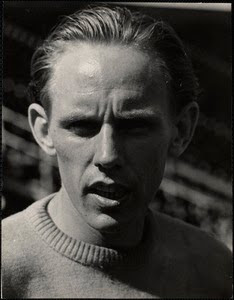
Jim Beatty
March 1963 Indoor track is dead. Long live outdoor track. Yep, the indoor season has come to an end and in the warmer climes the outdoor season is going full steam. The indoor season has not gone quietly as the weekend of March 8-9 produces a world record and two American records. Let's go to the Chicago Daily News Relays where the largest crowd of the season, 16,758, watches Jim Beatty take a shot at Murray Halberg's 2 mile world record of 8:34.3. The field includes the iconic teenager, Bruce Kidd, Poland's Witold Baran and Beatty's LATC teammates, Bob Schul and Merle McGee, but as far as Beatty is concerned it is race between him and the clock. Coach Mihaly Igloi  prescribed a 62 second opening quarter and that is what he got as Beatty hears teammate Bob Seaman call out 61.5 at that point.
  Bob Seamon
Grelle Schul Beatty
The rest of the field is willing to let him go. The next splits are 2:05.3 and 3:08.9 before hitting the mile in 4:13.5. Sixty-five second quarters will produce the record and that is what the former North Carolina runner produces the next three quarters: 65.0 (5:18.5), 65.2 (6:23.7) and 65.3 (7:29.0). With the record virtually assured, the crowd erupts, exhorting Beatty to ratchet it one more notch. He responds with a 61.7 and the record is his at 8:30.7. Jim Beatty now owns both the indoor (8:29.0) and outdoor two mile world records. Lost in the hubbub is a great race by the heretofore unheralded Schul whose strong finish brings him home in the third fastest time ever, 8:37.5. Indeed his last mile is faster than Beatty's. Kidd, who has missed training time because of an infected blister on his foot, is well back at 8:55.4. Kidd's University of Toronto

Bill Crothers
teammate, Bill Crothers, is taking aim at Peter Snell's 2:06.0 1000 yards WR. Running from the front, he barely misses, finishing in 2:06.4.
In second with a new American record is Missouri's Robin Lingle who runs 2:07.6.

Robin Lingle
There is a notable mile as well. Jim Grelle vs. Tom O'Hara with Bill Dotson thrown into the mix.

Dotson seen taking a baton from Ted Reisinger at Drake Relays later in the year
The field follows a rabbit through a 58.9 quarter before O'Hara is forced to take over.
 The next quarter slows to 2:01.2 before the pace rallies a bit at 3:02.5. At this point O'Hara leads with Grelle and Dotson right on his heels. When the gun sounds on the tenth and last lap Grelle moves wide to pass and nearly allows Dotson the inside advantage, but they are only running for second place as O'Hara moves away easily to win 3:59.5 to 3:59.8 for second place Grelle and third place Dotson. The next evening, Saturday, March 9, finds us in Milwaukee for the USTFF meet where 19 year old Brian Sternberg from the University of Washington separates from himself from former WR holders John Uelses and C.K. Yang by clearing 16-3½ to set the American record.His vast potential is demonstrated on his second try at a WR height of 16-9½ as he just brushes the bar off with his chest.
 |
| C.K. Yang |
 |
| Brian Sternberg |
 As the year starts the WR at 200 meters on the turn, 20.5, is shared by Britain's Peter Radford, set in 1960, and equaled Villanova's Paul Drayton last year. This situation is about to be altered dramatically. February 10 at the Southern Games in Pointe-a-Pierre, Trinidad, 100 yard world record holder Bob Hayes joins the 20.5 200 club.
  Now it is March 2 in Coral Gables, Florida and he braves a hindering wind in the straight to cover the slightly longer 220 yards in the same time. The 20.5 log jam doesn't last long. In Tempe, Arizona, in an evening dual meet with Utah, 20 year old Arizona State sophomore Henry Carr simplifies the record keeping with a 20.4 220. It is not as if this is a designed record attempt as he PRs in winning the broad jump at 24-1¾, takes the 100 in 9.6 and runs on both winning relay teams. The front page story gives the background of his amazing potential.
 As a high school sophomore in Detroit he ran 9.7 and 20.8 on the straight. The next year he added the 400 to his repertoire, running 9.6, 20.6 and 48.3 and broad jumping 23-4½ . He continued his improvement as a senior with 9.5, 20.6 and 47.8 performances. The warm weather and longer season in Arizona as a freshman agreed with him as he tied the freshman record of 9.4 in the 100, established a frosh record of 20.1 at 200 on the straight and had a 45.5 carry on the ASU mile relay team. As good as his new 220 record is, it doesn't last long. Under the heading of “Late News” we learn that four days later on March 23 he has done it again. In what appears to be a triangular meet with USC and Arizona, he runs 20.3, clipping a tenth off his previous mark. He also wins the 100 at 9.5 and, although not mentioned in the brief notes, probably runs legs on the 440 and mile relays. The latter is almost assured as the Sun Devils set a national collegiate record of 3:07.2. Pretty sure they didn't do that without Henry on board. Hopefully we will have more information, specifically splits, in the next issue. At this point we can say with confidence that Henry has earned his scholarship. Also in the “Late News” column, we learn that John Pennel has wrested the outdoor pole vault WR from Pentti Nikula, topping his mark by half an inch on March 23 in the Memphis Relays. The impact of this mark is reduced by the fact that Nikula's indoor mark is over half a foot better. Retribution may loom when the Finn is able to get outdoors
.If outdoors ever happens in the Finnish climate.
Penti Nikula today

Other items in this issue include the headline, “Another Double by Dyes”. It seems that at the West Texas Relays held March 16 in Odessa,

 the amazing Jerry Dyes has won his third javelin – broad jump double in as many weeks, throwing 244-2 and jumping 23-9½. The previous week in the Border Olympics in Laredo, he posted marks of 240-3½ and 24-0, efforts that, along with leading off the winning Abilene Christian 440 relay and placing fourth in the 100 at 9.8, earned him the meet's outstanding athlete award. There is a pretty good high school athlete in Texas who may bear some watching. He is 6-6, 220 pound Pampas HS senior
  Randy Matson who last year showed promise with shot and discus marks of 64-7 and 186-6. As a senior he has spent his time playing football and basketball, sports in which Texas sports writers have confirmed that he is “above average”. While no specifics are given for football, “above average” appears to be a term applied loosely in basketball as he was voted to the Texas AAAA all state team and lead the state in rebounding with 18.2 a game. This season, after one day of practice, he has thrown 64-1¾ and 188-7½. We'll keep an eye on this kid and see if he improves.Matson will go to Texas A&M, but the U. of Oklahoma can't be faulted for not trying to get him to Norman. They gave scholarships to two of Randy's buddies from Pampa hoping Randy would decide to attend OU.