Once Upon a Time in the Vest

Showing posts with label Bill Dotson. Show all posts

Monday, May 27, 2013

Vol. 3 No. 32 Memorial Day Remembrance of Cliff Cushman and Others Who Died in War.

This article came from the University of Kansas athletics website.  We've written about Cliff Cushman and his having died in Viet Nam.  On this Memorial Day weekend we feel it's more than appropriate to remember Cliff again.   Mike Solomon, former Jayhawk runner sent this to us today.  One of our regular readers, Ernie Cunliffe was especially close to Cliff as a former Olympic team member with Cliff in Rome.  Ernie has made considerable efforts to try to get help in locating Cliff's remains, but to no avail.

One of my teammates from the University of Oklahoma also lost his life in Viet Nam.  Phil Neislar, a 440 runner from Ft. Smith, Arkansas  became a navy pilot and died on his first mission from an aircraft carrier.  His plane went into the water right after takeoff and Phil was never found.

Also to be remembered is Ron Zinn,  US team racewalker and West Point graduate who died in Viet Nam and Bill Rawson,  University of Missouri 880 runner who died in Viet Nam.     If you can think of others let us know to add to the list.

We can take names from any side of a conflict.  I'm thinking of Rudi Harbig and Karl-Ludwig "Luz" Long as well.

Best to all of you old guys who have served.

REMEMBERING TEAMMATES ON MEMORIAL DAY
Cliff Cushman (above) showing off his NCAA Championship ring and Bill Dotson below.
May 24, 2013
Memorial Day is for family and friends to remember the men and women who died while serving in the United States Armed Forces. And the reality is these family and friends think of those who have perished every day since they have passed. That truth lays the same for Kansas’ world-class track standout Bill Dotson who was mentored by teammate and Olympian Cliff Cushman.
The two became the best of friends in their time as teammates at KU. When asked about his friend Cliff, Dotson glows. He describes a passionate man, full of life, talent and a love for others. Although soft spoken, Dotson still can’t think of a more ideal teammate and the duo became even closer after KU. In fact, just two weeks before leaving on his tour of duty in Vietnam, Cushman came to see Dotson.
That would be the last time the two saw each other as Cushman’s plane was shot down in battle. 
“It was like I missed my brother when I heard about him being shot down in Vietnam,” Dotson said. “I believe he was there only 18 days when he was shot down. He was loved and admired by everyone on the track team. He was a better person than he was an athlete. No one had anything bad to say about Cliff.” 
Cushman was a main cog in Kansas’ 1959 and 1960 NCAA Men’s Track and Field Championship teams. A native of Grand Forks, N.D., Cushman came to KU as a well-rounded star having won state titles in the long jump, high hurdles and mile. At KU, he ran the 400 hurdles for head coach Bill Easton, finishing second in the NCAA championship in 1959. His senior year, 1960, Cushman was the most outstanding performer at the Kansas Relays and later won the NCAA championship in the 400 hurdles. 
“I can still remember in my mind’s eye Cushman doing the 400-meter intermediate hurdles, which I think is the toughest event in all of track and field,” KU long-time broadcaster Max Falkenstien said. “I remember seeing that blond hair he had coming around the turns at Memorial Stadium. He was such a tremendous hurdler and sprinter combined in such a very demanding event.” 
As a captain on the KU team, Cushman mentored Dotson, a distance standout from Jamestown, Kan., who was two years behind Cushman at Kansas. Dotson literally rewrote the KU records book in distance events. Dotson, a two-time All-American and six-time Big Eight Conference champion, was a three-time American Record holder in the mile (all three times in 1962). He became the first KU and Big Eight athlete and only the fourth collegian to break the four-minute mile. To this day, only two Jayhawks have broken the four-minute mile collegiately, Dotson and Jim Ryun. 
“I remember at the (Big Eight) conference meet as a sophomore, Cliff was a senior and he’d coach me a lot,” Dotson said. “He’d say ‘just wait around until that last 330 (yards), that last lap and then just pass everybody and bring it on home. Just outrun all of them.’ And that’s what I did.” 
Following KU, Cushman went on to win the silver medal, behind U.S. teammate Glenn Davis, in the 1960 Olympics in Rome. The following year he joined the U.S. Air Force and continued training for the hurdles as well as training to become a jet-fighter pilot. Tripping over a hurdle in the U.S. trials in 1964, Cushman failed to qualify for his second Olympic games. Dotson would go on to be a part of a world-record mile-relay team and earned a spot as U.S. team member for the 1963 Pan American Games. 
“I remember another time when I was running in Madison Square Garden in New York City and I was running against some of the best milers in the world,” Dotson said. “Cliff was standing on the side of the track and he said ‘to run around on that last lap, you’re waiting on them. Why didn’t you win it?’ That was the way Cliff was, giving you that type of assurance that you can do it. He was a big brother and mentor. We were both quiet. We weren’t loud in making a lot of commotion. We let our actions speak louder than our words.” 
It was 1966 when Cushman received his orders and was sent to fight in the Vietnam War. On Sept. 25, 1966, his wife, Carolyn was notified by Air Force officials that Cushman’s plane had been shot down and he was missing in action. Cushman’s body was never recovered. 
“At the time I was with New York Life Insurance Company when he got his orders to go to Vietnam,” Dotson said. “He was crazy about flying. He used to fly those 172 Cessnas when we were in college. I’d go up with him once in a while. He was always trying to max those things out. He came to me a week or two before he went to Vietnam and wanted me to write an insurance policy, which at that time no insurance company would take for a pilot that was in the armed forces, especially if they had their orders to go to Vietnam. I experienced at that time that he knew, and the way he said it, he wasn’t coming back. He had just gotten married and his son was a few months old. He sensed he wasn’t coming back so he wanted an insurance policy. I felt really bad at that time. It kind of strikes you that you know the feeling inside of him that’s going on.” 
Many bonds teammates develop in any sport are like family, including two track standouts from North Dakota and small-town Kansas. In practice and competition they share the blood, sweat and tears of the defeats and the victories during their college careers. For Dotson these memories of Cushman are still vivid in his mind today, some 46-plus years after Cushman was declared missing in action while fighting for USA’s freedom in the Vietnam War. 
“With Cliff I always say hello every night before I fall asleep,” Dotson said. “I always remember him as one of my best buddies. In spirit or whatever, I always say hello to him and share a few thoughts just about every night. He’s always in my thoughts, especially when I fall asleep. That’s the type of friendship and energy we had between us. He’s always there.” 
Memorial Day is a time many will reflect on those who have died while serving in the United States Armed Forces. These individuals are not just family and friends but also teammates. 
If you know of a former Jayhawk student-athlete who fought for their country, we’d like to hear from you. 

Monday, February 18, 2013

Vol. 3 No. 11 March , 1963


Jim Beatty
March 1963 Indoor track is dead. Long live outdoor track. Yep, the indoor season has come to an end and in the warmer climes the outdoor season is going full steam. The indoor season has not gone quietly as the weekend of March 8-9 produces a world record and two American records. Let's go to the Chicago Daily News Relays where the largest crowd of the season, 16,758, watches Jim Beatty take a shot at Murray Halberg's 2 mile world record of 8:34.3. The field includes the iconic teenager, Bruce Kidd, Poland's Witold Baran and Beatty's LATC teammates, Bob Schul and Merle McGee, but as far as Beatty is concerned it is race between him and the clock. Coach Mihaly Igloi prescribed a 62 second opening quarter and that is what he got as Beatty hears teammate Bob Seaman call out 61.5 at that point. Bob Seamon


                                                  Grelle                   Schul            Beatty

The rest of the field is willing to let him go. The next splits are 2:05.3 and 3:08.9 before hitting the mile in 4:13.5. Sixty-five second quarters will produce the record and that is what the former North Carolina runner produces the next three quarters: 65.0 (5:18.5), 65.2 (6:23.7) and 65.3 (7:29.0). With the record virtually assured, the crowd erupts, exhorting Beatty to ratchet it one more notch. He responds with a 61.7 and the record is his at 8:30.7. Jim Beatty now owns both the indoor (8:29.0) and outdoor two mile world records. Lost in the hubbub is a great race by the heretofore unheralded Schul whose strong finish brings him home in the third fastest time ever, 8:37.5. Indeed his last mile is faster than Beatty's. Kidd, who has missed training time because of an infected blister on his foot, is well back at 8:55.4. Kidd's University of Toronto  
             Bill Crothers


teammate, Bill Crothers, is taking aim at Peter Snell's 2:06.0 1000 yards WR. Running from the front, he barely misses, finishing in 2:06.4.
 In second with a new American record is Missouri's Robin Lingle who runs 2:07.6.
    Robin Lingle

 There is a notable mile as well. Jim Grelle vs. Tom O'Hara with Bill Dotson thrown into the mix.
Dotson seen taking a baton from Ted Reisinger at Drake Relays later in the year 

The field follows a rabbit through a 58.9 quarter before O'Hara is forced to take over. The next quarter slows to 2:01.2 before the pace rallies a bit at 3:02.5. At this point O'Hara leads with Grelle and Dotson right on his heels. When the gun sounds on the tenth and last lap Grelle moves wide to pass and nearly allows Dotson the inside advantage, but they are only running for second place as O'Hara moves away easily to win 3:59.5 to 3:59.8 for second place Grelle and third place Dotson. The next evening, Saturday, March 9, finds us in Milwaukee for the USTFF meet where 19 year old Brian Sternberg from the University of Washington separates from himself from former WR holders John Uelses and C.K. Yang by clearing 16-3½ to set the American record.His vast potential is demonstrated on his second try at a WR height of 16-9½ as he just brushes the bar off with his chest.
C.K. Yang

Brian Sternberg


 Remember the 1968 Harvard – Yale game where Harvard comes from 16 points down with 42 seconds left to tie the game and the headline reads “Harvard beats Yale 29-29”? Well, the Big Ten meet is something like that. With only the mile relay remaining the score is defending champion Wisconsin 38, Iowa and Michigan 35. Points are awarded on an 8-6-4-2-1 basis. Wisconsin is in trouble because 46.7 man Elzie Higgenbottom is injured and won't run. Last week Iowa ran 3:16.0. Michigan has yet to break 3:20. Splits are not given for Iowa, but somebody was doing something well because they run 3:14.7 to hold off the 47.0 anchor of Michigan's Kent Bernard by a tenth. Michigan State is third and Wisconsin fourth. Final score: Iowa 43, Michigan 41, Wisconsin 40. Or at least that is what it was when the team buses were boarded and the arena lights turned off. Turns out things aren't quite that simple. Michigan has filed a protest over placings in the 60 where Wolverine Ken Burley was given sixth and Illinois' Trenton Jackson placed fourth. Nine days later Big Ten commissioner Bill Reed reviews the film of the race and reverses those placings. Michigan beats Iowa 43-43. The outdoor season blooms rich with promise. As the year starts the WR at 200 meters on the turn, 20.5, is shared by Britain's Peter Radford, set in 1960, and equaled Villanova's Paul Drayton last year. This situation is about to be altered dramatically. February 10 at the Southern Games in Pointe-a-Pierre, Trinidad, 100 yard world record holder Bob Hayes joins the 20.5 200 club. Now it is March 2 in Coral Gables, Florida and he braves a hindering wind in the straight to cover the slightly longer 220 yards in the same time. The 20.5 log jam doesn't last long. In Tempe, Arizona, in an evening dual meet with Utah, 20 year old Arizona State sophomore Henry Carr simplifies the record keeping with a 20.4 220. It is not as if this is a designed record attempt as he PRs in winning the broad jump at 24-1¾, takes the 100 in 9.6 and runs on both winning relay teams. The front page story gives the background of his amazing potential. As a high school sophomore in Detroit he ran 9.7 and 20.8 on the straight. The next year he added the 400 to his repertoire, running 9.6, 20.6 and 48.3 and broad jumping 23-4½ . He continued his improvement as a senior with 9.5, 20.6 and 47.8 performances. The warm weather and longer season in Arizona as a freshman agreed with him as he tied the freshman record of 9.4 in the 100, established a frosh record of 20.1 at 200 on the straight and had a 45.5 carry on the ASU mile relay team. As good as his new 220 record is, it doesn't last long. Under the heading of “Late News” we learn that four days later on March 23 he has done it again. In what appears to be a triangular meet with USC and Arizona, he runs 20.3, clipping a tenth off his previous mark. He also wins the 100 at 9.5 and, although not mentioned in the brief notes, probably runs legs on the 440 and mile relays. The latter is almost assured as the Sun Devils set a national collegiate record of 3:07.2. Pretty sure they didn't do that without Henry on board. Hopefully we will have more information, specifically splits, in the next issue. At this point we can say with confidence that Henry has earned his scholarship. Also in the “Late News” column, we learn that John Pennel has wrested the outdoor pole vault WR from Pentti Nikula, topping his mark by half an inch on March 23 in the Memphis Relays. The impact of this mark is reduced by the fact that Nikula's indoor mark is over half a foot better. Retribution may loom when the Finn is able to get outdoors
.If outdoors ever happens in the Finnish climate.
Penti Nikula today


Other items in this issue include the headline, “Another Double by Dyes”. It seems that at the West Texas Relays held March 16 in Odessa, the amazing Jerry Dyes has won his third javelin – broad jump double in as many weeks, throwing 244-2 and jumping 23-9½. The previous week in the Border Olympics in Laredo, he posted marks of 240-3½ and 24-0, efforts that, along with leading off the winning Abilene Christian 440 relay and placing fourth in the 100 at 9.8, earned him the meet's outstanding athlete award. There is a pretty good high school athlete in Texas who may bear some watching. He is 6-6, 220 pound Pampas HS senior Randy Matson who last year showed promise with shot and discus marks of 64-7 and 186-6. As a senior he has spent his time playing football and basketball, sports in which Texas sports writers have confirmed that he is “above average”. While no specifics are given for football, “above average” appears to be a term applied loosely in basketball as he was voted to the Texas AAAA all state team and lead the state in rebounding with 18.2 a game. This season, after one day of practice, he has thrown 64-1¾ and 188-7½. We'll keep an eye on this kid and see if he improves.Matson will go to Texas A&M, but the U. of Oklahoma can't be faulted for not trying to get him to Norman. They gave scholarships to two of Randy's buddies from Pampa hoping Randy would decide to attend OU.

Monday, April 23, 2012

Vol. 2 No. 42 Photo 1962 NCAA Mile Run

Paul Ebert, a former OU miler sent this to us. Hi George, Paul Ebert here, At the Big Eight 1961 mile I finished 2nd to Bill Dotson in 4:15.9 and there was a scramble, as I outkicked three others for second place. After the race I was doubled over couldn't seem to catch my breath (oxygen debt) Incidently Bill Dotson was Kansas Univ. first sub 4:oo miler, It was 3:59 in 1962 His fastest (he finished 5th in race). enjoy your track info. Paul Ebert 1958-1962 univ. okla.
Ebert at NCAA Mile Eugene Oregon 1962 Ebert, Bill Dotson Kansas, Mike Fleming Nebraska, Barrie Almond Houston, Dyrol Burleson Oregon, Bill Cornell Southern Illinois, Smith BYU

Friday, April 20, 2012

Vol 2 No. 37 June, 1961

--------------------------------------------------------------------------------

JUNE 1961

If you are a track fan of a certain age, this issue of T&FN will make you feel warm and fuzzy all over. We'll take it chronologically beginning May 20.

The Big Eight Championships are held in Boulder, Colorado. Oklahoma upsets perennial champ Kansas 99-88¼ with Oklahoma State right there at 84½. This is the first time Kansas has not won the championship since 1951. It is the first Big Eight championship for Oklahoma since.....are your ready?....1935. If you want to take a moment to sing a few verses of Boomer Sooner, we'll wait.
Oklahoma University Big 8 Champions , Boulder, Colorado 1961
Front Row: Mike Lindsay, Cal Sharpe, Neville Soll, Mark Sullivan, Tim Leonard, Paul Ebert, Don Warrick, Lee Smith, Buddy Stewart
Top Row: Bob Wilcox, Walter Myers, Richard Sinclair, Bill Noble, J.D. Martin, Coach Bill Carroll, Mark Brady, Tom Raley, Steve Swafford, E.H. Miles
(Click on photo to enlarge)
But team scores pale when compared to the world record vault of Okie State's George Davies who, after two misses at 15-10¼, clears to raise Don Bragg's record by an inch.

An aside here. There is a photo of Davies, who is 6-3, 190 and blessed with movie star good looks. Have you ever noticed that pole vaulters are the quarterbacks of track? More often than not they are broad shouldered good looking guys. Not that we have a 50 year old man crush on the guy. Just making an observation.

Given the importance of the meet, the marks are not outstanding. The best marks on the track are a conference record 46.5 440 by Colorado's Jim Heath, a 1:49.2 880 by Kansas' Kirk Hagan.


and a 14.1, 22.8 hurdle double by Kansas State's Rex Stucker. Apparently the altitude takes its toll in the distance events as Bill Dotson and Billy Mills run only 4:14.5 and 9:31.2, just good enough to win.

The Sooners, led by Mike Lindsay's weight double, 57-5½ and 164-2, garner 54 of their points in the field events.

Aside number two: Perhaps this kid, Toomey at Colorado
should find a sport better suited to his talents. He places fifth in the lows at 24.1 and fails to score in the long jump. Maybe tennis, golf or croquet would be a better fit.

Bill Toomey and Coach Frank Potts , after they figured it out. On this same day the Far West Championships are held in Corvallis, Oregon. Oregon's Harry Jerome runs 9.3 to grab a share of the 100 WR. Dyrol Burleson miles in 4:05.6 and returns to run a PR of 1:48.7 in the 880.

Four days later in Eugene Archie San Romani leads through splits of 59.0 and 1:58.5 before Burleson takes over, hitting the 1320 in 2:58.0 and hanging on to finish in 3:57.6 to break Jim Beatty's American mile record of 3:58.0. In another three days Beatty and Burleson will be in Modesto for the California Relays, but the long awaited match between them won't come about. Beatty is running the mile and Burleson is anchoring the Oregon 4 mile relay.

Now it is Saturday evening, May 27 and we are in Modesto. This meet will be remembered because it is tonight that the 27 foot barrier is broken with half an inch to spare by Ralph Boston. Each member of the overflow crowd of 11,100 has an I-was-there story to tell. Overshadowed are great performances. Hal Connolly experiments with four turns instead of three in the hammer and it pays off with a prodigious 226-0½, the third longest throw in history, only five feet short of his WR. Hayes Jones nips Don Styron in the highs, 13.6 to 13.7, but Styron returns to edge Bo Roberson in the lows 22.1 to 22.3. Dennis Johnson, Harry Jerome and Dave Styron cross the line in that order in the hundred, all running 9.4. Like his twin, Styron is not done. He returns to win the 220 in 20.7. The 880 goes out in 55.5. Jerry Siebert takes the lead into the final straight only to be passed by George Kerr. But Siebert isn't through. He regains the lead and powers to a three yard win over the great Jamaican in 1:50.2.

Dale Story of Oregon State has only been training for eight weeks after coming off an injury, but he has enough in the tank to finish the last half of the two mile in 4:17.9 to win in 8:46.9 and leave Doug Kyle and Charley Clark behind. Jim Beatty is stalked by Jim Grelle through laps of 58.2, 2:00.2 and 3:02.2. The pace doesn't pick up until the backstretch when Beatty drops the hammer and pulls away for a 3:58.8 to 4:01.3 win. His 56.6 last lap is even more impressive considering his delayed late sprint. Cordner Nelson says Beatty's last 220 had to be 26 flat.

Since the meet is the California Relays, yes, there are relays. Texas Southern wins two close ones, upsetting San Jose State in the 440, 40.2 for both, then returns to edge Abilene Christian in the 880, 1:23.6 for both.

Oregon State also wins a couple impressive races. Norm Hoffman, given a slight lead on the anchor leg, brings the baton around in 1:48.8 to cement the second fastest sprint medley ever run, 3:18.4. In the two mile relay the Beavers gamble, holding Norm Monroe out of the 880 relay and inserting him on the third leg. It pays off. OSU has a tenth on the Santa Clara Valley Youth Village and the pressure is on Monroe to open a gap because Ernie Cunliffe will be anchoring for SCVYV. He comes through. His 1:50.8 produces a three second gap for Hoffman who needs it. Though Cunliffe runs 1:48.1, the fastest two laps of the evening, Hoffman's 1:50.1 is enough to bring the Beavers home in 7:27.3.

The WR in the 4 mile relay is 16:25.2 by the Hungarian national team. Oregon plans to break it, but after two disappointing legs, it is obvious this will not happen. Indeed they may not win. Dyrol Burleson is 12 yards down to Southern Illinois' Englishman, Mike Wiggs, at the start of the anchor leg. His 57.7 opening lap closes the gap. With no chance at the record, Burley is content to follow before blowing by in the final straight. His 4:00.5, three seconds faster than Wiggs, gives the Ducks a bittersweet victory in 16:32.8.

Now it is June 2 and we are at the Compton Invitational where a crowd of 7800 sees Herb Elliot take a beating. Okay, not Herb himself – he wasn't there – but his records. Jim Grelle wins the mile in 4:02.7, but the crowd is cheering for 18 year old high school senior Tom Sullivan who breaks Elliot's world junior record (4:04.3), finishing second in 4:03.5. The assault on the great Aussie's records continues. Seventeen year old Bruce Kidd races to, in Cordner Nelson's words, “the most amazing performance, by age, of any runner in history”, a 13:56.4 5000 victory over Max Truex and Lazlo Tabori. After following Truex through mile splits of 4:28 and 9:00, with a lap and a half to go, the young Canadian takes off and leaves the Olympic veteran in his wake. His three mile time obliterated Elliot's WJR of 14:02.4. His final time lowered Kidd's own record of 14:29.9.

Abilene Christian ties USC's collegiate mile relay record as Earl Young's 46.0 brings the Texans home in 3:07.6. Ernie Cunliffe has a big evening, breaking the meet record at 800 meters (1:47.5) en route to a convincing 1:48.2 victory in the half mile. Among the scalps he collects this evening is that of Jim Beatty who finishes sixth in 1:50.2.

If you are a meet director, you want to invite Bo Roberson. He definitely gives you your money's worth. In addition to broad jumping, he ran the lows at Modesto last week. Tonight he wins the broad jump at 25-9¾ and fills his idle moments placing second in the 100 and fourth in the 200. Last seen, he was sweeping out the stands after the crowd left.

Ron Morris wins the pole vault at 15-4 as new world record holder George Davis and previous record holder Don Bragg can do no better than a tie for fourth at 15-0¾. Dallas Long bests Parry O'Brien 62-3¾ to 61-7¼ in the shot. Hal Connolly, once again proves that his performance in Rome was an aberration. His 221-1 wins by 26 feet.

Great discus competition does not required the presence of Olympic champ Al Oerter. Rink Babka and Jay Silvester are doing just fine without him, thank you. On his second throw Silvester spins a world record distance of 198-0½, but loses his balance and steps on the ring. (Why a foul is measured is not addressed.) Still he leads through five rounds with 194-1½. Babka has been throwing well all night, but now, up for the final time, it is for all the marbles. The big guy, “his injured knee encased in plastic”, readies himself, takes a deep breath, spins and fires. The spot is marked, the tape stretched out, the measurement taken and announced: 194-4½ and a three inch victory. Who needs Al Oerter to have a good time?

Now you may be saying what a great meet, but where was Ralph Boston? That would be at the NAIA championship in Sioux Falls, South Dakota supporting his team, Tennessee A&I. Well, if we are to be totally forthcoming, he is the team. He wins the broad jump at 25-6½, the hop-step-jump at 48-10¾, the highs in 13.7 and the lows in 23.2 and finishes in a tie for second in the high jump at 6-6 for TA&I's 47 points, two behind Texas Southern. Ralph earned his scholarship this day, but he doesn't get the headline in the article. That goes to a Florida A&M freshman, Robert Hayes, who adds his name to the long list of those who hold the 100 record at 9.3. For record purposes the track is measured: 100 yards and a half inch. There was some mention that he also participates in football.

Listed under Late News there are a couple AAU meets of interest. In the Middle Atlantic AAU at Villanova Frank Budd runs his second 9.3 100. The Southern Pacific AAU showcases young talent. Dallas Long, still only 20, puts it all together and comes up with three puts over 64 feet with a PR of 64-7¾. Only Bill Nieder has thrown further. High school boys give their elders a lesson. Ulis Williams of Compton HS takes the 440 in 46.5. Ralph Turner of Burroughs edges Forest Beaty of Glendale Hoover in the 220 on a curve as both run 21.0.

Inexplicably, though the AAU meets just mentioned were run on June 9 and listed under Late News, the Pacific Association AAU meet run the following day at Stanford is front page material...and justly so. Oregon failed in an attempt to break the WR in the 4 mile relay. Now it is the Santa Clara Valley Youth Village's turn. The problem is that they have virtually no competition. US 10,000 record holder Max Truex will lead off, followed by Lazlo Tabori, Ernie Cunliffe and Jim Beatty. Truex figures to be the slow leg and he is. After two laps in 2:03.1, the pace slows dramatically and he hands the baton off in 4:10.8. Tabori, after 59.7 and 2:01.0 splits, also suffers a case of the slows in the second half mile and finishes in a disappointing 4:08.9. Still with Cunliffe up and Beatty on deck, 16:25.2 looks beatable. Ernie C. does his job, splitting 58.9, 2:00.0 and 3:01.9 and kicking home in 61.1 to run 4:03.0. All that is needed now is a 4:02.4 from Beatty. The recently dethroned American record holder at this distance is out well, 58.6, but a 62.7 puts him at 2:01.3. The third lap is even slower, 63.2 (3:04.5) and now the typical Jim Beatty kick is needed. His “usual blazing surge” isn't there and the last go round takes 59.3, producing a 4:03.8 leg and a 16:26.5 final time, an American record, but a disappointment just the same.

The season is heating up in Europe. Two world records are broken. The USSR's Grigoriy Taran runs the steeplechase in 8:31.2 and Italy's Carlo Lievore throws the javelin 284-7 (or 84.74 as they say in Europe).

We here at the Vest would be remiss were we not to give you an informational advantage the next time the conversation at the Dew Drop in turns, as it inevitably will, to track and field. Ask your buddies if they can recall the last time a major invitational had sprint fields consisting only of white guys. Oh, what the heck, all events having only white guys. Allow sufficient time for the significance of this to set in while they ponder. The answer would be the 1961 Meet of Champions in Houston held on June 9, well before racial enlightenment. When black athletes found that seating would be segregated, they boycotted the meet. Being the possessor of this sort of inside information means you will not have to pay for a round the rest of the evening.

Thursday, March 1, 2012

Vol.. 2 No. 24 (Kansas National Champion Team, Fred Norris , Vic Hall


1960 UNIVERSITY OF KANSAS NCAA OUTDOOR NATIONAL CHAMPIONS
Coached by BILL EASTON

photo courtesy of Bob Tague

Athletes and Coach
Top L-R Bill Easton, Cliff Cushman, Terry Beucher, Charlie Tidwell, Paul Williams, Bill Dotson, Bill Boardman

Front L-R Bob Tague, Bill Alley, Billy Mills, Darwin Ashbaugh

This same bunch of athletes won the previous year when the national meet was held at Lincoln, Nebraska See below


We mentioned Fred Norris briefly in the previous post as he finished runner up to Al Lawrence in the AAU national cross country meet in Lexington, Kentucky. Below is Fred's obituary from 2007 and a link to a good Sports Illustrated article about him.


Obituary
Fred Norris
by
Neil Shuttleworth
The Guardian, Tuesday 16 January 2007

Fred Norris, who enjoyed much success as an international cross-country, road and track runner, and set times in the 1950s in long-distance track races only then achieved by the great Emil Zatopek, has died aged 85. A full-time electrician at a Lancashire coalmine, he was hindered by an IOC rule that stopped an employer paying wages to an absent employee competing for his country. The 1950s was Bolton United Harriers' golden decade, and in 1954 Fred led them to victory as (English) national cross-country team champions.
Norris was born in Tyldesley, Lancashire. He became a competent member of Leigh Harriers, soon joined Bolton United Harriers, and by 1952 was on the Olympic team for Helsinki, and the international cross-country team (12th), the first of six occasions. His peak came in 1959 when, after a clean sweep winning the northern, national and international races, he led England to a win at Lisbon. At 37½, he was one of the oldest ever champions.

Described as "diminutive and with the courage of a lion," Norris came a creditable eighth in the Helsinki Olympics 10,000m and was sixth in the 1958 British Empire and Commonwealth Games six-mile race in Cardiff (29:44.0). He ran like a metronome and set a world record, and 53 British empire, British national, British all-comers and English records. In 1958 he was the first Briton to run more than 12 miles in one hour, a time then only bettered by Zatopek. That autumn he broke the two-hour world record at Walton-on-Thames. He retained the 1959 AAA 10 miles title in a British record of 48:32.4 (the world record was 48:12, held by Zatopek). The British records for 20km, 25km and 15 miles achieved in 1959 in Dublin were then second only to Zatopek. And there Norris lapped Alain Mimoun, the 1956 Olympic marathon winner, three times.

In his short marathon career, Norris's best race was the bronze medal in the 1958 European games (2:21:15); then Sergei Popov (Russia) set a world best of 2:15:17 at Stockholm.

Norris and his wife Doris, whom he married in 1944, emigrated with their son Edmund to America in late 1960, and the following spring he came third in the famous Boston marathon. He gave up any hope of winning when a stray dog went for a rival in the leading group; typically of Norris, he stopped to check if his rival was all right and lost vital time. In 1962 he won the Washington hill road race that climbed to 6,288m (20,630ft) and set a record that lasted for 39 years. Edmund, who became an accomplished runner himself, moved to Hawaii. His parents returned to England 10 years ago, and Doris died in 2003, shortly before her 80th birthday.

Norris, a quiet and modest man, was uneasy in the new commercial world. He never took up the invitation from Chris Brasher (who also nominated him for a national honour) to join the London marathon as a guest celebrity. He was an inspiration to members of the recently formed Astley and Tyldesley road runners' club, and pleased that Leigh Harrier Peter Riley was the 2006 national cross-country champion.
Eino "the Ox" Oksanen, Johnny Kelly, Fred Norris after the 1961 Boston Marathon

A longer article on Fred Norris that appeared in Sports Illustrated after the 61 Boston Marathon can be found at

http://sportsillustrated.cnn.com/vault/article/magazine/MAG1072504/index.htm


I'm in a bit of a morbid state right now. In the previous entry it was mentioned that Vic Hall, an alternate on the US team as a 400 meter runner , lost his life the following year in a plane crash with the Cal Poly football team. Vic had been second in the NCAA 400 behind Ted Woods of Colorado with a 46.1 time. I found the following article on line that talks about the crash and the aftermath. I was a senior in high school at the time in Ohio and remember the event, because the crash had been in Toledo, Ohio after a football game at Bowling Green St. University.

L.A.'s last bowl? 1961 Mercy BowlGame was played as benefit to honor the Cal Poly football team killed in plane crashEmailPrintComments37 By Arash Markazi
ESPNLosAngeles.com
Archive


AP Photo
Sixteen Cal Poly players, a team manager and a booster were killed in a plane crash in 1960.There are 57 bronze plaques mounted throughout the arches on the peristyle end of the Los Angeles Memorial Coliseum. Most of the names and faces of the athletes, coaches and presidents in the "Court of Honor" are easily recognizable from a distance and need no explanation for their inclusion.


Underneath the center arch, below the Olympic torch and gold-leafed painting, rests a bronze plaque that despite its prominent placement and unique design -- a fallen plane in the background of 11 football players lined up on a field -- has gone relatively unnoticed by the millions who have walked past it over the past 50 years.

USC players walking through the oversized entrance before home games with dreams of playing in the Rose Bowl would be hard-pressed to explain the meaning of the plaque or know the story behind the last college bowl game ever played in Los Angeles. It was a one-time game so unique in nature and so tragic in circumstance it was never held again and was almost forgotten by many as soon as it was over.


--------------------------------------------------------------------------------
Diana Owings vividly remembers going to the Mercy Bowl at the Coliseum on Thanksgiving Day 1961.

She was only 7 years old but she remembers the game and the marching bands and the smile on her face as she took it all in from the stands with her family.

What wasn't as clear to her at the time was why the game was being played and why she needed to be there.

A year before the game, Owings' father, Ray Porras, died when a plane carrying the Cal Poly football team crashed shortly after takeoff in Toledo, Ohio, on Oct. 29, 1960. The accident killed 22 of the 48 people on board, including 16 football players, the team manager and a booster.

A plaque commemorating the 1961 Mercy Bowl at the Coliseum. It was the last college bowl game played within L.A.'s city limits.It was the first time an entire athletic team had been involved in a fatal plane crash in the United States.

Porras was a 27-year-old fullback and the oldest player on the Cal Poly team after serving in the Navy. He married his high school sweetheart, Dorothy, when he was 20 and she was 18. They met at Garfield High School in East Los Angeles and were married before moving up north to attend Bakersfield College.

Ray and Dorothy had four daughters: Diana, who was 7 at the time of the crash; Kathy, who was 5; Eileen, who was 2; and Rebecca, who was just 3 months old.

Owings remembers sitting in front of the television with her sisters and watching an episode of "Bonanza" when a special bulletin came on the screen saying that the Cal Poly football team had been involved in a plane crash.

"I ran to go get my mother," Owings said. "She was in the kitchen. We still didn't know exactly what had happened or if there were any survivors. My mother didn't tell me about my father passing until the next day. It took hours for them to find out what had happened."

Suddenly at the young age of 25, Dorothy Porras was forced to raise four young daughters by herself.

In all, five women were widowed and 11 children lost their fathers as a result of the crash.

The images of the widows and children stuck with Los Angeles County Supervisor Warren Dorn, who was the president of the Coliseum Commission at the time, and Ferron Losee, the athletic director at Cal State L.A . They came up with the idea of staging a Mercy Bowl game on Thanksgiving Day 1961 to raise money for the Cal Poly Memorial Fund, which would later be primarily used to fund scholarships for the children of the crash victims.

The game played between Bowling Green and Fresno State attracted a crowd of 33,145 and helped raise $278,000 for the memorial fund but was discontinued soon after. Of all the bowls games currently being held today, none is staged for the sole purpose of benefitting a charitable cause like the Mercy Bowl, which remains the last college bowl game ever played in Los Angeles.

"I've often wondered what happened to the spirit of the Mercy Bowl," said Gil Stork, who was a 19-year-old center on the 1961 Cal Poly team. "We have 35 bowls this season and they're sponsored by everything from candy bars to potato chips. Now it's all about big money for the universities, conferences, television networks and advertisers. The spirit of the Mercy Bowl was all about helping people deal with a tragedy. It really did change a lot of lives. I'm not sure how many bowl games can say that anymore."


--------------------------------------------------------------------------------
The randomness of it all still sticks with the surviving Cal Poly players all these years later.

Oct. 29, 1960 wasn't supposed to be a memorable day in the history of Cal Poly football. Most of the players on the Mustangs that dreary Saturday afternoon simply wanted to forget it had ever happened long before the sun had set in northern Ohio as Bowling Green put the finishing touches on a 50-6 blowout win.

Everyone wanted to get on the plane as soon as possible and get back home. Simply seeing the plane, a twin-engine C-46 propliner, a relic from World War II, in the thick fog proved to be difficult, though.

"When we got out of the bus we were about 25 feet from the airplane and we couldn't even see it," said Carl Bowser, who was a 23-year-old fullback on that Cal Poly team. "We thought maybe the plane hadn't arrived yet. That's how bad it was."


-- Ted Tollner, Cal Poly QB and later a head coach at San Diego State and USC
Tollner, now 71, was Cal Poly's quarterback and a team captain and would later go on to have a 47-year coaching career which included head-coaching stints at USC and San Diego State.

He remembers Curtis Hill, a star receiver and the one player on the team most likely to play in the NFL, coming up to him after the game and asking if they could switch seats. Hill had gotten nauseous on the flight over and felt more comfortable sitting toward the front of the plane.

"As a captain, I usually sat in the front, but because I didn't get sick, I said I can certainly change seats," Tollner said. "I didn't think much about it at the time; I was just doing a favor for a friend."

Hill was one of the 22 who died in the crash. When the plane went down the fuselage snapped in two and fire engulfed the right wing, cockpit and forward cabin areas.

Others have similar stories of being saved by a simple seat change. Don Adams, a senior guard on Cal Poly, gave his seat to Vic Hall, Cal Poly's speedy running back and cornerback, who was also an alternate sprinter on the 1960 U.S. Olympic team. Bowser was actually knocked out of his front-row seat by a lineman, which nearly caused a fight before Bowser said he would take care of the lineman when they got back home.

"There was really no significance in changing seats until I realized that everyone sitting in front of me died," Tollner said. "I was sitting on the wing and everyone on my row and behind me survived. The significance and irony of someone asking you to change seats becomes greater then. Curtis lost his life and I was spared because he asked to change seats."

Bowser wasn't supposed to be one of the survivors. He was supposed to be sitting in the first row next to his friends. He has lived with this thought in the back of his mind for the past 50 years and it always comes to the forefront whenever he goes to the Greenlawn Memorial Park in Bakersfield, Calif., where his teammates Larry Austin and Joe Copeland are buried.

The three of them were always together. They grew up in the same neighborhood and played on the same football team in high school, junior college and at Cal Poly. They had made plans to become coaches after graduating and raise their families in Bakersfield. Austin had already gotten a head start by marrying his high school sweetheart, Marlene, and having a 2-year old son, Thane, while Copeland had recently married his girlfriend, Kay. Austin and Copeland were born in the same maternity ward two days apart and were buried at the same cemetery 23 years later, 90 minutes apart.

Bowser would name his only son Larry Joe in honor of his fallen friends and teammates.

"I flew back even though I didn't want to fly after the crash because I wanted to be at the funeral for Larry and Joe," said Bowser, who spent 28 years as the coach and later the athletic director at Bakersfield College from 1968 to 1996. "It was a sad day and it still is. Not a day goes by that I don't think about those guys. When I worked at Bakersfield College, I would drive up there every day and I would stop at the cemetery where they're buried. I would go see my mom's grave and their grave and I put a rose on them."


--------------------------------------------------------------------------------


Cal Poly canceled the final three games of the 1960 season and after some deliberation decided to keep the football team and hold an eight-game season in 1961. The Mustangs finished a surprising 5-3 with a 35-man roster that included 10 crash survivors. The football team, however, wouldn't fly to a road game for nine years after the crash and wouldn't play another road game east of the Rocky Mountains until 1978. For nearly a decade it would play only schools in California or in bordering states accessible by train.

"They were very competitive," said Pete Mehas, who was the center on Fresno State's Mercy Bowl team and is now on the board of trustees for the California State University system. "When we played them the next year their team was depleted but they never gave up. I just remember after one play toward the end of our game, one of their players screaming, 'Don't feel sorry for us!' They just never quit."

Fresno State actually beat Cal Poly 42-13 en route to a 10-0 season in 1961, which ended with a 36-6 upset win over an 8-1 Bowling Green team that came into the Mercy Bowl heavily favored. Although the name Mercy Bowl sounds jarring compared with the more commercialized names of bowl games today, it made perfect sense to the players.

"I don't think it was a bad thing because everyone felt mercy for the guys who had the misfortune of being on that plane," said Bill Violet, a center and linebacker for Bowling Green in the Mercy Bowl. "I think it was a very touching and very apropos name. We were just kids and we felt very sorry for them."

Even though Fresno State is Cal Poly's rival, the Bulldogs felt as if they were representing Cal Poly in the game and playing for them against Bowling Green that Thanksgiving Day.

"I remember when we were walking out of the tunnel at the Coliseum there was a man in a Cal Poly letterman jacket and he yelled, 'Remember our guys. This one's for them,'" Mehas said. "We all heard that and knew what it meant. It was a very special game."

Most of the Cal Poly football team, survivors of the plane crash and families of the victims traveled to Los Angeles for the Mercy Bowl and were brought onto the field at halftime, when they were presented with the bronze plaque that would later be hung in the peristyle end of the Coliseum.

Stork rode down to the game on the "Mercy Bowl Express," a special train service from San Luis Obispo to Los Angeles for the game.

"It was kind of light-hearted in the beginning when we were there and the closer it got to halftime the quieter and more serious we all became," Stork said. "Then we went down onto the field for the ceremony. It was hard. It was hardly a year before that we were in a hospital after being on an airstrip trying to figure out what the heck had happened and what was going to happen."


--------------------------------------------------------------------------------


Courtesy of Diana Owings
Ray Porras, 27, left behind a widow and four daughters when he was killed in the crash. Sisters Eileen Lozano, Becky Porras, Kathy Zaragoza and Diana Owings are pictured with their children.Every survivor who saw Dorothy Porras and her daughters after the crash wondered why he was spared and Ray was not.

Stork, who was seated a couple rows behind Porras, has often asked himself that question.

"It was a real haunting experience when you think back to where you were sitting in relation to those that died," said Stork, who is now the president at Cuesta College next to Cal Poly. "There's a lot of survivor guilt entered into this. Ray Porras died and he was married and had four little girls. Why did I survive and not him? I didn't understand that. The impact on his family was so tragic and so significant."

The significance didn't fully hit Owings until she had twin daughters, Megan and Jennifer, who are now 30. When her children turned 7 years old, the same age she was when she lost her father, suddenly her memories of going to her father's football practices and sitting on his lap after he came home from working two jobs rushed back and were as fresh as ever.

"The loss actually struck me more when I had my own children and saw what it was like for them to have a relationship with their father and it made me feel more of the loss of losing my dad in a lot of ways," Owings said. "Throughout my life I have thought of that. When I had my children, I think of my dad missing out on seeing his children growing up and his grandchildren growing up. There's sadness to that. I think whenever you have a loss like that it never goes away. It reappears in different times in your life and you think about it in different ways. It never goes away."

The money raised during the Mercy Bowl ended up covering the expenses for Porras' four daughters to attend college, something they admit might not have been financially possible otherwise. Diana graduated from UC Berkeley, Kathy graduated from UC Santa Barbara, and Eileen and Rebecca graduated from Cal State Fullerton.

"The Mercy Bowl was really pivotal and it really changed our lives," Owings said. "My sisters and I are extremely grateful because my mother wasn't in the position to send all four of us to college. She had limited funds so it made a big difference. My father would have been very proud of us to have had that opportunity to go to college and accomplish something. It really is an honor to him."


--------------------------------------------------------------------------------

Courtesy of Cal Poly
Mustang Plaza was built -- albeit not until 2006 -- to honor the victims of the Cal Poly plane crash.For 45 years, until 2006, the Mercy Bowl and the bronze plaque at the Coliseum and a similar plaque underneath the flagpole of Cal Poly's football stadium were the most prominent reminders of the tragedy.

After years of urging by many of the surviving players, the school finally built Mustang Memorial Plaza, a 15,000-square-foot area in front of the remodeled Alex G. Spanos Stadium, in memory of the 16 football players, team manager and booster who lost their lives in the plane crash.

There are 18 copper pillars, each standing the exact height of its honoree, situated in a circular huddle around a life-size bronze sculpture of a mustang. Each pillar has a granite display with the honoree's photo and biographical information and is topped with a light that illuminates at night.

No one fought for the memorial harder than Al Marinai, the all-city guard out of San Francisco who suffered the worst injuries of the survivors. Marinai, 72, was in and out of hospitals for three years after the crash and has walked with a brace on his right leg and a walking cane since the accident.

Marinai returned home to San Francisco after the crash and didn't return to campus for 40 years until he was finally inducted into the Cal Poly Athletics Hall of Fame in 2000.

"I didn't want to go back. They forgot about us," Marinai said. "Everybody told me that's life but for a long time I lived with that. When I went back and was inducted into the hall of fame, they asked me to help out with the new stadium and I said that I wanted them to finally honor my teammates. I never had a chance to say goodbye to them but I didn't want them to be forgotten."

As much as the survivors wished the memorial plaza had been built sooner, the unveiling on Sept. 29, 2006 gave survivors and the families of the victims a chance to reconnect for the first time. Nearly 400 friends and family members of the 1960 team attended the ceremony.

All four of Ray Porras' daughters and their families attended the ceremony, but their mother, Dorothy Porras, who never remarried or fully recovered from the loss of her husband, did not. She has never talked about the crash publicly and refuses to go on campus. As much as Owings wanted her mother to be there with the family that day, she understood the emotions behind her mother's decision as she walked up to her dad's pillar and stared at his 27-year-old face etched into the granite plaque for the first time.

"It was very moving and very emotional when I first stood in front of it and looked at my father," Owings said. "It gave us that connection to him which we were missing, especially for my two youngest sisters and his grandchildren, who had no memories of him. It really made us feel like we had come full circle."


Arash Markazi is a columnist and reporter for ESPNLA.com.

Follow Arash Markazi on Twitter: @ArashMarkazi

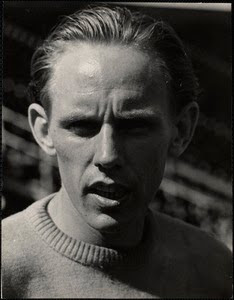
V 15 N. 10 Gunder 'The Wunder' Haegg Visits Cincinnati

Bob Roncker of Cincinnati, Ohio has sent in this account of one day on the 1943 tour that Gunder Haegg of Sweden made to the US to help rais...