Once Upon a Time in the Vest

Showing posts with label Otis Davis. Show all posts

Sunday, September 29, 2013

Vol. 3 NO. 55 April , 1964

APRIL 1964


In our last report we promised you two world records and the return to competition of one of the icons in the sport. That is coming up. But first let's go to Santa Barbara for the Easter Relays on March 28 where there are many fine early season marks and almost a collegiate record. Remember the sloppy officiating in the indoor meets reported in the March issue? Well the outdoor season isn't starting any better.


Fresno State's Charles Craig is the victim. He triple jumps 52-1½ to better the 51-9¼ collegiate record set by Luther Hayes of USC in 1962 but there is no wind gauge.


hoping this is the Charles Craig of the story
 
 
Whoever was in charge of the gauge had taken it home. While it was in use it had recorded only one race in excess of the limit and witnesses say the wind was minimal at the time of Craig's jump but without a wind reading, record recognition is doubtful.


The mile relay is won by the Camp Pendleton Marines in 3:08.9, the fastest time of the season. One second back are the Striders who are handicapped by a 49.2 lead off leg from Mike Larabee.
Mike will be a tad faster in Tokyo
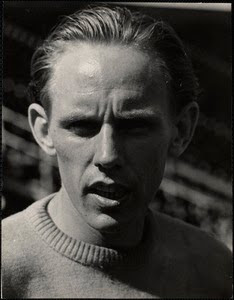
The Striders beat the LATC in an unremarkable distance medley, unremarkable except that the lead off man for the Striders is comebacking Olympic 400 champ, Otis Davis, who eases into his season with a 48.6 split.

Otis Davis
 
The best race of the day is the 880 relay where Adolph Plummer of the Striders takes the baton five yards down to Darryl Newman of Fresno State and blows by to win by three with a 20.4 split.

Things heat up the next week with three solid meets. The Texas Relays are held on April 3 and 4. In what is the only open division race, Ollan Cassell clocks the fastest 440 this year, 46.6. Perhaps more significant is the second place 47.0 of high schooler Blendon Johnson who beats established stars Earl Young, Ted Nelson and Ray Saddler. LSU's Billy Hardin, son of 1936 Olympic champion Slats Hardin, shows genetics weren't wasted on him as he blisters the 400IH in 50.8 to top the world list.
 
 In the frosh-junior college division Texas A&M freshman Randy Matson opens eyes with an amazing PR of 62-11½.

As good as those marks are, the star of the day is Missouri's Robin Lingle. Lingle, a transfer from the US Military Academy, anchors the Tigers to wins in the two mile relay and the distance medley with splits of 1:48.3 and 4:02.3 in posting the year's fastest times, 7:22.3 and 9:45.2. He is voted athlete of the meet.

In 1964 when an athlete wanted to continue competing after his college career had ended there were three choices: join the service and compete for the Marines, Navy or Army, join a club or compete unattached. The first required a serious commitment. The last required the expense of getting to meets. Club teams flourished. The Grand Street Boys Club, the Pasadena AA, the Striders, the Santa Clara Valley Youth Village, the Pacific Coast Club, the San Francisco Olympic Club, the LA Track Club provided coaching and travel and thus were the choice of many post collegiate stars.

On April 4 two club teams had dual meets with colleges. The Pasadena AA took on nearby Occidental and the Striders traveled to Tempe to run against college powerhouse Arizona State.

Whereas the PAA-Oxy meet was the lesser of the two, no one went home disappointed after witnessing the performance of shot put record holder Dallas Long. As you may remember, Long is in dental school at USC, a commitment that kept him from competing until the last two weeks of the season last year. Although he produced the best mark in the world, 63-9, it was only by and inch and one had to wonder whether his cloak of invincibility is gone. That doubt is erased this afternoon. In his first meet of the year Long throws over 65 feet three times and his 65-11½ breaks his world record by an inch. Long is surprised, “I felt like I was in the twilight zone, it came so easy”.

Now we are in Tempe where ASU's 220 world record holder, Henry Carr, takes the baton in the 440 relay well down to the Strider's Adolph Plummer. Though he doesn't catch the 440 record holder, he gives an indication of what is to come by gaining five yards. Minutes later he is in the blocks for the 100. Gerry Ashworth of the Striders leads for 80 yards but Carr comes on strong at the end to win in 9.5 for both. This victory is not without cost. The Arizona State star suffers a “muscle injury” during the race. Henry Carr is the odds on favorite for the Olympic gold at 200 meters in six months. Indeed he is the only man to run faster than 20.5 with two 20.4s and his WR of 20.3. Obviously the wise thing to do is watch the rest of the meet from a spot on the infield. No, not Henry. He is a spit on it, rub a little dirt on it, get back in the game kind of guy. The 220 is coming up and he will take another shot at Adolph Plummer.

For some reason they are in the lanes with the tightest curve, Plummer in one, Carr in two. This is no problem for the ASU star. He leads by four yards off the curve and increases the margin to six at the tape. The watches read 20.2. Once again the Detroit native has broken the record. Plummer's 20.8 is hardly noticed.

And now for the return of the former world record holder and Olympic champion who hasn't competed since the 1960 Olympics. This would be Charlie Dumas, the first man to jump seven feet, but only a figure in history for the last four years. Where has Charlie's road taken him? After the Games he tried out for the San Diego Chargers but was cut early on. As he was never paid, his AAU eligibility was reinstated just last month. An effort to join the Marines had come to naught because of a bad knee. In the time that he was out of the track spotlight he returned to USC and earned his teaching credential. Now Charlie is employed by the Inglewood, CA school district. As satisfying as making lesson plans and grading papers may be, he has decided to give track one more shot.

          Charles Dumas
And what a shot it is. Not certain of his fitness, he opens at 6-0. As that goes well, he skips 6-2 before clearing 6-4, then 6-6, then 6-8. He misses at 6-10 but at this point he has to be happy with 6-8 in his first meet back. Not bad for an old timer. But Charlie is buying none of this old guy stuff. He clears 6-10. Now he is back in the Olympic team picture. With the bar set at 7-0½, all eyes are on him as he readies himself on the apron. Over he goes and the crowd erupts. Charlie D hisownself is back. He decides to end the evening on a high note and retires with a seven foot clearance in the books. Time to work on Monday's lesson plans. Good to have you back, Charlie.

Richard Romo leading a stellar field of milers
Oddly, there is no report of a meet on the weekend of April 11. We move ahead two weeks to the Kansas Relays held on the 17th and 18th. Robin Lingle proves his performance in the Texas Relays wasn't an aberration. He anchors the Missouri four mile relay team to victory with a 4:01.0 split on Friday and returns the next day to take the Tigers to the victory stand in the two mile relay in 7:26.6 with a 1:49.9 split. The college distance medley is won by Emporia State on the strength of a 4:02.3 anchor by John Camien. Richard Romo nearly matches that with his 4:02.5 anchor to bring Texas in second in the four mile relay.

Richard Romo, president U. of Texas San Antonio
where Jerry Dyes is now cross country coach
 
Jerry Dyes displays his significant decathlon potential by scoring 7059 to defeat veteran Phil Mulkey who scores 6961. Mulkey's 15.2 to 17.0 advantage in the hurdles is more than made up by Dyes' 249-1 javelin effort which puts him 63 feet ahead of Mulkey.

Olan Cassell of Houston betters his yearly world best at 440 yards. His 46.4 gives him a full second advantage over Ted Nelson of Texas A&M.

Apparently no meet would be complete without the mention of poor officiating. The 10,000 winner is John Macy in 29:49.0 with the parenthetical note that the race might be a lap short and that no other times are available.

Under the heading of Profiles of a Champion we have two in hammer thrower Ed Burke and triple jumper Charlie Craig. Unfortunately their photos are transposed making Craig the thickest necked triple jumper ever.

A check of the US Report listing the top marks in each event finds that Bob Hayes has equaled his own WR at 100 yards in 9.1....Jerry Siebert hasn't raced since the USSR meet in 1962. Jerry's work for a doctorate in physics has taken priority over training. Yet on March 28, while at the track “to trot around”, he was talked into competing by coach Brutus Hamilton just 20 minutes before the start of the half mile. The former Cal star clipped off a 1:50.2 for the second fastest time in the country this year. Still he says that the doctorate comes first and that he isn't considering a return to serious running and a shot at the Olympic Games......The national leader in both the mile and two mile is Bob Schul of Miami (OH) with times of 4:00.9 and 8:47.3.

Coming up in the next issue are the major relay meets: Drake, Penn, Mt. SAC. West Coast (Fresno), Coliseum and California (Modesto).


Sunday, January 20, 2013

Vol. 3 No. 4 January, 1963, as Promised


January 1963

Alert readers may remember that 1963 had gone missing. How can January 1963 suddenly show up? Good question. The person responsible is Leif Bugge in Denmark, a faithful follower of the sport. Lief scanned and emailed his copy. Thank you, Lief. We owe you one. And now....(drum roll).....January 1963.


York Volunteers
The Canadians are coming! The Canadians are coming! 
At least +Bruce Kidd and +Bill Crothers have come to New Orleans, Boston and Los Angeles and they are kicking butt. Six races and the University of Toronto duo haven't been seriously challenged.
Bruce Kidd
Bill Crothers and Harry Jerome
On Dec. 31 in the Sugar Bowl meet Kidd erases Greg Rice's 22 year old three mile meet record by 25 seconds, racing to an unpressed 13:37.9. Crothers demonstrates his versatility by taking on +Tom O'Hara in the mile. After 3:08.6 at the bell, they run together before Crothers' 46.2 400 speed gives him the edge at the finish in 4:06.4 with O'Hara two tenths back.
Two weeks later, January 12, and a little closer to home, the Canucks show they can dominate indoors as well. In the Massachusetts Knights of Columbus meet, held in the Boston Garden, the 19 year old Kidd leaves the field far behind in running the third fastest indoor two mile, 8:43.2. The only superior clockings belong to Olympic champion +Murray Halberg and Kidd himself. Crothers is hardly challenged at 1000 yards as he breezes to a nearly two second victory over a comebacking Ernie Cunliffe in 2:08.6.
Interview with Bill Crothers can be seen at the site below.

http://www.conacher-rosenfeld.ca/videos/bill_crothers-eng.html

Next up is the LA Invitational held in the Sports Arena Jan 19. It may be a different coast, but the results are virtually identical. Kidd runs 8:43.8 to better Charlie Clark's 8:51.5. Crothers trots the 1000 in 2:08.9 once again at the expense of Ernie Cunliffe who runs 2:11.5.
Ernie C. is not the only international class runner making a comeback. +Eddie Southern takes the 500 in 59.3 with Olympic champ +Otis Davis third in 59.9.
The shot sees Parry being Parry. O'Brien wins at 61-1 with long time rivals +Jay Silvester and +Dave Davis trailing at 60-2 and 58-6½. +Ralph Boston complains about the runway, but the Olympic champ wins at 25-7½, 16 inches ahead of +Darrell Horn.

T&FN makes an initial effort at gender equality, including women's results in the story on the LA meet by reporting Marilyn White's 6.9 win in the 60 over +Wilma Rudolph (7.1) among others.
Pennti Nikula

The fiberglass pole is creating a rush on the world record. On January 19, outdoor WR holder +Pentti Nikula vaults 16-1¾ to add the indoor record to his resume. Doesn't last long. In the January 25 Maple Leaf Games in Toronto, +Dave Tork overshadows Bruce Kidd's 13:34.6 three mile (second fastest ever) by taking the record with a 16-2½ leap.
His reign lasts only until the next night, when, in Portland at the Oregon Invitational, 
+C.K. Yang grabs the record with a vault of 16-3¼. Yang, considered a good vaulter for a decathlete, has an affinity for the fiberglass pole. In a year he has gone from just another guy in the open vault to the world record holder. There may be more of this in his future as he has a close miss at 16-5. Crothers and Kidd are not the only Canadians having a bang up winter. In this meet +Dave Steen upsets Parry O'Brien by three inches with a PR of 61-5½.

Remember that four mile relay between New Zealand and the University of Oregon last month? We'll they are at it again. On January 5 the same eight guys line up and produce the same result. +Vic Reeve, who fell the last time, keeps his feet and finishes the lead off leg only a couple yards behind +Bill Ballie. +Archie San Romani Jr. opens up couple yards on Murray Halberg. Now it is +Dyrol Burleson's job to open up enough cushion on John Davies to give +Keith Forman a chance against +Peter Snell on the anchor leg. Doesn't happen, not even close. Burleson opens with a 64.0 and then slows to a 2:12.3 half. Surely something has to happen now. Nope, a 65.8 puts him at 3:18.3. Foreman has to be grinding his teeth. Sure enough Burley cranks out a 53.7 final go around, for a 4:11.8, but it is too little, too late. Davies is good for a 54.6 and 4:12.1. Given only a five yard advantage against the finest miler the world has ever seen, Forman shows what he is made of, going out in 58.4 then splitting 2:01.8 and 3:04.3. One has to admire his courage, but there can be only one outcome. Forman runs 58.4, but Snell pounces. His 57.7 last lap, outstanding for anyone else, but pedestrian for the Olympic champion, produces a 4:01.5 and a Kiwi victory 16:29.2 to 16:29.8. Wonder if Forman spoke to Burleson the rest of the tour.

Ralph Boston at Rome


Reading the columns, we learn that Ralph Boston is working as a research technician at a Los Angeles hospital, but still has found time to hit 26-9 twice in practice......   +Don Bowden, the US's first four minute miler, is now an assistant coach at the +Santa Clara Valley Youth Village.…
Dave Tork
...Dave Tork, when not vaulting, does public relations work for the state of West Virginia, employment which the AAU is investigating as violating amateur regulations......Speaking of that august group, the AAU has followed the lead of the NCAA in eliminating the 200/220 low hurdles as a championship event......

Who is the best discus thrower – shot putter as judged by the Portuguese Tables? In a list on page 21 we find that to be Parry O'Brien whose 63-5 and 193-2 are worth 1960 points, edging Jay Silvester's 61-5½ and 199-7½ by a point. Surprisingly, Bob Humphries (58-8 & 203-5) is third at 1942.

Peter Snell and Arthur Lydiard
Six pages are devoted to the 1962 world list, interesting reading, but reporting, not so much. Still, let's give it a crack. Not surprisingly, our sprinters and hurdlers dominate the lists, but they don't stand alone. The US has 12 of the top 15 pole vaulters and our broad jumpers have the number 2-3-4-5-6 marks. Peter Snell reigns supreme in the 800, but Americans have the next four best marks. How dominate is Snell? His 1:44.3 world record is two full seconds ahead of the next best mark by +Jerry Siebert. Following Siebert in the next 1.9 seconds there are 23 guys. Yes, in 1962 dominance is spelled P-e-t-e-r-S-n-e-l-l.

As good as the US is in some events, there is work to be done in others. The triple jump, hammer and javelin come readily to mind. Bill Sharpe is the only American to rank in the top 25 in the European dominated triple jump, barely making it at number 25. Our javelin throwers rank 14thand 23rd. +Hal Connolly's WR 231-10 is an enigma. He and Al Hall, ninth at 219-3, are the only Americans in the top 25. Yes, there is room for improvement in these events.


Carmel River Inn
If you are planning on attending next month's Golden Gate Invitational, you could stay at the Cabana Motor Hotel of Palo Alto, only thirty minutes away so says a full page ad. Alas for those of us living in the 21st century, the Cabana is no more. However the prudent +Carmel River Inn which popped for a more economical quarter page ad is still going strong and looks like a great spot for a romantic weekend. Check it out on the internet.
It was clearly not all work and no play for Percy


Had the “Got Milk” ad existed in 1963, it is unlikely that one would have seen +Percy Cerrutty's smiling face with a milk mustache. Says the iconic Australian coach, “Milk has a psychologically terrible effect on males and should be banned early in life. Addiction to milk makes a boy mother-drawn. Deep parts of his consciousness retain a link with his mother. Once he has the taste for milk he will never develop properly as an individual. We are approaching something like a matriarchal society.
The Queen circa 1955
 The fact that the Commonwealth can accept a queen as its head is evidence of this.” This may also explain Percy's failure to be knighted.

Editor's note       


Our lead writer on this blog, Roy Mason,  to whom all libel, defamation and anti-trust suits should be addressed, will shortly be undergoing total knee replacement surgery.  We wish him well and hope that he will be able to continue his output for "Once Upon a Time in the Vest" as he goes through the post-op and rehabilitation process.  If there are some delays in output from Roy's end of the continent, please be understanding.  I have a few projects on the sideboard that I will try to revive while Roy is recovering.  George Brose

Thursday, February 23, 2012

Vol. 2 No. 22 October 1960 The Season Just Keeps Rolling Along

OCTOBER, 1960

The Rome Olympics are history, but the season goes on in Europe. The headline on the cover of this issue of TFN reads, “Bolotnikov 28:18.8, Brumel 7-2 ¼, Rowe 62-8½.” The first is a world record, the other two are European records. Pytor Bolotnikov, having followed in the steps of his mentor, Vladimir Kuts, as Olympic 10,000 champion, now eyes Kuts' world records at 5000 and 10,000.


On September 28 he runs a 1500 PR of 3:47.4 then returns the next day for a shot at the 10K record. His 28:32.4 misses by two seconds. On October 7 at halftime of a soccer match in Kiev, he takes on Kuts' 13:35.0 5K mark. Running without significant competition, he clocks 13:38.1. If at first you don't succeed, try and try again is his motto. On a warm, windless afternoon on October 15, again in Kiev, he leaves Russia's best runners behind early and achieves his goal at 10,000, clocking 28:18.8 to break his hero's record by 11.4 seconds. How far distance running has come can be measured by combining the best 5000 times of two of the greatest, Paavo Nurmi and Emil Zatopek. Together they total 28:25.2, 6.4 seconds slower than Bolotnikov's effort this day.
Valeriy Brumel, the precocious Soviet 18 year old, marks himself as a threat to John Thomas' WR with a 7-2¼. Apparently on the same day he has a very close miss at 7-4 1/8. Time will tell, but it seems to be on the kid's side. Great Britain's Arthur Rowe atones for a disappointing Olympics with a put of 62-8½, an effort not only a European record, but equal to the fourth best ever, tying him with Dave Davis.
Europe or anywhere else for that matter hadn't seen much of Herb Elliot for the last couple years. The great Aussie makes up for that starting in mid-September. He races 11 times in 19 days, winning all but one, including three classic races with Sweden's Dan Waern.
The journey begins in London on September 14 where he runs a mile in 3:58.6, leaving a surprisingly good Terry Sullivan of Rhodesia well behind in 4:00.9. Three days later in Cardiff he attempts to finish in a dead heat with Tony Blue. The judges give him the win anyway in 1:52.8. The first of the matches with Waern is the next day in Goteborg at 1500. Blue, the pace setter, takes them out too fast; 54 and 1:54. Elliot is content to stay two seconds off that pace. When Blue drops off on the third lap, the race is all Elliot's or so it would seem. He opens up five meters on the backstretch and spectators entertain visions of his Olympic finish two weeks earlier. But Waern, who barely missed making the Olympic final, has other ideas. To the delight of the hometown fans, he catches Elliot at the bell. They battle around the curve and into the straight. Down the homestretch they come, Elliot on the inside, Waern on his shoulder. With ten meters to go, Elliot leads by inches. Waern can't hold on and the race belongs to Elliot by a meter. His 3:38.4 is his fourth fastest. Waern's 3:38.6 is the Swedish record.
Fans don't have to wait long for the next match between these two as it comes two days later over a mile at Malmo. Once again Blue is the pacesetter. It appears that he has mastered even pacing. Three laps go off in 60.5 each, reaching the bell in 3:01.5. Waern, Albie Thomas and Elliot follow in that order. Spurred by the wildly cheering fans, Waern takes the lead and begins a long drive. This time it is Elliot hanging on. At the top of the straight he moves into the lead and ever so slowly pulls away for a narrow win 3:58.6 to 3:59.0.
Now Elliot is off for Dublin, where two days later he will toe the starting line in an 880 against two other Olympic champions, Rome's 800 winner Peter Snell and Melbourne's 1500 champion Ron Delany, the obvious favorite of the Irish fans. No details of the race are given, but Elliot can do no better than fourth. Snell takes it 1:47.9 with Delany second at 1:48.2 (an Irish record), the same time as Tony Blue. Elliot takes his only loss of the tour with a 1:48.4.
Having lost to Snell at the New Zelander's distance, Elliot looks forward to meeting him on the same track the next day at his distance, a mile. This time the heavy lifting falls to Albie Thomas who takes the field through a 1:57.0. Lazlo Tabori leads at the bell in 2:59.0. At this point Elliot makes sure it is over early. He leaves no doubt about who is the king at this distance, winning in 3:57.0. Terry Sullivan breaks four for the first time in placing second in 3:59.8, a tick ahead of Gordon Pirie. (*editor's note This is possibly the first 4 minute mile by a native born African runner.. When I lived in Zimbabwe from 1982-85, Sullivan was still there in the construction business.) Tabori is fourth at 4:00.7. Snell places fifth in 4:01.5. Any disappointment that may have resulted from this loss is mitigated by the fact thatn this is a 9 second improvement on his PR, perhaps an indication of better things to come.
Elliot fills the rest of the month with less competitive races. He wins a 1000 meter race in Glasgow (2:20.7) on the 24th. The 28th sees him in London for a mile (3:59.8). On the 30th he takes another 1000 in 2:23.1 in Manchester. October 1 is taken up with a 1320 in Birmingham (2:57.8). This would seem like a lot, but there is one more page to be turned before the book on Herb Elliot's magical 1960 season can be closed. Tomorrow Dan Waern will be waiting for him in Stockholm for a race at 1000 meters, an event in which the Swede set the world record of 2:18.1 two years ago before lowering it to 2:17.8 last year.
This will be no easy task for Elliot. It has been an intense stretch in which he has raced 11 times in 2½ weeks. Popular as Elliot is, the Stockholm crowd will be wildly enthusiastic for the hometown boy, Waern. Not only is this Waern's crowd, it is probably his best distance. Herb will not be able to mail this one in.
Chances for a world record go out the window right away. The plan was to have a rabbit take the field through a fast 400 and then Per Knuts, “a good Swedish half miler” was to take over. When Knuts fails to take over after a pedestrian 55.4 opening go around, Waern finds himself in the lead about 500 meters before he wants to be. His 57.6 (1:53.0) puts the race in the tactical category. There is no description of the race other than those splits, but both finish strongly with Elliot the winner, 2:19.1 to 2:19.4. This was the year's final race for both. Elliot is off to bask in Australia's spring and summer while Waern looks forward to a season of ice fishing.
And yes, there are still Americans in Europe. Olympic 400 champ, Otis Davis, tangles with silver medalist Carl Kaufmann twice.


The first, in Cologne, is closer than their Olympic finish. They are given a tie at 45.7. Four days later in Wuppertal, Kaufmann wins 46.5 to 46.7. Previous to these races, Davis had been nipped by George Kerr in Amsterdam, 47.0 for both.
The balance in the season long competition between Lee Calhoun and Willie May has shifted. After Calhoun's ever so close victory in the Olympics, May wins three over the Olympic champ, then three over Olympic finalist Keith Gardner of Jamaica.
Imagine that you have come to the meet in Paris on Oct. 2 to see the great American pole vaulter, Don Bragg. Then imagine your shock when you see him fail at 13-9. The competition is won at 14-1, but wait, there's more. Bragg is going to give the fans their money's worth with an exhibition. He clears 15-1 and everyone goes home happy.
In the Cologne meet Ernie Cunliffe takes the 1500 in 3:48.0. Five days later he tangles with Kerr in an 800 in Frankfort and comes out on the short end, 1:48.9 to 1:49.1.
Perhaps when it is all said and done, the American who will go home with the best memories of the Europe tour will be Max Truex.


Coming off his great performance in the Olympic 10,000, he has no let down. In Cologne he wins the 3000 in an American record of 8:03.6. He is cheered vigorously by the home town crowd as he is wearing a German Olympic uniform. He wins two 5000's in Germany before suffering his only defeat of the tour, a three mile in London where he is third, four tenths behind the winner. His last race is in Paris where he is supposed to meet French star Michel Bernard over two miles. Bernard pulls out and Max runs near to the American record with an 8:44.2. A great Olympic race and four wins in five tries afterward. Good job, Max.
Items gleaned from various columns: Lee Calhoun, Ron Morris, Parry O'Brien, Tom Murphy and Rafer Johnson have retired. Jerry Siebert almost added his name to the list, but has decided to run one more year as a member of the Santa Clara Valley Youth Village, saying, “I want one more crack at Snell.” The SCVYV could be pretty good in the middle distances. Jack Yerman and Ernie Cunliffe may wear there colors next season. Cunliffe, now a graduate student at Stanford, just became engaged......Carl Kaufmann, silver medalist in the 400 at 21, has decided that track and field is not the fast track to big money. He will devote his energies to a singing career...*editor Wasn't this Lauer who became the C&W singer?....The Styron twins are following coach Lew Hartzog from NE Louisiana to Southern Illinois.....Jim Dupree, feeling a lack of support from his coach at New Mexico, is joining them at SIU.....Hammer thrower Al Hall has decided not to devote full time to his job as a chicken inspector. He will continue his track career. Bill Dellinger will take a year off from competition. He will continue to run however, with an eye towards 1962.....Deacon Jones is a multi-talented guy. Aside from competing in the steeplechase in Rome, he kept his teammates looking sharp by cutting their hair. “I've been a licensed barber since 1950.”.....We won't see Phil Coleman on the boards this winter. He is eschewing competition in favor of working on his PhD at the University of Illinois......Add Glenn Davis and Ray Norton to the list of those who won't be back. Both will play football; Davis for the Lions, Norton for the 49ers. Rafer Johnson, though retiring, will not join them in the NFL. He squelches the rumor that he will play for the Rams, saying that he hasn't played football since 1954 at Kingsburg High......Billy Mills has been named captain of the Kansas cross country team.....If you are waiting to see Olympic 100 meter gold medalist, Armin Hary, in the leading role in three non-sports films, you will be disappointed. He demanded $23,800 for each film from the company that held the option and was turned down. Armin is now spending time writing his memoirs......500 German boys and girls were sent to Rome as winners of a nationwide contest. They camped in the outskirts of the city and rooted on their favorites from the standing room area at either end of the stadium. Their most notable shout of Teutonic support was, “Hoy, hoy, hoy, Lauer, Lauer, Lauer, cha, cha, cha!” Say it a few times and it grows on you. Not to be outdone, the British fans showed their support with the more traditional, “Two, four, six, eight, who do we appreciate, P-I-R-I-E, Pirie, Pirie, Pirie!”.....Apparently whatever the cost of the Track and Field New tour was, it was money well spent. Many of the group were housed at the luxurious Rome YMCA.
Did You Say Rome YMCA? Two Versions Below


Posh Version
American Version

Sunday, October 9, 2011

Vol. 1 No. 59 June, 1959

JUNE 1959
You want big meets? We got ‘em. Let’s go to Modesto and the California Relays. The photo on the cover shows Ralph Alspaugh of Texas leaning at the tape to edge San Jose State’s Ray Norton and Bill Woodhouse of Abilene Christian on the anchor leg of the 440 relay and establish a new WR of 39.6. Bobby Poynter opens a yard lead for San Jose on the first leg, but that is swiftly negated by Eddie Southern’s second leg for Texas and bad passing by San Jose to produce a four yard deficit for Norton who gets back all but about a foot of it. Norton and his Spartan teammates reverse the finish on the Longhorns in the 880 relay, as Norton splits 19.8 to make up three yards on Southern to win by a tenth in 1:23.3. Oregon sophomore Roscoe Cook surprises the field in the 100, getting a great start and holding on for a foot victory over fast closing Ray Norton to tie the WR of 9.3. Bobby Morrow loses ground and finishes fifth in 9.5 behind Sid Garton and Bobby Poynter, both 9.4. Morrow returns to take the 220 over a lackluster field in 20.5. Hayes Jones runs “the fastest hurdle double in history, 13.6 and 22.5”. Alvis Andrews and Strider teammate Herm Stokes put on a show in the HSJ. Andrews PRs “over 51’”, only to have Stokes take the lead with a 51-6½ effort. Andrews then puts Bill Sharpe’s national record of 52-1 and Adehmar da Silva’s all comers’ record of 52-4 behind him with a leap of 52-5¼. Joel Wiley of LA State joins the very exclusive 26 foot broad jump club with a 26-2½ effort. Parry O’Brien takes a Dallas Long-free shot put at 61-5 as Charlie Butts joins the 60 foot club by two inches to place second. Former basketball player, Otis Davis, now in his second year of competition, records the fastest time in the world with a 46.2 440. Colorado’s Mike Peake (1:50.2) and Dyrol Burleson (4:06.7) take the 880 and the mile. But what of the two mile relay you may ask. Yes, once again an Ernie Cunliffe anchored Stanford team rolls to victory in a slow, for them, 7:30.0, beating second place USC by more than 18 seconds. Prospects look thin for the California mile relay team when Eddie Southern takes the baton three yards up on Jack Yerman, but Yerman isn’t buying into defeat. He dogs Southern until the final straight where he works past to win by two yards with a 45.7 split as Cal runs 3:09.6.
A week later much of the same cast of players meet in the Compton Invitational. A crowd of 7500 is in attendance, but only 200 witness a world record. Al Cantello, “the 5-7½, 163 pound yellow-clad Marine lieutenant, his arms and chest swelling with ten pounds of muscle put on since last August, sprinted down the runway at 5:48 p.m., twisted sideways with nimble footwork, whipped his arm forward with all his strength, and followed through with a full length dive onto his hands and chest. His javelin, a metal Held, rattled mysteriously as it arched incredibly high and glided down. The point struck the turf at 282-3½, a full foot beyond the world record.” Glenn Davis and Eddie Southern tangle in the 440. Southern is on the pole with Davis in lane two. Down the backstretch Southern opens up two yards on Davis, but Davis pours it on around the curve to lead Southern by half a yard. But wait; there are others in the race. The two old rivals trail three others as they enter the straight. Dave Mills, the leader, falls to last place. Mal Spence of ASU and North Carolina Central’s Walter Johnson also find the straight uphill and fall back to 6th and 7th. Southern scores his first victory over Davis 46.4 to 46.5. Much of the joy in this is lost because Chuck Carlson of Colorado goes by both to finish in 46.3. But even his efforts are trumped. Mike Larabee owns the stretch, going by everyone to win in the year’s best time of 46.1. Dave Scurlock ekes out a victory over Ernie Cunliffe in the 880, 1:49.8 to 1:50.2, as a photo on page 6 testifies. Nineteen fifty-nine was a simpler time when athletes doubled. Dickie Howard takes the lows and intermediates in 22.6 and 51.4. High school boy Dixon Farmer runs 23.1 and 52.9. Both return to sweep out the stadium and put away equipment at the end of the meet. Parry O’Brien takes the shot (62-7) over Bill Nieder (62-4), Dallas Long (61-1) and the still improving Charlie Butts (60-7¼). (Editor’s note: No, Perry O’Brien has not changed the spelling of his first name. I am such an idiot that, although it is clearly spelled p-A-r-r-y in everything I have read, I have consistently misspelled it. This goes a long way towards explaining that 2.0 college gpa.) Jerome Walters takes a 4:06.2 mile, but the real story is the match up of history’s two fastest high schoolers, Archie San Romani and Dale Story. Story had set the national record of 4:11.0 in the California state meet the previous week. The week before that San Romani had run 4:10.0 for second in the Missouri Valley AAU meet, a mark not considered a HS record because it was run in an open meet. The two concentrate on each other, going through the 1320 in 3:11.3 with Story on San Romani’s shoulder the entire way. On the backstretch San Romani opens up, leaving Story and closing on USC’s Bob Shankland. He doesn’t catch him, but his 57.7 gives him third place and a high school best of 4:08.9. Story runs 59.9 to finish fifth in 4:11.2. San Romani has signed a letter of intent to Kansas. Story says he will go to a JC for a year then attend Oregon State where he will study fish and game management.
The next day sees the Meet of Champions held in Houston. The headline reads “Oklahomans Do Well”. The Sooners stamp themselves as contenders in next week’s NCAA meet. Dan Erwin, usually the #2 of Oklahoma’s 1-2 punch in the shot, surprises teammate Mike Lindsay and probably himself with a collegiate leading 58-4. Lindsay acquits himself well with 57-4 and a discus win of 162-4. Potential big points here. J.D. Martin vaults 14-9 to tie with intrastate rivals Jim Graham and Aubrey Dooley. Gail Hodgson runs 4:03.4, the second fastest college mile of the year. Bob Ringo takes the 880 in 1:50.9. Dee Givens is recovered from his injuries enough to place third in both sprints (no time given) behind Bill Woodhouse and Ollan Cassell. The Sooners look like they have a real shot.
As good as Oklahoma is, Kansas is probably better. The Jayhawks dominate the Central Collegiates with a 98 to 36 margin over second place Notre Dame. The NCAA meet may come down to how many races Charlie Tidwell runs. Here he wins the sprints and the lows: 9.6, 21.0 and 23.3. Billy Mills cruises the 3M in 14:18.9 and Cliff Cushman takes the intermediates in 51.5. Bill Alley, the javelin winner here at 266-6, can probably throw left handed and win next week. Oh, yes, Ernie Shelby who is not listed in these results, is the broad jump favorite.
On the high school level, the best high hurdle competition has been in Oregon where Steve Pawley establishes a HS record of 13.8 in defeating Mel Renfro who runs 13.9 for a junior class record. Farmington, Michigan’s Warren Cawley (known to friends as Rex) has also run 13.9. He seems ready for college competition if his performance at the U of Chicago Invitational is any measure: 14.8, 23.5 and 53.9 in the same day. Andrews HS (Texas) runs the fastest HS mile relay, 3:16.4, to better the existing mark of 3:17.5, but it won’t count because it was in an open race. Apparently they can do better as the slow leg was 50.1 and they had a 49.2 guy sitting on the sidelines.

V 15 N. 10 Gunder 'The Wunder' Haegg Visits Cincinnati

Bob Roncker of Cincinnati, Ohio has sent in this account of one day on the 1943 tour that Gunder Haegg of Sweden made to the US to help rais...