Once Upon a Time in the Vest

Showing posts with label Harry McCalla. Show all posts

Wednesday, March 13, 2013

Vol. 3 No. 14 May, 1963


MAY 1963
It is spring and we have relay meets, specifically Kansas, Drake, Penn, Mt. SAC, Quantico, West Coast and the Coliseum. Pour a cup of coffee, get comfy in the recliner and let us take you back to those golden days of yesteryear.
April 19-20 find us in Lawrence, Kansas, basking in 75 degree weather at the Kansas Relays. There are exciting races, but no great marks. Colorado sophomore, Bill Miller earns his scholarship this weekend. In addition to running heats in the 440 and mile relays and the high hurdles, he wins the 400 meter hurdles in 52.6, places second to Rex Wilson of Texas in the highs, 14.1 for both, anchors the 440 relay to a third place finish, brings the 880 relay from third to first on the anchor leg and blisters a 45.9 anchor to win the mile relay in 3:10.1.
John Camien
John Camien, who outkicked Dyrol Burleson in the Texas Relays, is outkicked himself in the Glenn Cunningham Mile as Missouri's Robin Lingle powers past in the home straight to win by three tenths in 4:04.8.
Now it is the last weekend in April, the traditional home of the three major relay meets in the US, Drake, Penn and Mt. SAC.
The wet weather in Des Moines hurts the Saturday portion of the Drake Relays, but the competition is tight. Texas Southern dominates the college division, winning four relays, three of them with faster times than the winners of the university division. Englishmen, now Southern Illinois students, Brian Turner and Bill Cornell, shine. Turner takes the two mile in 8:51.7 while Cornell blazes a 1:47.1 anchor in the sprint medley as the Salukis record an outstanding 3:18.7.
Robin Lingle tangles with Dyrol Burleson in the mile. John Camien outkicked Burleson at Texas and Lingle outkicked Camien last week in Kansas, so it makes sense that Lingle outkicks Burleson today, right? Nope, this isn't the math equation in which A is greater than B and B is greater than C, therefore A is greater than C. Burly debunks that by opening up on the back straight and it is over. The ex-Oregon star puts Lingle away by 30 yards in 4:05.4. No splits are given. But this isn't the fastest mile of the day. Harry McCalla runs a 4:04.8 anchor to make up 40 yards on So. Illinois and bring Stanford home first in the 4 mile relay.
Coverage of this meet would not be complete without mention of the efforts of one of our favorites here at OUTV, Jerry Dyes, who wins the javelin at 238-9, places fifth in long jump at 23-8 and leads off the Abilene Christian teams which win the 880 relay and take second in the 440 relay.
Brian Sternberg


And now to Philadelphia and the Penn Relays where the big news is Brian Sternberg's 16-5 world record pole vault. After missing at 15-0 and 15-6, the University of Washington “sophenom” (T&FN's word). clears 16-1 and 16-5 on his first attempts. His second attempt at 16-7 is oh, so close, making this height a definite possibility in the near future.
After seven years of placing second in the mile relay, Morgan State finally wins in 3:12.4 much to the delight of coach Eddie Hurt who says, “At the end of every leg we were in front and I couldn't believe it. I could hardly bear to watch Nick Lee come down the homestretch, I was so excited.” The top individual time of the day belongs to Maryland's Chris Stuaffer who runs the 400 intermediates in 51.2. The best relay split belongs to Oregon State's Norm Hoffman who brings the Beavers' sprint medley team from far back to second with a 1:48.2 effort. Double relay winners are Michigan State (440 and 880) and Fordham (2M and 4M).
If you got excited about Drake and Penn, you are going to get all wiggly about what happens the same weekend in Walnut, CA in the Mt SAC Relays. Penn and Drake are prestigious universities. Mt. SAC is a junior college. The Penn Relays began in 1895 and is the oldest track meet in the country. Drake got its start in 1910. Mt. SAC is a neophyte, just finding its way in its fifth year of life. Yet the disrespectful newcomer has placed its esteemed forefathers out of focus in the rear view mirror if the quality of competition is to be the judge.
You want world records? How about three on the same day? The first day of competition is rained out. The second and third days see one of the great meets in track and field history. Two time Olympic champion Al Oerter extends his discus world record by half a foot to 205-5½ in the greatest discus display in history. Five of his six throws are over 200 feet. But Big Al can't rest on his laurels. Jay Silvester is second at 197-4, but that is not the full story. 
Jay Silvester
He has a foul at 205 and a warm up throw at 215. Yes, the discus will be fun to watch the rest of this season.
Just as Oerter's record is not unexpected, neither is Arizona State's mile relay mark. What is to be surprised about? They have already set this record twice this season. Mike Barrick opens with a 48.0. Henry Carr once again is the fast leg at 45.1. The big difference is that Ron Freeman lowers his best to 45.6. Anchor Ulis Williams goes out too fast and pays the price in the homestretch, but his 45.8 is enough to drop the record to 3:04.5.
Now to the jaw dropping performance that left spectators stunned, specifically C.K. Yang's dominating, unbelievable, off the chart, (fill in your own superlative here) dismantling of Rafer Johnson's decathlon world record. On the morning of Sunday, April 28 the WR is 8683 points. By that evening, after a second day like no other, it is 9121.
Indeed, at the end of the first day C.K trails Rafer's first five event total by 207 points (4750 to 4543). The first three events, 100, broad jump and shot put, give no indication of what is to happen. Yang runs an expected 10.7, the followed with slightly below normal marks of 23-6¼ and 43-4½. He balanced this by slightly exceeding expectations in the high jump (6-3 ½) and 400 (47.7). Still when he goes to bed that night he is down 207 points.
The next day the sun shines brightly and the angels sing. C.K. opens with a sizzling, yet not surprising, 14.0 in the hurdles. Then comes his other weak event, along with the shot put, the discus, where he throws only 134-6, losing 375 points vis a vis Rafer's 170-6.
The pole vault is next and this is where it all comes together. Yang has become a very good vaulter as evidenced by his indoor WR of 16-3 two months ago. This time he clears 15-10½ for 1515 points, a stupefying 785 points more than Rafer's 13-0¼ had given him. A fine javelin throw of 235-5 and a 5:02.4 1500 are enough to produce the record. In truth the record may increase. As Yang's vault is ¾ of an inch higher than the decathlon point table goes, more points may be added upon review.
There are two ways to look at this. Yang's performance can be viewed as one of the great achievements in track and field history. He crushes the great Rafer Johnson's world record by 438 points. Numbers don't lie. There is no room for argument.
On the other hand, you can view this record as the result of the fiberglass pole. Rafer Johnson vaulted 13-0¼ with a metal pole. What would he have done with a fiberglass pole or how high would Yang have vaulted had he been restricted to a metal pole? (He did 14-1¼ the day Johnson did 13-0.) Take the pole vault points out of the equation and Johnson wins 7953 to 7606.
Your reporter has peeked at the January 1964 issue. Track and Field News has taken the mathematical position. C.K. Yang's photo graces the cover as the world athlete of the year based on this performance.
April 30 finds us in Monroe, Louisiana on the campus of NE Louisiana State
for a midweek dual meet. Remember the 16-5 WR vault by Brian Sternberg three days ago? Today it becomes the former world record as John Pennel flies 16-6¾. Sternberg had said he didn't think his record would last very long, but one would think he had hoped for at least a week.
It is May 4 and we are in Quantico, Virginia for the Quantico Relays where sectionalism is rewarded. Jim Dunaway writes that “the East” saw not only its first four minute mile, but its fastest mile relay. Indeed Cary Weisiger runs 3:59.2, but details such as splits or the names and places of other competitors are missing. Coach Eddie Hurt of Morgan State has reason to be pleased. After winning at Penn State last week in 3:12.4, his foursome clocks 3:08.8 today. Undoubtedly his joy is tempered somewhat by the fact that his lads are beaten by Maryland State as Charley Mays' 45.8 anchor catches Nick Ellis. Mays also takes the broad jump at 25-4.
Adolph Plummer
Georgetown wins a competitive 2MR on the strength of Eddie Duchini's 1:49.1. The Hoyas clock 7:29.4 to edge Villanova by a tenth and Fordham by three tenths. And a ghost from the past emerges in the hurdles as comebacking Elias Gilbert edges John Bethea, 13.9 for both.
A week later the West Coast Relays are hampered by an unusually cool Fresno night, but Mahoney Samuels has a bang up night. Well, the actual bang up came just a few minutes before the competition. The car in which he was riding was in an accident that sent the three other occupants to the hospital and Mahoney to the top of the triple jump runway with a stiff neck. Undetered, the Jamaican, now representing the Santa Clara Valley Youth Village, pops a wind aided 54-5 for the outstanding mark of the night. Oddly, this is the only wind aided jump of the competition.
Given the quality of the competition, with a few notible exceptions, the meet produces disappointing marks. Frank Covelli sets the meet record in the javelin at 263-9½ and Jay Silvester does the same in the discus with his 194-11½ effort. Arizona State takes a shot at the WR in the 880 relay, but poor passing leaves them short at 1:22.9 even with Henry Carr's 19.8 split. The most exciting race of the evening is the 2MR where Oregon State edges Occidental 7:23.4 to 7:24.0.
Six days later, May 17, the Coliseum Relays provide the excitement that the was missing in Fresno. A crowd of 32,000 watches eight meet records set. Bob Hayes dominates the 100, winning by three tenths in 9.3, then beats Henry Carr in the 220, 20.8 for both. Villanova's latest Irish import, Noel Carroll, powers past Kevin Hogan and Jim Dupree in the straight to take the 880 in an impressive 1:47.5. Hogan and Dupree run 1:48.0 and 1:48.3.
New Zeland's Olympic gold medalists, Peter Snell and Murray Halberg, have mixed results. Snell allows Tom O'Hara to lead the parade through a 3:06.5 1320 before dropping the hammer for a 53.1 last lap and a 4:00.3 win over Dyrol Burleson who makes the mistake of allowing Snell to kick first. Cordner Nelson says Burleson's 4:00.8 doesn't reflect how close he finished to Snell. Nelson's estimate is four feet. O'Hara is third at 4:02.0.
Tom O'Hara
Halberg doesn't meet with the same success in the 5000 where Jim Beatty cranks out a 56.1 final go around for a 13:57.4 victory. Halberg is second at 13:59.2, Ron Larrieu third at 14:00.0. USC's Julio Marin runs 14:02.4 for a collegiate record in fourth.
Ron Morris, John Rose and Gerald Pratt all vault 16-0½ to finish in that order. Pratt can take comfort in knowing his mark is the best ever third place finish. World record holder John Pennel can do no better than fifth at 15-0. Ralph Boston broad jumps a meet record 26-3½. His four 26 foot jumps are the only ones in the Coliseum Relays history. Jay Silvester's 197-9 throw takes the discus gold by over two feet from Rink Babka.
Ah, but the relays are what this meet is about. Texas Southern takes the 440 relay in 40.7 when ASU's Henry Carr can't gain on TSU's Lester Milburn on the anchor leg. Arizona State does not go home empty handed as the Wilcats handle TSU easily in the mile relay, 3:05.2 to 3:07.7. Once again Carr's 45.4 second leg is the fastest of the day. The Lobos of New Mexico are heard from in the 880 relay. They run 1:24.4 as Adolph Plummer comes from behind to pass TSU and win by three tenths.
The two mile relay is a classic dual between Occidental and San Jose State with Oxy's Ron Whitney holding off Ben Tucker on the final carry to win 7:21.6 to 7:22.2. Surprisingly, the fastest split of the race belongs to fifth place Long Beach State's second leg, Darryl Taylor, who cranks out an impressive 1:48.6.
According to Cordner Nelson, the best race of the night is the frosh 2MR in which UCLA's anchor, Bob Day, runs 1:49.0 but comes up inches short as San Jose State and the Bruins both cross the line in 7:30.6.
The Pan American Games are contested from April 27 to May 4 in Sao Paulo, Brazil. Often this is a lackluster, ho hum sort of affair and 1963 is no different. Even with Joe Faust retired at the last minute (though he competed and won at Mt SAC the day the Pan Am Games opened), the US goes 1-2 in every field event except the triple jump where we are 1-4. Ralph Boston fills in for Faust with a second place 6-8 3/8 behind Gene Johnson's 6-11 3/8.
Jim Grelle turns the tables on Jim Beatty in the 1500, running 3:43.5 to win by a tenth. No splits or race description is given. Oddly, the US won neither sprint race. Ira Murchison was second in the 100. Ollan Cassell took second in the 200, a race in which the first three were separated by one onehundreth.
J.D. Martin would win the decathlon at
these Pan Am Games

Cordner Nelson's Track Talk column profiles 16 high school kids who may bear watching, three in particular. Randy Matson is described as “the greatest shot-discus doubler of all time. His 66-10½ shot put is the second best ever (behind Dallas Long) and his 192-3 discus throw is number three on the all time list.
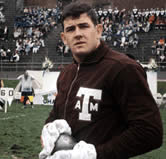
Randy Matson in later years as a
Texas A&M aggie
Ryun in his early high school career
 Cordner avows that “when he becomes serious about these events, he'll be quite good”. Then there is Tommy Smith of Lemoore, CA who is showing some potential in the sprints. He has marks of 9.6, 21.1 and 47.4. Oh, and he has broad jumped 24-6½. CN opines prophetically, “He has a poor start, making his future in the 220 or 440”. Then there is this skinny kid in Wichita who is only a sophomore, but has the fastest time in the mile this season, 4:17.5, Jim Ryun. Elsewhere in this issue we find Ryun has lowered that time to 4:16.2, a new sophomore class record.
In Fran Errota's Prep Panorama column we learn of one of the best races ever at the league level. This would be Southern California's Foothill League 880 where Larry Arnett of Pasadena High wins in a nation leading 1:53.4. Times for the next four places are 1:54.1, 1:54.6, 1:54.6 and 1:54.7. This race produces five of the top eleven times in the country and all the runners are from different schools.
We will close with a comments from the Quotable Quotes column. Brian Sternberg: “I didn't really break the record. Don Bragg still holds it with the metal pole.”
Don Bragg: “Sternberg wrote me a letter when he was in high school. The kid had heard I was against fiberglass and begged me to keep up the campaign. But I see he has changed his mind.”
Sternberg

New Zealand coach Arthur Lydiard: “We have lots of boys with more natural talent than Snell and Halberg and so do you. To be a really great runner you have to have speed to begin with. Then you build in the endurance, the ability to carry speed over a long distance. Snell can only run the 220 on the curve in 22.2. When we started him on long distance running he couldn't do much. On his first 22 mile run it took him three hours and 15 minutes and he was so fatigued he lay on the bed and cried like a baby for half an hour. Later he was able to run it in 2:05.”
Because we haven't mentioned it lately and therefore have had a mounting number of inquiries, we feel obligated to inform you that ad for Adidas at Clifford Severn's North Hollywood store still adorns a large portion of the last page. Records may come and go, but Clifford Severn is forever.


Lynn Saunders Abiliene Christian and
Adolph Plummer take off on their relay legs


Wednesday, February 27, 2013

Vol. 3 No. 12 April 1963


April 1963

Editor looking over the work of our linotype operator

In the interest of accuracy – our watchword here in the offices of Once Upon a Time in the Vest - we have to start by making a correction regarding Henry Carr's successive 220 yard world records described in last month's issue. It seems that his 20.4 will not be submitted for a record, because his lane measured 18 inches short. A surveyor got to work on that right away and the measurement was correct four days later when he ran 20.3.
March 30 finds us in San Angelo, Texas for the appropriately named San Angelo Relays where once again Jerry Dyes displays his amazing range of talents. He wins both the javelin at 248-11 and the broad jump at 24-10½'w, places fourth in the shot put at 50-5 and leads off the winning Abilene Christian 440 relay. Thanks to Jerry, ACC nearly doubles the point total of Texas A&M, 60-30 ½.
Jerry Dyes, An American Hero


On the same page there is a photo the multi-talented Jerry Dyes. That's the good news. The bad news is that he is misidentified. There are two closeups, side by side. On the left is a swarthy gentleman with a hammer and sickle badge on his singlet.  
could this be Bulishev?

He is identified as “Jerry Dyes, versatile Abilene Christian field event ace”. On the right is a bright eyed bespectacled youngster, just the sort of young man you would feel good about having your daughter date, gripping a javelin, who is identified as Valeriy Bulishev, Russian 800m star who made the indoor tour”. After a lengthy conference of editors, reporters, staff assistants, correspondents and outside experts, we here at OUTV have come to the conclusion that the photos are reversed.

In early April, Stanford, San Jose St. and Oklahoma had a triangular meet at Stanford.  In reality it was a dual meet between Stanford and San Jose, with Oklahoma caught in the middle.  The Sooners had run at Arizona St. on the previous Tuesday night, then at Arizona on Thursday night , and finally at Stanford on Saturday afternoon.  A bit much in anybody's book.  That's the way   Spring break was spent in those days.  The youtube site shows a bit of the 2 mile run that included Jeff Fishback and Danny Murphy of SJS and Harry McCAlla of Stanford.   McCalla had won the mile that day in 4:04, went on to win the 2 mile in about 9:04 over Murphy and Fishback.  You can see in one brief moment Payton Jordan running over to the pack to encourage the Stanford runners.  I don't know who the other Stanford runners are. The two Oklahoma runners were David Hayes and John English.


Also on April 30 the Easter Relays are held in Santa Barbara where Arizona State takes a determined shot at the college mile relay record of 3:07.2 it set last week. This time everyone is fresh. This is each runner's only race of the day. Mike Barrick leads off in 47.9. The pace picks up on the second leg as Henry Carr tours the track in 45.3. Ron Freeman and Ulis Williams finish up in 47.1 and 46.0 and the new record is 3:06.3. Makes one wonder what April, May and June might hold. C.K. Yang tops George Davis and Dave Tork in the vault 16-0½ to 15-6 both and is named the outstanding performer. Dave Davis is back on the scene. His 61-3 tops the 59-8 of Jay Silvester in the shot. Silvester doesn't go away empty handed as he wins the discus with a toss of 194-2½, ll feet ahead of Rink Babka.
The following weekend, April 6, sees the Texas Relays befouled by bad weather. Three inches of rain fall in 24 hours and the Friday night portion of the meet is moved to Saturday. Times suffer as the track is slow and the sprints and hurdles are run into an 8 mph wind. Fred Hansen is not discouraged, however, as he chalks up his first 16 foot vault. The surprise of the meet comes in the mile where Dyrol Burleson follows Bill Dotson for three laps then bursts into the lead only to be passed in the home straight by Emporia State sophomore John Camien whose 56.2 last lap brings him home three yards ahead of the 1960 Olympian in 4:02.6. 

See the finish of this mile by clicking on this address  on the youtube link that follows. 


http://youtu.be/1i6EtzHNSuo     John Camien defeats Dyrol Burleson in Mile at Texas Relays 1963   4:02


     Even John Camien has never seen this clip, as fuzzy as it is.  It has been in my home movie collection for 50 years.  I've set it on slow motion as it is just the last 40 or so yards.  Bill Dotson can be seen following in the all white uniform.  If anyone knows John, perhaps they can inform him of this site.  Ed.   

  
No report of this meet would  be complete if it didn't mention the dominance of Texas Southern University in the college division. The Tigers win the 440 relay, 880 relay, mile relay, two mile relay, sprint medley and the distance medley. There are no others. The first three are faster than run in the university division.
John Pennel's outdoor PV world record of 16-3 reported last month in the “Late News” section is the front page story along with Carr's 220 record. The smiling Pennel is pictured with a pole on his shoulder, wearing the distinctive – okay I'll say it, ugly - Northeast Louisiana State tee shirt type top. (Frankly, this reporter thinks those shirts may have been the reason the Styron twins transferred.) for more on the Styron's see story at the end of this post.   ed.  

  Pennel's performance that day is fleshed out a bit in this story. It seems that the previous week he had vaulted 15-9, but had cracked his pole in the doing. No pole is available from the factory so his coach, Bob Groseclose, called Rice assistant, Augie Erfurth, who shipped him one of Fred Hansen's poles. (Coach, I can't find my extra pole..... You did what?)
At the bottom of the page is a brief story entitled “Pennel Ups Mark to 16-4”. The story is only eight lines. The meet was in Natchitoches, Louisiana on April 10. The only additional information is the John P'Red in the broad jump as well that day, going 23-4¾ and hurting his back in the process.
Five pages of this issue are devoted to the US Report, a listing of the top ten marks for each event. We'll give you the top one or two. 100: Dennis Richardson of ACC 9.3, 220: Henry Carr 20.3, Bob Hayes 20.5, 440: Ulis Williams 46.4, Rex Cawley and Bob Tobler 46.5, 880: Ernie Cunliffe 1:49.0. Mile: Keith Forman' 4:00.1, Harry McCalla 4:01.5 Two Mile: Charley Clark 8:49.0; 120 HH: Willie May 13.8, Ralph Boston and Brian Polkinghorne 13.9; 330 IH: Jim Miller 36.2, Dee Andrews 36.5; HJ: John Thomas 7-2, Lou Hoyt 7-0½, Joe Faust 7-0¼; PV: John Pennel 16-4, Fred Hansen 16-1, Gerald Pratt and CK Yang 16-0½; BJ: Ralph Boston 26-6; TJ: Pete Danna 51-2¾ (Boston 5th at 49-6½); SP: Dave Steen 61-8¾, Dave Davis 61-8½ (O'Brien 6th at 58-11¼); JT: Larry Stuart 267-3; HT: George Frenn 196-4; 440R: Texas Southern 40.7, Arizona State 40.8, Kirkland State (now Truman State) 40.9; 880R: USC 1:24.9, Arizona State, So Cal Striders and Texas Southern 1:25.0; Mile Relay: Arizona State 3:05.9 note: this breaks ASU's WR of 3:06.3 covered in this report, but there is no reference to where or when this was run. We do have splits: Barrick 47.8, Carr 45.5, Freeman 46.6, Williams 46.0. No other information is available. 2MR: Occidental 7:29.0, USC 7:29.2; Sprint Medley: Texas Southern 7:20.1; Distance Medley: San Jose State 9:47.6, LATC 9:48.0, Stanford 9:48.2; The 3 Mile only has one time, Ned Sargent's 13:53.8 and the 440IH (yes, yards) have only 4 times with the note that they are 440 times less 0.3. Go figure.
Many of our loyal readers are of an age that we remember baseball and football without Rotisserie, Hot Stove or Fantasy Leagues. When did this sort of nonsense begin? Perhaps it was circa 1962 and the sport was our own beloved track and field. In Cordner Nelson's Track Talk, the editor writes, “Most of you are missing out on one of the most enjoyable games I know, and I feel it my duty to tell you about it. Nine of us play it and we call it simply 'The Game'. In brief, we choose up sides among the active athletes in the nation and our teams score exactly as those athletes do in the National AAU and NCAA meets.”
The initial draft produces a permanent team which is supplemented by additional monthly or yearly drafts. Players can draft high school kids and potentially reap the benefit years down the road. There is a limit that each player can have although this appears to be variable depending on the league. When you draft an athlete, you have to drop one. More guideline minutia is involved, but you get the idea. You also get the feeling that Cordner doesn't get out a lot.
A couple notes from here and there: Bob Hayes' 9.2 will not be submitted for world record status. The starting pistol was of too small a caliber. No further information is supplied. Bet someone is embarrassed....20 year old Joe Faust is retiring and giving up his spot on the Pan Am team roster....Remember when colleges had dual meets that really mattered? This reporter remembers numerous runs with a buddy over the years that were spent doping out the UCLA – USC dual meets. Here are a couple duals reported in this issue that must have been fun. USC wins the mile relay to top Stanford 73-72. Despite CK Yang's 16-0, 14.1, 226-4½ and 24-5½, Oxy tops UCLA 74½ to 70½......These meets are close, but we can give you even closer. How about the 72-72 tie between Abilene Christian and New Mexico? That only adds up to 144 points, one short. What happened? It seems that only the two ACC vaulters made the unmentioned opening height. Had the Lobos had a vaulter just clear a height, the meet would have been theirs. This is where OUTV's vast source of expert correspondents comes into play, specifically Pete Brown of Plano, Texas, who as alert readers are aware, has furnished us with his copies of T&FN for 1963. Pete ran in this meet. He tells us that the Lobos' vaulter, Don Beattie, would have easily cleared the opening height of 12-6, but he was sidelined with a sprained his knee. The two teams will meet again May 20 and we will be there to record the action.

"Hey, Old Henry Carr"
We will close with Henry Carr's comments in the Quotable Quotes column. “My name is just plain Henry Carr. When you're the ninth of twelve children your parents don't have many choices left........It's real funny about the world record. As a kid I dreamed of such things. Now it has come true and it doesn't seem real. At night I wake up and realize what has happened and tell myself, 'Hey, old Henry Carr, how about that?'”

Whoa Hoss, we're not done yet.  In the words above there was mention of one Gerald Pratt whom I clearly remember from these times as a top pole vaulter, and he was an African American, and he was a lefthander.  It was nice as well to read that Pratt received some early encouragement from my Oklahoma teammates.   Following is an article on Pratt, from 'The Defender' by   Max Edison


By: Max Edison


The 58th  Annual TSU Relays are right around the corner (March 20-21) at the Alexander Durley Sports Complex on the campus of Texan Southern University. Just the mere thought of the relays conjures thoughts of years gone by when the event was one of the nation’s premiere track & field meets, featuring some of the fastest athletes in the country. From Olympians to world record-setters they all came to Third Ward to race at TSU. Names like: Bob Hayes, Charles Frazier, Homer Jones, Jim Hines, Rod Milburn, Carl Lewis, Leroy Burrell and countless all competed at the TSU relays. The TSU Relays.
Throughout the sixties and seventies, the men’s track teams at Texas Southern, under the direction of track coach Stan Wright, were some of the most prolific teams in the country.
The TSU track team was known as the Flying Tigers, but in 1961 a unique element was added to the Tiger repertoire, that truly legitimized that moniker. Galveston born and Los Angeles raised, Gerald Pratt came to Texas Southern and began to compete for the Tigers in 1962. What made Pratt so unique? He was an African-American who excelled in the pole vault!
Pratt arrived to the Cleburne street campus after making a name for himself nationally at Los Angeles City College. Of course, regardless to where he was, Coach Wright had an eye for talent.
“I was participating in the National AAU meet in New York (1961) when Coach approached me about a scholarship to Texas Southern,” Pratt recalled. “I had run across Texas Southern at meets in Modesto and Fresno (California). I didn’t know much about the school, only that they had a track team that traveled.”
The fact that Pratt was Black and one of the world’s top vaulters is itself somewhat of a miracle and a testament to African-American ingenuity.
“We started in my backyard in Los Angeles. Myself, my brother Matt and some neighbors started off high jumping,” Gerald explained. “We got to a point where we had jumped as high as we could go, so we grabbed a metal pole in the garage and started using it to see how high we could go.
“I attended Dorsey High School and high jumped for the track team. I would wander over to the pole vault guys and play around with them and soon discovered I could do better than them. After winning more meets in the pole vault than I did high jumping or running the high hurdles, I just stuck with it. I never really had any real formal training.”
A coincidental brush with athletes from the University of Oklahoma sealed the pole vaulting deal for an impressionable young Gerald Pratt.
“One year during the Coliseum Relays (L.A.) a couple of guys from the Oklahoma track team came over to Dorsey to practice before the meet. Their vaulters were using fiberglass poles and they gave me one. I had been using bamboo and metals poles, which were the standard back then (1959). I was winning meets with a metal pole at 12’4″. The first time I used fiberglass in a meet I went 13’9″. As a matter of fact I still hold the pole vault record at Dorsey High.”
Gerald Pratt attended L.A. City College and his dominance in his event continued, amazingly enough, with little to no formal pole vault training and being left handed, which was extremely unorthodox for the event.
“At City College the training was very basic, essentially what you could read from a book,” Pratt continued. “There was no pole vault specialty training or coach. I got a few tips from the guys from Oklahoma, but that was pretty much it. Even later when I got to TSU I was pretty much on my own. At City College I set the National Jr. College record jumping around 14’6″ during my second year (1961).”
At Texas Southern, Pratt was an integral part of the TSU track juggernaut in the’60′s, a team that was second to none.
“We took a back seat to no one nationally or internationally if we ran against them,” Gerald proudly recalled. “We had a tremendous group of athletes. Guys like Homer Jones, Charles Frazier, Barney Allen, Overton Williams and Ray Saddler just to name a few. We always represented the University well. We had our TSU blazers, shirt and ties. We always strived to be professional.”
Pratt recalls the TSU Relays in the sixties as being a meet that attracted star power from all over the country.
“It was 1963 at the TSU Relays when I went over 16 feet and they were measuring it for a world record jump. Unfortunately the meet did not follow the correct procedure to accurately measure for a record, but I knew I was really close.”

Pratt became the first person in state history to ever pole vault 16 feet and at one time was ranked as high as No. 7 in the world, all while representing Texas Southern. An unfortunate back injury curtailed his 1964 season, yet he was still selected as an alternate for the 1964 Olympics in Tokyo, Japan. A subsequent back surgery ended Pratt’s track and field career. 
Max Edison


from the Louisiana Sports Hall of Fame.
Don and Dave Styron or is it Dave and Don?


Don Styron

Sport: Track and Field
Induction Year: 1977
When he won three gold medals in the 1956 Melbourne Olympics, sprinter Bobby Morrow relied on getting 11 hours’ sleep a night to keep up his strength.
Four years later, twin brothers Don Styron and Dave Styron used the same strategy to rank among the world’s best athletes in the specialties.
They might have a combined total of 11 hours’ sleep before major meets – 5 1/2 apiece for Don and Dave.
“If they got three or four hours sleep,” recalled former teammate Jerry Dyes, “they could run with anybody in the world.”
Former LSU track and field coach Murrell “Boots” Garland, who considered himself somewhat of an authority on the subject, said the Styrons’ reputation for being world class drinkers was greatly exaggerated. “They did plenty of carousing, but not much drinking,” Garland said. “I’ve spilled more liquor on the bar than they ever drank.”
Lew Hartzog, who coached the Styrons at Wheat Ridge, Colo., High School and Northeast State College (Northeast Louisiana University, Univ. of Louisiana-Monroe) was a great track coach, but he didn’t exactly run a tight ship. Any of his athletes would’ve had a hard time matching their coach’s reputation as a free spirit.
When Hartzog took the Styrons and Dyes to the 1960 Olympic Trials at Stanford by automobile, they were on the road for four weeks – with a two-day layover in Juarez, Mexico, highlighted by Hartzog’s leap from a second-floor balcony into a motel swimming pool.
“Looking back,” Dyes recalled when the Styrons were inducted into the Louisiana Sports Hall of Fame in 1977, “I don’t think stopping in Juarez was a very good idea."
In the Olympic Trials, the field for the 400-meter intermediate hurdles was the fastest ever assembled.
It included world record holder Glenn Davis, the defending Olympic champion, and the other two medalists in the Melbourne Game – Eddie Southern and Josh Culbreath. Whoever qualified for the U.S. team would be part of another 1-2-3 sweep in Rome.
Don Styron, running the event for only the sixth time in his life, had a personal best of 49.9. Leading the pack at 300 meters, he hit the eighth hurdler and lost his balance for a few strides.
“I lost my concentration, and wasn’t able to get my rhythm back,” he recalled. Despite the mishap, he finished sixth with 50.3 – one-tenth behind Culbreath. Davis won in 49.5 and the next three broke 50 seconds – but Southern, Culbreath and Styron didn’t make the team.
The following spring, Northeast won the Florida Relays as Dave Styron won the 100, Don Styron won the high hurdles and both ran on winning 440-yard and mile relay teams. The Indians rolled up 50 1/2 points to 28 for runner-up Florida.
When Northeast beat LSU’s Southeastern Conference champions 55-53, the Styrons accounted for 36 points. Don Styron had a personal best in the high hurdles that day, beating Dickie Durham of LSU with 13.9.
Later in the 22-yard low hurdles, he lowered the world record to 21.9 seconds.
The 220-yard low hurdles was a standard collegiate event at that time, but it was dropped in favor of the 440-yard intermediate hurdles.
Two years in a row, Track and Field News selected Don Styron as the world’s best triple hurdler – combining the 120-yard highs, 220-yard lows ad 440-yard intermediate hurdles. He was the national AAU champion in the 220-yard lows in 1961, the next-to-last time the event was held in a national meet.
Don Styron won his first race with his younger brother on March 18, 1940, when he was born 20 minutes before Dave.
The twins played football and basketball at Wheat Ridge, Colo., and also participated in track and field. But they enjoyed only modest success. In the 1957 state meet, Don Styron was second in the 180-yard low hurdles and Dave Styron was third in the broad jump (now the long jump).
When Hartzog got the Northeast job a couple of months later, he located the Styrons working on a summer job at hay and cattle ranches near Jackson Hole, Wyoming, and gave them the only scholarship offer they received from a four-year school.
At Northeast, they had to build a track before they could build one of the nation’s best collegiate teams. “We had to borrow hurdles from Neville High and practice on the football field,” Don Styron recalled.
Social barriers also blocked their development as world-class athletes, because a Louisiana law did not allow state schools to participate in integrated events at that time. That prevented Northeast from winning national titles, and cut down on its athletes’ opportunities for top competition.
The Styrons shared Gulf States Conference “Athlete of the Year” honors three years, leading the school to its first three conference titles in any sport.
Two years after he completed his collegiate eligibility, Don Styron tried to come back and win a berth on the 1964 U.S. Olympic team. In the 400-meter intermediate hurdles, he was runner-up to Eddie Southern in the Texas Relays and runner-up to Cliff Cushman in the Kansas Relays. But the Amateur Athletic Union offered little of no help to world class athletes after their collegiate eligibility expired, and his comeback bid ended in frustration and failure.
He was able to fly to Corvallis, Oregon, for a qualifying meet, and finished second. But he ran out of money, and the AAU officials – who promised per diem expenses to the top three in each event – said they would mail a check.
Meanwhile, Don had to hitchhike to Los Angeles – where Southern Cal coach Jess Mortensen allowed him to stay in the athletic dorm while he trained with USC athletes, and then hitchhike across the nation to compete in the Olympic Trials at New Brunswick, N.J. But the time he arrived in New Brunswick, he had lost his conditioning and finished last in a qualifying heat.
More than 25 years later, he was still waiting for the check.


Tuesday, December 18, 2012

Vol. 2 No. 108 November 1962 A Lot of Cross Country

NOVEMBER, 1962

We just went over 17,000 hits on this site today.  Not bad for a very narrow niche blog.  And what a great lot of information.  I've included a Villanova U.  website with a bio  about Vic Zwolak,  some good pictures of Tom O'Hara who won the NCAA cross country meet in 1962,  and a brief recollection of Leslie Hegedus,  an American Hungarian  who made his mark in the Midwest and also nationally in this year.   Thanks to Roy Mason  for a great synopsis of events. 
George Brose

As would seem fitting, the November issue of Track and Field News is filled with results of cross country meets. Well, sort of. The meets earlier in the month are covered in detail, but the most important competitions, the NCAA and the AAU mention only the first few finishers and the team champions with the note “complete details will appear in the December issue”. Well, that kind of shoddy reporting is not what you readers are paying good money for. Your resolute reporter is not above peeking at the December issue in order to provide the full story. And now, the results in chronological order.
November 10 finds us in Ames, Iowa for the Big Eight meet where the distance is three miles. To a spectator standing at the finish, it would appear the team race is between Nebraska and Kansas. Mike Fleming of Nebraska is the winner in 14:53 and teammate Ray Stevens is second, eight seconds back. But here comes Kansas. The Jayhawks take 4th, 5th and 6th. Now the question is depth. Unfortunately for the Cornhuskers and Jayhawks, the depth comes from Colorado. The Buffaloes place 9th, 10th, 12th, 13th and 16th with a spread of 13 seconds to edge Kansas 60 to 63 with Nebraska third at 76.
This is not the end of big time cross country in Iowa, for two days later the Big Ten meet takes place in Iowa City. Allen Carius of Illinois smashes his own four mile course record by nearly a minute, winning by 12 seconds. Michigan State places four in the top ten and wins its tenth Big Ten championships in thirteen years. Spartans 39, Hawkeyes 64, Wisconsin 83.
Now it is November 16 and we are in Chicago's Washington Park for the Central Collegiates which quickly turn into the Tom O'Hara Show. The Loyola of Chicago junior has had a couple bang up indoor seasons, but injuries have hampered him outdoors. Not this day, however. He pulls away from the pack with ease in the final mile of the rain soaked four mile race to win by 18 seconds in 19:21. Ohio University takes the team title with 50 points. Western Michigan and Kansas follow at 62 and 87.

On November 17 in Wheaton, Illinois Central State of Ohio adds the NCAA college division championship to the one it won in 1960 to become the first school to win this meet twice. Central's Leslie Hegedus covers the four miles in 19:59 for the individual title. Central 77, Northern Illinois 96, Emporia State 119.  Ed'.s note.  I first saw Leslie Hegedus run at the Ohio AAU cross country championships in Dayton, OH about 1958 when I was in high school.   I talked to Leslie tonight by phone, and he confirmed that  he was third that meet running for the Cleveland Magyar Club, Press Whelan from the University of Kentucky was the indivudual winner that day.  Central State  recruited him on the spot.  The Magyar club was made up of Hungarian Americans and some refugees from the 1956 Hungarian revolution who settled in the Cleveland area.  Julius Penzes an older member of the club had been ninth ranked in the the world in the 10,000 meters back in Hungary and had been coached by Mihaly Igloi there.    Penzes is 86 years old now and living in Oregon.   I remember too that Leslie had a long scar on his upper arm that was probably the surgical result of a broken humerus, but we all speculated that  it was probably from a Soviet bullet.  We were wrong about the bullet wound.   In Roy's comments about one of the races, it is mentioned that Leslie was a Displaced Person, but Leslie was adamant that was not true.  His mother was born in the US but her family returned to Hungary when she was 16.  Leslie was born in Hungary in 1937, but had rights of citizenship through his mother.  They came back to the US in 1949 when he was 12 years old.   His father was able to join the family at a later date having to bribe Communist  officials to get an exit permit.   He never  ran in High School.  Leslie was a music major at Central State and taught music in several Catholic schools in the Cleveland suburbs  St. Dominic's in Shaker Heights and St. Cyril's in Lakewood.   He is still a very fit man and remains at his old racing weight of 152 pounds.  At the age of 44 he was able to run a 4:29 mile and 31:29 10 Km.  Though he no longer runs much he does climb a lot of steps in a local park and is very active with his music at age 75.

Two days later and we are in New York's Van Cortlandt Park for the ICAAAA meet, a meet Villanova has never won. Not anymore. The Wildcats edge Big Ten champion Michigan State 49-53 thanks to a 1-2 finish by Vic Zwolak and Pat Traynor. At the start of the day the five mile course record is the 25:19.8 run by Peter McArdle earlier in this year. The collegiate record is the 25:38.3 put up last year by Cornell's Steve Machooka. Ed's. note.   Machooka from Machakos, Kenya may have been the first Kenyan to run at an American University.  This was a time when very, very few Kenyans had ever attended college outside of England where the lucky few were sent at the time of independence.  Those records weren't beaten; they were obliterated. Zwolak wins by 40 seconds over his teammate in 24:47.3. He says once Traynor fell back, he eased up to save something for the NCAA meet which will be held in five days.
The USTFF meet is held in Columbus on November 22. Although there are a few top runners, the meet is an amalgamation of oddly mixed teams. Leslie Hegedus and John Macy, a former Polish army officer, match strides for five miles before Hegedus pulls away in the last mile for a 15 second win. Team scores reflect lack of continuity: Houston Track Club 23, Ohio University 32, Kentucky Federation 70, Ohio State 85.


year of photos unknown

The next day sees us at Stanford for the fourth annual West Coast Cross Country Championships run over 4.2 miles on the university golf course. This meet also has an odd air about it. Stanford wins with 10 points. Oops! How is that possible? Well, it seems that the five scorers thing hasn't made its way over the Rockies. The yet-to-be-offensively-named Indians run 1-2-3-4 with sophomore Weym Kirkland the winner in 20:06. Team captain Harry McCalla is held out as he is to depart for the NCAAs the next day. Team scores are included here to emphasize what a strange conglomeration of schools are involved. Following Stanford are San Diego State 50, Cal and San Jose State 51, Occidental 63, Whittier 128, Pomona 137, Claremont-Mudd 154. The esteem in which this meet is held is made clear by the fact that San Jose State held out its top six runners so that they would be fresh for the NCAA meet three days later. We will see how that works out shortly.
Peter McArdle may not have the Van Cortlandt Park record, but on November 24 he overcomes that disappointment sufficiently to hold off John Gutknecht over 10,000 meters and win the AAU championship in Chicago's Washington Park, a victory that earns him a trip to Sao Paulo, Brazil for the Midnight Run on New Year's Eve. Third placer Max Truex's LATC wins the team championship.
The last cross country meet of the season, fittingly enough, is the most important, the NCAA meet, held over four miles on the Michigan State course on the 26th day of November. The conditions are optimal: 43 degrees, virtually no wind and a dry course. The individual race appears to be between Villanova's Vic Zwolak, the ICAAAA winner, and the Central Collegiate champion, Tom O'Hara of Loyola. The team battle should be between ICAAA champ Villanova and San Jose State who has thrashed a good Stanford squad twice.


Zwolak takes it out hard, but O'Hara, who has been told to stay with the leader, does exactly that. In the second mile Idaho's Paul Henden takes the lead briefly and O'Hara responds. Zwolak regains the lead, but in the fourth mile Danny Murphy of San Jose tries to break away with no success. With a half mile to go Zwolak drops off the pace, but teammate Pat Traynor takes the lead and tries to steal the race. O'Hara, a 4:01.7 miler, is having none of it. He stays with Traynor until 150 yards are left and blows by to win by ten yards, 19:20 to 19:22. Murphy hangs tough for third at 19:32 with Zwolak fourth in 19:41.
The San Jose team gets off to a terrible start. At the half mile they have no one in the top 40. But races aren't won at the half mile and the Spartans work up steadily. Behind Murphy in 3rd, comes Ron Davis in 6th. Jeff Fishback and Ben Tucker finish 17th and 18th. When Horace Whitehead crosses the line in 30th, the west coasters have won. San Jose has 58 points to Villanova's 69. No other team is close. The next three spots go to Western Michigan 120, Houston 134 and Michigan State 147.

For an update on Vic Zwolak, check out this website made by Villanova on Vic.  Nice job by a university that does not forget its past athletes. 

http://villanovarunning.blogspot.com/2011/04/three-time-ncaa-champ-vic-zwolak-still.html
Our report would not be complete without some mention of track and field. The season may be long over in the US, but much of the rest of the world is still having a go at it. There are meets from Europe still to report and, believe it or not, the British Commonwealth Games in Perth, Australia will run into December.
The mark that stands out to this reporter is the decathlon score run up by Latvian Janis Lusis. Janis Lusis, destined to be arguably the greatest javelin thrower of all time, that Janis Lusis? Yep. This year he has established the USSR record and won gold in the European Championships. Seems Janis is a pretty good all around athlete. Just to put the cherry on the top of his regular season sundae, he competes in the decathlon held Oct. 18-19 in Tashkent, Uzbekistan. On the first day he runs the 100 in 11.2, broad jumps 23-6, puts the shot 48-8, high jumps 6-2¾ and runs the 400 in 51.8. The next day he hurdles 15.5, throws the discus 123-3, vaults 11-9¾ and runs the 1500 in 4:50.3. Oh, I almost forgot. He flings the javelin 265-10½ for a total of 7763 points. Good job Janis. Take a little time off to chop some wood and do a little ice fishing. We will see you next spring.
The IAAF has met (though no date is given) and the world of track and field has been dragged kicking and screaming into the 20th century. Let us count the ways.
The fiberglass pole has been approved with the result that Pentti Nikula's 16-2½ is now the official world record.
The committee approved ten meter run up zones in sprint relays.
Javelins that will be used in the 1964 Olympics must meet IAAF standards and be sent to Tokyo for approval by March 31, 1963. No country can send more than six wooden or two metal javelins.
Another gigantic step forward was taken with the adoption of electronic timing for the Tokyo Olympics and future European Championships.
Field event measurements submitted for world record consideration must be done so in meters to the nearest centimeter below.
Sprinters, be warned that if you do not come to your final set position within “a reasonable time” once the command is given, you will be charged with a false start. Apparently the burden of determining “a reasonable time” falls to each individual starter.
The first 100 meters of 800 meter races in international competition must be run in lanes.
And here is the biggie. Athletes have hopped their last hop, stepped their last step and jumped their last jump. The official name of the event is now the triple jump. Good job, IAAF. Now can we talk about that broad jump thing?


V 15 N. 10 Gunder 'The Wunder' Haegg Visits Cincinnati

Bob Roncker of Cincinnati, Ohio has sent in this account of one day on the 1943 tour that Gunder Haegg of Sweden made to the US to help rais...