Once Upon a Time in the Vest

Showing posts with label Ted Haydon. Show all posts

Friday, June 28, 2013

Vol. 3 No. 39 Thomas Coyne Memories of the Chicago Distance Running Scene 1940s- 1970's

Over the past few weeks (June, 2013) I've had the pleasure of meeting and talking via email with Thomas Coyne.  The following from Tom will tell you more about him than I can ever hope to convey in a few lines.  We've crossed paths in our lives once or twice without ever knowing it.  I think we could have been good neighbors or running club mates.  Tom's memories of growing up in Chicago and running for a legendary coach  Ralph Mailliard at St. Ignatius HS and then with Ted Haydon at the University of Chicago Track Club will be of interest to many of our readers.  Tom Coyne also reminded me that  June 1 , 2013 was the 50th anniversary of Tom O'Hara's running the first 4 minute mile in the state of Michigan. the time on cinders was 3:58.8 at Western Michigan's Waldo Stadium.  That record lasted for decades.  ed.


Thomas Coyne, a Brief Biography
Attended then Western Michigan College from 1951-55  first running for Coach Clayton Maus and then for George Dales when he arrived to begin  his long and illustrious career.
Returned to Western Michigan University in 1962 and retired in 1992 after having served as Alumni Relations Director, Assistant to the President and, for the last twenty years, as Vice President for Student Services.

I've been a club runner all my life and, like many, have gotten more out of the sport than I have given back.  I do, however, take pride in the fact that in the beginning days of the Road Runners Club of America I served as Editor (a volunteer like all the other folks) of the club's quarterly newsletter, Footnotes, from 1967 to 1978.  I was also one of the founders of the Mall City Pacers which has evolved into the Kalamazoo Area Runners, the largest running club in Michigan.

Most of all, I have had a lot of fun and met a great many very fine people while participating in what is surely the oldest of all sports.

Take care,

Tom


Dear George:

Here is the article I mentioned to you.

I wrote the vast bulk of it back in 1981 but, partly because I should have included the Shorter/Cusack bit then and partly because you say your readers look for familiar names, I have added that story.

I double checked 1972's AAU National Cross Country Championship to be sure my memory was correct.  I'm really pleased to say I had remembered it even better than I realized.

If this would be useful to you, go ahead and use it.

Take care,

Tom

MILES PAST
(This article was written in 1981 and holds a lot of memories)

Warm summer days, effortless miles, family gatherings at track meets and the paternalistic prodding of coaches like Ralph Malliard of St. Ignatius High School and the inimitable Ted Haydon of the University of Chicago Track Club.  This is what I remember most about my early days of running in the Chicago area during the late 40’s and 50’s and even into the 70’s.  It wasn’t all like that, of course, but a selective memory is often of more help to a runner than a good pair of waffle treads (before we learned of their defects).  Nonetheless, there is a glow about those days that lingers in the mind to gladden my heart like the welcome smile of an old friend.

To locate events for the reader I must tell you I lived on 147th Street, two miles west of Midlothian, Illinois, a small town about 35 miles south of Chicago.  However, I went to St. Ignatius High School on 12th Street in Chicago and most of my races were in and about the University of Chicago on 55th Street or on the lake front.

My first running was at St. Ignatius.  I didn’t originally “go out” for the track team, having had visions of glory as a football star instead, so I struggled through my freshman season collecting splinters on the bench.  However, a combination of my weight (115 lbs.) and a good performance in an intra-mural track meet easily persuaded Kevin Donlon, Freshman Football Coach, that my future, such as it was, lay on the cinder circuit.  He eagerly turned me over to Head Football and  Track Coach Ralph J. “Mal” Malliard.

Two weeks before the end of the school year and the Catholic League Finals, I started training.  Round and round the Quonset hut gym we’d circle singing “Sioux City Sue” to set the tempo.  Our typical training routine had us running in a long congo line with the last runner in line sprinting forward to take the lead at the conclusion of each two or three laps.  On good days we would travel by street car to Rockne Stadium on Chicago’s South Side to use the outdoor track there.

In the late 40’s it was felt high school freshmen and sophomores couldn’t stand the rigors of running a full mile so we only went three quarters in the Finals.  At the starting line in Rockne Stadium that morning I felt excited but relaxed and easy (lack of knowledge is a wonderful thing).   By the conclusion of my first real race, my lungs burning and gasping for air, I had finished 5th out of about 40 runners.  I was out of the money, but a lot smarter about foot racing.  I had never tried anything so hard…..nor did I want to again.
Coach Maillard
Then Mal, a rough-visaged giant, wrapped an arm around me and walked me across the infield with that pigeon-toed John Wayne style of his.  He congratulated me on my race, told me I would have won if I had had more time to train and said he was proud of me.  I was hooked.  In all the years I ran for Mal he never gave up on me although I rarely ran up to his expectations.  He was father figure, tyrant and masculine power at its gentlest, strongest, best;  a helluva of an idol for a young boy trying to become a man.

Ted Haydon, however, was the pivot around which the Chicago running scene moved.  There were other men who promoted runs; Bob Craib, a transplanted Bay Stater, local AAU honcho Marvin Thomas and the Rosses, father and son, of the Lane Tech Green and Gold A.C; but Ted, with his white hair, ruddy complexion, gently joshing style and the ability to hold more stop watches simultaneously than any known human, was the key figure through the 50’s and 60’s.  He was Athletic Director and track coach at the University of Chicago, but in founding the University of Chicago Track Club he opened running opportunities for runners throughout the Chicago area.

Runners were few in those days, particularly compared to the herds on today’s roads, but those there were seemed to drift in and out of the UCTC scene, like proverbial moths.   Ted hosted a series of Thursday evening and Sunday afternoon track meets.  At U of C’s Stagg Field great runners like Olympian steeplechasers Phil Coleman and Charles “Deacon” Jones, Olympic 1500 meter runner Warren Drutzler, Gar Williams, later to be a National AAU Marathon Champion, Big Ten Champions Lawton Lamb, Alan Carius and Walter Deike matched strides with each other and also with the rankest of beginners.  Hal Higdon, whose glory days have been as a Masters runner, was also a prominent figure.  Later, as the years went on, other outstanding runners like Rick Woldhuter, Lowell Paul and Tom O’Hara ran for the UCTC, but that was another era the runners of the 50’s hardly hoped to see.

One thing we weren’t in those days was “joggers”, although I’m amazed at how little we really seemed to know about effective training methods.  When miler Lawton Lamb returned from a trip to England running repeat quarters he introduced a whole new element of serious training and helped create an increasingly more proficient group of trackmen.  Randy Hoffman, another veteran of the Chicago scene, remembers Gar Williams running 45 quarters in a workout and astounding the troops.

We, less talented, runners were prone to copy the training methods and even running styles of the better athletes.  After running in the 1951 “Bud” Billiken 15K road race through Washington and Jackson Parks and seeing diminutive black marathoner, Lou White, speed away from the field with his short shuffling stride I copied White’s form. 
Lou White finishing 3rd at Boston in 1949
2 hrs. 36 min.
I worked at it for weeks and was only mildly discouraged when, during one of my training runs at the Midlothian Country Club near my home, Bill Shea, my Ignatius High buddy and our X-C team manager, came out of his house to ask if I had injured myself.  I finally gave up the experiment four miles into the first race I attempted with the “new” me.  The next four miles of that eight miler seemed like a breeze.

Other running styles also attracted attention.  Hal Higdon was just then getting into steeplechasing.  Now Hal has tight, efficient road racing form, but going over a steeplechase barrier he would shave it so close the spectators flinched.  Even Haydon used to get nervous.

Much of our running was on the track.  The Chicago AAU used to hold a big summer track meet at Rockne Stadium on Roosevelt Road.  There would be a laundry list of events so runners would bring their families and spread blankets on the infield.  Wives and girlfriends would visit (women runners, if there were any, were limited to the occasional teenager running sprints); babies would sleep in the sun, toddlers would toddle and running fathers would alternate running in as many events as they could with returning to flop down on the blankets and join again in the gossip and banter.

There were relatively few road races and even those took place more on park paths than the open roads.  Washington Park on 55th Street was the site of many local cross country runs and even collegiate and national championships.   It was on the Washington Park course I once saw Houston stars Al Lawrence and John Macy duel each other in a Central Collegiate Conference Championship and realized for the first time what really good running was.  Dry, the Park was a flat, fast grass course including a brief stretch of cinder bridle path.  In snow or rain it was one long quagmire.

One snowy fall both the Big Ten and the Central Collegiate Cross Country Championships were held in the Park.  The Big Ten ran first and at the conclusion of their race the course was a mud field.  As the Central Collegiate race got underway midst mud and cinders one runner went by running barefoot.  The great Iowa runner and Olympian, Ted Wheeler, relaxing after his race, couldn’t believe it and I overheard him comment wryly, “You can always get a new pair of shoes.  Where will you get a new pair of feet?”

It was also in Washington Park on November 25, 1972 that I was an eyewitness to one of the most bizarre finishes ever to a National AAU Cross Country Championship. 

The last half mile or so of the 10 K course at Washington Park consisted of a run down one side of a large open field, a turn around a course marker and a long stretch run back to the finish line.  I was crossing the lower section of the field, well behind the lead runners, when I saw to my right Neil Cusack, from Ireland and now a junior at East Tennessee State, running down the left side of the field with a good 80 to 100 yard lead over Frank Shorter.  Cusack, who had won the NCAA cross country title the previous week, was motoring along and Shorter was moving smoothly and relaxed and clearly running for second place.

Suddenly, for no apparent reason, in mid-field, Cusack cut the course short, ran to his left and left again back up to the finish line.  Even from a distance I could see the surprise on Shorter’s face as he turned to stare at Cusack.  Shorter stayed on course, made the turn and finished in what would have been second place.

The hullabaloo was still going on in Bartlett Gym when I was done running and had made my way there.  Cusack clearly deserved to be disqualified but because he had finished so far ahead his coach was trying to say it shouldn’t make a difference.   Ted Haydon even asked Shorter’s coach, “What does Frank want?”   Frank told Ted, “If I had cut as much as Cusack, I would have disqualified myself.”  In a decision, for which the rationale  is known only to God and Ted Haydon, Ted dropped Cusack to fourth place and Frank won his third straight National AAU cross country title.

It gets cold in Chicago and especially so on the lake front.  Another favorite running site, Waveland Golf Course on North Lake Shore Drive, with the breeze blowing off Lake Michigan was a pleasant spot to run cross country in the fall.  Towards winter that lake wind frequently carried snow.  In one AAU cross country race a runner named Lynch from the University of Illinois was the winner, but the officials had to scrape the snow off him to determine who he was.

Not everyone was affected by the cold apparently.  As I stood shivering at the starting line at Waveland G. C. one bitter cold morning, I was stunned to see Leo Dick, a legendary runner in the early Chicago days, walking around in shorts and singlet, seemingly oblivious to the temperature.  Leo was as calm as on a spring day, while the rest of us turned to icicles.

The hot weather got to runners too.  In one very humid, May, Sunday afternoon meet at Stagg Field, slim, blond, crew cut Gar Williams was running away from the field in a six miler, as was his usual style, when he started to weave on the track, hitting the concrete curb.  Haydon immediately stepped in, stopped Gar and led him to the shade beneath the stands.  For over half an hour we walked Gar back and forth while he babbled on about the White Sox in some baseball game.  I never did find out who the Sox were playing and Gar finally snapped out of it, but it was scary for a while.

Perhaps the less said about the road racing we did the better.  There was a certain laissez-faire attitude about it all that would make some current day purists shudder.  One favorite road race site was along the lake front with a turnaround point at La Rabida Sanitarium near Jackson Park.  We used that course one summer in the late 50’s for a National AAU 15K Championship.  The star of the occasion was a New York import, Peter McArdle, late of Ireland.  As the son of Irish immigrants, I was thrilled to share a locker in U of C’s Bartlett Gym with this great Irish runner, a true international competitor.  Peter, on the other hand, may not have shared this pleasure especially since I started name dropping by asking his opinion on how well local Irish runners, like Willie Morris in County Galway, would do against U.S. competition.  McArdle must have thought I was nuts.  He was undoubtedly dumbfounded to learn anyone five miles outside of County Galway had even heard of Willie Morris.  I vaguely remember telling him my father occasionally received a Galway newspaper when the conversation was mercifully cut short by the announcement a van would take any interested runner over the course.  Alas, that trip didn’t help Peter any more than did the news about Willie.

When the gun sounded and the pack headed off down South Lake Shore Drive McArdle rapidly took the lead following an injured Gar Williams on a bicycle, whom Haydon had dragooned into service as a poor man’s pace car.  Well, it seems Gar had a bit of bike trouble and rather than wait for the rest of us to catch up, Peter decided to be his own pacer.  He was well off-course down Jeffery Boulevard before he was missed and mad as a tinker in a rainstorm when I next saw him back at the gym.  However, his anger at the race preparations and at losing one of the few AAU Championships he missed in those days subsided and he returned to the U of C a few years later to compete in the U.S.A. vs Poland track meet.

I like to brag about having been running long before the boom began.  I’ve been reminded that I have been running in five decades, the 40’s into the 80’s.  However, when I think of old time runners like Leo Dick (who ran against Venske and Fenske) and Dick King, both of whom are still active competitors, I feel like a freshman.  Both Leo and Dick seemed old in the late 40’s, but time has stood still for them.  They weren’t fast then and they aren’t now, but they are steady.  More importantly, they come to run.

Once in the mid-60’s a violent rainstorm in my now hometown of Kalamazoo, Michigan caused us to cancel a local road race here.  I was relaxing at home after having contacted seemingly everyone, when Dick King called me from the train station.  I drove down to explain to Dick, a little man with his running gear in a brown paper shopping bag, that the race had been cancelled.  Dick, reluctant to have his trip go for naught, asked if there were any other scheduled races in the area.  The only one I knew of was a 15 miler in Cleveland the following morning.  Dick found out he could take the train to Detroit and a bus to Cleveland in time to make the starting line.  I cashed a check for him and he was off.  I learned later Dick arrived at the starting line in a cab just as the race started.  He changed quickly in the back of the cab and followed after.  Not a winner, perhaps, but always a competitor.

Not all of the great-hearted ones have survived, however.  A familiar figure in the UCTC days was an awkward, lanky, gentle guy with great love for running named Arnie Richards.  Arnie was a classic example of someone with not a great deal of natural talent, becoming a good competitor by dint of hard work, perseverance and miles and miles of running.  He ran for years on into the Masters Class.  As a librarian at Kansas State in Manhattan, Kansas, he was a mainstay of their local club as he had been in Chicago before.  Arnie had a wide circle of running friends and few gave as much to the sport as he did.  However, one day in 1979, perhaps more tired from some recent ultra-marathoning than he realized, Arnie went out for a work-out from which he didn’t return.   He had a gentle heart, but it gave out on him.
 
Stagg Field in Football Season
In memory, the 50’s seem like such a relaxed time, yet I know there were fiercely contested races and lonely miles of training.  Randy Hoffman, for example, remembers for three year taking long runs from Chicago Heights to Frankfort, Illinois and return while never seeing another runner.  The meets and road races served to draw us together in competition and fellowship.  Stagg Field, perhaps the finest track I have ever run on, oval shaped and clay surfaced, is long gone.  The University of Chicago in a gesture worthy of former President Robert Maynard Hutchins, built a library on it.  A Henry Moore sculpture marks the spot where Enrico Fermi and his colleagues produced the world’s first nuclear chain reaction under a section of the stands. 
Stagg Field 1963  Jim Beatty pulls away from
Cary Wiesiger and Witold Baran in the USA  Poland Dual Meet
  
Henry Moore's Statue to Nuclear Energy at the Site of Old Stagg Field


The Chicago area is even greater running country now.  Its annual marathon is a far cry from the first Windy City Marathon won by Orville Atkins in the late 50’s in a looping, out and back, course along South Lake Shore drive over a handful of rivals.  The races are better organized now with huge fields compared to the small band of regulars who were competing when I started.  But, I met fine runners then…..good people.  Best of all, most of them are still running.   I hope their memories are as pleasant as mine.


Tom Coyne
1981


Ralph `Mal` Mailliard, Ex-coach At St. Ignatius

May 11, 1990|By Kenan Heise.
Ralph ``Mal`` Mailliard, 84, longtime football and track coach at St. Ignatius College Prep, was an All-American football player and a member of the 1929 Chicago Bears. He was also a history teacher at St. Ignatius and at De Paul University.
A resident since 1975 of Omaha, he died there Wednesday after a long battle with Parkinson`s disease.
St. Ignatius` track facilities have been named in his honor. For many years, he had to take his teams 12 miles each day to a field where they could practice. Nevertheless, he developed some of the top high school track teams and runners in the country, including world record miler Tom O`Hara. His track team won 20 straight Catholic League championships.

He once expressed his philosophy for coaching track: ``Never cut a boy from the squad. He may develop into a champion. . . . ``
His 1945 football team that battled Fenwick High School to a scoreless tie but lost the coin flip for a Prep Bowl bid.
Mr. Mailliard starred at Creighton University in Omaha in 1926, 1927 and 1928. He was a member of the All-Missouri Conference All-Star team and was picked on Walter Camp`s and Walter Eckersall`s All-America teams.
He earned a doctorate in history at Loyola University and in 1946 joined the faculty of De Paul University. Meanwhile, he continued to coach St. Ignatius football until 1958 and track until 1975.
Survivors include his wife, Margaret; a son, Dennis; and three grandchildren.
Mass for Mr. Mailliard will be said at 10 a.m. Saturday at St. John`s Chapel of Creighton University.


Wednesday, February 29, 2012

Vol. 2 No. 23 November 1960

NOVEMBER 1960

This issue reports on the championship cross country meets, more tidbits from the track season and the final US lists.

The US cross country season is dominated by Australia's Al Lawrence
Al Lawrence today
Lawrence setting world indoor 3 miles record

and the University of Houston, the best team money can import. On Nov. 21 in East Lansing, Lawrence takes 40 seconds off the course record, winning in 19:28. Teammate John Macy is second, 16 seconds back. Barrie Almond and Pat Clohessey finish 8th and 11th. At this point it doesn't matter that George Rankin is 50th. He could have finished 84th in the field of 99 and the Cougars would still have won. All of these guys are foreigners. Their average age is 27. Coach John Morriss recruits well.(See Tribute to Johnny Morriss, below) Houston 54, Michigan State 80, Western Michigan 84. Once again all the teams are from the East or Midwest. The schools furthest west are Air Force and Colorado State.

Three days later it is the AAU meet in Lexington, Kentucky. It is a smaller field, but the results are the same. Lawrence runs away from 39 year old Englishman Fred Norris to win by 6 seconds in 31:21. Norris' affiliation is listed as Lake Charles. He is a freshman at McNeese State, but can't represent the school because of Louisiana segregation policies. ( Another interesting note about Fred Norris is that he was 39 years old when he came to McNeese St., already a hardened journeyman runner working in the coal mines of England. He was older than the McNeese coach. One can only imagine what Lake Charles, LA seemed to be to Fred after all those years underground. Did he get used to gumbo and crawfish over fish and chips? We'll never know. Nevertheless he ran some sub 9 minute two miles indoors for them and was in the lead pack late in the Boston marathon before getting thrown off stride by an unleashed dog. He was so thin, some called him the running cadaver. Harold Norpoth would have looked like Arnold Scwharzenegger beside Norris. If you google "Fred Norris,McNeese St." a site for 'Brawn Drain', will appear and an interesting chapter can be seen about old athletes and imposter athletes gaming the NCAA recruiting system. the editor) This time Houston flies the colors of the Houston Track and Field Club. They thump the New York AC for the title 33-42. The University of Chicago TC is a respectable third at 50 points. Morehead College is fourth at 94, but then it gets interesting. Berea College takes fifth with what looks like a PE class. In the field of 61 over 10 K, the local lads place 43-47-52-56-58-59 with times between 38:15 and 43:24. As the saying goes, 80% of success is showing up.

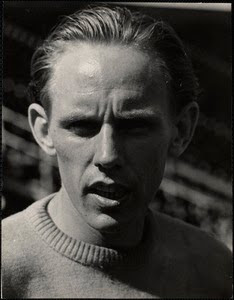
Ted Haydon, U. of Chicago Track Club Coach

Ted Haydon captained the University of Chicago track & field team in 1933 and returned to Chicago to serve as head track & field coach from 1950-85. A member of the U.S. Track & Field Hall of Fame, Haydon formed the University of Chicago Track Club, which became a national force. As a student-athlete at Chicago, he was a national qualifier in the javelin.


The most significant of the collegiate meets is the Big Eight meet in Stillwater, Oklahoma where the hometown Cowboys win their first conference championship and end Kansas' streak of 13 consecutive titles. The finish is one for the ages. Billy Mills of Kansas takes the individual title, but not by much. His 15:03.6 gets him home barely ahead of three Okie Staters, John Haraughty, 15:04, Jack MePhail, 15:05, Harold Smith, 15:06, and teammate Bill Dotson, 15:07. That's five guys within 3.4 seconds over three miles.

Remember the retirements of Ron Morris and Parry O'Brien? Forget it, they will be competing indoors and perhaps outdoors as well. Tell you who will not be back: Lee Calhoun and Bobby Morrow because they have been declared professionals. Morrow has made public his business affiliation with a company that produces among other things the Bobby Morrow Kick Gauge, a device that positions one's starting blocks for maximum leverage. Calhoun's professional status stems from his acceptance of the job of sports director for the the city of Gary, Indiana's parks and playgrounds. As this is enough to keep him from competition, he is free to accept a gift of $3000 as a down payment on a home.

High jumper Joe Faust (see article below) has dropped out of Occidental College “for personal reasons” and has jumped for the last time. How many times have we seen the term “personal reasons” used to gloss over something negative? Not this time. Joe Faust is leaving the school and the sport to enter the priesthood.

Remember the tragic crash that took the lives of so many of those on board the plane that carried the Cal Poly San Luis Obispo football team Oct. 29, 1960? One of those who lost his life is 46.0 400 meter runner Vic Hall.

Last month we reported that Olympic 100 meter champion Armin Hary, not having his price met for three films featuring his own wonderfulness, had devoted his time to writing his memoirs. Well, it appears that the siren call of the silver screen has once again captured his attention. He is now interested in filming The Armin Hary Story with himself playing the title role. Not to be outdone, his Olympic teammate, Carl Kaufmann, is moving forward with his entertainment career as well. He has just recorded his first song, “Und Amor lauft mit” which translates as “Cupid Runs too”. If you know the tune, feel free to hum along as you read further.

Archie San Romani Jr. has transferred from Wichita State to Oregon.
San Romani Jr. 2 nd to Jim Grelle at Mt. San Sac? Relays


Glenn Cunningham, Archie San Romani Sr. and Gene Venzke the 3 US 1500 entrants at 1936 Olympics on the boat to Europe.

Gordon Pirie has retired and moved to New Zealand. Roger Moens, Belgium's 800 WR holder is the subject of conflicting reports. Some say he will retire, but others report an interest in continuing his career in the 1500 where he has a PR of 3:41.4.

The IAAF ruled that 200 meter races around a turn which have aiding wind in the stretch will not be considered for record purposes. As this was not the case when England’s Peter Radford's 20.5 was accepted as the WR, his mark will be referred to as a “record accepted by mistake”. Awkward at best.

From our thinking outside the box department: Harold Abrahams of Great Britain has a suggestion that would revolutionize broad jumping. He proposes a “step off board” one meter in length. The jumper can take off anywhere within this zone and the measurement will be taken from the footprint (made more visible through the use of an adequate material). Jumpers would be “psychologically unbothered” while going down the runway and there would be practically no fouls. The more your hard working reporter thinks about that, the better the idea seems.

With the track world abuzz from the Olympics, this issue is full of ads. For the first time an entire page is devoted to an ad, specifically Champions on Film who offer “1960 Olympic Movies from Rome” ($25), 16mm “loop” movies and sets of “loops” in 8mm ($19.95). Honest to God,.....I am not making this up,......the address is 303½ S. Main Street, USA. No phone number. Think someone got yelled at for that?

The choice of shoes now includes Spot-Bilt (with all-kangaroo uppers), Puma (the imported shoe), Dreske (a fine, new track shoe / dealers wanted) and, of course, Adidas (the proof is in the wearing).


A Tribute to Johnny Morriss from the Lousiana Sports Hall of Fame
Johnny Morriss
Sport: Track and Field
They don't make hurdles – or hurdlers – like they did before World War II.

Johnny with US team in Torino,Italy 1933

Johnny later in life.
Six of the 15 track and field athletes in the Louisiana Sports Hall of Fame were world class hurdlers, including two of the five members of Bernie Moore's LSU team that won the 1933 National Collegiate Athletic Association championship. But modern day hurdlers such as Rodney Milburn and Willie Davenport should be thankful that they didn't compete in the good old days.

Hitting a hurdle now might cost an athlete a tenth of a second. Fifty or sixty years ago, it could mean a broken leg.

“It was straight upback and did not have anything on it that would give,” Johnny Morriss said of the hurdles he conquered in tying the world record with a time of 14.3 seconds in 1933.

In one exhibition race in Cleveland, Morriss didn't even run in a straight. “We ran on the baseball field,” he recalled. “The high hurdles started at home plate and five hurdles were down the right field line. Then it curved toward centerfield for the last five hurdles. Of course, it was all on grass. I ran 14.6, and it was published as a world record.”

His first taste of international competition was a victory over Lord Burghley of England (the 1928 Olympic 400 meter hurdles champion, and one of the Olympians portrayed in the movie “Chariots of Fire”) in the 1930 Toronto World's Fair. Lord Burghley was elected to Parliament in 1931, but was granted a leave of absence for the 1932 Olympics.

Morriss was a three-year letterman in football, basketball and track at Lafayette High, graduating in 1926. He earned 12 letters at Southwestern Louisiana Institute – four apiece in football and track, two apiece in football and golf.

Abbeville High hired him in 1930 – officially as a teacher and assistant principal, to protect his amateur status. But unofficially, he did plenty of coaching, Marty Broussard, then a student at Abbeville High, recalled Morriss setting up hurdles in the school's hallway on rainy days to practice when he was preparing for a major meet.

The year before he broke the world record, Morriss was the first alternate in the 110 meter high hurdles on the 1932 U.S. Olympic team.

George Saling of Iowa, the NCAA champion, won the gold medal and Percy Beard, who had nipped Morriss by a foot for the third spot on the U.S. team, won the silver medal.

One year later, Morriss won the national AAU championship at Chicago's Soldier Field with a world record clocking of 14.3 seconds in a qualifying heat. Perseverance paid off for Morriss, who had finished fourth or fifth in the previous three national AAU championships. Third place in that race went to Al Moreau of LSU, another member of the Louisiana Sports Hall of Fame.

The other “old-timer” in the Louisiana Sports Hall of Fame is Glen “Slats” Hardin, whose specialties were the longer hurdles races.

After the 1933 national AAU meet in Chicago, Morriss toured Europe for two months and won 17 consecutive races in international competition. In the World Student Games in Turin, Italy, Morriss was selected to carry the U.S. flag in the opening parade of nations. He won the high hurdles in that meet. Throughout his career, he wore a red and white SLI shirt, even in European meets.

Morriss, who coached athletes in four sports at Abbeville High, later coached North Carolina to Southern Conference championships four years in a row, directed SLI to three consecutive Gulf States Conference championships and led the University of Arkansas to the Southwest Conference cross country title. Between those stints, he spent three years in the U.S. Navy during World War II and worked with a Chicago athletic supply company for two years.

In 1955, Morriss took over the track and cross country program at the University of Houston. His Cougars won three consecutive national AAU cross country championships.

Morriss coached 30 All-Americans in track and field, and 36 in cross country. His athletes tied or broke eight world records, and nine of them competed in the Olympic Games – three for the United States and six for Canada.

He originated the “Meet of Champions” in Houston and brought indoor track to Houston. Morriss was instrumental in bringing the national championship meet to Houston's Jeppesen Stadium in 1986.

“He's the only man I know,” said one friend, “who can start talking about football, basketball or anything else, and wind up talking about track.”

Morriss, author of The Self-Coached Runner, is the only track coach from Louisiana or Texas to be elected president of both the NCAA Cross Country Coaches' Association and the Outdoor Track Coaches' Association. He is a member of numerous Halls of Fame.

In recent years, Morriss has been battling Alzheimer's disease. A man who had seven holes-in-one as a golfer, his golf game has been limited to practicing putts in the backyard of Houston's Sheltering Arms Day Center. The game that kept him alert was dominoes.

Alzheimer's is a progressive, degenerative disease that claims more than 100,000 lives a year – making it the fourth leading cause of death nationally behind heart disease, cancer and stroke.

His wife, Nona, said the most difficult thing was watching a dynamic person who was always self-reliant become dependent on others for everything. “We still have a lot of good conversations,” she said in the winter of 1991. “We take walks and we have friends who involved us in what they do. But I cry easily now. That's something I never used to do.


The following is an article about Joe Faust from the Culver City HS Alumni News by Rick Weingarten including an exerpt from "Rome 1960".
An Olympian from Culver High : : Joe Faust

From the book: "ROME 1960..The Olympics That Changed The World” by David Maraniss

“The high-jump competition was an all-day affair. It started at 9 that morning with 32 jumpers, and by lunch the field had narrowed to 17 who had cleared 6’-6 ¾” . American Joe Faust, with a sore lower back, was the first one out in the afternoon. “

“It could be said that Joe Faust failed at the Rome Olympics, coming up short after working toward a single moment for 7 years, but his disappointment was not written into the larger drama of U.S. men’s track-and-field team on what came to be known as Black Thursday. Few had heard of Faust before or after 9/1/60, and he was virtually invisible at the competition, withdrawing after the preliminary round in the high jump. He barely dragged his pained body over the bar at 6-4 ¾, then bowed out, finishing in 17th place, which was far worse than he might have done but better than 14 other jumpers from Tunisia to Iceland. That is how most Olympic athletes finish, unknown and unseen, away from the glare of media hype and patriotic hope. Like any of them, Faust would have been delighted to win a gold medal at the Stadio Olimpico, but he understood that in the larger scheme of things it would not have mattered, and the scheme of things is what he was all about.

There had been a touch of fame in the family before his athletic career. His father, Louis (Bob) Faust, was an actor who played a villain in several John Wayne movies, including the 1947 “Angel and the Badman.” Bob assumed the role of bad man in the family, too, leaving his pregnant wife and 7 children. Joe was 5 when his parents separated, and spent much of his childhood with a foster family in Culver City. He was a normal kid except in two respects: he had wondrous spring in his legs and religious curiosity in his heart. By age 10 he was a precocious Catholic, searching for the spiritual essence of life.

His junior high track coach notice Joe’s exuberant bounce and quickly steered him toward the high jump. It was 1953, and together they developed an ambitious long-term plan to get to the 1960 Olympics. One out of a million chance, perhaps. ‘But I believed him,’ Faust said of his coach. ‘And we started working.’ His first jump was 3-foot-7, but by the end of that year he was at five-eight and moving higher by the week. He did the straddle jump, like most jumpers of that era, approaching the bar from a left angle and kicking up and over with his lead arm & leg. ‘I loved seeing the bar as I went over it,’ he said, something no high jumper would do in later decades after Dick Fosbury introduced the revolutionary Fosbury Flop, going over shoulders first, torso and head skyward. (as an interesting aside, I watched the 1976 Montreal Olympics with Dick Fosbury when I lived in Eugene and was blessed to hear his commentary while Dwight Stones was going for the gold. We sat in a friend’s backyard, drinking beer and watching Dwight with rapture on our faces. I remember it well. In fact 30 years later, I tracked Dick down in Ketcham, Idaho where he owned a surveying company and was able to convince him to do a feature for Fox Sports Net that I produced, called, “Where are They Now.” Great memories indeed.)

At fifteen Faust cleared the bar at 6-8, setting a new standard for his age group, and as he approached age 17 he was recruited to jump at UCLA. Faust lasted a month there, dropped out, and transferred to nearby Occidental College. He had been valedictorian of his high school class, but school now was all confusion to him. The seven-year plan to reach the Olympics still drove him, and he worked out twice a day, all the while feeling pangs of guilt about ‘the achievement complex.’ Jumping was his ambition and salvation; he infused it with religious symbolism.

Each jump had its own ritual; what he called the cycle of repair. He looked at the crossbar and saw the crucifix. As he approached, he imagined jumping into the arms of a loving God. He rose with penance, sorry for his sins, and descended with gratitude, thankful for love and forgiveness. Over and over again, penance and gratitude, sin and redemption, repairing himself inside and out, jumping a hundred times a day. It was all deeply personal and private. He never talked about it to others, never boasted that God was on his side. His heavenly thanks were not for how high he jumped, but simply for the act of jumping at all.

By July 1, 1960, Faust was exceptional enough to compete at the Olympic Trials at Stanford. Everything felt right that day. He was struck by the beautiful care with which Payton Jordan, the Stanford track coach, had prepared the stadium. The grass was a velvet cut of green, the track smooth and flawless, the takeoff area with just the right bounce, the landing pit soft and inviting. Hours before the competition, Faust went off by himself to meditate, visualizing his jumps. There were 13 competitors, led by John Thomas, the amazing leaper from Boston U., and Charley Dumas, the defending Olympic champ. All the attention was on Thomas, as he set a new world record, but there was a lively contest for the other tow Olympic slots. When the height reached 6-9, 7 jumpers were still around. Faust nicked the crossbar on his first 2 jumps and was on the verge of elimination. ‘I started visualizing the prayer part,’ he said later of his preparations for the 3rd try. ‘I dedicated the next jump to all the people who might be on crutches around the world. But it was not a trade-off with God. It was a feeling of, Why leave anyone behind?

He cleared the bar with ease. And then 6-10, and 6-11, and finally he soared over 7 feet for the first time in his life and clinched a spot on the team.

That moment, as it turned out, was the Olympic peak for jumping Joe Faust. A few day later he strained a disc in his lower back. Determined to fulfill the 7-year plan, he gutted it out at practice meets in Oregon and Switzerland, wincing in pain but showing enough to keep his place on the team. He was still only 17 when he reached Rome, the youngest man on the track and field squad, and he soaked it all in, joining the throngs who saw Pope John XXIII at the Vatican, mixing with foreign athletes, even coming to the aid of Leif Kvist, a young man from Sweden who had lost all his money and had been standing outside the gates of the village, broke and starving, until Joe brought him food from the bounteous Olympic cafeteria.

Then came the day of competition, the anticlimax, a jump of 6-4 ¾ and no more. He returned to California and wanted to become a Trappist monk. He fasted outside the gates of the Abbey of New Clairvaux up near Vina for 3 days and asked to be called Zachary, but could not clear his mind of images of a woman he had fallen in love with decided the monastic calling was not for him, not exactly. Over the years, he married, had children, got divorced, and struggled with questions he could not answer. He wondered what purpose God could invest in a molecule 2,000 feet underground. What part did that molecule play in the scheme of life? It was a hole in his theological construct that remained unfilled for years, until it cam to him that a single molecule had its own graceful movement in the universe. ‘That lonely molecule is not so lonely,’ he decided.

Nearly a half century after his moment in Rome, Faust, in his mid 60’s, lived a monastic life alone in a cramped room in a cottage nestled on the side of a scrubby tan hill just off the 710 Freeway not far from Cal State, L.A.. Inside his room, he had a table, a filing cabinet (folders on new high-jump landing pit designs, trash technology, mind and spirit notes), a shelf of books (The Joy of Mathematics, The Sistine Chapel, The Child’s Creation of a Pictorial World), another shelf of food (cereal, bananas, 7-grain bread, grapes, oranges), a small refrigerator, a sofa bed, and a computer. There were makeshift shelves and a grill out near the side door. It seemed all he needed. He was like a single molecule of Olympic history buried deep underground, alone, but still moving, and in his movement connected to everything else. Once he knew Rafer Johnson, Wilma Rudolph, Cassius Clay.

The backyard had the marking of a scavenger, a cluttered junkyard of collected planks of oak, sheets of plywood, scraps of iron, chunks of cement, bricks, stones, all arranged in a haphazard yet loving array. Down at the bottom third of the yard there was a clearing with an old mattress on the ground, and a further look showed two poles rising at either end, a bamboo crossbar nearby, and a worn path in the dirt coming from the left toward the tattered mattress. With no one watching, Joe Faust was high-jumping still, with a sore knee but bounce in his step, practicing his cycle of repair, rising with penance, clearing the crucifix, absolving his sins, descending with gratitude.

================

Just a footnote in the Olympic lore, but as a Culver City man, I thought worth recalling and giving some reverence to a man who might have won a medal had it not been for his damaged disc. I believe he may be the only Culver City person to ever compete in an Olympics. Not positive of that however.

This might be the most I have typed since my last term paper in 10th grade for Patty Logsdon. Whew..See you.

Rick Weingarten


--------------------------------------------------------------------------------

V 15 N. 10 Gunder 'The Wunder' Haegg Visits Cincinnati

Bob Roncker of Cincinnati, Ohio has sent in this account of one day on the 1943 tour that Gunder Haegg of Sweden made to the US to help rais...