Once Upon a Time in the Vest

Showing posts with label Chris Chataway. Show all posts

Monday, January 20, 2014

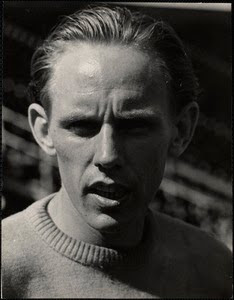
Vol. 4 No. 3 Sir Christopher Chataway R.I.P.

Chris Chataway passed away this weekend.  His obituary appeared in the New York Times today, January 20, 2013.  

He led the third lap of Roger Bannister's epic first four minute mile at the Iffley Road track in Oxford, England.    He was 82 years old.   At the age of 64 he returned to Iffley Road and ran a 5:48 mile.    During his career he set world records at 5000 meters and  twice at three miles, once defeating Vladimir Kuts in a tremendous race at London's White City Stadium.  He finished fifth in the 5000 meters at Helsinki in 1952 after taking a tumble on the last lap  and 11th at Melbourne in 1956.   His life did not end with athletics.  He went on  television and then to serve his nation in parliament and as a cabinet minister.     Chris Brasher , the third runner in that four minute mile died a few years ago.  Now only Roger Bannister remains. 

 Below are obituaties from several of the world's leading newspapers

http://www.nytimes.com/2014/01/20/sports/chris-chataway-british-runner-and-politician-dies-at-82.html?ref=obituaries&_r=0

The Telegraph and Guardian  have probably the most definitive obituary including a youtube clip
http://www.theguardian.com/uk-news/2014/jan/19/sir-christopher-chataway-athlete-dies-82

.
 

http://www.telegraph.co.uk/news/obituaries/10582675/Sir-Christopher-Chataway-obituary.html


beginning of last lap at Iffley Rd.
a few weeks later in Turku, Finland when Landy ran the second sub 4


Chataway's story brings back memories of the storied era of British middle and long distance running. Sadly, and perhaps politically incorrect, the prominence of the European runners is definitely a relic of the past. As the Africans took over, I feel the global interest in distance running waned. Even people like me find it difficult to keep up with it all as we are deluged with more and younger Kenyans, Tunesians, and Moroccans popping up in meet results. I wonder if we will ever see any parity in the world of distance running. Maybe not, if one takes to heart the findings in "The Sports Gene".


I hope all of you have a good day. It is beastly cold here and we can expect more of the same with an expected low of -5 on tap for Thursday.    Steve 
 
Don't forget, Cram, Coe, and Ovett kept the tradition going into the 80's.   Even though I had the experience of living and working in Kenya and Tanzania for a number of years, I too find it difficult to keep up with all these great African runners.  I couldn't from memory name a single runner who won an Olympic distance medal after 1984.   It was easy with the advent of Keino,  Jipcho, Temu , Bayi, and Rono but they too seem to have gotten swamped by all these new chaps.  Maybe it's just the process of aging on my part.   George


I didn't forget, just temporarily stored the information elsewhere ......believe that ?  Steve

Friday, June 28, 2013

Vol. 3 No. 40 Alain Mimoun R.I.P.

Alain Mimoun b. January 1, 1921, d. June 27, 2013 at age 92.  He was the great rival of Zatopek in the 1950's and winner of the Marathon at the the Olympic Games of Melbourne in 1956.
Leading at Melbourne. He would win in 2 hr. 25 min.
Zatopek finished 6th in 2 hr. 29 min.


Born in the arrondissement of Maïder in the town of Telagh, then in French Algeria (his birth name was Ali Mimoun Ould Kacha), Mimoun lost several years of competition to World War II. After the war (in which he was a combatant), he was French champion in the 5000 metres and 10000 metres.
Schade, Zatopek, Mimoun
Into the Homestretch
Helsinki 5000
Herbert Schade, Germany(14:08.6), Alain Mimoun , France (14:07.4),
Emil Zatopek, Czechoslovakia (14:06.6) ,
 Chris Chataway GBR on the  ground  would finish 5th in 14:18 behind Gordon Pirie


Mimoun's path to an Olympic gold medal was blocked in both 1948 and 1952 by Czech runner Emil Zátopek. Mimoun won silver medals in 10000 metres in 1948 and 1952 as well as another silver medal in 5000 metres in 1952. His second place finishes behind Zátopek gave him the nickname "Zátopek's Shadow." He finally won a gold medal in the marathon at the 1956 Summer Olympics inMelbourne, Zatopek finished sixth.
Mimoun made the French team for the 1960 Summer Olympics in Rome. He won his final national championship in 1966, twenty years after his debut.
With Zatopek after the 1952 Helsinki 5000m


Cross Country, French Style

                                                                                    photo  by Jerry McFadden


Alain Mimoun was a virtual unknown in international track and field when he won a silver medal for France in the 10,000-meter race at the 1948 London Olympics. The Algerian-born Mimoun soon became one of the world’s most brilliant distance runners.
But gold eluded him. He was the runner-up twice at the European championships in 1950 and twice more at the 1952 Helsinki Olympics.
Emil Zatopek of Czechoslovakia, perhaps the greatest distance runner ever, won all five of those races, leaving Mimoun tagged as his “shadow.”
Mimoun finally ran the race of his life at the 1956 Melbourne Olympics. At 35, he won the first marathon he ever entered. Zatopek, the winner of the 1952 Olympic marathon, was far back, in sixth place.
When Mimoun died on Thursday at 92 in Champigny-sur-Marne, a suburb of Paris, he was hailed for the grandeur of his achievements and for his grit.
His death was announced by France’s athletics federation.
“He left a deep mark on the history of French sports,” said France’s president, François Hollande.
But Mimoun, whose victory proved a precursor to the arrival of great international runners from Africa, was remembered as well for embodying the amateur ideal. The story of the respect he showed for a rival who had become his friend, and whom he had ultimately vanquished, was told once more.
On Dec. 1, 1956, a crowd of more than 100,000 cheered the 5-foot-7 Mimoun, a mustachioed man with a blue jersey bearing the French tricolor and the number 13, as he ran a seemingly effortless final marathon lap at the Melbourne Cricket Ground on a day when the temperatures reached about 100 degrees. Mimoun had looked back for a glimpse of Zatopek or anyone else challenging him in his final strides, but there was no one in sight.
After crossing the finish line, Mimoun lingered among the officials.
“I was sure Emil was there at my heels,” he told Sports Illustrated in 1972. “I was hoping he would be second. I was waiting for him. Then I thought, well, he will be third. It will be nice to stand on the podium with him again. But Emil came in sixth, oh, very tired. He seemed in a trance, staring straight ahead. He said nothing. I said: ‘Emil, why don’t you congratulate me? I am an Olympic champion. It was I who won.’ ”
Mimoun continued: “Emil turned and looked at me, as if he were waking from a dream. Then he snapped to attention. Emil took off his cap, that white painting cap he wore so much, and he saluted me. Then he embraced me.”
“For me, that was better than the medal,” Mimoun said.
Ali Mimoun Ould Kacha was born on Jan. 1, 1921, in Telagh, in northwest Algeria, the eldest of seven children in a farming family. He began running as a teenager, then joined the French Army during World War II and was wounded in the foot at Monte Cassino in the Italian campaign.
He faced possible amputation, but the wound healed and he moved to Paris after the war. He joined an athletic club and took the French name Alain. When he showed promise as a runner, he was named to the French Olympic team for the 1948 London Games.
Zatopek beat Mimoun by nearly a lap in the 10,000-meter run in London. They became friends, and Zatopek invited Mimoun to visit Prague as his guest. Their rivalry resumed at the 1950 European championships in Brussels, where Zatopek and Mimoun finished 1-2 in the 10,000 and the 5,000. Zatopek bested Mimoun again in the 10,000 and in the 5,000 at the Helsinki Olympics.
Mimoun hoped his luck would change in a marathon, and he dutifully prepared for Melbourne over a two-year period. When the French team arrived there, he shunned distractions.
“He woke me at 5:30 in the morning to go run, and in the evening, he made me go to bed at 8:30,” his fellow Olympic runner Michel Jazy told the French commercial radio network RTL on Friday. “Even though we were at the Olympics, I couldn’t go to any of the parties.”
But there were other matters on Mimoun’s mind. His wife had remained in France expecting their first child. Word came a day before the marathon that she had given birth to a daughter. The Mimouns named her Olympe.
Mimoun took the lead about halfway through the marathon and shunned the cups of water on tables lining the course as he pulled away. He lost nine pounds, but he finished in 2 hours 25 minutes, about a minute and a half ahead of the runner-up, Franjo Mihalic of Yugoslavia. Zatopek, who had undergone hernia surgery six weeks earlier, finished 4:34 behind Mimoun.
Mimoun never raced against Zatopek again, but his career embraced a host of superlatives beyond that rivalry. He won the International Cross-Country championship four times from 1949 to 1956. (Zatopek did not compete in those events.) He won six French marathon championships, the last when he was 45, along with many other French national running titles. He made his last Olympic appearance at Rome in 1960, finishing 34th in the marathon.
He worked as a physical education instructor and ran recreationally into his 90s. Many French streets and municipal running tracks bear his name.
Information on survivors was not immediately available.
When Zatopek died in November 2000 at 78, Mimoun was deeply affected.
“I haven’t lost an opponent,” a Czech newspaper quoted him as saying. “I’ve lost a brother.”

Comment from Phil Scott, Clayton, OH
I was never more happy for someone else winning a race, than when Mimoun won the marathon gold in 1956! 
Thanks George

George,  Every day i check my "score" in the obits to see how many people younger than i died.  today i had my best score ever; 20-1.  Who was the one you ask?  it was the incomparable Alain Mimoun, that's who.  Toledo Blade ofJjune 29, 2013.  Richard Trace


Wednesday, August 31, 2011

Vol. 1 No. 26 October 1956

OCTOBER, 1956
I don’t have the September issue so obviously some information, including the results of the four US tune-up meets, has gone missing. Additionally, I don’t have the November issue, so this will be it before the games begin.
European distance runners are setting the tone. Sandor Rozsnyoi, the world record holder at 1000, 1500 and 2000, adds a fourth WR with an 8:35.6 steeplechase. Four distance WRs makes him the second coming of Henry Rono. Oops, make that the first coming. This is not to say that Rozsynoi is unbeatable. Gordon Pirie jumps on the WR bandwagon by beating Rozsynoi at 3000 in 7:52.8 to Roz’s 7:53.4. Pirie previously set the 5000 WR of 13:36.8. But wait, the records continue to come. Vladimir Kuts of Russia just ran 28:30.4 at 10K to break Sandor Iharos’ record by 12 seconds. Throw in Iharos, England’s Chris Chataway, who recently finished a 5000 with a 38.8 300, and the great Emil Zatopek and the Melbourne distances look to provide great entertainment. Zatopek was recently operated on for a hernia and is reportedly in poor shape. He will concentrate on the marathon though he may run the 10K on the opening day as a “warm up”.
The middle distances are equally unpredictable. Ireland’s Ron Delany has the world’s fastest mile this year, 3:59.0, but was beaten by England’s Derek Ibbotson at 1500. 3:44.4 to 3:44.6. Rozsnyoi’s 3:40.6 makes him the favorite, but with so much time left before the Nov. 23 start of the games, one wonders who will maintain fitness and who will be run out. Norway’s 1:46.4 man, Audun Boysen, undefeated at 800 and the prime competition for Sowell and Courtney, says he will pass on the Olympics. The guess here is that they conflict with ice fishing season.
Two American throwers have suddenly put themselves in medal contention. Bud Held set the national record in the javelin with a 270 foot toss. Hal Connolly did him one better, breaking the WR in the hammer at 218-10+. With our contingent in the shot and discus, the throws should go well for the US.
The high school list fills a page and a half. Jerry White of Corcoron, CA is tied for the lead in the 100 with 9.5 and dominates the 440 at 46.7, but oddly is not listed at 220. He did make the list in the 880 at 1:55.6 . Speaking of the 880, the leader is Jerry Siebert of Willits, CA. I am fascinated by this guy. Willits is a town of 5000, 25 miles north of Ukiah, in the middle of nowhere. Many years ago I stopped by to see the records posted in the gym. He held (and I guarantee you he still does) the 220, 880 and mile, but oddly, not the 440 which wasn’t anything special. As he was a stalwart on those great Cal mile relay teams, I found this strange. Hayes Jones hurdled 14.3 for a tie for seventh fastest mark. Willie White of LA Jefferson leads the lows at 18.9 along with being tied with four others for the 100 lead at 9.5. He is not the only LA Jefferson national leader. Oscar Bean broad jumped 25-4+. Jefferson lead the country in the 880 relay at 1:25.9. They definitely had some sprinters. The quartet is pictured. Bean isn’t one. Jeff also lead the 8 man mile relay (don’t ask) at 2:56.3. (Just did some research on Jefferson as I don’t remember the school being mentioned in any sports context in recent years. Apparently it has been restructured without sports.) In a burst of record keeping accuracy, Marv Sturgeon of Cannelton, IN is listed as 13th in the 880 at 1:55.8, but in a section at the end of the lists entitled “Other Events” is credited with an 800 mark of 1:52.5. Apparently conversions were frowned upon at that time.
Page 10 has a photograph of five pole vaulters. Bob Richards, a Long Beach guy, is shown wearing an LB Poly shirt with the script green on faded gold “Poly” just as I remember it from my Poly days.
Lots of columns, the fun stuff: Track Talk (Cordner Nelson), On Your Marks, Bank Notes (Dick Banks) and So They Tell Me (Bert Nelson). On Your Marks (no author mentioned) mentions that five soon to be US college athletes will be competing for Jamaica: George Kerr, Ernie Haisley, Keith Gardener and the Spence twins, Mel and Mal. O’Brien’s shot and discus double in Eugene was the best ever. Not having last month’s issue, we don’t know what it was. Houston’s cross country success is assured for the near future as John Macy and Jerry Smart have just enrolled. Ohio State coach Larry Snyder is in India “helping to train the Olympic squad there.” Was he the coach or did he just happen to be in the neighborhood?
Track Talk is principally about a book on nutrition, “Let’s Eat Right to Keep Fit” by Adelle Davis. “Lack of protein causes flabbiness of muscles and ligaments. Too little fat in the diet can cause overweight.” And a bunch of other stuff. Looked it up on Amazon.com. It is out of print, but you can still get copies. Hardback goes for $205, paperback $80.
So They Tell Me informs us that “Perry O’Brien now utilizes slick soled track shoes – absolutely no spikes – as a development of his form.” “He will only use spikes on a rough and uneven ring.” My lack of knowledge in this area left me puzzled. Haven’t shot and discus rings always been cement? No, apparently dirt was common. In Melbourne they will be cement. Former Stanford and present San Francisco Olympic Club coach, Dink Templeton, says that there will never be another great shot putter who does not use the O’Brien technique. At the other end of the prediction continuum, Percy Cerutty prophecies that when runners develop a relaxed style, “men (will) run three miles at 4:10-4:15 rate, around 4:20 for six miles.” He also predicts an 800 time of 1:40 and a mile between 3:40-3:45.
Apparently the two great “down under” coaches, Cerutty and Franz Stampfl, had philosophical disagreements and a contentious relationship. A letter appears in this issue defending Stampfl’s training methods. It is written by a young Ron Clarke.
Bank Notes deals primarily with the college choices of high school athletes. Willie White is going to California (extension) whatever that is. Dave Davis will be at USC (extension) as well. Jerry White will be at Mt. SAC. Ron Gregory, who apparently held the HS mile record for a day or two before Jim Bowers broke it, is reported going to Kansas. Not so, the brother of comedian/activist Dick Gregory studied at Notre Dame, a fact I know because I ran against him (more accurately, behind him) in the ’59 Missouri AAU Championship two mile. The highlight of the article is that the seventh ranked miler in the country would be attending Kansas. That would be 4:21.4 man Cliff Cushman of North Forks, ND. Banks says Kansas coach “Bill Easton is pointing him towards the steeplechase and he looks like a natural.” In an amazing double, Cushman is the 11th ranked high hurdler at 14.4, only 0.4 behind the leader. I’m betting that 4:21.4 and 14.4 are still the best mile – hurdles double in US high school history, not that there is a long list.
The more things change, the more they stay the same dept: Track and Field News is no longer 25 cents. Now it costs $3 for a year. There is still time to join the TFN Olympic Tour if you have $1444. And yes, Cliff Severn still sells…….well, you know.
Coming up: The Olympics

V 15 N. 10 Gunder 'The Wunder' Haegg Visits Cincinnati

Bob Roncker of Cincinnati, Ohio has sent in this account of one day on the 1943 tour that Gunder Haegg of Sweden made to the US to help rais...