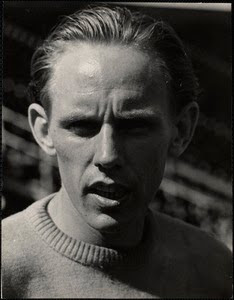
And so we begin with Roy's review of March 1962 taken from the pages of Track and Field News and his encyclopedic memory.
MARCH 1962

Snell on the Turf
Let's get this straight right off. In the world of track and field in 1962 there are two divisions. One is Peter Snell. The other is everybody else. After throwing down five world records in three weeks, you would think the man would take a break. Nope, the week after adding the indoor records at 880 and 1000 yards in the LA Times meet, he returns to New Zealand and takes a shot at his own WR in the mile. The fact that he fails is beside the point. His 3:56.8 on February 22 is the sixth fastest ever run and his second best. If this is failure, we'll take a second helping, please. His splits are more even than in his record run three weeks earlier: 59.1, 59.4 (1:58.5), 60.3 (2:58.8) and 58.0. Except when Gary Philpott moved ahead briefly on the second lap, Snell led the entire way.
Four weeks later in Tokyo on March 18, he became the first man to run sub 1:50 in the indoor 880 with a 1:49.9 breaking his own 1:50.2 record. Six world records so far this year; one can only wonder what is yet to come.
As with last month's issue, this one covers indoor action more by events than meets. Frank Budd ties the world record in the 60 with two 6.0's in the ICAAAA meet. Hayes Jones gets his long awaited 6.9 WR in the highs in the Chicago Daily News meet. Also in the Daily News meet Kansas takes down Manhattan's WR in the 2MR by two seconds. Kirk Hagan blows the race open on the first leg with a 1:52.2. Tonnie Coane and Bill Thorton do their parts with 1:54.4 and 1:53.1 before Bill Dotson anchors in 1:51.1 for a 7:30.8. Two weeks later at the Kansas State Relays, the Jayhawks lower this mark to 7:29.2. None of those annoying details or splits are given.
Dave Mills tops the indoor 440 list at 47.8. Scanning further we find that this Toomey kid who resembled a Timex watch at Colorado (“Takes a licking, but keeps on ticking.”), is running for the Santa Clara Youth Village and may have found an event. He is ranked seventh at 49.1. Jack Yerman has the fastest 600 time, 1:10.1, a tenth of second ahead of old rival George Kerr. Jim Beatty likes newspaper sponsored meets. He set the indoor record in the mile of 3:58.5 in the Times meet (documented in last month's report) and now adds the only other sub 4:00 clocking with a 3:59.7 at the Daily News meet. In news somewhat akin to
God having an off day, Ralph Boston loses for the second time this season when he comes up half a foot short of Michigan's Dave Raimey's 24-3¾ in the Daily News meet. Dave Raimey, from my home town of Dayton, OH, had a good football career at Michigan and was a Hall of Famer in the Canadian Football League. ed. Boston does have the longest effort of the season, 25-2. A couple of Big Ten football players have displayed their long jump wares. Ohio State's Paul Warfield has the second best mark of 24-11½, but tastes defeat in the Big Ten meet at the hands of Michigan State's Sherm Lewis who leaps 24-6. Warfield as some will remember was an NFL pro bowler at Cleveland. ed. John Thomas is the only seven foot high jumper at that exact mark. John Uelses' 16-0¾, reported last month, provides him a nearly half foot cushion over the next vaulter. The outdoor season is in an embryonic state, with a few promising marks, but nothing to write home about and so we shan’t. If you are a top athlete who has used up his college eligibility and you are not in the service, you have probably moved to Southern California. The
Southern California Striders have a long history of dominating national championships, but now two more teams have formed. The Los Angeles Track Club, coached by Mihaly Igloi, seems to have cornered the market on middle distance and distance runners. Wearing the LATC singlet are Bob Seaman, Lazlo Tabori, Jim Grelle, Max Truex, Jim Beatty, Willie Atterberry, Bob Schul and Nick Kitt. 

LA Track Club withTom Rodda (Kansas St.) and Jim Grelle (Oregon) leading Paul Ebert (Oklahoma) in 1963 Southern Pacific AAU Cross Country Meet (contributed by Paul Ebert)

LATC Team Photo. Ebert Top Row second from Left. Igloi on the right. Front, Peter Mundle (Oregon) Rodda, Grelle Ray Hughes (Arizona), Meryle McGee Can anyone ID the other runners?
If you are a top notch weight-man, your affiliation is with Joe Mangan's Pasadena Olympians, at least Parry O'Brien, Rink Babka, Hal Connolly, Tony Conkle and Bob Humphries seem to think so. The following is gleaned from the writings of Bert Nelson in his Of People and Things column. You probably want to resist the urge to invest in a company producing metal vaulting poles. Eleven of the top twelve vaulters this indoor season use fiberglass, J.D. Martin being the exception.(In those days J.D was told by the manufacturers that a fiberglass pole strong enough to hold him would have weighed more than 50 pounds ed.)......................Thinking of setting a world record in a race longer than 220 on a track that is oversized or the event is not run as a complete oval? You'll be wasting your time, Bucky. The IAAF has decreed that records that are produced on less than an oval (one turn 440 or three turn 880) shall not be recognized for record purposes. But how are the rules makers handling that sticky 220 on the straight vs. 220 on the curve thing? Minds wiser than yours or mine have produced the only possible result: there will be separate (but equal) records for each type of race. Any race involving a curve run on a track exceeding 440 yards will not be considered for record purposes......Get your big meet tickets early. The NCAA will be in Eugene June 16-17, the AAU at Mt. SAC June 22-23 and the USSR-USA meet at Stanford July 21-22. Who is the best all around hurdler (highs, lows and intermediates) as determined by the Portuguese Scoring Tables? Rex Cawley is fifth (13.9m, 22.5ys, 49.9m) with 3013 points. Fourth goes to Glenn Davis (14.3y, 22.5mt, 49.2m) with 3019. Surprising Fran Washington takes third (13.6y, 22.3ys, 51.5y) with 3020. But these guys aren't close to the top two. Second goes to Germany's Martin Lauer (13.2m, 22.5mt, 51.2m) at 3073.. And the winner is …......Don Styron (13.7y, 21.9ys, 50.1y) with 3084. Make special note of this as it could be on the midterm.
Page 17 has an ad for Elmer's Weights (Big Spring, Texas) which sells hand, leg and vest weights. You can get Olympic Style (“Used by Olympic Champions”) or, if you can't clear your calendar for Tokyo in '64, you can just get the Regular Style. Elmer also sells Bobby Morrow's Kick Gauge (to measure your starting block position). You can also buy a Track Leveler and if you have to ask what that is, you don't need to know. An ad for Archie's Little Black Book takes up all of page 20. I'm thinking Archie is having some trouble getting endorsements. Aside from a high school coach who during the time he has been giving the books as prizes every school record has been broken, the only other endorsement is from Charles (Chick) Evans, “one of America's greatest all-time amateur golfers”. Charles (call me Chick) says, “I put the book down with the thought that one should persevere no matter what the odds may be”. On page 17 there is an ad for Minerva Watches which has a photo of a ten second face split timer. This caused your reporter to clutch his chest an emit a cry best described as unmanly. I had one of those. I loved it more than life itself. Wonder where it is now? Just to assure equilibrium in your life, let me report that, yes, Cliff Severn Sporting Goods is still selling Adidas on the back page and the cost of a subscription continues to be only $3 a year.
The pictures seen below are all of the same pair of shoes which are thought to be from the 19th century, approx. 1879. Phil purchased this pair in Lancaster, PA from a gentleman who had run a sporting goods store in the 1920's when the shoes were only 50 years old. Through searching old Sears and Roebuck and Montgomery Ward catalogues, Phil found advertisements from the 1880's for shoes much resembling this pair. The old gentleman told Phil that sometimes these shoes which all originated in England would be marketed under the local store's name. Top grade shoes were made of kangaroo leather, which is what Adidas and Puma and Dresske advertised in the 1950's and 60's as well. Eventually A.J. Spaulding began having shoes made in Massachusetts. J.W. Foster and Sons founded 1895 in England (later to become Reebok in 1958) was an early manufacturer. I personally held these shoes and found them to be very light and supple despite their age and rather thick sole in which spikes, quite long, were pounded into the sole. In these days the spikes were not interchangeable and started out rather long. Many were eventually made with a hardened steel and did not wear out. Believe me, getting spiked in those days meant some serious damage. Phil and I both remember wearing long spikes on good cinder tracks and the incredible grip you sometimes felt that you had and the sense of the shoe pushing you forward. We also remembered eating a lot of cinders being thrown up by these long spikes, and on wet tracks a lot of wet, mucky cinders covering those who ran back in the pack. Only the leader stayed clean, and even he usually kicked up a lot of dirt onto the back of his uniform. Also the inevitable cinders working their way into your shoes during a race and irritating your feet or causing blisters or abrasions was a common part of the sport. If you have any thoughts and memories of long permanent spikes and want to share them, click on the word "comments" at the end of this article. A box will then appear box below in which you can make a comment. We'll publish them as we continue our blog.< Smelly Feet