Once Upon a Time in the Vest

Showing posts with label Cleveland Magyar Club. Show all posts

Wednesday, January 30, 2013

Vol. 3 No. 7 Central State University Cross Country 1960-62


A few months ago we wrote about the 1962 NCAA cross country results and the other national meets of that year, and a name popped out to me in the placings.   That name was +Les Hegedus, who place 7th in the Division I meet representing Central State University of Ohio.   Les,  an American of Hungarian origin ran for a traditionally African American university.   It seemed there was a good story in this, and I sought out Les through the internet to ask him about his running history and maybe more.
                                               (Click on Image to see in a larger format)

Les is modest in talking about his exploits from those days.  He did mention that he might have done better in the NCAA University ( Division I)  race, but it was his third hard race in 9 days.  He first won the US Track and Field Federation 10,000 meters National meet  in Columbus, OH beating the formidable University of Houston runners+ John Macy, +Al Lawrence, Geoff Walker, and Pat Clohhessy.  Then on the way to the College Division race (which he won) the van broke down,  and then they got hopelessly lost near Wheaton, IL and barely made it to the meet on time.   A few days later he ran the University or Division  I meet and got 7th place.   
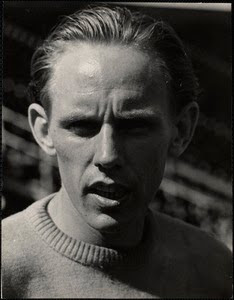
Above, Les Hegedus winning a cross country meet at Central State


The first time I had seen Les run was in 1958 at the Ohio AAU cross country championships in Dayton, Ohio, my home town.  I was a high school sophomore and had been getting ready to play basketball, but my  coach John Ross decided to have me run one last meet, and I was third in the HS race.   The HS race was followed by an Open 4 mile race that was contested by several colleges including Bowling Green and Central State and the University of Kentucky, led by a runner with a unique name, +Press Whelan.  Also entered was the Cleveland Magyar Club. The Magyars were made up of a bunch of guys of varying ages and mismatched uniforms and all speaking Hungarian to each other.   It must be remembered that in November of 1958, this was just two years after the Hungarian revolution in which thousands of refugees had fled their country after the Russians had come with their army to quell a popular uprising against the Communist government of Hungary.  We assumed the Magyar Club was a contingent of those refugees.  Being quite naive to the sport and looking for tips, I remember approaching those guys and asking them what it would take to run well like they had done that day.  In their limited English, they replied "Practice, practice, practice".  Les Hegedus, a tall blond young man ran well that day and finished 4th in the Open race.  A year later he was wearing a Central State uniform.

Central State was in the NCAA in those days competing in what was then called the  'College Division'.
The big universities competed in the 'University Division'.   Today if you look in NCAA records, those College division teams  are  referred to as Division II or Division III,  the current nomenclature.  'College Division' schools were allowed to grant athletic scholarships.   Since then the nonscholarship Division III has been added.    The NCAA record book on cross country shows that Les was a 4 time All-American in cross country , so 'College Division' freshmen in those days were allowed to run varsity, unlike their 'University Division' counterparts.  Central State it is noted also is the first College Division team to win and repeat as NCAA cross country champions, doing that in 1960 and 1962.  Among the other All-Americans in those days was were Central State teammates +Josh Ruga and +Choice Phillips.  In 1962 William Moore and +Teddy Seymour also joined Les in the All-American listings for Central State.   Moore would be an All-American in 63 and 64 as well.   In that time other runners of note winning the same honors were ++Jim Dupree of Southern Illinois and Ed Winrow of Buffalo State.


I had never met Les Hegedus after that 1958 cross country meet, but I did hear numerous stories about his great running history at Central State.   As the history of those times is what this blog is concerned about, I decided to find Les Hegedus and talk to him about those days.  Central State has had an up and down history of fat years and lean years in track and field.  At one time +Josh Culbreath, the great intermediate hurdler was coaching there, and more recently Josh's son  Jahan Culbreath was the coach.  Jahan was recently named the athletic director at Central State.  +Martin McGrady once ran for Central State and was unbeatable at 500-600 yards on the indoor circuits.  He was known as 'The Chairman of the Boards'.  +Clifton Mayfield, a very good long jumper was also a student at Central State.  Their women's program  produced a number of Olympians out of Jamaica in the 1990's.

Les proved easy to find.   He lives in Westlake, Ohio.   He is a retired music teacher in Cleveland parochial schools, and an  absolutely wonderful person to talk to,  so gracious and humble about his running credentials.

The first thing I wanted to know about Les was how he got to the US from Hungary after the 1956 revolution.  He corrected me on that one.   He said that his grandparents had come to the US in the early 20th century and settled in western Pennsylvania where his grandfather worked in the coal mines.  His mother was born in the US,  but when she was 16 years old, the family decided to return to Hungary.   Les was born in Hungary in 1937 and lived there through WWII.  Because his mother was a US citizen they were able to emigrate back to the US in 1949,  well before the 1956 revolution.  His father was not able to come with them immediately, but eventually did reunite with the family in Cleveland.  So Les arrived here as a twelve year old not speaking English and set about going to school with American kids, learning the language, and working to support his family.   He had worked in a gas station, a potato chip factory and several stores.  But in those days his passion was playing the accordion.  On his thirteenth birthday , he and his mother were walking past a music store, and she asked him what instrument he might want to learn.  Amongst all those shiny instruments he  chose the accordion. Les confided that maybe he had an ancestor who was a muscian, because in Hungarian his name 'Hegedus" means 'Violinist".   With all his work and learning the accordion,  he never ran track or cross country while attending West Tech HS in Cleveland where he graduated in 1956.   It is only after he graduated and  was working, that he met some of the Hungarian runners in the Cleveland area and joined their club.  One of the members of the club was +Julius Penzes, who had run the 6th fastest time in the world at 10,000 meters back in 1953.   Julius did a lot of the coaching then and still ran, but no longer at the international level he had registered in '53.   I've since learned that Penzes had been coached to some extent by +Mihaly Igloi when they were both still in Hungary.  Penzes is still alive and living in Oregon which is another story I intend to pursue at a later date.

Julius Penzes and Istvan Rozavolgyi  1959

                                                                   The 1962 national champions


+Dave Youngblade was a graduate student at Central State and had been assigned the coaching duties by Country Lewis, the long time A.D. at CSU.   Youngblade all but offered Hegedus a scholarship on the spot at the AAU meet in Dayton that November.  According to Les,  he had never considered going to college.  He was already two years out of high school and working several jobs.  But his parents encouraged him to continue his education.   So Les took his accordion to Central State and became a music major and a distance runner.


In an interview with Dave Youngblade who lives now in Saginaw, Michigan recalled that he had been attending Central State and coached two years as an undergraduate.  When he got his degree, he was offered $5,000 to go to Indiana University as an assistant.  When Central State heard that, they offered him $4,000 to stay.  His last year of coaching was the 1966-67 season after which he moved to Michigan and worked in the field of public education.    The track teams were very strong then, and on one occasion they beat Bowling Green State U.  113-14 in 1962.   As mentioned earlier ,  freshmen were eligible to run in the College Division.   When CSU showed up to run at Ohio University in the  OU Relays,  a venerable Big Ten coach, whose school will not be named, but are sometimes referred to as that school up north by Ohioans, went up to the meet director and told him that if CSU ran any freshmen in the relays, the Big Ten team was going home.  CSU agree not to run their freshmen and still beat the Big Ten team.  To this day Dave Youngblade still roots for the team up north to lose.    Dave also  firmly believes that segregation made CSU stronger, because few if any scholarships were being offered to African American athletes by the big schools in the late fifties,  therefore the traditionally black colleges and universities were getting the pick of the best black athletes.

Among Les' memorable races recounted to me by another of our readers, at the Ohio AAU track and field championships in 1962 or 63,  Les and Andy Schramm of Miami of Ohio went head to head in a 3 mile race with Les edging Schram at the tape.  Fifteen yards behind them was Billy Mills running for the Quantico Marines.

Les continued to run road races into his mid forties and had a 4:29 mile and 31:29 10,000 meters when he was 44 years old.   He taught music at St. Dominic's School in Shaker Heights, OH and St. Cyril's  in Lakewood.  He has retired from teaching   He is 75 years old at the time of this writing and stays active doing hill walking in the parks near where he lives and plays music regularly in a band.

       Teaching 2002


Tuesday, December 18, 2012

Vol. 2 No. 108 November 1962 A Lot of Cross Country

NOVEMBER, 1962

We just went over 17,000 hits on this site today.  Not bad for a very narrow niche blog.  And what a great lot of information.  I've included a Villanova U.  website with a bio  about Vic Zwolak,  some good pictures of Tom O'Hara who won the NCAA cross country meet in 1962,  and a brief recollection of Leslie Hegedus,  an American Hungarian  who made his mark in the Midwest and also nationally in this year.   Thanks to Roy Mason  for a great synopsis of events. 
George Brose

As would seem fitting, the November issue of Track and Field News is filled with results of cross country meets. Well, sort of. The meets earlier in the month are covered in detail, but the most important competitions, the NCAA and the AAU mention only the first few finishers and the team champions with the note “complete details will appear in the December issue”. Well, that kind of shoddy reporting is not what you readers are paying good money for. Your resolute reporter is not above peeking at the December issue in order to provide the full story. And now, the results in chronological order.
November 10 finds us in Ames, Iowa for the Big Eight meet where the distance is three miles. To a spectator standing at the finish, it would appear the team race is between Nebraska and Kansas. Mike Fleming of Nebraska is the winner in 14:53 and teammate Ray Stevens is second, eight seconds back. But here comes Kansas. The Jayhawks take 4th, 5th and 6th. Now the question is depth. Unfortunately for the Cornhuskers and Jayhawks, the depth comes from Colorado. The Buffaloes place 9th, 10th, 12th, 13th and 16th with a spread of 13 seconds to edge Kansas 60 to 63 with Nebraska third at 76.
This is not the end of big time cross country in Iowa, for two days later the Big Ten meet takes place in Iowa City. Allen Carius of Illinois smashes his own four mile course record by nearly a minute, winning by 12 seconds. Michigan State places four in the top ten and wins its tenth Big Ten championships in thirteen years. Spartans 39, Hawkeyes 64, Wisconsin 83.
Now it is November 16 and we are in Chicago's Washington Park for the Central Collegiates which quickly turn into the Tom O'Hara Show. The Loyola of Chicago junior has had a couple bang up indoor seasons, but injuries have hampered him outdoors. Not this day, however. He pulls away from the pack with ease in the final mile of the rain soaked four mile race to win by 18 seconds in 19:21. Ohio University takes the team title with 50 points. Western Michigan and Kansas follow at 62 and 87.

On November 17 in Wheaton, Illinois Central State of Ohio adds the NCAA college division championship to the one it won in 1960 to become the first school to win this meet twice. Central's Leslie Hegedus covers the four miles in 19:59 for the individual title. Central 77, Northern Illinois 96, Emporia State 119.  Ed'.s note.  I first saw Leslie Hegedus run at the Ohio AAU cross country championships in Dayton, OH about 1958 when I was in high school.   I talked to Leslie tonight by phone, and he confirmed that  he was third that meet running for the Cleveland Magyar Club, Press Whelan from the University of Kentucky was the indivudual winner that day.  Central State  recruited him on the spot.  The Magyar club was made up of Hungarian Americans and some refugees from the 1956 Hungarian revolution who settled in the Cleveland area.  Julius Penzes an older member of the club had been ninth ranked in the the world in the 10,000 meters back in Hungary and had been coached by Mihaly Igloi there.    Penzes is 86 years old now and living in Oregon.   I remember too that Leslie had a long scar on his upper arm that was probably the surgical result of a broken humerus, but we all speculated that  it was probably from a Soviet bullet.  We were wrong about the bullet wound.   In Roy's comments about one of the races, it is mentioned that Leslie was a Displaced Person, but Leslie was adamant that was not true.  His mother was born in the US but her family returned to Hungary when she was 16.  Leslie was born in Hungary in 1937, but had rights of citizenship through his mother.  They came back to the US in 1949 when he was 12 years old.   His father was able to join the family at a later date having to bribe Communist  officials to get an exit permit.   He never  ran in High School.  Leslie was a music major at Central State and taught music in several Catholic schools in the Cleveland suburbs  St. Dominic's in Shaker Heights and St. Cyril's in Lakewood.   He is still a very fit man and remains at his old racing weight of 152 pounds.  At the age of 44 he was able to run a 4:29 mile and 31:29 10 Km.  Though he no longer runs much he does climb a lot of steps in a local park and is very active with his music at age 75.

Two days later and we are in New York's Van Cortlandt Park for the ICAAAA meet, a meet Villanova has never won. Not anymore. The Wildcats edge Big Ten champion Michigan State 49-53 thanks to a 1-2 finish by Vic Zwolak and Pat Traynor. At the start of the day the five mile course record is the 25:19.8 run by Peter McArdle earlier in this year. The collegiate record is the 25:38.3 put up last year by Cornell's Steve Machooka. Ed's. note.   Machooka from Machakos, Kenya may have been the first Kenyan to run at an American University.  This was a time when very, very few Kenyans had ever attended college outside of England where the lucky few were sent at the time of independence.  Those records weren't beaten; they were obliterated. Zwolak wins by 40 seconds over his teammate in 24:47.3. He says once Traynor fell back, he eased up to save something for the NCAA meet which will be held in five days.
The USTFF meet is held in Columbus on November 22. Although there are a few top runners, the meet is an amalgamation of oddly mixed teams. Leslie Hegedus and John Macy, a former Polish army officer, match strides for five miles before Hegedus pulls away in the last mile for a 15 second win. Team scores reflect lack of continuity: Houston Track Club 23, Ohio University 32, Kentucky Federation 70, Ohio State 85.


year of photos unknown

The next day sees us at Stanford for the fourth annual West Coast Cross Country Championships run over 4.2 miles on the university golf course. This meet also has an odd air about it. Stanford wins with 10 points. Oops! How is that possible? Well, it seems that the five scorers thing hasn't made its way over the Rockies. The yet-to-be-offensively-named Indians run 1-2-3-4 with sophomore Weym Kirkland the winner in 20:06. Team captain Harry McCalla is held out as he is to depart for the NCAAs the next day. Team scores are included here to emphasize what a strange conglomeration of schools are involved. Following Stanford are San Diego State 50, Cal and San Jose State 51, Occidental 63, Whittier 128, Pomona 137, Claremont-Mudd 154. The esteem in which this meet is held is made clear by the fact that San Jose State held out its top six runners so that they would be fresh for the NCAA meet three days later. We will see how that works out shortly.
Peter McArdle may not have the Van Cortlandt Park record, but on November 24 he overcomes that disappointment sufficiently to hold off John Gutknecht over 10,000 meters and win the AAU championship in Chicago's Washington Park, a victory that earns him a trip to Sao Paulo, Brazil for the Midnight Run on New Year's Eve. Third placer Max Truex's LATC wins the team championship.
The last cross country meet of the season, fittingly enough, is the most important, the NCAA meet, held over four miles on the Michigan State course on the 26th day of November. The conditions are optimal: 43 degrees, virtually no wind and a dry course. The individual race appears to be between Villanova's Vic Zwolak, the ICAAAA winner, and the Central Collegiate champion, Tom O'Hara of Loyola. The team battle should be between ICAAA champ Villanova and San Jose State who has thrashed a good Stanford squad twice.


Zwolak takes it out hard, but O'Hara, who has been told to stay with the leader, does exactly that. In the second mile Idaho's Paul Henden takes the lead briefly and O'Hara responds. Zwolak regains the lead, but in the fourth mile Danny Murphy of San Jose tries to break away with no success. With a half mile to go Zwolak drops off the pace, but teammate Pat Traynor takes the lead and tries to steal the race. O'Hara, a 4:01.7 miler, is having none of it. He stays with Traynor until 150 yards are left and blows by to win by ten yards, 19:20 to 19:22. Murphy hangs tough for third at 19:32 with Zwolak fourth in 19:41.
The San Jose team gets off to a terrible start. At the half mile they have no one in the top 40. But races aren't won at the half mile and the Spartans work up steadily. Behind Murphy in 3rd, comes Ron Davis in 6th. Jeff Fishback and Ben Tucker finish 17th and 18th. When Horace Whitehead crosses the line in 30th, the west coasters have won. San Jose has 58 points to Villanova's 69. No other team is close. The next three spots go to Western Michigan 120, Houston 134 and Michigan State 147.

For an update on Vic Zwolak, check out this website made by Villanova on Vic.  Nice job by a university that does not forget its past athletes. 

http://villanovarunning.blogspot.com/2011/04/three-time-ncaa-champ-vic-zwolak-still.html
Our report would not be complete without some mention of track and field. The season may be long over in the US, but much of the rest of the world is still having a go at it. There are meets from Europe still to report and, believe it or not, the British Commonwealth Games in Perth, Australia will run into December.
The mark that stands out to this reporter is the decathlon score run up by Latvian Janis Lusis. Janis Lusis, destined to be arguably the greatest javelin thrower of all time, that Janis Lusis? Yep. This year he has established the USSR record and won gold in the European Championships. Seems Janis is a pretty good all around athlete. Just to put the cherry on the top of his regular season sundae, he competes in the decathlon held Oct. 18-19 in Tashkent, Uzbekistan. On the first day he runs the 100 in 11.2, broad jumps 23-6, puts the shot 48-8, high jumps 6-2¾ and runs the 400 in 51.8. The next day he hurdles 15.5, throws the discus 123-3, vaults 11-9¾ and runs the 1500 in 4:50.3. Oh, I almost forgot. He flings the javelin 265-10½ for a total of 7763 points. Good job Janis. Take a little time off to chop some wood and do a little ice fishing. We will see you next spring.
The IAAF has met (though no date is given) and the world of track and field has been dragged kicking and screaming into the 20th century. Let us count the ways.
The fiberglass pole has been approved with the result that Pentti Nikula's 16-2½ is now the official world record.
The committee approved ten meter run up zones in sprint relays.
Javelins that will be used in the 1964 Olympics must meet IAAF standards and be sent to Tokyo for approval by March 31, 1963. No country can send more than six wooden or two metal javelins.
Another gigantic step forward was taken with the adoption of electronic timing for the Tokyo Olympics and future European Championships.
Field event measurements submitted for world record consideration must be done so in meters to the nearest centimeter below.
Sprinters, be warned that if you do not come to your final set position within “a reasonable time” once the command is given, you will be charged with a false start. Apparently the burden of determining “a reasonable time” falls to each individual starter.
The first 100 meters of 800 meter races in international competition must be run in lanes.
And here is the biggie. Athletes have hopped their last hop, stepped their last step and jumped their last jump. The official name of the event is now the triple jump. Good job, IAAF. Now can we talk about that broad jump thing?


V 15 N. 10 Gunder 'The Wunder' Haegg Visits Cincinnati

Bob Roncker of Cincinnati, Ohio has sent in this account of one day on the 1943 tour that Gunder Haegg of Sweden made to the US to help rais...