Once Upon a Time in the Vest

Showing posts with label Phil Scott. Show all posts

Monday, November 18, 2013

Vol. 3 No. 71 More on Non Collegiate Competition


In previous postings we've been discussing delayed entry rules of the NCAA and how it affects athletes who do not go directly into university after high school or who seem to be getting some advantage from play in church leagues or against professionals in non collegiate competition.  One of the things I brought up was how military teams during WWII used college players who were in the service and how it affected their eligibility in those days. It seemed possible that some could have gotten 8 years of eligibility and come out with a Phd.   I don't know if any went that far.   Bill Schnier answered this question in part , but he has now added some further information.  I know that this applies to football rather than track and field, but it is still an interesting situation and a part of our history.    Also let's not forget that a lot of guys went into the service after college careers and continued to run on military teams and participate in Conseil Internationale du Sport Militaire  (CISM)  international meets that in some races resembled a world cup or world championship type event back in the 50's 60's and 70's.  One runner who was 'discovered' in the military and then went to university  was Adolph Plummer who eventually set the world record in the 440 yards while at the U. of New Mexico.

Here is Bill's additional information about the Great Lakes Naval Station teams out of Chicago.

    I have no idea whether college players avoided combat by playing football, but I do know that bases such as Great Lakes Naval Station and Quantico Marines wanted strong teams to indicate a strong military.  College football was far more popular than pro football then so this provided a natural stage.  Otto Graham played there as did many others such as Marion Motley.  It was a time when black players played on those military teams which also helped to integrate college teams afterwards.  Otto Graham had played at Northwestern before going to GLNS then the Cleveland Browns.  
   Paul Brown was the coach at Massillon Washington HS (Paul Brown Stadium) then Ohio State.  He entered the service as a coach and got a guarantee from OSU that his job would be available upon returning after the war.  When the war ended he instead opted to go to the pros.  The Cleveland Rams had gone to Los Angeles so he started a new team in Cleveland which he named after himself.  With many of the stars from Great Lakes Naval Station, the Browns were immediate successes, a trend which lasted well into the 1970s.  Since then they have fallen on hard times and even fled Cleveland to go to Baltimore.  A new team is now in Cleveland, also called the Browns.


From Steve Price.    Really enjoyed all the pap re; N.C.A.A. rules and "out of school" competitions. The runners who competed for the Kettering Striders probably broke some of those rules hundreds of times. Only good fortune prevented them from being caught. I know that I was always involved in some type of flap with the high schools as to who can compete, where, and when. Everybody wants to be in control don't they !

Steve,    The Kettering Striders were an organization which was ahead of its time, doing much of their work before high school teams for girls had been established.  In the early KS days there were few or no HS teams so there was no real problem.  When HS teams began to proliforate in the early 1970s, the KS were at odds with them and had to be dealt with.  I remember talking with you at the time about these controversies with high schools and coaches and was very glad I was at a school (Trotwood-Madison).  I understood schools and did not really understand clubs although I certainly was a spectator as well as a member of the KS.  
   It appeard to me at the time that eventually your girls would prefer their school teams, especially when they got good coaches and good teams which eventually happened.  Once that happened there was not nearly the need for the KS club so it eventually disappeared, especially after you left to go to UD & BGSU.  Ironically you left a club and went to a school, much like your girls did.  All of this reminds me of the Women's Professional Baseball League of "A League of Their Own" fame.  Once the major leaguers returned from war, the women's league was not as necessary and faded a few years later.  None of this diminishes the women's baseball players nor the T&F clubs but instead enhances their contribution.  In essence schools and baseball saw a good thing and emulated it.  You were a pioneer.  Enough said!nn  Bill Schnier


 George: (From John Bork, Jr.)

I'm passing this blog on to my Western Michigan Coach, Geroge Dales, who was a P.T. Instructor at Great Lakes during WWII and then served on a Cruiser/Destroyer in some of the most ferocious naval battles of WWII. 
Coach Dales was the youngest Chief Petty Office in the Navy in WWII

Coach Dales may be able to fill us in on the Great Lakes P.T and atheltic programs during WWII.

I plan to visit Coach Dales in December when he comes out to S.Calif. to visit his daughters in Costa Mesa.

John Bork

Here is a link to a blog about Notre Dame playing a professional studded GLNS baseball team during the war. http://tomandkatehickeyfamilyhistory.blogspot.ca/2013/08/notre-dame-and-my-father-play-major.html

Fro
m:  Richard Trace        Great Lakes could have won the pennant!

From George Brose;
One case, more modern,  that just came to mind is that of Bob Schul, the 1964  5,000 meter Olympic champion.  ln his autobiography he mentions that he did not attend college right out of high school, but instead, worked in a factory for a year.   There probably wasn't much opportunity for a 4:30 high school miler to run in any open or road races then in the Dayton, Ohio area.  Bob then went to Miami of Ohio for a couple of years and made significant gains but left for the Air Force before graduating.  In the Air Force he worked a regular military schedule but trained after hours with some other good runners at his base including Max Truex.  I'm not sure if this is when he connected with Igloi.  After the Air Force he came back to Miami and ran for them for a season and trained through a hard winter outdoors for the indoor racing season.  He eventually had some disagreements with the school about where he could compete and left the program.  But there was nothing that the NCAA did about restricting his eligibility.    Bob, if you are reading this and have corrections to make, contact me.

Les Hegedus who was a three time All American in the College Division of the NCAA back in the 60's did not go to school right after high school, but he did compete for the Cleveland Magyar Club for a year where he developed his talent.   Subsequently he was discovered by the Central State coach Dave Youngblade  and offered a scholarship to run.

 The real grumbling in the ranks began when Houston and several other Texas schools and Oklahoma City University started having success with older Aussie imports.   The Aussie Athletics Association also grumbled on their side saying the American schools were draining their nation of talent and put a ban on their own athletes going overseas to compete for US universities.    Good Irish runners such as Ron Delaney and Noel Carroll were already in US universities but the Irish powers that be took a different view of their talent drain.  Then by the late 60's American coaches discovered the Kenyans and Tanzanians.   Getting secondary school education in English in their own countries made the transition to the US somewhat easier, compared to recruiting in Ethiopia.  The recruiting wars overseas began, and eventually the age restrictions etc.  began appearing in the rules.  More aggressive coaches were always looking for an advantage, and as they found them,  other coaches would complain and lobby for rules to change.  Now it seems that we have arrived at the point that the NCAA has imposed a lot of restrictions on outside competition, but it applies  mainly to sports that the NCAA is less and less interested in supporting.  Most of our readers seem to feel that in football and basketball schools can get away with a lot more serious wrong doing and suffer less severe penalties, because they bring a lot of revenue into the NCAA coffers. 


George: I became a member of the Kettering Striders age 14 and immediately was at odds with my H.S. I was victim or maybe an over achiever when it came to track and field  and my interest in becoming better. Steve Price and Kettering Striders filled the void that my High School did not offer. I was  looked down on by my high School coaches because I was a traitor not representing the school in open summer AAU meets and indoor meets. Without becoming bitter all over again in my old age, I used those weird athletic experiences to overcome a lot of obstacles that life as thrown my way! WOW I said that!!! Drinking coffee after 6 P.M. does wonders! lol
Phil Scott

Friday, October 11, 2013

Vol. 3 No. 58 Valiery Brumel remembered in Moscow

 
George and Roy,
I really enjoy reading your blog.  Mary Ann and I had the opportunity to go to the World Track and Field Championships in Moscow this past August.  One day we were exploring a cemetery not too far from the Olympic Stadium.  We were told that Kruschev was buried there and we were searching for his gravesite.  Well, I came across something better.  How well can you read Cyrllic?

Bob Roncker


Good quote from Geoff Peitsch.


I can't read Cyrillic but I can read high jump form. And Brumel's style was so recognizable.


George,

getting used to tim horton's coffee houses yet? Great photo from russia you just sent.

I remember going to the big indoor meets in L.A. years ago ( sunkist invite and l.a. times meet) and watching the great Russian athletes. When I was a senior in high school competing in an invitational mile run  the sports editor of the now defunct l.a  hearld examiner introduced me to  Gerry Lindgren and Richmond Flowers...pretty cool

but back to Brumel... there was a story that during the ussr vs. usa dual meet taking place in Palo Alto  Brumel walked into the Stanford gym and the Stanford basketball team was working out and they sort of laughed at this guy wearing the CCCP outfit on his sweats....they didn't have a clue who he was....so Brumel runs onto the court and jumps and touches the basket tim with his foot!!! just to shut them up.
 Another h.s. pal saw Brumel work out one day at Orange Coast junior college in Costa Mesa and everyone was in awe watching him work out on the track...things that American jumpers wouldn't even fathom doing!!!.

Mike Solomon


Thanks to Mike Solomon and Phil Scott for reminding us
about this picture.  Phil thought it was in NYC , but the  equipment
looks rather East European.  I recall seeing the photo in
Track and Field News many years ago.  And TF&N has
their name on the pic.

Wednesday, September 4, 2013

Vol. 3 No. 53 Another Shoe Report (Smelly Feet Part 2)

September 4,2013
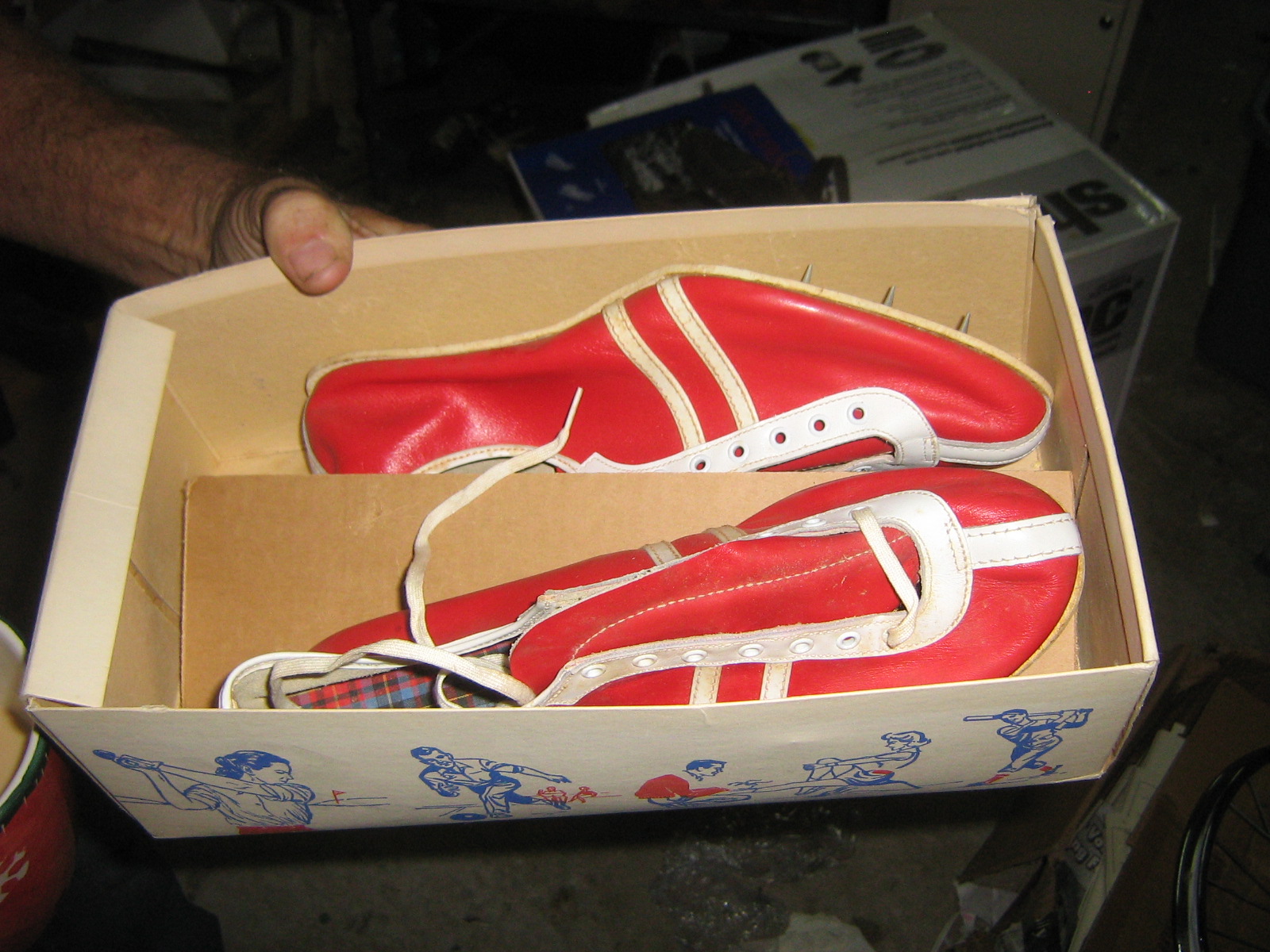
I spent the morning and part of the afternoon with my friends Steve Price and Phil Scott.  Steve was for years the women's coach at Bowling Green State University, and Phil  coached many years in the Midwest and most recently at Cedarville University.  His son Jason is pushing 18 feet as a pole vaulter.   Phil restores antique bicycles, was a national JC decathlon champ in the early 70's at Santa Barbara JC, and now lives in the Dayton, Ohio area.  He  is the collector of track shoes who was featured in the blog last year.  He is a fount of track stories, humour, wisdom, absurdity, and an unabashed raconteur.    His mother once told him,  "Phil, I only asked you what time it was, not how to make the watch."   Below are some of the shoes Phil has collected over the years on eBay, by calling people up and charming them with his interest in them and his ability to demonstrate his profound track and field knowledge.  In one instance Phil was talking to Ron Morris the bronze or silver polevault medalist in 1960.  He learned that Ron had never seen any film of himself vaulting in the Olympics.  Phil contacted the IAAF in Switzerland and borrowed video from them and got it copied and sent to Ron.   He's always doing things like that and sometimes the favors are returned.

He tells a story of working in a shoe department in Dayton and a lady, completely irate, came in to return a pair of Nikes.   Her comment,  "Don't even get me started.  I'm so angry.  There was no note in the box saying you could not put these in the washer and dry them in the dryer.  Now look at them."   Phil opened the box and found a pair of track shoes all dried up burnt, and twisted.   He didn't know what to do.
Finally the owner of the store came down to see what all the commotion was about, heard her story and replied,   "Maman,  there wasn't any note on your stove saying not to stick your head in the oven was there?"

Phil in his basement, he's recovering from serious back surgery. That explains the brace.
1920's indoor shoe
Pin Head Spikes in those 1920 indoor shoes

Phil with Bill  Ashenfelter's  shoe worn in 1952 Olympic Steeplechase.  Bill's brother Horace won at Helsinki,  Bill DNF'd.


1958 knockoffs to look like Adidas, made by Brooks
1920's or 30's marathon shoe

John Walker model Brooks

John Walker signature model, not his actual signature


A shoe called Magnus

1950's Aussie Shoe


Lilly Whites  Piccadilly Circus    -   England 1960

Sportcraft  England late 1960's

Gola


Gotham Athletic Footwear

Gotham's 

One of Phil's Shrines
These in center are all of the shoes son Jason ever wore.  Jason is
still vaulting and coaching at Cedarville University in Ohio, his alma mater.

A brand called Lowe & Campbell, cities listed on label
Cincinnati, Kansas City, Minneapolis,

Lowe and Campbell

One of the early jazzed up Nikes

These shoes worn by Joe Deloach at 1988 Olympics kept Carl Lewis to 3 golds instead of 4 with Deloach winning the
200 meters at Seoul.  Phil picked these up at a sports memorabilia auction.  He was the only bidder.  They
are signed by Deloach

Deloach winning the 200 over Lewis

Phil is still trying to figure out what these shoes were used for.
The have an inscription 'Wimbeldon' on the sole.

Sole on the 'Wimbeldon'  Tennis anyone?

Restoration projects in another wing of the basement.
The orange frame belonged to a world champ from Dayton, Karl Kiser from the
1920's.  Found in a garage in Old North Dayton.  Slowly being rebuilt.  Black bike
in the back has wooden wheel rims.  Phil won a national championship for
antique bikes on this model.


Spotbilts
An early Lydiard.  Phil thinks this is the lightest shoe ever made.


Friday, June 28, 2013

Vol. 3 No. 40 Alain Mimoun R.I.P.

Alain Mimoun b. January 1, 1921, d. June 27, 2013 at age 92.  He was the great rival of Zatopek in the 1950's and winner of the Marathon at the the Olympic Games of Melbourne in 1956.
Leading at Melbourne. He would win in 2 hr. 25 min.
Zatopek finished 6th in 2 hr. 29 min.


Born in the arrondissement of Maïder in the town of Telagh, then in French Algeria (his birth name was Ali Mimoun Ould Kacha), Mimoun lost several years of competition to World War II. After the war (in which he was a combatant), he was French champion in the 5000 metres and 10000 metres.
Schade, Zatopek, Mimoun
Into the Homestretch
Helsinki 5000
Herbert Schade, Germany(14:08.6), Alain Mimoun , France (14:07.4),
Emil Zatopek, Czechoslovakia (14:06.6) ,
 Chris Chataway GBR on the  ground  would finish 5th in 14:18 behind Gordon Pirie


Mimoun's path to an Olympic gold medal was blocked in both 1948 and 1952 by Czech runner Emil Zátopek. Mimoun won silver medals in 10000 metres in 1948 and 1952 as well as another silver medal in 5000 metres in 1952. His second place finishes behind Zátopek gave him the nickname "Zátopek's Shadow." He finally won a gold medal in the marathon at the 1956 Summer Olympics inMelbourne, Zatopek finished sixth.
Mimoun made the French team for the 1960 Summer Olympics in Rome. He won his final national championship in 1966, twenty years after his debut.
With Zatopek after the 1952 Helsinki 5000m


Cross Country, French Style

                                                                                    photo  by Jerry McFadden


Alain Mimoun was a virtual unknown in international track and field when he won a silver medal for France in the 10,000-meter race at the 1948 London Olympics. The Algerian-born Mimoun soon became one of the world’s most brilliant distance runners.
But gold eluded him. He was the runner-up twice at the European championships in 1950 and twice more at the 1952 Helsinki Olympics.
Emil Zatopek of Czechoslovakia, perhaps the greatest distance runner ever, won all five of those races, leaving Mimoun tagged as his “shadow.”
Mimoun finally ran the race of his life at the 1956 Melbourne Olympics. At 35, he won the first marathon he ever entered. Zatopek, the winner of the 1952 Olympic marathon, was far back, in sixth place.
When Mimoun died on Thursday at 92 in Champigny-sur-Marne, a suburb of Paris, he was hailed for the grandeur of his achievements and for his grit.
His death was announced by France’s athletics federation.
“He left a deep mark on the history of French sports,” said France’s president, François Hollande.
But Mimoun, whose victory proved a precursor to the arrival of great international runners from Africa, was remembered as well for embodying the amateur ideal. The story of the respect he showed for a rival who had become his friend, and whom he had ultimately vanquished, was told once more.
On Dec. 1, 1956, a crowd of more than 100,000 cheered the 5-foot-7 Mimoun, a mustachioed man with a blue jersey bearing the French tricolor and the number 13, as he ran a seemingly effortless final marathon lap at the Melbourne Cricket Ground on a day when the temperatures reached about 100 degrees. Mimoun had looked back for a glimpse of Zatopek or anyone else challenging him in his final strides, but there was no one in sight.
After crossing the finish line, Mimoun lingered among the officials.
“I was sure Emil was there at my heels,” he told Sports Illustrated in 1972. “I was hoping he would be second. I was waiting for him. Then I thought, well, he will be third. It will be nice to stand on the podium with him again. But Emil came in sixth, oh, very tired. He seemed in a trance, staring straight ahead. He said nothing. I said: ‘Emil, why don’t you congratulate me? I am an Olympic champion. It was I who won.’ ”
Mimoun continued: “Emil turned and looked at me, as if he were waking from a dream. Then he snapped to attention. Emil took off his cap, that white painting cap he wore so much, and he saluted me. Then he embraced me.”
“For me, that was better than the medal,” Mimoun said.
Ali Mimoun Ould Kacha was born on Jan. 1, 1921, in Telagh, in northwest Algeria, the eldest of seven children in a farming family. He began running as a teenager, then joined the French Army during World War II and was wounded in the foot at Monte Cassino in the Italian campaign.
He faced possible amputation, but the wound healed and he moved to Paris after the war. He joined an athletic club and took the French name Alain. When he showed promise as a runner, he was named to the French Olympic team for the 1948 London Games.
Zatopek beat Mimoun by nearly a lap in the 10,000-meter run in London. They became friends, and Zatopek invited Mimoun to visit Prague as his guest. Their rivalry resumed at the 1950 European championships in Brussels, where Zatopek and Mimoun finished 1-2 in the 10,000 and the 5,000. Zatopek bested Mimoun again in the 10,000 and in the 5,000 at the Helsinki Olympics.
Mimoun hoped his luck would change in a marathon, and he dutifully prepared for Melbourne over a two-year period. When the French team arrived there, he shunned distractions.
“He woke me at 5:30 in the morning to go run, and in the evening, he made me go to bed at 8:30,” his fellow Olympic runner Michel Jazy told the French commercial radio network RTL on Friday. “Even though we were at the Olympics, I couldn’t go to any of the parties.”
But there were other matters on Mimoun’s mind. His wife had remained in France expecting their first child. Word came a day before the marathon that she had given birth to a daughter. The Mimouns named her Olympe.
Mimoun took the lead about halfway through the marathon and shunned the cups of water on tables lining the course as he pulled away. He lost nine pounds, but he finished in 2 hours 25 minutes, about a minute and a half ahead of the runner-up, Franjo Mihalic of Yugoslavia. Zatopek, who had undergone hernia surgery six weeks earlier, finished 4:34 behind Mimoun.
Mimoun never raced against Zatopek again, but his career embraced a host of superlatives beyond that rivalry. He won the International Cross-Country championship four times from 1949 to 1956. (Zatopek did not compete in those events.) He won six French marathon championships, the last when he was 45, along with many other French national running titles. He made his last Olympic appearance at Rome in 1960, finishing 34th in the marathon.
He worked as a physical education instructor and ran recreationally into his 90s. Many French streets and municipal running tracks bear his name.
Information on survivors was not immediately available.
When Zatopek died in November 2000 at 78, Mimoun was deeply affected.
“I haven’t lost an opponent,” a Czech newspaper quoted him as saying. “I’ve lost a brother.”

Comment from Phil Scott, Clayton, OH
I was never more happy for someone else winning a race, than when Mimoun won the marathon gold in 1956! 
Thanks George

George,  Every day i check my "score" in the obits to see how many people younger than i died.  today i had my best score ever; 20-1.  Who was the one you ask?  it was the incomparable Alain Mimoun, that's who.  Toledo Blade ofJjune 29, 2013.  Richard Trace


Tuesday, June 5, 2012

Vol. 2 No. 47 March , 1962 and Introducing A Brief History of Track Shoes

Once again for the 137th posting on this blog, Roy Mason, our track historian does his customary and expected great job of bringing us a review of our sport's history. Some pictures of the Los Angeles Track Club are from 1963, a year out of sequence, but I thought some of you West Coasters would get a little teary eyed looking at them. In addition we will be introducing a section of track and field shoe history from our friend Phil Scott of Clayton, Ohio who among his many talents has a hobby of collecting old track shoes. Phil is one of the most dedicated and knowledgeable track nuts around as well as being a former National Junior College decathlon champion and bike racer and specialist in bicycle restoration. He is also the proud father of Jason Scott who is currently threatening to clear 18 feet in the pole vault and qualify for the Olympic Trials. Phil has shared some of his vast collection displaying it at Endurance Sports in Bellbrook, OH. Joe Sargent, entrepreneur of Endurance Sports allowed me into his establishment to photograph some of the shoes, without requiring me to actually make a purchase. Joe, always a gentleman.


And so we begin with Roy's review of March 1962 taken from the pages of Track and Field News and his encyclopedic memory.

MARCH 1962


      Snell on the Turf

Let's get this straight right off. In the world of track and field in 1962 there are two divisions. One is Peter Snell. The other is everybody else. After throwing down five world records in three weeks, you would think the man would take a break. Nope, the week after adding the indoor records at 880 and 1000 yards in the LA Times meet, he returns to New Zealand and takes a shot at his own WR in the mile. The fact that he fails is beside the point. His 3:56.8 on February 22 is the sixth fastest ever run and his second best. If this is failure, we'll take a second helping, please. His splits are more even than in his record run three weeks earlier: 59.1, 59.4 (1:58.5), 60.3 (2:58.8) and 58.0. Except when Gary Philpott moved ahead briefly on the second lap, Snell led the entire way.

Four weeks later in Tokyo on March 18, he became the first man to run sub 1:50 in the indoor 880 with a 1:49.9 breaking his own 1:50.2 record. Six world records so far this year; one can only wonder what is yet to come.

As with last month's issue, this one covers indoor action more by events than meets. Frank Budd ties the world record in the 60 with two 6.0's in the ICAAAA meet. Hayes Jones gets his long awaited 6.9 WR in the highs in the Chicago Daily News meet. Also in the Daily News meet Kansas takes down Manhattan's WR in the 2MR by two seconds. Kirk Hagan blows the race open on the first leg with a 1:52.2. Tonnie Coane and Bill Thorton do their parts with 1:54.4 and 1:53.1 before Bill Dotson anchors in 1:51.1 for a 7:30.8. Two weeks later at the Kansas State Relays, the Jayhawks lower this mark to 7:29.2. None of those annoying details or splits are given. 

Dave Mills tops the indoor 440 list at 47.8. Scanning further we find that this Toomey kid who resembled a Timex watch at Colorado (“Takes a licking, but keeps on ticking.”), is running for the Santa Clara Youth Village and may have found an event. He is ranked seventh at 49.1. Jack Yerman has the fastest 600 time, 1:10.1, a tenth of second ahead of old rival George Kerr. Jim Beatty likes newspaper sponsored meets. He set the indoor record in the mile of 3:58.5 in the Times meet (documented in last month's report) and now adds the only other sub 4:00 clocking with a 3:59.7 at the Daily News meet. In news somewhat akin to

God having an off day, Ralph Boston loses for the second time this season when he comes up half a foot short of Michigan's Dave Raimey's 24-3¾ in the Daily News meet. Dave Raimey, from my home town of Dayton, OH, had a good football career at Michigan and was a Hall of Famer in the Canadian Football League. ed. Boston does have the longest effort of the season, 25-2. A couple of Big Ten football players have displayed their long jump wares. Ohio State's Paul Warfield has the second best mark of 24-11½, but tastes defeat in the Big Ten meet at the hands of Michigan State's Sherm Lewis who leaps 24-6. Warfield as some will remember was an NFL pro bowler at Cleveland. ed. John Thomas is the only seven foot high jumper at that exact mark. John Uelses' 16-0¾, reported last month, provides him a nearly half foot cushion over the next vaulter. The outdoor season is in an embryonic state, with a few promising marks, but nothing to write home about and so we shan’t. If you are a top athlete who has used up his college eligibility and you are not in the service, you have probably moved to Southern California. The


Southern California Striders have a long history of dominating national championships, but now two more teams have formed. The Los Angeles Track Club, coached by Mihaly Igloi, seems to have cornered the market on middle distance and distance runners. Wearing the LATC singlet are Bob Seaman, Lazlo Tabori, Jim Grelle, Max Truex, Jim Beatty, Willie Atterberry, Bob Schul and Nick Kitt.

 LA Track Club withTom Rodda (Kansas St.) and Jim Grelle (Oregon) leading Paul Ebert (Oklahoma) in 1963 Southern Pacific AAU Cross Country Meet (contributed by Paul Ebert)


LATC Team Photo. Ebert Top Row second from Left. Igloi on the right. Front, Peter Mundle (Oregon) Rodda, Grelle Ray Hughes (Arizona), Meryle McGee Can anyone ID the other runners?

 If you are a top notch weight-man, your affiliation is with Joe Mangan's Pasadena Olympians, at least Parry O'Brien, Rink Babka, Hal Connolly, Tony Conkle and Bob Humphries seem to think so. The following is gleaned from the writings of Bert Nelson in his Of People and Things column. You probably want to resist the urge to invest in a company producing metal vaulting poles. Eleven of the top twelve vaulters this indoor season use fiberglass, J.D. Martin being the exception.(In those days J.D was told by the manufacturers that a fiberglass pole strong enough to hold him would have weighed more than 50 pounds ed.)......................Thinking of setting a world record in a race longer than 220 on a track that is oversized or the event is not run as a complete oval? You'll be wasting your time, Bucky. The IAAF has decreed that records that are produced on less than an oval (one turn 440 or three turn 880) shall not be recognized for record purposes. But how are the rules makers handling that sticky 220 on the straight vs. 220 on the curve thing? Minds wiser than yours or mine have produced the only possible result: there will be separate (but equal) records for each type of race. Any race involving a curve run on a track exceeding 440 yards will not be considered for record purposes......Get your big meet tickets early. The NCAA will be in Eugene June 16-17, the AAU at Mt. SAC June 22-23 and the USSR-USA meet at Stanford July 21-22. Who is the best all around hurdler (highs, lows and intermediates) as determined by the Portuguese Scoring Tables? Rex Cawley is fifth (13.9m, 22.5ys, 49.9m) with 3013 points. Fourth goes to Glenn Davis (14.3y, 22.5mt, 49.2m) with 3019. Surprising Fran Washington takes third (13.6y, 22.3ys, 51.5y) with 3020. But these guys aren't close to the top two. Second goes to Germany's Martin Lauer (13.2m, 22.5mt, 51.2m) at 3073.. And the winner is …......Don Styron (13.7y, 21.9ys, 50.1y) with 3084. Make special note of this as it could be on the midterm.

Page 17 has an ad for Elmer's Weights (Big Spring, Texas) which sells hand, leg and vest weights. You can get Olympic Style (“Used by Olympic Champions”) or, if you can't clear your calendar for Tokyo in '64, you can just get the Regular Style. Elmer also sells Bobby Morrow's Kick Gauge (to measure your starting block position). You can also buy a Track Leveler and if you have to ask what that is, you don't need to know. An ad for Archie's Little Black Book takes up all of page 20. I'm thinking Archie is having some trouble getting endorsements. Aside from a high school coach who during the time he has been giving the books as prizes every school record has been broken, the only other endorsement is from Charles (Chick) Evans, “one of America's greatest all-time amateur golfers”. Charles (call me Chick) says, “I put the book down with the thought that one should persevere no matter what the odds may be”. On page 17 there is an ad for Minerva Watches which has a photo of a ten second face split timer. This caused your reporter to clutch his chest an emit a cry best described as unmanly. I had one of those. I loved it more than life itself. Wonder where it is now? Just to assure equilibrium in your life, let me report that, yes, Cliff Severn Sporting Goods is still selling Adidas on the back page and the cost of a subscription continues to be only $3 a year.


 The pictures seen below are all of the same pair of shoes which are thought to be from the 19th century, approx. 1879. Phil purchased this pair in Lancaster, PA from a gentleman who had run a sporting goods store in the 1920's when the shoes were only 50 years old. Through searching old Sears and Roebuck and Montgomery Ward catalogues, Phil found advertisements from the 1880's for shoes much resembling this pair. The old gentleman told Phil that sometimes these shoes which all originated in England would be marketed under the local store's name. Top grade shoes were made of kangaroo leather, which is what Adidas and Puma and Dresske advertised in the 1950's and 60's as well. Eventually A.J. Spaulding began having shoes made in Massachusetts. J.W. Foster and Sons founded 1895 in England (later to become Reebok in 1958) was an early manufacturer. I personally held these shoes and found them to be very light and supple despite their age and rather thick sole in which spikes, quite long, were pounded into the sole. In these days the spikes were not interchangeable and started out rather long. Many were eventually made with a hardened steel and did not wear out. Believe me, getting spiked in those days meant some serious damage. Phil and I both remember wearing long spikes on good cinder tracks and the incredible grip you sometimes felt that you had and the sense of the shoe pushing you forward. We also remembered eating a lot of cinders being thrown up by these long spikes, and on wet tracks a lot of wet, mucky cinders covering those who ran back in the pack. Only the leader stayed clean, and even he usually kicked up a lot of dirt onto the back of his uniform. Also the inevitable cinders working their way into your shoes during a race and irritating your feet or causing blisters or abrasions was a common part of the sport. If you have any thoughts and memories of long permanent spikes and want to share them, click on the word "comments" at the end of this article. A box will then appear box below in which you can make a comment. We'll publish them as we continue our blog.< Smelly Feet

Monday, April 23, 2012

Vol. 2 No. 40 Pole Vaulters vs. Distance Runners

Jason Scott, the son of one of our reader's was going for 17'7" in the PV at Kansas Relays last weekend. Pole snapped and he got 7 stitches in his elbow. I asked his father Phil Scott (a former national junior college decathelon champ), about polevaulters and their battle scars. Phil said Jason got a broken pole into his stomach once and another time one stuck under his eye. So it rather humbles our discussions of how badly our legs hurt when we run at or above sea level. Anyway those guys belong in another category of human endeavor. Just having to transport a pole to a meet via a bus or airplane is almost inconceivable. At least they don't have to worry too much about lactic acid build up at altitude. George

V 15 N. 10 Gunder 'The Wunder' Haegg Visits Cincinnati

Bob Roncker of Cincinnati, Ohio has sent in this account of one day on the 1943 tour that Gunder Haegg of Sweden made to the US to help rais...