Once Upon a Time in the Vest

Showing posts with label Glenn Cunningham. Show all posts

Friday, August 28, 2020

V10 N. 65 Pressure's on When Dad's a Legend by Bob Lutz

Mike Solomon (K.U. Jayhawker) sent this to me this week.  Source is the Wichita Eagle May 28, 2010.  It tells three different examples of being the son of a famous runner played out.  All the famous guys were U. of Kansas milers who you all know, Ryun, San Romani, and Cunningham.
Trivia question.  Who was the first Jayhawk to break 4 minutes in the mile?   See at end of story.
Cunningham

Ryun

San Romani


Ned Ryun

Archie San Romani Jr


runLawrence newsletter: Second Wind, spring 2006
Glenn Cunningham Jr.

Pressure's on when dad's a legend


If you want to see what you're made of, try walking in the footsteps of greatness. 
Better yet, try running in them.
Jim Ryun, Glenn Cunningham and Archie San Romani Sr. are three of America's greatest distance runners, all produced right here in Kansas.
Ryun, from Wichita East, was a three-time Olympian and multi-world record holder. He ran a 3-minute, 58.3-second mile as a high school senior in the 1965 state high school track and field meet, a ridiculous accomplishment that, 46 years later, hasn't been matched.
Cunningham, an Elkhart native who nearly lost his legs after being badly burned in a schoolhouse fire when he was 7, later used those scarred legs to set the world record in the mile (4:06.8) in 1934 and was the 1933 winner of the Sullivan Award, given annually to the country's top amateur athlete.
And San Romani, from Frontenac, was an AAU and NCAA champion in the mile who finished fourth in the 1500 meters at the 1936 Olympics in Berlin. Like Cunningham, San Romani was badly injured as a child when his right leg was nearly crushed.
But how do you measure up if you're a son of one of the greatest distance runners in history? How do you resist the comparisons? Running is something you've been born to do, but how do you resist hating it?
Ryun (1963-65), Cunningham (1929-30) and San Romani (1932) were all winners of the mile race in the Kansas state high school track and field meet.
So were their sons: Ned Ryun (Lawrence, 1991); Glenn Cunningham Jr. (Leon, 1966) and Archie San Romani Jr. (Wichita East, 1957-59).
They are legacies unlike any other in the soon-to-be 100-year history of the state track and field meet, three magical last names in the annals of Kansas sports history.
Whether they acknowledged it or not, there will built in pressure in being the sons of such prolific fathers. Fortunately, it wasn't overwhelming, at least it wasn't for Ned Ryun and Glenn Cunningham Jr.
Neither was close to being as accomplished as their fathers. But they ran, free in their minds that comparisons to their famous fathers, while inevitable, wouldn't swallow up their own accomplishments or identity.
The Ryuns
"It was kind of funny because my dad really didn't want us to run,'' said Ned Ryun, 37, who had a twin brother and two sisters who, of course, were runners. "It wasn't because he didn't want us to be competitive. We played soccer, baseball — all of those things. But we really didn't pick up running seriously until we were around 15 or 16. Our dad just didn't want to have that pressure on us.''
That's because Jim Ryun knew what that kind of pressure could conceivably do. It could turn off his kids toward running, make them apprehensive about being named Ryun and trying to compete in a sport their father conquered.
"Something Ann (his wife) and I tried to do from the very beginning was to help our kids establish their own identities and not mine,'' said Jim Ryun, a Kansas second district representative in Congress from 1995-2006. "God gives each one of us different talents.''
Ryun's children were born in California, where he and his wife moved after his college track career at Kansas in part to protect his kids from his notoriety. In Santa Barbara, the Ryuns lived a subdued life. He was famous everywhere, but the children were better shielded from the spotlight.
"He never wanted to live through us,'' said Ned Ryun, who lives with his family in northern Virginia. "He was always there for us, always supportive. But, boy, he really wanted to be hands off because he didn't want us to feel that pressure. It was a delicate balance.''
Jim Ryun has lived as quiet a life as a former world-class athlete and Congressman can. Ned recalls walking in the halls of the Congress with his father and being approached by people who asked him about being the son of a man who had been the greatest in his sport of choice.
Ned was unaffected because hid dad was.
"A more humble guy you would not meet,'' Ned said of his father.
The San Romanis
Archie San Romani Jr., on the other hand, struggled to find a balance with his father, a man who struggled to let things be.
Archie Sr., who died in 1994 at the age of 82, was a strong rival to Cunningham and their battles often crossed state lines. They came from opposite corners of Kansas, but crossed paths in a mile race 28 times, according to the Kansas Sports Hall of Fame. Each won 14.
The San Romanis moved from Frontenac to Wichita before San Romani Jr. entered high school. While at East, he never lost a mile race. A month after graduating, he ran the fastest mile for a high school athlete, 4:08.9, in Compton, Calif.
Yet it's fair to question how satisfying his accomplishments were because of an overzealous father who, unlike Jim Ryun, couldn't keep his hands off.
San Romani Sr. and East coach Bob Timmons, San Romani Jr.'s coach at East who later would coach Ryun, often butted heads over San Romani Jr.'s, development, which caused friction between father and son.
"It's difficult to be the son of.. '' San Romani Jr., said without finishing his thought. "I never really tagged along with my dad when he was running and I was a kid. But I know he got pretty involved in what I was doing. I think my dad — and I'm not sure how to phrase this — but I think he was trying to re-live parts of his life through me. And that became a deterrent, almost.''
Fortunately, the younger San Romani had Timmons, a my-way-or-the-highway type who was not afraid to confront the father.
"Timmons was an old Marine and I remember one time he asked my dad, 'Who's coaching this kid, you or me?' '' San Romani Jr. said. "That was while I was still in high school, of course, and apparently they had more than one visit.''
But the pressure didn't lessen for San Romani Jr., who after high school enrolled at KU, then quickly transferred to Wichita State. But living at home wasn't the answer and pressure built for him to move away, to go somewhere that would put distance between him and dear ol' dad.
"I told my mother, 'I've just got to do this on my own,' '' San Romani Jr., said. "I couldn't deal with the constant pressure. I just had to go make my own footprint. So I bought a one-way ticket and went to Oregon.''
It was a bold move for such a young man, but Oregon is where he prospered, running on a world-record mile relay team, finishing second in the NCAA mile and twice competing in the Olympic Trials.
San Romani Jr., 69, has been in Oregon ever since his move, living in Eugene, where he worked in pharmaceutical sales and taught scuba and flying. He and his wife, Janie, who have four children, have also taught ski patrol classes for years.
All of San Romani Jr.'s children became competitive downhill skiers, just dabbling in track and field. He didn't push them, he said, because he was cognizant of what his own father's pushing took away from his experience.
It was a strain on their relationship, but the two became closer as they got older.
"I think I was very fortunate to have a dad like I did,'' San Romani Jr., said. "A man who finally was able to back away.''
The Cunninghams
Glenn Cunningham and his wife, Ruth, had 10 children. They later opened a facility to help care for disadvantaged and neglected children, influencing close to 10,000 kids. And they always raised horses.
So Cunningham didn't really have an abundance of time to become over-involved in his children's endeavors.
"I was always aware that it was going to be all right with my dad whether I ran or didn't run,'' said Cunningham Jr., 62, who works in a Wal-Mart pharmacy in Poteau, Okla. "That doesn't mean my dad didn't push me in many things. I learned a work ethic from him at a very early age. He was a strict dad and a disciplinarian.''
Being the oldest son in the family, and named for his dad, Glenn Jr., embraced the legacy his father established. He wanted to run and he wanted to be successful.
"I really did want to excel, but I never felt that kind of pressure from my father that I needed to get out there and emulate or equal what he accomplished,'' Glenn Jr. said.
That would have been impossible, anyway. Glenn Cunningham was the state's first distance-running star, setting the stage for those who would follow like Billy Mills, Wes Santee, Bill Tidwell and, of course, Ryun. Cunningham was so good he carried three nicknames: The Kansas Flyer, The Elkhart Express and The Iron Horse of Kansas.
His story was compelling on so many levels, beginning with the nearly-decapitating injury he suffered in the schoolhouse fire, in which one of his brothers was killed.
Cunningham was larger than his running, larger than life, really.
"And I felt lots of encouragement from him,'' Cunningham Jr., said. "After I won the state mile in 1966 for Leon, I was invited to the Golden West meet in California. I knew I was invited as much due that my father was Glenn Cunningham as for the fact that I was running the mile.''
Cunningham Jr. ran a 4:22.1 to win the Class B mile for Leon. Every other runner invited to the Golden West meet had run 4:10 or better. He feared he would be swallowed up by the competition.
Knowing that, Glenn Cunningham took three weeks to help his son train for the California meet. They would go on daily 10-mile runs, during which Cunningham would drive his car while Glenn Jr. ran along on Butler County dirt roads.
"He really worked with me, really tried to sharpen me,'' Cunningham Jr. said. "And I dropped my mile time to 4:13.8 and placed fifth in the Golden West mile. I was so pumped up for that race that I ran a 56-second first quarter, three seconds better than my previous best time.''
As a kid, Cunningham Jr. was constantly asked what he was going to do to try and be a better runner than his dad. Perplexed, he often just nodded his head because he didn't know what to say.
Deep down, though, he knew it would be impossible to surprise his father's accomplishments. That didn't keep him from running — for fun and to compete.
"I grew up on a ranch where we did a lot of physical labor and a lot of running,'' Cunningham Jr. said. "I remember being out on a back pasture, maybe a mile or so from the house, and deciding I was going to run back and dad was going to run with me. I was maybe 10 or 11. We were going stride for stride and I remember thinking my dad was probably waiting for me to drop out. But I was determined I wasn't going to drop out. I ran all the way back.''
It was fun for Cunningham Jr. to be his father's son.
"I never felt intimidated or pressured by him,'' he said. "I never felt that my dad expected me to be in a race or to accomplish a particular thing. He was tremendously proud of what I was able to accomplish, even though it was far less than what he did.''

Answer:  Bill Dotson.   Unfortunately for Dotson, he did not break the WR for the mile, so he is all but forgotten when talking about these luminaries.

Monday, March 19, 2012

Vol. 2 No. 29 That 1936 1500 Final

The Berlin 1500 Meters


Eric Ny (Swe 572), Glenn Cunningham (USA 746), Fritz Schaumberg ?(Ger), Jack Lovelock (NZ467), Luigi Beccali(hidden behind Lovelock) ITA, Wern Boettcher? (Ger 82x) Jerry Cornes (GBr 258), Miklos Szabo (Hun708), Philip Edwards (Can 74), Archie San Romani (hidden behind Edwards) , Gene Venzke (USA 141), Robert Goix (Fr)

In this picture of the 1936 Olympic 1500 meter final we see left to right Eric Ny, Glenn Cunningham, Fritz Schaumberg ?, Jack Lovelock, Luigi Beccali


I’ve put the picture of the 1936 Berlin 1500 meters on the top of the blog because the picture and the event intrigued me. What happened to these runners? Where did world events lead them? How did their lives end? When I was sophomore or junior at the U. of Oklahoma, Glenn Cunningham made an appearance at the Big 8 indoor meet along with Wes Santee. Both were legends. Both spent much of their lives in Kansas. We had always heard of Cunningham’s terrible burns as a child and his recovery and his work with children afterwards on his ranch in Kansas.

But little or no information was available beyond Jack Lovelock who set the world record that day in Berlin and who was also a medical doctor. In fact there were two M.D.’s in that race. The other was an interesting figure in that he was the only black runner. Who was he, who did he run for? John Cobley helped me out with the names of the runners. But what were their final finish places and times after the first three Lovelock, Cunningham


Cunningham in a win

and Beccali? Fortunately the website www.sports-reference.com/olympics/athletes lets us know something about anybody who ever competed in the Olympics in any sport. Some biographies are more extensive than others. Some give only a birth date and date of death. Once you learn to manipulate the site you will find a universe of information about the Olympics and several other major sports. For example you can look up every runner in the 1936 Olympic marathon with his finishing time and a brief bio. It will show every race including preliminaries, times and finish places of just about any athlete. You can search athletes by name only or by event or by Olympic year. There may be a more comprehensive list or website somewhere. But I’m not aware of anything else like this.
Cunningham later in his career beating Beccali in third place


Berlin Podium

Cunningham and Lovelock


The top three with Paavo Nurmi in Berlin


Lovelock, Cunningham, Beccali, Edwards

The finish from the stands


What I learned about the Berlin 1500 runners

There were two doctors running the race. Jack Lovelock, the winner had just completed his medical studies in England. Lovelock came to the US after WWII and was working in New York. In 1949, he was feeling ill and dizzy at work and called his wife that he was coming home early. He never made it. Waiting on a subway or train platform he fell onto the tracks and was killed by an incoming train. He was a few days shy of his 40th birthday.


The other doctor was Phil Edwards running for Canada, who originally came from British Guyana. He got a medical degree at New York University and moved to Canada where he was to become a leading authority in infectious diseases and practiced and did research in Montreal. Phil is notable in Olympic history as the only person to have won 5 bronze medals in his Olympic career. He ran from 1928 to 1936 and placed in the 400, 800, 1500 and 4x400 over the years. He was second in the 800 meters at Berlin.


Dr. Phil Edwards, Canada
Edwards hoisting Percy Williams winner of the 100 and 200 meters in 1928

Edwards winning 1934 Empire Games 800m


Edwards in 1932 L.A. games


Luigi Beccali third place in Berlin held several European titles and was the defending Olympic 1500 champion at Berlain having won at the 1932 games in Los Angeles. Before the US was involved in World War II , Beccali had emigrated to the US and settled in Florida where he was a wine salesman. Died at age 82 in Daytona Beach, FL.


Beccali


Beccali winning 1500 in 1932 followed by Jerry Cornes and Phil Edwards in third place. All three would run the 1500 in Berlin four years later. All would be faster, but none would place as well in 1936.
Beccali


Fourth place went to Archie San Romani who raced for many years against Cunningham and beat him on 8 occasions. His son Archie San Romani Jr. went on to fame at Wichita St. and Oregon as a miler in the 1960’s. He died at the age of 82 in 1994.


San Romani edges Cunningham in Lawrence, KS


Cunningham, San Romani, and Venzke on the boat to Europe, 1936

Phil Edwards of Canada, already mentioned above was fifth in the race. He was the youngest to die of natural causes at 63 in 1971 in Montreal. Perhaps his working with infectious diseases, pulmonary diseases and parasitological diseases led to an earlier demise.

In sixth place was Jerry Cornes from Great Britain, died in 2001 at the age of 91 after serving many years in the Colonial service in Africa before and after the 1936 Olympics. (See Cornes' obituary at the bottom of this post)


Venzke, Lovelock, Cornes
Qualifying for 1500 finals
Pierre Leichtnam of France DNQ

In seventh place was Miklos Szabo of Hungary. He was the 1934 European 800 meter champion in 1:52. He also set the WR for 2000Meters after the Olympics in 5:20, then followed with a WR at 2 miles in 8:56 in 1937. He died in Budapest in 2000 at age 91.

Eighth place was Robert Goix of France who outlived the field at 106, passing away in 2011.

Ninth was the American , Gene Venzke who often raced Cunningham and San Romani indoors in the late 1930’s and early 1940’s. He was originally from Minnesota and died at the age of 83 in 1992 in Berks County , PA.


Tenth was Fritz Schaumberg who survived WWII and died in Germany in 1988 at the age of 82. In the photo I could not differentiate Schaumberg from the other German Boettcher as I could not find other photos with their identities given.

The last two places and the first in the race were the least lucky.

Eleventh place was Eric Ny of Sweden who died an untimely death in a sailing accident in 1945 at the age of 35.

Walter Boettcher of Germany died in 1944 in combat in Poland.

Longevity is pretty strong in this group of individuals after eliminating those who died untimely deaths, the other nine survived to an average age of 84 years.

Some even had progeny who became fairly decent runners later on.
See below.
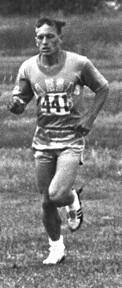
Glenn Cunningham Jr.about 1967
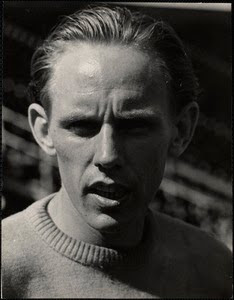
Archie San Romani Jr. finishing second to Jim Grelle in the late 1960's


Jerry Cornes Obituary and Biography

From the "Telegraph"
12:00AM BST 25 Jun 2001
JERRY CORNES, who has died aged 91, followed up a career in the Colonial Service by becoming headmaster of West Downs Preparatory School; in youth, however, he had been more widely known as a superb middle-distance runner, the winner of an Olympic silver medal in a world still undarkened by professionalism.

Cornes's athletic prowess began to attract notice at Oxford, not that he allowed training to exclude other university pursuits. He played a full part in the life of his college, Corpus Christi, and enjoyed the distinction of being rusticated for pelting the dons on the college's high table with a bread roll.

In the Oxford University Sports of 1930, the mile was won in a time of 4 min 28 sec. Cornes came third, but realised that he could have done rather better. Competing a fortnight later in the Varsity match, he won the mile in 4 min 22.6 sec.

Four months afterwards, Cornes found himself representing the British Empire against the United States at Chicago. Running with an Australian, a Canadian and another Briton (Reg Thomas) in the 4 x one mile relay, he helped to set a new world record of 17 min 2.4 sec. The next year, 1931, representing Great Britain against Germany, he was a member of a relay team which established another world record by recording a time of 15 min 55.6 sec in the 4 x 1,500 metres.

Cornes gave the appearance of running with great ease. He liked to turn on the pressure in the third lap, so that the opposition had nothing left at the finish.

In 1932, when he was President of Athletics at Oxford, he won the Varsity cross-country race, beating the previous record by almost a minute, and also triumphed against Cambridge in both the mile and half-mile. In a typically generous gesture he paused at the end of the mile to allow Jack Lovelock, a New Zealander who was second string in the Oxford team, to dead heat with him and thus gain a Blue.

Later that year Cornes went out to Los Angeles to compete in the Olympics. As he came into the home straight in the last lap of the 1,500 metres final, he felt he had the race in the bag. The crowd rose, as he thought, in his honour; in fact, though, they were cheering another runner, an unknown Italian called Luigi Beccalli. By the time that Cornes apprehended the danger, it was too late. The disappointment nagged him for the rest of his life. "I did not represent the United Kingdom to collect silver," he said.

After Oxford Cornes went into the Colonial Service, though he still managed to run when on leave, and in 1934 finished third behind Lovelock and Sydney Wooderson in the Empire Games mile at the White City.

He took a nine-month sabbatical from the Colonial Office to train for the Berlin Olympics of 1936. In the final of the 1,500 metres, Lovelock ran the race of his life to carry off the gold. Cornes returned the fastest time of his life for the distance (3 min 51.4 sec), but this only sufficed to gain him sixth place.

John Frederick Cornes (always known as Jerry) was born on March 23 1910 at Darjeeling, the son of a judge in the Indian Civil Service; he had a twin sister and a younger brother. Partly due to the First World War, after the age of three he spent his childhood away from his parents with relations and friends in England. Sent to school at Clifton, he excelled at work, games (especially cricket) and athletics.

Having left Oxford with a Second in Modern History he chose the Colonial Service in preference to the family firm of Cornes & Co of London, Kobe & Yokohama. In 1932 he was sent to northern Nigeria where he rode from village to village collecting taxes and assessing incomes.

In 1937, Cornes was transferred to Palestine, where as terrorism began to increase during the Second World War, he took to sleeping with a pistol under his pillow. He was lucky to escape with his life when the King David Hotel was blown up in June 1946, having just left the hotel to investigate the effect of diversionary bombs in front of the building.

Shortly afterwards Cornes returned to Britain. With his young family growing up, he refused further postings abroad, and found an agreeable job as supervisor of the Colonial Services courses at Oxford. This involved helping visitors from overseas to acclimatise to life in Britain; to this end he ran a hostel, the Colonial Services Club, and founded a cricket club, the Hartebeestes. He also enjoyed dining rights at Corpus Christi's high table, formerly the target of his bread missile.

In 1953 he left the Colonial Office, and the next year, after teaching for a couple of terms at the Dragon School, bought West Downs preparatory school at Winchester.

West Downs was then a highly traditional boarding school for about 100 boys. Cornes proved a breath of fresh air, encouraging all kinds of new activities, including film shows, musical productions, pets and computers. There were visits to plays and concerts - but also to a telephone exchange, a butterfly farm, and a chocolate factory. Games players were encouraged, but so were non-games players, and even school haters. And while horizons were being widened under Cornes's liberal regime, the Common Entrance and scholarship record became one of the best in the country.

In the 1970s the demand for boarding places began to decrease; and although Cornes's decision to introduce day boys, and day girls, meant that the number of pupils reached a peak of 165 in 1978, he was unable to make the school permanently viable. When he retired in 1988, West Downs closed. Six years later the site was sold to King Alfred's College, now part of Southampton University.

Jerry Cornes married, in 1937, Rachael (Ray) Addis, youngest daughter of Sir Charles Addis, formerly chairman of the Hong Kong and Shanghai Bank. They had four sons.


George Brose

Sunday, December 4, 2011

Vol. 1 No. 79 March, 1960

MARCH 1960

A conundrum to test your problem solving skills. To wit: An athlete sets a world record. Two weeks later he still is the record holder only now three competitors have passed him and indeed have left him in the dust. Your homework for tomorrow is to have a logical explanation for how this seemingly incongruous situation has come about. Be prepared for class discussion.
Our protagonist is one Parry O'Brien, the two time Olympic shot put champion, the world record holder in both the indoor and outdoor shot, the man who has dominated the event like no other since Ralph Rose 50 years ago. As we pick up our story it is March 5 and O'Brien's co-holder of the WR, 19 year old Dallas Long, has just bettered the 63-2 record they share by five inches. But it doesn't count because it was his seventh throw of the day. Still, the message has been sent.
March 12 sees O'Brien break his indoor WR (62-1¾) at the Milwaukee Journal Games with a throw of 62-5, leaving his most significant competitor, Dave Davis, nearly two and a half feet behind. On the West Coast, Long throws 61-4 in a dual meet.
The next week the track world is shocked by Bill Nieder. Competing in the Stanford Invitational, Big Bill drops it 63-10 from the toe board. And he isn't alone; Dave Davis has raised his PR to 62-8. Long is in the West Texas Relays where he throws 61-8¾. He and Davis (have shot, will travel) will tangle next week in the USC – So Cal Striders meet.
And what a match up it is. Long explodes 64-6½. This jaw dropping effort is needed because Davis is close behind at 63-10½. Nieder's WR has lasted a week.
At the end of the day the all time list reads:
Long 64-6½
Davis 63-10½
Nieder 63-10
O'Brien 63-2
In two weeks Parry O'Brien has gone from world record holder to a distant fourth. Can the Air Force lieutenant find another gear or will the young guys pull away? He will begin his outdoor season next month. Stay tuned.........Oh, and as for that class assignment, O'Brien is still the world record holder indoors.
Speaking of world records, John Thomas just upped his half an inch, jumping 7-2½ in the Chicago Daily News Relays.
Stanford's Ernie Cunliffe has busied himself racing longer than his usual 880. On March 5 the Stanford Winter Championships sees him split 58-2:00-3:03 en route to a solo 4:04.4 mile. Two weeks later in the Stanford Invitational his 2:55.7 1320 relay leg is the highlight of the track activity. “The Stanford co-captain hit 55.7, 1:56.6 and finished strongly, unlike his usual dying half mile windup, in 2:55.7. Only Brian Hewson (2:55.2) has run faster and the best on record by an American is Jim Grelle's 2:57.7.” No results for the Stanford team are given. Eight days later the then politically correct Indians take a shot at the American record for the four mile relay in a dual meet with the Santa Clara Valley Youth Village (identified as SCVYV from now on). Although their time of 16:57.8 misses by 5.2 seconds, it isn't Ernie's fault. His 4:02.4 anchor is the second fastest mile of the year.
Aside from the aforementioned world records, the most amazing performance of the month is that of San Jose State sophomore, Vance Barnes. Not even on the team three days earlier, Barnes, a basketball player with a high jump best of 6-4, is pressed into service at the Stanford Relays when the Spartans third string jumper is injured. Six feet four inches is achieved easily enough and so are 6-6 and 6-8 on his first efforts. Six feet nine inches doesn't come until his second try as does 6-10. When he finally misses it is at 6-11, a foot over his head. We'll have to see what the future holds for this young man.
On March 12 Bobby Morrow makes his 1960 debut in Southwest Recreation meet in Fort Worth, winning special races in 9.5 and 21.3, but real stars are the Styron twins.


Running in the college division, Dave takes the 100 and 220 while Don wins the highs and lows. They both run on the winnng 440 and mile relay teams. Don also runs a heat in the 440 before being relieved of duty for the final when the team championship is assured. His 22.4 time in the lows is the fastest in the world this year and his seventh race of the day.
A week later Morrow's comeback hits a bump in the road when he is defeated twice by Jimmy Weaver who runs 10.5 and 21.0. No time is given for the Olympic champ. Eddie Southern is third and fourth.
After a low key year, Herb Elliot is preparing for the Olympics. On March 5 he runs 1:50.1 and 4:02.1, but nine days later the best he can do is a 1:53.5 sixth place behind some guy from New Zeland named Snell who runs 1:51.3. Five days later Elliot clocks 1:52.1.
Another Australian is setting records in the US. On March 2 in Houston Al Lawrence runs 10K in 29:36.4 to meet the Olympic qualifying standard and set the American record. Wait a minute, he isn't an American. Apparently citizenship isn't required to set an AR. All that is needed is that you set the record on US soil. The record he broke was 30:11.4 set in 1932 by Poland's Janusz Kusocinski.
As T&F News is located in the Bay Area it is privy to the doings of Cal, Stanford, San Jose State and the SCVYV. This time we have Cal time trials for you. Recently Jerry Siebert and Jack Yerman tangled in a 660 with Yerman winning by inches in 1:18.0 for both. In another workout Siebert ran a 1320 in 3:00.0. Other bits and pieces from columns: Glenn Davis is teaching junior high mechanical drawing in Columbus, Ohio. He is ten pounds overweight, but is working at losing it by the National AAU meet..... A high school junior in Compton, CA has just set the class record 48.0 in the 440. His name is Ulis Williams.....Ron Delany and Don Bowden are training together on the polo field in San Francisco's Golden Gate Park. Both are recovering from tendon problems and hope to race in April......Ira Murchison has recovered from the illness that saw his weight to drop to under 100 pounds. He is now at his usual 135 and feeling strong.
From the Quotable Quotes column come the following. Glenn Cunningham: “Our races were strictly competitive, to beat the other fellow. But in the workouts sometimes I did run all out. Yes, I bettered four minutes. But I didn't think anything about it. I was just curious to see what I could do,”......J.D. Martin:Jim Graham, the Oklahoma State vaulter, helped me a lot when I competed against him last year. He's that kind of a guy. At the Drake Relays I was trying 14-6. I'd never cleared it. Graham told me that I wasn't rocking back on my pole at the top of my jump. On my last jump, I rocked and sailed over. Graham knew that if he gave me that tip I might beat him. Of course, I didn't. He was first and I was second.”


J.D. Martin early in his coaching years, about 1968
We'll close with the first non-track related add I can remember. It is for the Desert Star Motor Hotel in Phoenix, AZ. Among its many benefits are air conditioning, phones and TV, a heated swim pool, and private sun decks. A little short on folding money? Not to worry, all this can be paid for with a credit card.

Vol. 1 No. 78 1936 Berlin Olympics sequences

We're going to go a bit out of sequence here, because I've found some great film footage of the 1936 Olympics on Youtube. Most of this was filmed by Leni Reifenstahl, Hitler and Goebbels' film propagandist. The easiest way to view these is go to Youtube and type in "1936 Olympics, Leni Reifenstahl" and the clips will come up and you can choose from all of them. Otherwise you will have to type in the rather complex html's below.

Last two laps of 1500 meters Great footage of Jack Lovelock of New Zealand winning over Glenn Cunningham.
http://www.youtube.com/watch?v=aeXPyJI24tk1936

Jesse Owens semis and finals 100 meters
http://www.youtube.com/watch?v=K1XclGwJY8s&feature=endscreen&NR=1

Some of these clips are backed with Pink Floyd music, be prepared.

the 1936 marathon can also be found at http://www.youtube.com/watch?v=JQY6MfX5420

German naratiion, Wagner instead of Pink Flloyd.
Winner was Kiti Son Japan/Korea, 2hr 29min 19 sec
2nd Ernest Harper Great Br. 2hr 31min 23 sec
3rd Nan Shoryu Japan/Korea 2 hr 31 min 42 sec.

US entries Johnny A Kelly 16th

Tarzan Brown and Billy McMahon DNF
Below is a picture of Ellison Tarzan Brown at Naragansett Indian from Rhode Island.

V 15 N. 10 Gunder 'The Wunder' Haegg Visits Cincinnati

Bob Roncker of Cincinnati, Ohio has sent in this account of one day on the 1943 tour that Gunder Haegg of Sweden made to the US to help rais...