DECEMBER 1959
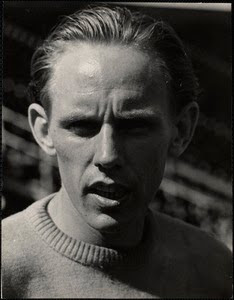
Front page photos are of Ray Norton, winner of the top US trackman award, Parry O’Brien, the top field event man, and Martin Lauer, the Athlete of the Year. Vasiliy Kuznyetsov, the Russian decathlon WR holder, is named the best field event performer, but doesn’t rate a photo.
Let’s run through the events. Norton edges Kansas’ Charlie Tidwell for first in the 100. Bobby Morrow is sixth. Norton repeats in the 200, this time beating out Italy’s Livio Berruti. Eddie Southern certainly did not have a dominant year, losing four of his ten races, but somehow he beats out undefeated George Kerr who won their only match up. Chuck Carlson, who had the year’s fastest time, 45.9, is third.
Stefan Lewandowski of Poland is the 800 winner. As in the 400, it could have been one of several. His 1:46.5 is the second fastest time of the year and his victory over WR holder Roger Moens apparently is enough to rank him one spot above. But wait a minute, neither of them won that race. They were beaten by five meters by Sweden’s Dan Waern. Waern is only seventh. The fastest time of the year, 1:46.2, belongs to sixth ranked Paul Schmidt of Germany. If there is any truth to the adage that 88% of success is showing up then Schmidt got screwed. He ran an amazing 23 800’s in 1959.
Istvan Rozsavolgi of Hungary is the clear number one in the 1500. He has the year’s fastest time, 3:38.9, and is undefeated. Dan Waern is second. Where is Herb Elliot you may ask? That would be sixth. He concluded his season on March 14 and raced only four times, all miles, with a best of 3:58.9, never leaving Australia. Poland’s Kazimierz Zimny tops an exclusively European top ten in the 5000/3M. Third ranked Pyotr Bolotnikov of Russia tops the 6M/10K rankings which, with the exception of the eighth placer, Pan Am winner Osvaldo Suarez of Argentina, are also all-European.
Although Americans fill seven of the ten places in the high hurdle rankings, the top spot is taken by Martin Lauer of Germany, based primarily on his questionable 13.2 WR, four tenths better than his next fastest time. He lost only once, but never ran against the Americans. Hayes Jones and Lee Calhoun are second and third. High schooler Rex Cawley makes the list in tenth.
An undefeated season and the year’s fastest time, 50.1, puts South Africa’s Gert Potgieter atop the 400 hurdles list. Dick Howard is second and Olympic champion and WR holder Glenn Davis is sixth. And here is Rex Cawley again, this time ranked 8th. The kid may have a future in this sport.
The achievement of the seven foot high jump hasn’t seemed to have had a lasting effect. It has been done only once in 1959, appropriately enough by Charlie Dumas who jumped exactly 7’0”. This jump combined with an undefeated season up to a lackluster 4th in the dual meet with the Soviet Union is enough to rank him first.
The pole vault belongs to the U.S. Don Bragg, Jim Graham and Aubrey Dooley all have vaulted 15’5”, but Bragg’s consistency earns him the #1 ranking. Other Americans are Graham, 2nd, Bob Gutowski, 3rd, Mel Schwarz, 4th, Dooley, 6th, Ron Morris, 8th, George Mattos, 9th, and J.D. Martin, 10th.
As good as we are in the PV, we aren’t in the Hop-Step-Jump. No American makes the list. Russia’s Oleg Fyedoseyev wins 8 of 10 competitions and has the best mark, 54-9½, to take first in the rankings.
Our guys do better in the broad jump. Greg Bell, whose 26-7 is only an inch off Jesse Owen’s WR, takes first. The soon-to-be-great Igor Ter-Ovanesyan of the USSR is second. Irv Robertson is third. Not to be over looked in the soon-to-be-great department is 8th placer Ralph Boston.
If there is an event that looks rosy for the US in next year’s Olympics it is the shot put. Only seven putters have bested 60’ and five of them are Americans. Parry O’Brien’s first place ranking is the seventh of his storied career. He is followed by Dallas Long, Bill Nieder and Dave Davis in the 2-3-4 spots. Charlie Butts is 7th.
The hammer throw rankings are a pick ‘em sort of thing. Vasiliy Rudenkov of the Soviet Union has thrown 222-10 and lost only once. Olympic Champ Harold Connolly has thrown 222-8½ and lost twice (once being a lackluster effort in the Pan Am games). More significant is his other loss, a 219-0 to 216-7 defeat at the hands of Rudenkov in the USSR-USA dual. It is enough to give the Russian the first place ranking.
The great Janusz Sidlo of Poland takes the javelin title. His 280’8½ best is short of fourth placer Al Cantello’s WR 282’3½, but though they never met, Sidlo has a better competitive record. Kansas’ Bill Alley is fifth.
The decision as to who is the best decathlete in the world is perhaps the easiest of all. World record holder Vasiliy Kuznyetsov of Russia has had a dominate season. His 8357 total leaves second place in the dust by 362 points. Does that mean he is a shoo-in for the Olympic gold? Maybe not. That second placer is Athlete of the Year Martin Lauer who competed only once, but it is enough to rank him second. C.K. Yang and Dave Edstrom are 3rd and 4th. Wait a minute, where is Rafer Johnson? Not on the top ten list, that’s where. Injuries have made this an off year for the Olympic champion.
But what of the Stanford Fall Championships you may be asking? Sure enough, there is a short story with the lead paragraph, “Ernie Cunliffe, noted as a half miler, switched to the two mile today and ran 9:18.8 at the Stanford Fall Championships”.
The following has been gleaned from various columns. Dyrol Burleson “in a recent attempt to run four quarters in 60 seconds each” “with George Larson and Dick Miller pacing him. His first quarter was 59.5, the half in 1:59.5 and three quarters in 2:58. He was timed a 3:26 with a 220 to go.” The reporter goes on to say that Burleson was losing ground to Miller, didn’t realize how fast the time was and quit. Does this sound right to you? Me, neither. He runs 59.5, 60, then accelerates to 57.5, throws down a 28.5 220……and then quits? First, he had to have timers yelling his splits. This is a time trial set up for specifically for him to run fast. He knows his splits. Secondly, unless it is an extremely slow pace, milers don’t get faster on the third lap. He has accelerated dramatically on the third lap. He continues this pace (actually slightly increases) through the first half of the last lap. He is on world record pace…..and he quits? Something doesn’t ring true here. (Sorry, I couldn’t suppress that; it just popped out.) …….Of the 49 WRs existing in on Jan. 1, 1950, only one remains, Mel Patton’s much-tied 9.3 for 100 yards…….The greatest distance runner of all time? That’s easy, Emil Zatopek. At one time he held every WR above 2 miles, ten in all.
There are three “Profiles of Champions”, Dave Davis, John Macy and Ray Norton. Macy’s is particularly interesting. Thank God he shortened his name from the Jan Miecznikowski he was stuck with at birth in Poland. As a 14 year old, he fought in WWII in which his mother, brother and two sisters were killed. He was a 22 year old senior at an army school when he began his running career after realizing that he was faster than anyone else in the Polish army. In 1954, while in Bern, Switzerland for a meet, he requested and received asylum at the American embassy. He came to the US in 1956 and received a scholarship from the University of Houston.
A sample of his training is included. He trains six days a week, ll months a year. Mon: “trot” six miles; Tues: 12x120, a total of five miles; Weds: 5-7 miles; Thurs: 8-12x440; Fri: trot, exercise, hurdles; Sat: 6x60, total of 8 miles. Doesn’t seem much for a 5000-10,000 guy does it?
The shoe war has heated up. Cliff Severn’s 3/8 page Adidas ad has been countered by a half page Puma ad. Puma now has a dealer in the US, the aptly named Sports Equipment Corp out of Urbana, Illinois. Gill has also bought a half page ad: starting blocks and jump standards.

Beginning our 14th year and 1,200+ postings. A blog for athletes and fans of 20th century Track and Field culled from articles in sports journals of the day, original articles, book reviews, and commentaries from readers who lived and ran and coached in that era. We're equivalent to an Amer. Legion post of Track and Field but without cheap beer. You may contact us directly at irathermediate@gmail.com or write a comment below. George Brose, Courtenay, BC ed.
Showing posts with label Chuck Carlson. Show all posts
Showing posts with label Chuck Carlson. Show all posts
Saturday, November 19, 2011


Tuesday, October 25, 2011
Vol. 1 No. 63 Mr. Cunliffe's Recollections of August, 1959
Once again, Ernie Cunliffe was gracious enough to give us a follow up to the August 1959 accounts from T&FN. It's great to have the (insider, from the horse's mouth, as I recall, personal point of view) to go with Roy's reporting. It reminds me a bit of Dustin Hoffman's character in Little Big Man, recalling the battle of the Little Big Horn (Greazy Grass) many years later. The little personal bits like getting cinders in his eyes during a race bring back many memories. I remember visiting my aunt and uncle in Chicago prior to the Pan Am Games that were to be held at Soldier Field and going to the stadium to see where they would be. Picked up some pre games brochures that the city was using to promote the Games. I was probably just finished with my second year of hs track. What follows is from Ernie. GB
A week following the AAU in Boulder, I was enroute to Europe with 5 other Track and Field guys, PV Mel Schwartz, Hurdles Willie May,
400 Chuck Carlson, Sprints Bill Woodhouse, & Discus Rink Babka. 3 of the 6 would make the 1960 Olympic team, Willie, Rink, and myself.
With a best 880 time of 1:49.2 I was eager to improve with some highly competitive races but little did I know that my lst race in Menden
would be my best mark, lst place in 1:49. 6 for 800 meters running virtually solo the entire race with little competition.
My competition showed up in Frankfurt with Moens and Schmidt the big names with many others with times similar to mine. I was in a
great position at 650 meters when I abruptly almost came to a halt. A chunk of the cinder track was kicked up and hit me in the face
right in the eye where my contact lens was dislodged. In pain, I dropped back, finished 6th with a 1:49.7, but later was able to retrieve
the lens that had gone off center into the corner of my eye. Didn't know what hurt the most, the 6th place or the eye, as I was surely on
pace for a good PR.
Helsinki Olympic stadium was the next competition. There was no 800 and they had entered me in the 1500 but I decided to work on
my speed and entered the 400 instead. I remember very little about that race as it was my lst time to run in lanes the whole way but
I did get a PR of 49.4. But of course this was my lst ever flat 400. I was normally the 2nd leg on the mile relay and quickly learned that
even though I had split a 47.7 relay leg, I became a 420 yd man, taking the baton way up front in the relay lane and handing off way back
in the relay lane. 49.4 flat vs 47.7 relay leg? I obviously needed a running start as I never learned how to come out of the blocks fast enough.
I had always been told that you add a minute to your 400 time to get your 800 potential time but it didn't work for me.
The next meet was in northern Sweden in Bollnas on a grass track, again a lst for me but not my last as I ran on grass in New Zealand at
Wanganui in the Snell Mile in 1962, but again this will come later after Roy gets into T & F News issues of 1962. I ran the 800 at Bollnas
with little competition. I was so far ahead at the 600 that Babka told me to slow down, but I would have none of that as I had only
won 1 race, finished 6th in Frankfurt, and 5th in Helsinki, so I wanted another lst, which I got with a modest time of about 1:50+.
Stockholm was our next meet and Moens was present and attempted to be friendly in a pre race strategy talk. Roger was still the World
Record Holder and really had no fear that I would challenge him, but I still remembered my upset of Don Bowden and hoped for the best.
Just before the start, Roger said, carry the pace and when I go by you follow me to the finish. So much for his thoughts of any upset.
But the race developed as he had planned it out. He kicked by me with 150 to go and I tried to make use of my Helsinki 400 speed work
and began my kick, slowly losing ground to him down the straight. He won of course and I was a fairly good 2nd in 1:50.0
As the tour ended I was disappointed and knew that I had to improve alot to challenge the runners I met in Europe that summer of 1959.
I flew home barely in time to prepare for Air Force ROTC summer camp and then try to maintain conditioning for the Pan American Games
in Chicago where I was the 3rd USA entry in the 800 along with Murphy and Walters. I have referred previously to Cliff Cushman and how
our lives kept crossing paths. On one of the AF ROTC trips in Nevada to Section 51, I first actually met Cliff as I had only seen him run in
meets and never talked to him. On this day he was decked out in a pith helmet and knee socks and shorts. We compared notes as to
how we were trying to train for the Pan Am Games as he was in the 400 meter hurdles. Eventually I was excused from part of the 4
week ROTC summer camp and headed for Chicago to test my conditioning or lack thereof for 3 rounds of the 800. But that will be up to
Roy in his next summation of T & F News and the saga of Cliff Severn and his shoes.
A week following the AAU in Boulder, I was enroute to Europe with 5 other Track and Field guys, PV Mel Schwartz, Hurdles Willie May,
400 Chuck Carlson, Sprints Bill Woodhouse, & Discus Rink Babka. 3 of the 6 would make the 1960 Olympic team, Willie, Rink, and myself.
With a best 880 time of 1:49.2 I was eager to improve with some highly competitive races but little did I know that my lst race in Menden
would be my best mark, lst place in 1:49. 6 for 800 meters running virtually solo the entire race with little competition.
My competition showed up in Frankfurt with Moens and Schmidt the big names with many others with times similar to mine. I was in a
great position at 650 meters when I abruptly almost came to a halt. A chunk of the cinder track was kicked up and hit me in the face
right in the eye where my contact lens was dislodged. In pain, I dropped back, finished 6th with a 1:49.7, but later was able to retrieve
the lens that had gone off center into the corner of my eye. Didn't know what hurt the most, the 6th place or the eye, as I was surely on
pace for a good PR.
Helsinki Olympic stadium was the next competition. There was no 800 and they had entered me in the 1500 but I decided to work on
my speed and entered the 400 instead. I remember very little about that race as it was my lst time to run in lanes the whole way but
I did get a PR of 49.4. But of course this was my lst ever flat 400. I was normally the 2nd leg on the mile relay and quickly learned that
even though I had split a 47.7 relay leg, I became a 420 yd man, taking the baton way up front in the relay lane and handing off way back
in the relay lane. 49.4 flat vs 47.7 relay leg? I obviously needed a running start as I never learned how to come out of the blocks fast enough.
I had always been told that you add a minute to your 400 time to get your 800 potential time but it didn't work for me.
The next meet was in northern Sweden in Bollnas on a grass track, again a lst for me but not my last as I ran on grass in New Zealand at
Wanganui in the Snell Mile in 1962, but again this will come later after Roy gets into T & F News issues of 1962. I ran the 800 at Bollnas
with little competition. I was so far ahead at the 600 that Babka told me to slow down, but I would have none of that as I had only
won 1 race, finished 6th in Frankfurt, and 5th in Helsinki, so I wanted another lst, which I got with a modest time of about 1:50+.
Stockholm was our next meet and Moens was present and attempted to be friendly in a pre race strategy talk. Roger was still the World
Record Holder and really had no fear that I would challenge him, but I still remembered my upset of Don Bowden and hoped for the best.
Just before the start, Roger said, carry the pace and when I go by you follow me to the finish. So much for his thoughts of any upset.
But the race developed as he had planned it out. He kicked by me with 150 to go and I tried to make use of my Helsinki 400 speed work
and began my kick, slowly losing ground to him down the straight. He won of course and I was a fairly good 2nd in 1:50.0
As the tour ended I was disappointed and knew that I had to improve alot to challenge the runners I met in Europe that summer of 1959.
I flew home barely in time to prepare for Air Force ROTC summer camp and then try to maintain conditioning for the Pan American Games
in Chicago where I was the 3rd USA entry in the 800 along with Murphy and Walters. I have referred previously to Cliff Cushman and how
our lives kept crossing paths. On one of the AF ROTC trips in Nevada to Section 51, I first actually met Cliff as I had only seen him run in
meets and never talked to him. On this day he was decked out in a pith helmet and knee socks and shorts. We compared notes as to
how we were trying to train for the Pan Am Games as he was in the 400 meter hurdles. Eventually I was excused from part of the 4
week ROTC summer camp and headed for Chicago to test my conditioning or lack thereof for 3 rounds of the 800. But that will be up to
Roy in his next summation of T & F News and the saga of Cliff Severn and his shoes.
Subscribe to:
Posts (Atom)
V 15 N. 10 Gunder 'The Wunder' Haegg Visits Cincinnati
Bob Roncker of Cincinnati, Ohio has sent in this account of one day on the 1943 tour that Gunder Haegg of Sweden made to the US to help rais...
-
 Noting the passing of Brian Oldfield on March 26, 2017. Oldfield came from Elgin, IL and left the world from that same town. He was 71 y...
 -
 JUNE 1963 The top half of the first page of this issue is devoted to a photo of a powerfully striding Adolph Plummer nearing the finish...