|
| Commemorative Postage Stamp |
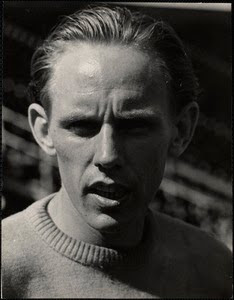
Today, Rick Lower sent us a note about the passing of Ottavio Missoni. "Who is this man?" you may ask. It was certainly a question I asked myself. Checking him out on Google I found a fascinating individual. His history indicates that there is life after track. He was from Croatia, born in Dubrovnik, but under Italian rule at the time he displayed his track talents for the nation of Italy running in the European Championships in 1939, and he continued to do so after WWII. He last competed in the 1948 Olympics in London and placed 6th in the 400m Hurdles. He met a 16 year old Italian beauty in London and married her a year later. They went on to found a major fashion house specializing in high end wool clothing. They also made the Italian team uniforms for the games in 1952. He was a 47+ 400 runner and 53 second hurdler. He fought in the Battle of El Alemein in North Africa, was captured by the British and was a prisoner for four years. I found references in Italian, that he competed regularly in Master's level track in Italian, European, and World Championships. He lived the good life afterward, but in the last year he lost his eldest son and daughter-in-law who who had taken over running the family business, in a plane crash in Venezuela. I'm including a number photos taken off the google pages. If any of you would like to donate one of his sweaters, let me know. You would have to be very wealthy or shop in exclusive second hand stores. According to an article below, Target carried his brand at cut rate prices and sold out in a day.


 |
| Note that this is a wool fabric, probably his first big contract in the fashion business |
 |
| Converse Auckland Racer $200 retail |
 |
| Missoni Nike Swaggerjacks |
 |
| Track meet probably inside the Monza Formula 1 track or the Avus Ring in Berlin |
 |
| London Olympics 1948 |

From The Telegraph, May 10, 2013
Ottavio 'Tai' Missoni
Ottavio 'Tai' Missoni, who has died aged 92, was the founder of his eponymous family fashion house, which became famous for its colourful geometric knitwear; he was also a track star who represented Italy in the 400 metre hurdles at the 1948 “austerity” Olympics in London.
The two strands of his career are connected. For it was in London that the 27-year-old “Tai” Missoni met Rosita Jelmini, a 16-year-old Italian girl who happened to be in the crowd at Wembley on the day he was running in the finals (he came sixth); she was being chaperoned by nuns who ran the language school she attended.
She and Missoni married in 1953 and set up a small business called Maglificio Jolly, making woollen tracksuits, in Gallarate, near Bergamo, not far from Rosita’s home village. Later they moved on to knitwear, presenting their first collection in Milan in 1958, when they changed their label to Missoni.
To begin with the business lost money, but as demand for “ready-to-wear” began to take off in the early 1960s the Missonis found themselves inundated with requests from top Italian department stores to produce ready-to-wear variations on designs featured in the Paris collections.
Their work was spotted by Anna Piaggi, the influential Italian fashion editor, and another big break came in 1965 when they made a knitwear collection with the French designer Emmanuelle Khanh. However, the event that really put them on the map was a show in Florence that proved to be a huge (if unintended) succès de scandale.
In 1967 the Missonis were invited to show at the city’s Pitti Palace, but before the models went out on the catwalk Rosita noticed that their bras were showing through their lamé tops, ruining the intended effect; so she told them to remove the offending items of underwear. Under the catwalk lighting, however, the tops became totally transparent, sending the photographers into a snapping frenzy.
The show’s organisers did not see the funny side, accusing the Missonis of turning the Pitti Palace into a sort of “Crazy Horse” cabaret, and the couple were not invited to return the following year. Soon afterwards, however, they found themselves featuring on the covers of magazines such as Vogue, Elle, Marie Claire, Women’s Wear Daily and Harper’s Bazaar. After moving to a new factory in Sumirago in 1969, with their designs championed by Vogue’s then editor Diana Vreeland, they opened their first in-store boutique, at Bloomingdale’s, in 1970, and their first directly owned boutique, in Milan, in 1976.
In the early 1970s the Missonis reached the peak of their influence in the fashion world. Their bold use of intricate zigzags, waves, multicolour stripes, checks and patchwork allowed women to mix, if not match, the most daring colours and patterns — for example, a striped skirt and chequered jacket with a patchwork scarf. It was Tai who did the watercolours and gouaches that settled the colour and patterns, while Rosita shaped them into the easy to wear clothes that have become design classics.
Unlike most of their early competitors, the Missonis weathered the vagaries of fashion and the financial markets, finding new ways of updating their characteristic style to accommodate even such trends as grunge and minimalism. The company’s archives feature more than 7,000 designs of stripes, zigzags, tartans, patchworks and mélanges in fibres including silks, cottons, linens, wools, rayons, mohairs and metallic yarns like Lurex.
“We have always tried to innovate, to revamp the concept of knitwear. We have always remained artisans,” Rosita explained in a recent interview. “We have never thrown anything out — even the unsuccessful models — as we knew they could lead us to some new idea.”
Today the company is a global brand run by the Missonis’ children and grandchildren, encompassing ready-to-wear, haute couture, household furnishings, scent and even luxury hotels. The label had a turnover of £59 million in 2012 and has 40 stores around the world. Riding high on the recent revival of interest in print and colour, Missoni designs are advertised by Kate Moss and worn by Hollywood actresses such as Kate Hudson and Demi Moore.
One of two children of a captain in the Italian Navy and a Dalmatian noblewoman, Ottavio Missoni was born on February 11 1921 in Dubrovnik and brought up in Zadar, a city on the Dalmatian coast of what is now Croatia.
Zadar was occupied by the Italians during the First World War and they remained in control until Italy capitulated in 1943, after which the city was taken over by the Germans and then heavily bombed by the Allies. At the end of the Second World War it became part of Yugoslavia.
As a boy Ottavio excelled in athletics, and in 1937, aged 16, he became the youngest member of Italy’s national team.
That year, in the 400 metres at an event in Milan, he beat the American Elroy Robinson, then the world record holder for the 880 yards, putting in a performance which, he was always proud to recall, remained the best ever by a 16 year-old in the 400 metres.
The following year he ran in the European Championships, and in 1939 won the 400 metres at the Italian Championships and at the World Student Games.
Missoni’s athletics career had to be put on hold during the Second World War, when he served in the Italian Army in North Africa. In 1942 he fought at El Alamein, but was captured by the British and spent the remainder of the war as a PoW in Egypt. “It wasn’t exactly a Club Med type of environment ideal for training,” he recalled.
Though not in top physical shape when he emerged, he was selected for the Italian team for the 1948 Olympics, an event he recalled in later life as being “beautiful, natural and spontaneous, not like now, when everything is inflated, blown out of proportion”. His trainer had a small knitting company in Trieste, and together they made woollen tracksuits for the Italian team that Missoni would later develop into his family business empire.
The laid-back Missoni liked to joke that when he and Rosita first set up shop he was the president but she would do all the work: “I’m lazy. My favourite pastimes are sleeping and reading, so work for me has always been an effort.”
Effort or not, his fabric designs, with their extraordinary range of textures and vivid colours, came to be seen as works of art, featuring in exhibitions at leading museums. Missoni also became involved in numerous other design projects, from interiors for Mazda cars and costumes for operas at La Scala, to carpets and tapestries.
Beginning in 1996, Tai and Rosita gradually passed control of their fashion empire to their children, and in 2011 Tai published his autobiography, Una vita sul filo di lana (“A life on the woollen thread”, written with Paolo Scandaletti), its title a pun referring to his twin successes as an athlete and fashion designer — before the arrival of photo-finishes, a thread was used to determine the winner of a race.
The final months of Missoni’s life were overshadowed by the disappearance in January of his eldest child, Vittorio, marketing director of the family business, with his wife and four others, while flying in a small plane during a holiday trip to an island off the coast of Venezuela. While wreckage of the plane has washed up on shore, their bodies have not been found.
Ottavio Missoni is survived by his wife and by their surviving son and daughter.
Ottavio Missoni, born February 11 1921, died May 9 2013
The two strands of his career are connected. For it was in London that the 27-year-old “Tai” Missoni met Rosita Jelmini, a 16-year-old Italian girl who happened to be in the crowd at Wembley on the day he was running in the finals (he came sixth); she was being chaperoned by nuns who ran the language school she attended.
She and Missoni married in 1953 and set up a small business called Maglificio Jolly, making woollen tracksuits, in Gallarate, near Bergamo, not far from Rosita’s home village. Later they moved on to knitwear, presenting their first collection in Milan in 1958, when they changed their label to Missoni.
To begin with the business lost money, but as demand for “ready-to-wear” began to take off in the early 1960s the Missonis found themselves inundated with requests from top Italian department stores to produce ready-to-wear variations on designs featured in the Paris collections.
Their work was spotted by Anna Piaggi, the influential Italian fashion editor, and another big break came in 1965 when they made a knitwear collection with the French designer Emmanuelle Khanh. However, the event that really put them on the map was a show in Florence that proved to be a huge (if unintended) succès de scandale.
In 1967 the Missonis were invited to show at the city’s Pitti Palace, but before the models went out on the catwalk Rosita noticed that their bras were showing through their lamé tops, ruining the intended effect; so she told them to remove the offending items of underwear. Under the catwalk lighting, however, the tops became totally transparent, sending the photographers into a snapping frenzy.
The show’s organisers did not see the funny side, accusing the Missonis of turning the Pitti Palace into a sort of “Crazy Horse” cabaret, and the couple were not invited to return the following year. Soon afterwards, however, they found themselves featuring on the covers of magazines such as Vogue, Elle, Marie Claire, Women’s Wear Daily and Harper’s Bazaar. After moving to a new factory in Sumirago in 1969, with their designs championed by Vogue’s then editor Diana Vreeland, they opened their first in-store boutique, at Bloomingdale’s, in 1970, and their first directly owned boutique, in Milan, in 1976.
In the early 1970s the Missonis reached the peak of their influence in the fashion world. Their bold use of intricate zigzags, waves, multicolour stripes, checks and patchwork allowed women to mix, if not match, the most daring colours and patterns — for example, a striped skirt and chequered jacket with a patchwork scarf. It was Tai who did the watercolours and gouaches that settled the colour and patterns, while Rosita shaped them into the easy to wear clothes that have become design classics.
Unlike most of their early competitors, the Missonis weathered the vagaries of fashion and the financial markets, finding new ways of updating their characteristic style to accommodate even such trends as grunge and minimalism. The company’s archives feature more than 7,000 designs of stripes, zigzags, tartans, patchworks and mélanges in fibres including silks, cottons, linens, wools, rayons, mohairs and metallic yarns like Lurex.
“We have always tried to innovate, to revamp the concept of knitwear. We have always remained artisans,” Rosita explained in a recent interview. “We have never thrown anything out — even the unsuccessful models — as we knew they could lead us to some new idea.”
Today the company is a global brand run by the Missonis’ children and grandchildren, encompassing ready-to-wear, haute couture, household furnishings, scent and even luxury hotels. The label had a turnover of £59 million in 2012 and has 40 stores around the world. Riding high on the recent revival of interest in print and colour, Missoni designs are advertised by Kate Moss and worn by Hollywood actresses such as Kate Hudson and Demi Moore.
One of two children of a captain in the Italian Navy and a Dalmatian noblewoman, Ottavio Missoni was born on February 11 1921 in Dubrovnik and brought up in Zadar, a city on the Dalmatian coast of what is now Croatia.
Zadar was occupied by the Italians during the First World War and they remained in control until Italy capitulated in 1943, after which the city was taken over by the Germans and then heavily bombed by the Allies. At the end of the Second World War it became part of Yugoslavia.
As a boy Ottavio excelled in athletics, and in 1937, aged 16, he became the youngest member of Italy’s national team.
That year, in the 400 metres at an event in Milan, he beat the American Elroy Robinson, then the world record holder for the 880 yards, putting in a performance which, he was always proud to recall, remained the best ever by a 16 year-old in the 400 metres.
The following year he ran in the European Championships, and in 1939 won the 400 metres at the Italian Championships and at the World Student Games.
Missoni’s athletics career had to be put on hold during the Second World War, when he served in the Italian Army in North Africa. In 1942 he fought at El Alamein, but was captured by the British and spent the remainder of the war as a PoW in Egypt. “It wasn’t exactly a Club Med type of environment ideal for training,” he recalled.
Though not in top physical shape when he emerged, he was selected for the Italian team for the 1948 Olympics, an event he recalled in later life as being “beautiful, natural and spontaneous, not like now, when everything is inflated, blown out of proportion”. His trainer had a small knitting company in Trieste, and together they made woollen tracksuits for the Italian team that Missoni would later develop into his family business empire.
The laid-back Missoni liked to joke that when he and Rosita first set up shop he was the president but she would do all the work: “I’m lazy. My favourite pastimes are sleeping and reading, so work for me has always been an effort.”
Effort or not, his fabric designs, with their extraordinary range of textures and vivid colours, came to be seen as works of art, featuring in exhibitions at leading museums. Missoni also became involved in numerous other design projects, from interiors for Mazda cars and costumes for operas at La Scala, to carpets and tapestries.
Beginning in 1996, Tai and Rosita gradually passed control of their fashion empire to their children, and in 2011 Tai published his autobiography, Una vita sul filo di lana (“A life on the woollen thread”, written with Paolo Scandaletti), its title a pun referring to his twin successes as an athlete and fashion designer — before the arrival of photo-finishes, a thread was used to determine the winner of a race.
The final months of Missoni’s life were overshadowed by the disappearance in January of his eldest child, Vittorio, marketing director of the family business, with his wife and four others, while flying in a small plane during a holiday trip to an island off the coast of Venezuela. While wreckage of the plane has washed up on shore, their bodies have not been found.
Ottavio Missoni is survived by his wife and by their surviving son and daughter.
Ottavio Missoni, born February 11 1921, died May 9 2013
In the early 1970s the Missonis reached the peak of their influence in the fashion world. Their bold use of intricate zigzags, waves, multicolour stripes, checks and patchwork allowed women to mix, if not match, the most daring colours and patterns — for example, a striped skirt and chequered jacket with a patchwork scarf. It was Tai who did the watercolours and gouaches that settled the colour and patterns, while Rosita shaped them into the easy to wear clothes that have become design classics.
Unlike most of their early competitors, the Missonis weathered the vagaries of fashion and the financial markets, finding new ways of updating their characteristic style to accommodate even such trends as grunge and minimalism. The company’s archives feature more than 7,000 designs of stripes, zigzags, tartans, patchworks and mélanges in fibres including silks, cottons, linens, wools, rayons, mohairs and metallic yarns like Lurex.
“We have always tried to innovate, to revamp the concept of knitwear. We have always remained artisans,” Rosita explained in a recent interview. “We have never thrown anything out — even the unsuccessful models — as we knew they could lead us to some new idea.”
Today the company is a global brand run by the Missonis’ children and grandchildren, encompassing ready-to-wear, haute couture, household furnishings, scent and even luxury hotels. The label had a turnover of £59 million in 2012 and has 40 stores around the world. Riding high on the recent revival of interest in print and colour, Missoni designs are advertised by Kate Moss and worn by Hollywood actresses such as Kate Hudson and Demi Moore.
One of two children of a captain in the Italian Navy and a Dalmatian noblewoman, Ottavio Missoni was born on February 11 1921 in Dubrovnik and brought up in Zadar, a city on the Dalmatian coast of what is now Croatia.
Zadar was occupied by the Italians during the First World War and they remained in control until Italy capitulated in 1943, after which the city was taken over by the Germans and then heavily bombed by the Allies. At the end of the Second World War it became part of Yugoslavia.
As a boy Ottavio excelled in athletics, and in 1937, aged 16, he became the youngest member of Italy’s national team.
That year, in the 400 metres at an event in Milan, he beat the American Elroy Robinson, then the world record holder for the 880 yards, putting in a performance which, he was always proud to recall, remained the best ever by a 16 year-old in the 400 metres.
The following year he ran in the European Championships, and in 1939 won the 400 metres at the Italian Championships and at the World Student Games.
Missoni’s athletics career had to be put on hold during the Second World War, when he served in the Italian Army in North Africa. In 1942 he fought at El Alamein, but was captured by the British and spent the remainder of the war as a PoW in Egypt. “It wasn’t exactly a Club Med type of environment ideal for training,” he recalled.
Though not in top physical shape when he emerged, he was selected for the Italian team for the 1948 Olympics, an event he recalled in later life as being “beautiful, natural and spontaneous, not like now, when everything is inflated, blown out of proportion”. His trainer had a small knitting company in Trieste, and together they made woollen tracksuits for the Italian team that Missoni would later develop into his family business empire.
The laid-back Missoni liked to joke that when he and Rosita first set up shop he was the president but she would do all the work: “I’m lazy. My favourite pastimes are sleeping and reading, so work for me has always been an effort.”
Effort or not, his fabric designs, with their extraordinary range of textures and vivid colours, came to be seen as works of art, featuring in exhibitions at leading museums. Missoni also became involved in numerous other design projects, from interiors for Mazda cars and costumes for operas at La Scala, to carpets and tapestries.
Beginning in 1996, Tai and Rosita gradually passed control of their fashion empire to their children, and in 2011 Tai published his autobiography, Una vita sul filo di lana (“A life on the woollen thread”, written with Paolo Scandaletti), its title a pun referring to his twin successes as an athlete and fashion designer — before the arrival of photo-finishes, a thread was used to determine the winner of a race.
The final months of Missoni’s life were overshadowed by the disappearance in January of his eldest child, Vittorio, marketing director of the family business, with his wife and four others, while flying in a small plane during a holiday trip to an island off the coast of Venezuela. While wreckage of the plane has washed up on shore, their bodies have not been found.
Ottavio Missoni is survived by his wife and by their surviving son and daughter.
Ottavio Missoni, born February 11 1921, died May 9 2013
Missoni for Target line sells out, raises question 2011

Lots of people did just that — some of them waiting in line outside the stores hours before they opened — and the result was a complete website crash, a manic rush for the shelves and a nearly completely sold-out inventory. Now, the question remains whether the admittedly odd pairing of the two brands has produced a net positive result for Target, or a swarm of customer ill-will.
"Missoni is so luxury driven, this is a huge deal," said Mary O'Brien, a New York fashionista who formerly worked at Bloomingdale's and now sells luxury apparel online. "Many people do not understand why a brand as exclusive as Missoni would ever even consider doing a line with Target."
Founded in 1953, Missoni knitwear is known for its distinctively colorful, zig-zag and geometric patterns. The company has also diversified over the years into carpet, perfumes and tapestries.
The partnership was announced earlier this year, with Target using the interim months to build excitement via blogs, social media, print and TV advertising and an appearance at New York Fashion Week. Giovanna Dimperio, advertising executive and sartorialist, said the retailer's buzz-building was amazingly effective.
"Target's PR team did a fantastic job generating buzz and getting placements," she said. "I believe about a month ago I learned the exact date it would be available, and marked my calendar."
Plenty of other people did too, evidently: By 7:47 am the target.com site was down, a courtesy message from the Target dog letting visitors know "we are suddenly extremely popular." From coast to coast, shoppers reported empty shelves as soon as a few minutes after the doors opened.
Story continues below...

Read this white paper from Motorola Solutions to see how omnichannel retailing is changing end-to-end supply chain operations, especially when it comes to meeting customers' complex fulfillment demands. Download now!
 |
| Lines form outside a San Diego Target, 30 minutes before opening. (Photo by Susie Yoo.) |
In San Diego, lines started forming at 7:30, a half-hour before the store opened. Shopper Susie Yoo said she "watched in amused horror as grown women name-called and literally snatched Missoni items out of each other's carts" when the doors were opened. The store sold out of the items within 20 minutes, she said.
Heather Adessa had a similar experience at a New York location. She arrived at the store an hour and a half after it opened, and although the Missoni shelves were bare, many of the shoppers were still in the aisles with their loot.
"People were wheeling around carts with 5 pieces of the Missoni Luggage, 5 comforter sets, 10 pillows," she said. "It was insane. Then a group of women with carts and carts of products each gathered near the registers and were dividing up the products amongst each other. The Target employees sat there and saw them and didn't say anything."
"I was very lucky not to get trampled," said Amy Halloran, a self-professed "proud Missoni owner" in Chicago. "I have never in my life witnessed grown women acting so aggressive. I saw several women with small babies in their cart full of Missoni product who left their cart (and child) and ran toward a Target employee bringing out more shoes."
The online experience was a frustration for many, too. Jewelry designer Ann Marie Sclafani said she bought around $300 worth of product during the "one-hour blip that it was working." She got an email later in the day with expected ship dates. The next day, she got word that three of the items she bought are not available for the estimated ship date and she would not be charged until they were on the way. "However, I was already charged for the entire order," she said. "It was a total failure on so many levels as a consumer."
The Target website was back up by Wednesday morning, but most Missoni products are listed as "out of stock."
Lifestyle blogger Stacy Geisinger sums it up bluntly: "Target failed," she said. "Their website crashed. So much promotion and not enough product. They could have made a fortune. Instead they have many disappointed customers."
Geisinger said the racks at her New York Target were empty by 10 o'clock, and that people "just took as much as they could grab. The store was filled with so many disappointed women."
Retail Customer Experience blogger AnnaMaria Turano posits that while the partnership might have generated dollars and buzz for Target, it could "prove to be disastrous for Missoni's brand."
"Now that the expensive knitwear's iconic images are within the reach of the mass audience, Missoni may unfortunately experience backlash from their consumers who were loyal to the brand pre-Target," she writes in her latest post. "These Missoni loyalists might stop shopping and might stop wearing Missoni if they are concerned that others might confuse the boutique offerings with the made-for-Target line."
Geisinger also speculates that most of the shoppers were snapping up the product with the intention of reselling it online, and she may be right: As of this writing, the number of listings for Missoni for Target products on eBay is around 44,000 and rising by the minute.
Target did not respond to our request for comment.