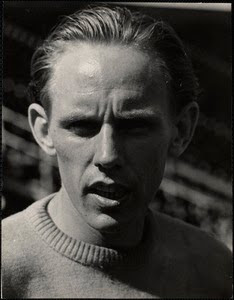
The Rome Olympics are history, but the season goes on in Europe. The headline on the cover of this issue of TFN reads, “Bolotnikov 28:18.8, Brumel 7-2 ¼, Rowe 62-8½.” The first is a world record, the other two are European records. Pytor Bolotnikov, having followed in the steps of his mentor, Vladimir Kuts, as Olympic 10,000 champion, now eyes Kuts' world records at 5000 and 10,000.

On September 28 he runs a 1500 PR of 3:47.4 then returns the next day for a shot at the 10K record. His 28:32.4 misses by two seconds. On October 7 at halftime of a soccer match in Kiev, he takes on Kuts' 13:35.0 5K mark. Running without significant competition, he clocks 13:38.1. If at first you don't succeed, try and try again is his motto. On a warm, windless afternoon on October 15, again in Kiev, he leaves Russia's best runners behind early and achieves his goal at 10,000, clocking 28:18.8 to break his hero's record by 11.4 seconds. How far distance running has come can be measured by combining the best 5000 times of two of the greatest, Paavo Nurmi and Emil Zatopek. Together they total 28:25.2, 6.4 seconds slower than Bolotnikov's effort this day.
Valeriy Brumel, the precocious Soviet 18 year old, marks himself as a threat to John Thomas' WR with a 7-2¼. Apparently on the same day he has a very close miss at 7-4 1/8. Time will tell, but it seems to be on the kid's side. Great Britain's Arthur Rowe atones for a disappointing Olympics with a put of 62-8½, an effort not only a European record, but equal to the fourth best ever, tying him with Dave Davis.
Europe or anywhere else for that matter hadn't seen much of Herb Elliot for the last couple years. The great Aussie makes up for that starting in mid-September. He races 11 times in 19 days, winning all but one, including three classic races with Sweden's Dan Waern.
The journey begins in London on September 14 where he runs a mile in 3:58.6, leaving a surprisingly good Terry Sullivan of Rhodesia well behind in 4:00.9. Three days later in Cardiff he attempts to finish in a dead heat with Tony Blue. The judges give him the win anyway in 1:52.8. The first of the matches with Waern is the next day in Goteborg at 1500. Blue, the pace setter, takes them out too fast; 54 and 1:54. Elliot is content to stay two seconds off that pace. When Blue drops off on the third lap, the race is all Elliot's or so it would seem. He opens up five meters on the backstretch and spectators entertain visions of his Olympic finish two weeks earlier. But Waern, who barely missed making the Olympic final, has other ideas. To the delight of the hometown fans, he catches Elliot at the bell. They battle around the curve and into the straight. Down the homestretch they come, Elliot on the inside, Waern on his shoulder. With ten meters to go, Elliot leads by inches. Waern can't hold on and the race belongs to Elliot by a meter. His 3:38.4 is his fourth fastest. Waern's 3:38.6 is the Swedish record.
Fans don't have to wait long for the next match between these two as it comes two days later over a mile at Malmo. Once again Blue is the pacesetter. It appears that he has mastered even pacing. Three laps go off in 60.5 each, reaching the bell in 3:01.5. Waern, Albie Thomas and Elliot follow in that order. Spurred by the wildly cheering fans, Waern takes the lead and begins a long drive. This time it is Elliot hanging on. At the top of the straight he moves into the lead and ever so slowly pulls away for a narrow win 3:58.6 to 3:59.0.
Now Elliot is off for Dublin, where two days later he will toe the starting line in an 880 against two other Olympic champions, Rome's 800 winner Peter Snell and Melbourne's 1500 champion Ron Delany, the obvious favorite of the Irish fans. No details of the race are given, but Elliot can do no better than fourth. Snell takes it 1:47.9 with Delany second at 1:48.2 (an Irish record), the same time as Tony Blue. Elliot takes his only loss of the tour with a 1:48.4.
Having lost to Snell at the New Zelander's distance, Elliot looks forward to meeting him on the same track the next day at his distance, a mile. This time the heavy lifting falls to Albie Thomas who takes the field through a 1:57.0. Lazlo Tabori leads at the bell in 2:59.0. At this point Elliot makes sure it is over early. He leaves no doubt about who is the king at this distance, winning in 3:57.0. Terry Sullivan breaks four for the first time in placing second in 3:59.8, a tick ahead of Gordon Pirie. (*editor's note This is possibly the first 4 minute mile by a native born African runner.. When I lived in Zimbabwe from 1982-85, Sullivan was still there in the construction business.) Tabori is fourth at 4:00.7. Snell places fifth in 4:01.5. Any disappointment that may have resulted from this loss is mitigated by the fact thatn this is a 9 second improvement on his PR, perhaps an indication of better things to come.
Elliot fills the rest of the month with less competitive races. He wins a 1000 meter race in Glasgow (2:20.7) on the 24th. The 28th sees him in London for a mile (3:59.8). On the 30th he takes another 1000 in 2:23.1 in Manchester. October 1 is taken up with a 1320 in Birmingham (2:57.8). This would seem like a lot, but there is one more page to be turned before the book on Herb Elliot's magical 1960 season can be closed. Tomorrow Dan Waern will be waiting for him in Stockholm for a race at 1000 meters, an event in which the Swede set the world record of 2:18.1 two years ago before lowering it to 2:17.8 last year.
This will be no easy task for Elliot. It has been an intense stretch in which he has raced 11 times in 2½ weeks. Popular as Elliot is, the Stockholm crowd will be wildly enthusiastic for the hometown boy, Waern. Not only is this Waern's crowd, it is probably his best distance. Herb will not be able to mail this one in.
Chances for a world record go out the window right away. The plan was to have a rabbit take the field through a fast 400 and then Per Knuts, “a good Swedish half miler” was to take over. When Knuts fails to take over after a pedestrian 55.4 opening go around, Waern finds himself in the lead about 500 meters before he wants to be. His 57.6 (1:53.0) puts the race in the tactical category. There is no description of the race other than those splits, but both finish strongly with Elliot the winner, 2:19.1 to 2:19.4. This was the year's final race for both. Elliot is off to bask in Australia's spring and summer while Waern looks forward to a season of ice fishing.
And yes, there are still Americans in Europe. Olympic 400 champ, Otis Davis, tangles with silver medalist Carl Kaufmann twice.

The first, in Cologne, is closer than their Olympic finish. They are given a tie at 45.7. Four days later in Wuppertal, Kaufmann wins 46.5 to 46.7. Previous to these races, Davis had been nipped by George Kerr in Amsterdam, 47.0 for both.
The balance in the season long competition between Lee Calhoun and Willie May has shifted. After Calhoun's ever so close victory in the Olympics, May wins three over the Olympic champ, then three over Olympic finalist Keith Gardner of Jamaica.
Imagine that you have come to the meet in Paris on Oct. 2 to see the great American pole vaulter, Don Bragg. Then imagine your shock when you see him fail at 13-9. The competition is won at 14-1, but wait, there's more. Bragg is going to give the fans their money's worth with an exhibition. He clears 15-1 and everyone goes home happy.
In the Cologne meet Ernie Cunliffe takes the 1500 in 3:48.0. Five days later he tangles with Kerr in an 800 in Frankfort and comes out on the short end, 1:48.9 to 1:49.1.
Perhaps when it is all said and done, the American who will go home with the best memories of the Europe tour will be Max Truex.

Coming off his great performance in the Olympic 10,000, he has no let down. In Cologne he wins the 3000 in an American record of 8:03.6. He is cheered vigorously by the home town crowd as he is wearing a German Olympic uniform. He wins two 5000's in Germany before suffering his only defeat of the tour, a three mile in London where he is third, four tenths behind the winner. His last race is in Paris where he is supposed to meet French star Michel Bernard over two miles. Bernard pulls out and Max runs near to the American record with an 8:44.2. A great Olympic race and four wins in five tries afterward. Good job, Max.
Items gleaned from various columns: Lee Calhoun, Ron Morris, Parry O'Brien, Tom Murphy and Rafer Johnson have retired. Jerry Siebert almost added his name to the list, but has decided to run one more year as a member of the Santa Clara Valley Youth Village, saying, “I want one more crack at Snell.” The SCVYV could be pretty good in the middle distances. Jack Yerman and Ernie Cunliffe may wear there colors next season. Cunliffe, now a graduate student at Stanford, just became engaged......Carl Kaufmann, silver medalist in the 400 at 21, has decided that track and field is not the fast track to big money. He will devote his energies to a singing career...*editor Wasn't this Lauer who became the C&W singer?....The Styron twins are following coach Lew Hartzog from NE Louisiana to Southern Illinois.....Jim Dupree, feeling a lack of support from his coach at New Mexico, is joining them at SIU.....Hammer thrower Al Hall has decided not to devote full time to his job as a chicken inspector. He will continue his track career. Bill Dellinger will take a year off from competition. He will continue to run however, with an eye towards 1962.....Deacon Jones is a multi-talented guy. Aside from competing in the steeplechase in Rome, he kept his teammates looking sharp by cutting their hair. “I've been a licensed barber since 1950.”.....We won't see Phil Coleman on the boards this winter. He is eschewing competition in favor of working on his PhD at the University of Illinois......Add Glenn Davis and Ray Norton to the list of those who won't be back. Both will play football; Davis for the Lions, Norton for the 49ers. Rafer Johnson, though retiring, will not join them in the NFL. He squelches the rumor that he will play for the Rams, saying that he hasn't played football since 1954 at Kingsburg High......Billy Mills has been named captain of the Kansas cross country team.....If you are waiting to see Olympic 100 meter gold medalist, Armin Hary, in the leading role in three non-sports films, you will be disappointed. He demanded $23,800 for each film from the company that held the option and was turned down. Armin is now spending time writing his memoirs......500 German boys and girls were sent to Rome as winners of a nationwide contest. They camped in the outskirts of the city and rooted on their favorites from the standing room area at either end of the stadium. Their most notable shout of Teutonic support was, “Hoy, hoy, hoy, Lauer, Lauer, Lauer, cha, cha, cha!” Say it a few times and it grows on you. Not to be outdone, the British fans showed their support with the more traditional, “Two, four, six, eight, who do we appreciate, P-I-R-I-E, Pirie, Pirie, Pirie!”.....Apparently whatever the cost of the Track and Field New tour was, it was money well spent. Many of the group were housed at the luxurious Rome YMCA.
Did You Say Rome YMCA? Two Versions Below