Once Upon a Time in the Vest

Showing posts with label Dan Waern. Show all posts

Wednesday, April 4, 2012

Vol. 2 No. 32 May , 1961

MAY 1961


May? Wait a minute, the last entry was March, what happened to April? Good question. I have all the issues organized in folders, but there is no April. Think my mom tossed it along with all my baseball cards. (Do you have any idea what a Mickey Mantle rookie card would be worth today? Don't get me started.) Anyway we are going to skip over April just like it never existed.
Here's your Mickey Mantle rookie card, Roy, that'll be $10,000 to my account.
George

That said, we have the West Coast, Drake, Penn, Mt. SAC and Kansas Relays and more. We will take them chronologically.

April 22 finds us in Lawrence, Kansas for the Kansas Relays where Baylor wins the 440 and 880 relays and takes five individual events. Jim Grelle runs a 4:07.4 mile, leaving Ernie Cunliffe and Jim Dupree in his wake. Cliff Cushman takes the 400H in 51.0 to beat 120HH winner Rex Stucker. The 10,000 is definitely not the event of the day. The winning time is 34:23 and there are only two finishers, probably better described as survivors.

The next weekend we have the three big relay meets. We'll start in Philadelphia and work our way west. Abilene Christian has come east for the Penn Relays, but things don't go as planned. Earl Young looks good anchoring the 440R to a meet record 40.9, but though he brings the stick home in 20.1 on the 880R, Frank Budd's 20.0 third leg for Villanova has created too much of a gap and the Wildcats win 1:24.8 to 1:25.0. Michigan takes the 2M and 4M relays while Yale wins the sprint and distance medleys. The big field event news is that Don Bragg is beaten by Villanova frosh Rolando Cruz, both at 15-0.

Des Moines and the Drake Relays is next stop on our trip across the country on this the last weekend in April.
Drake Stadium about 1907 (Click on picture for an enlargement.)

The big news here is the record breaking performance of the Western Michigan four mile relay team. Make that “records” breaking, as the Broncos' 16:50.4 effort breaks the Drake record of 17:15.2 by Oregon in 1959, the collegiate record of 16:53.2 by Occidental and the US record of 16:52.6 set in 1952 by the national team of Montes, Druetzler, Santee and Barnes. The 4:07.0 third leg by John Bork is the decider.
John Bork, Penn Relays?
John Bork Today
Bork's 1:48.7 split in the distance medley is instrumental in the Broncos winning that event also. Kansas, paced by Bill Dotson's 1:51.0 anchor, wins the two mile relay with the fastest time in the nation, 7:28.6. The best marks come in the field events where Ralph Boston leaps 26-1½ and George Davis, after two failures at the opening height of 13-6, vaults a personal best of 15-6 before failing at a world record 15-10.
Rex Cawley

And now to Walnut, California where the third annual Mt. SAC Relays provides a show that puts the two traditional meets to shame. It is a very good day if you are or were a USC Trojan. Indeed Rex Cawley and Bob Avant are named the outstanding track and field athletes. Avant becomes the fourth American 7 foot high jumper (and second SC 7 footer behind Dumas). Cawley outfinishes Eddie Southern in the 400 hurdles, 50.6 to 50.7 and splits 20.5 in the 880 relay as the Trojans win easily in 1:23.6, but the heroics are still to come. With the Trojans trailing Arizona State on the anchor leg of the mile relay,


Cawley takes the baton three yards down to Arizona's Mal Spence. Spence matches the 46.4 third leg split run by his twin, Mel, but it isn't enough to hold off Cawley whose 45.4 brings the Trojans home in 3:07.6 for a new collegiate record. A-State's 3:07.9 equals the old mark.

There is more USC flavor to the field events as current Trojan Dallas Long takes the shot at 61-9½ and former SC star Rink Babka takes over the world lead in the discus with a 194-7½. But the guy they beat in each of those events is the star of the day. Army lieutenant Jay Silvester produces a 61-1¾ PR in the shot and then PRs again in the discus with a throw of 192-5½ for the greatest weight double in history. Hal Connolly shows he is back on track in the hammer, as his 220-8 is 35 feet better than second.

There are some familiar faces in the open events and some not so familiar. Olympians Jerry Siebert and Ernie Cunliffe tangle in the 880 with Siebert winning by half a second in 1:50.7. Jim Beatty knocks off a 4:04.9 mile to easily dispose of Lazlo Tabori. The open 440 provides a couple pleasant surprises as Keith Thomassen edges Canadian Bill Crothers 46.1 to 46.2, but the real story is their improvement. Thomassen knocks half a second of his best, while Crothers lowers his PR by a jaw dropping 1.2 seconds.

Dennis Johnson, who has run 9.3 four times this season, finally gets his 9.2, well, sort of. There is an aiding wind of 11.2 mph and the notation that he had a rolling start. Remember the comment in the January entry that Bobby Poynter had left some personal problems behind at San Jose State and now was enrolled at Los Angeles State? Well, apparently things changed – perhaps explained in the missing April issue – because he runs the second leg of San Jose's winning 440 relay (40.5) and places fifth in the 100.

The following is information collected from columns. There were no meets at the LA Coliseum last year and there will be none this year. Something about the Dodgers playing baseball there.

In 1932 LA Coliseum


LA Coliseum for Baseball

By next year the team will have its own stadium and track can resume in the Coliseum. Bert Nelson makes two suggestions: “Make every effort to put in the fastest, best wearing all-weather track possible – - and protect it from desecration forevermore.” When that is done, he says it should be an oval with no extension running back into the tunnel for a 220 straightaway. Previously 220's were started well up the tunnel and spectators couldn't see the runners until the race was underway....Olympic 100 meter champion, Armen Hary, is retiring because of a knee injury.....Manhattan coach George Eastman says that ACC's Earl Young will run a 44.0 400 before he graduates. No pressure on Earl. .....
Bill Neider

Last we heard, Olympic shot put champion Bill Nieder had tested for the role of Jack Dempsey in an upcoming film. Bill, a big strong guy, apparently has all the qualifications except boxing ability. Obviously the fine line between boxing in a movie and real life has become blurred.

Name: Bill Nieder
Born: 1933-08-10
Nationality: US American
Hometown: Los Angeles, California, USA
Height: 6′ 3″ / 191cm
Boxing Record: click

1960 Olympic shot put Champion, after his only pro bout he observed "when you throw an iron ball it doesn't come back at you". A graduate of the University of Kansas. Bill was an all-round athlete; highjump 6-1, ran 100 in 10 flat. He has bowled a highgame of 224.

Amateur boxing record: 6 - 0 , All 6 wins by KO, no defeats, no draws.
Pro boxing record 0-1, he fought James Wyley (7-17-3 lifetime) on May 15, 1961 at the Alhambra A.C. in Philadelphia, PA. Neider was KO'd at 2:10 of the first round. Went on to announce his retirement from the ring 3 weeks later on June 10, 1961.

He tests the professional boxing waters and sinks like a rock as his first professional fight ends with big Bill on the receiving end of a first round knockout.....
Neider came to Kansas on a football scholarship , but injured his knee in his varsity debut against Texas Christian and never played again.
Steak dinner for the record: Blake Hocking, left, got to meet and have a steak dinner with former Olympic gold medalist and three-time world record holder Bill Nieder recently in Lawrence. Nieder had always said he would treat the person who broke his high school record to a steak dinner, and he flew here from California. Nieder called Blake several months ago to congratulate him on beating his high school record in shot put that had stood at Lawrence High School for 59 years. Hocking threw the shot put 62 feet, 9 inches — 2 feet further than Nieder's previous record. .


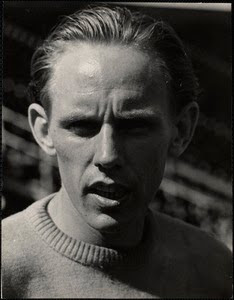
Loose lips sink ships and apparently Swedish milers as well. In a bylined article in a Swedish magazine, Dan Waern reveals that he has received under-the-table payments for running in meets.
Waern and Young Swedish Admirers

Now, thanks to those busybodies at the Swedish tax assessment board, he is facing a possible $10,000 fine. That no one finds out about secret under-the-table payments is sort of what the under-the-table part is all about, Dan.


Dan Waern, Percy Cerutty, Herb Elliot

Thursday, February 23, 2012

Vol. 2 No. 22 October 1960 The Season Just Keeps Rolling Along

OCTOBER, 1960

The Rome Olympics are history, but the season goes on in Europe. The headline on the cover of this issue of TFN reads, “Bolotnikov 28:18.8, Brumel 7-2 ¼, Rowe 62-8½.” The first is a world record, the other two are European records. Pytor Bolotnikov, having followed in the steps of his mentor, Vladimir Kuts, as Olympic 10,000 champion, now eyes Kuts' world records at 5000 and 10,000.


On September 28 he runs a 1500 PR of 3:47.4 then returns the next day for a shot at the 10K record. His 28:32.4 misses by two seconds. On October 7 at halftime of a soccer match in Kiev, he takes on Kuts' 13:35.0 5K mark. Running without significant competition, he clocks 13:38.1. If at first you don't succeed, try and try again is his motto. On a warm, windless afternoon on October 15, again in Kiev, he leaves Russia's best runners behind early and achieves his goal at 10,000, clocking 28:18.8 to break his hero's record by 11.4 seconds. How far distance running has come can be measured by combining the best 5000 times of two of the greatest, Paavo Nurmi and Emil Zatopek. Together they total 28:25.2, 6.4 seconds slower than Bolotnikov's effort this day.
Valeriy Brumel, the precocious Soviet 18 year old, marks himself as a threat to John Thomas' WR with a 7-2¼. Apparently on the same day he has a very close miss at 7-4 1/8. Time will tell, but it seems to be on the kid's side. Great Britain's Arthur Rowe atones for a disappointing Olympics with a put of 62-8½, an effort not only a European record, but equal to the fourth best ever, tying him with Dave Davis.
Europe or anywhere else for that matter hadn't seen much of Herb Elliot for the last couple years. The great Aussie makes up for that starting in mid-September. He races 11 times in 19 days, winning all but one, including three classic races with Sweden's Dan Waern.
The journey begins in London on September 14 where he runs a mile in 3:58.6, leaving a surprisingly good Terry Sullivan of Rhodesia well behind in 4:00.9. Three days later in Cardiff he attempts to finish in a dead heat with Tony Blue. The judges give him the win anyway in 1:52.8. The first of the matches with Waern is the next day in Goteborg at 1500. Blue, the pace setter, takes them out too fast; 54 and 1:54. Elliot is content to stay two seconds off that pace. When Blue drops off on the third lap, the race is all Elliot's or so it would seem. He opens up five meters on the backstretch and spectators entertain visions of his Olympic finish two weeks earlier. But Waern, who barely missed making the Olympic final, has other ideas. To the delight of the hometown fans, he catches Elliot at the bell. They battle around the curve and into the straight. Down the homestretch they come, Elliot on the inside, Waern on his shoulder. With ten meters to go, Elliot leads by inches. Waern can't hold on and the race belongs to Elliot by a meter. His 3:38.4 is his fourth fastest. Waern's 3:38.6 is the Swedish record.
Fans don't have to wait long for the next match between these two as it comes two days later over a mile at Malmo. Once again Blue is the pacesetter. It appears that he has mastered even pacing. Three laps go off in 60.5 each, reaching the bell in 3:01.5. Waern, Albie Thomas and Elliot follow in that order. Spurred by the wildly cheering fans, Waern takes the lead and begins a long drive. This time it is Elliot hanging on. At the top of the straight he moves into the lead and ever so slowly pulls away for a narrow win 3:58.6 to 3:59.0.
Now Elliot is off for Dublin, where two days later he will toe the starting line in an 880 against two other Olympic champions, Rome's 800 winner Peter Snell and Melbourne's 1500 champion Ron Delany, the obvious favorite of the Irish fans. No details of the race are given, but Elliot can do no better than fourth. Snell takes it 1:47.9 with Delany second at 1:48.2 (an Irish record), the same time as Tony Blue. Elliot takes his only loss of the tour with a 1:48.4.
Having lost to Snell at the New Zelander's distance, Elliot looks forward to meeting him on the same track the next day at his distance, a mile. This time the heavy lifting falls to Albie Thomas who takes the field through a 1:57.0. Lazlo Tabori leads at the bell in 2:59.0. At this point Elliot makes sure it is over early. He leaves no doubt about who is the king at this distance, winning in 3:57.0. Terry Sullivan breaks four for the first time in placing second in 3:59.8, a tick ahead of Gordon Pirie. (*editor's note This is possibly the first 4 minute mile by a native born African runner.. When I lived in Zimbabwe from 1982-85, Sullivan was still there in the construction business.) Tabori is fourth at 4:00.7. Snell places fifth in 4:01.5. Any disappointment that may have resulted from this loss is mitigated by the fact thatn this is a 9 second improvement on his PR, perhaps an indication of better things to come.
Elliot fills the rest of the month with less competitive races. He wins a 1000 meter race in Glasgow (2:20.7) on the 24th. The 28th sees him in London for a mile (3:59.8). On the 30th he takes another 1000 in 2:23.1 in Manchester. October 1 is taken up with a 1320 in Birmingham (2:57.8). This would seem like a lot, but there is one more page to be turned before the book on Herb Elliot's magical 1960 season can be closed. Tomorrow Dan Waern will be waiting for him in Stockholm for a race at 1000 meters, an event in which the Swede set the world record of 2:18.1 two years ago before lowering it to 2:17.8 last year.
This will be no easy task for Elliot. It has been an intense stretch in which he has raced 11 times in 2½ weeks. Popular as Elliot is, the Stockholm crowd will be wildly enthusiastic for the hometown boy, Waern. Not only is this Waern's crowd, it is probably his best distance. Herb will not be able to mail this one in.
Chances for a world record go out the window right away. The plan was to have a rabbit take the field through a fast 400 and then Per Knuts, “a good Swedish half miler” was to take over. When Knuts fails to take over after a pedestrian 55.4 opening go around, Waern finds himself in the lead about 500 meters before he wants to be. His 57.6 (1:53.0) puts the race in the tactical category. There is no description of the race other than those splits, but both finish strongly with Elliot the winner, 2:19.1 to 2:19.4. This was the year's final race for both. Elliot is off to bask in Australia's spring and summer while Waern looks forward to a season of ice fishing.
And yes, there are still Americans in Europe. Olympic 400 champ, Otis Davis, tangles with silver medalist Carl Kaufmann twice.


The first, in Cologne, is closer than their Olympic finish. They are given a tie at 45.7. Four days later in Wuppertal, Kaufmann wins 46.5 to 46.7. Previous to these races, Davis had been nipped by George Kerr in Amsterdam, 47.0 for both.
The balance in the season long competition between Lee Calhoun and Willie May has shifted. After Calhoun's ever so close victory in the Olympics, May wins three over the Olympic champ, then three over Olympic finalist Keith Gardner of Jamaica.
Imagine that you have come to the meet in Paris on Oct. 2 to see the great American pole vaulter, Don Bragg. Then imagine your shock when you see him fail at 13-9. The competition is won at 14-1, but wait, there's more. Bragg is going to give the fans their money's worth with an exhibition. He clears 15-1 and everyone goes home happy.
In the Cologne meet Ernie Cunliffe takes the 1500 in 3:48.0. Five days later he tangles with Kerr in an 800 in Frankfort and comes out on the short end, 1:48.9 to 1:49.1.
Perhaps when it is all said and done, the American who will go home with the best memories of the Europe tour will be Max Truex.


Coming off his great performance in the Olympic 10,000, he has no let down. In Cologne he wins the 3000 in an American record of 8:03.6. He is cheered vigorously by the home town crowd as he is wearing a German Olympic uniform. He wins two 5000's in Germany before suffering his only defeat of the tour, a three mile in London where he is third, four tenths behind the winner. His last race is in Paris where he is supposed to meet French star Michel Bernard over two miles. Bernard pulls out and Max runs near to the American record with an 8:44.2. A great Olympic race and four wins in five tries afterward. Good job, Max.
Items gleaned from various columns: Lee Calhoun, Ron Morris, Parry O'Brien, Tom Murphy and Rafer Johnson have retired. Jerry Siebert almost added his name to the list, but has decided to run one more year as a member of the Santa Clara Valley Youth Village, saying, “I want one more crack at Snell.” The SCVYV could be pretty good in the middle distances. Jack Yerman and Ernie Cunliffe may wear there colors next season. Cunliffe, now a graduate student at Stanford, just became engaged......Carl Kaufmann, silver medalist in the 400 at 21, has decided that track and field is not the fast track to big money. He will devote his energies to a singing career...*editor Wasn't this Lauer who became the C&W singer?....The Styron twins are following coach Lew Hartzog from NE Louisiana to Southern Illinois.....Jim Dupree, feeling a lack of support from his coach at New Mexico, is joining them at SIU.....Hammer thrower Al Hall has decided not to devote full time to his job as a chicken inspector. He will continue his track career. Bill Dellinger will take a year off from competition. He will continue to run however, with an eye towards 1962.....Deacon Jones is a multi-talented guy. Aside from competing in the steeplechase in Rome, he kept his teammates looking sharp by cutting their hair. “I've been a licensed barber since 1950.”.....We won't see Phil Coleman on the boards this winter. He is eschewing competition in favor of working on his PhD at the University of Illinois......Add Glenn Davis and Ray Norton to the list of those who won't be back. Both will play football; Davis for the Lions, Norton for the 49ers. Rafer Johnson, though retiring, will not join them in the NFL. He squelches the rumor that he will play for the Rams, saying that he hasn't played football since 1954 at Kingsburg High......Billy Mills has been named captain of the Kansas cross country team.....If you are waiting to see Olympic 100 meter gold medalist, Armin Hary, in the leading role in three non-sports films, you will be disappointed. He demanded $23,800 for each film from the company that held the option and was turned down. Armin is now spending time writing his memoirs......500 German boys and girls were sent to Rome as winners of a nationwide contest. They camped in the outskirts of the city and rooted on their favorites from the standing room area at either end of the stadium. Their most notable shout of Teutonic support was, “Hoy, hoy, hoy, Lauer, Lauer, Lauer, cha, cha, cha!” Say it a few times and it grows on you. Not to be outdone, the British fans showed their support with the more traditional, “Two, four, six, eight, who do we appreciate, P-I-R-I-E, Pirie, Pirie, Pirie!”.....Apparently whatever the cost of the Track and Field New tour was, it was money well spent. Many of the group were housed at the luxurious Rome YMCA.
Did You Say Rome YMCA? Two Versions Below


Posh Version
American Version

Thursday, September 1, 2011

Vol. 1 No. 47 September , 1958

September, 1958

This issue is pretty much devoted to goings on in Europe. The big meet is the European Championships in Stockholm. The most significant events were the 1500 where Brian Hewson of Great Britain blew away a good field including Olympic champion Rod Delany to win in 3:41.9. Hometown boy Dan Waern was second two tenths back, two tenths ahead of Delany.

The 100 went to Germany’s Armin Hary in 10.3. More on him later. Poland’s Zdzislaw Krzyszkowiak (say that three times fast) dominated the distances, winning both the 5 and 10K in 13:53.4 and 28:56.0. Martin Lauer, on his way to a great career, dominates the hurdles in 13.7, with second a distant 14.1. A 20 year old Igor Russian, Ter-Ovaneyan, takes the first of his many major championships with a 25-7 broad jump. Countryman Vasiliy Kuznyetsov, a legitimate rival of Rafer Johnson, takes the decathlon by a whopping 536 points. Overall the competition was great, but the marks weren’t much by US standards.

The real news is that Herb Elliott is running wild in Europe. He has already run his WR 3:54.4 mile (covered in an issue I don’t have). Now the 3:38.1 1500 meter record of Stanislav Jungwirth is on the menu. It is August 28 in Goteborg, Sweden, 7:24 in the evening to be precise, when he lines up against “the greatest 1500 field in history”. Jungwirth is there. So are former mile record holder Derek Ibbotson and Dan Waern and Albie Thomas and Murray Halberg. Thomas takes the field through 56.0 (Elliott 58.0) and 1:57.5. At this point Elliott puts all doubts to rest with a 58.0 third lap. The bell is sounded at 2:42.0 and the finish line is reached 54.0 seconds later for a WR of 3:36.0. Jungwirth is second at 3:39.0 with Halberg PRing in third at 3:39.4.

Six days later in London Elliott takes on European 1500 champ, Hewson, and thumps him by 3 ½ seconds in the second fastest mile ever run, 3:55.4. Two days later the Herb Elliot Show is in Oslo, where “reportedly tired”, he outruns Halberg 3:37.4 to 3:38.8, another PR for the New Zealander.

And now back to Armin Hary. It is Sept. 6 and we are in the southern Germany town of Friedrichshafen. Hary wins the 100 in 10.3, the same time he ran in winning the European Championship. No big news there. Here is where it gets strange. Hary and the second and third placers (both 10.7) like the track so much that they request a rerun. Hey, the European champ wants another race, he’s got it. “An hour later they were sent off by starter Max Muller in what was obviously an unofficial race. Hary took the lead after 10 meters and accelerated gradually. He won by a wide margin.” The three official watches have him in 9.9, 10.0 and 10.0. The backup timers have 10.0, 10.0 and 10.1. The wind is legal. It is a new world record. Or is it? The second placer runs 10.3, two tenths faster than his best and four tenths faster than an hour ago. Hmmm. Turn to Cordner Nelson’s column on the back page and we get a different view. “Mike Agostini says that the fast gun is prevalent in Northern Europe and that all smart sprinters take advantage of the situation.”

The track is recalibrated. Yep, it is long enough, but it is downhill by 10.9 centimeters, apparently a quarter inch more than the allowable. Leamon King is still the WR holder at 10.1 with Ira Murchison waiting approval to share the record.

And now another “stumper” for the boys at the Dew Drop. Bet the next round on who can correctly name the first four minute miler. Some doof will call out Roger Bannister. Hold your ground and smugly refute his claim. The first four minute miler, the first man to run exactly four minutes – 4:00.0 – is Derek Ibbotson who runs that time Sept. 3 at White City Stadium. Apparently this was an “invitational” race that preceded Elliot’s 3:55.4 effort mentioned earlier, as specific mention is made of Britain’s Mike Blagrove becoming the second to accomplish this feat in the race Elliot won the same day. Odd, but true.

The IAAF has made some changes. Now there will be official world record status for 200 meter and 220 yard races run around a curve (on a track not larger than 440). And no more wild and crazy hammer and discus throwing. The sector for these events has been reduced from 90 to 60 degrees.

The track world is lessened by the death of Ben Ogden, the coach at Temple for 30 years. He invented the starting gate, the automatic foul check for broad jumping and the pole vault safety net.

There are differing views on the future of Herb Elliott. Cordner Nelson says that “Elliott may have turned professional by the time you read this. In fact, I am only surprised that he has not done so already. He has no regard for amateurism and little for records and championships. He does have a high regard for money, and in his position I can only approve his action.” He goes on to say, “I still believe that properly organized professional track would be a boon to amateur track.”

Page 14 has a photo taken from an elevated angle of the AAU 100. Morrow has a foot on Murchison with Willie White another two feet back. Then come five runners in a blanket finish two feet further back: Givens, Collymore, Norton, Woodhouse and Coia.

Palo Alto High’s Mike Lehner dropped his own world’s best two mile for 15 year olds to 9:48.5.

Half of page 3 is devoted to an ad, “A Message from Mal Whitfield”. You can win $100, a 30 day supply of his food supplement and copy of his booklet on how to maintain a healthier body and mind by naming his new product. There is an order form with which you can order any of his three current supplements. “Guaranteed Results or Money Back”.

V 15 N. 10 Gunder 'The Wunder' Haegg Visits Cincinnati

Bob Roncker of Cincinnati, Ohio has sent in this account of one day on the 1943 tour that Gunder Haegg of Sweden made to the US to help rais...