MAY 1962
Generally, as we age, adding pounds is not a good idea. Al Oerter is the exception to the rule. As the 19 year old Olympic champion in 1956 he weighed 228. As the 23 year old Olympic champion in 1960 he weighed 235. Now, as a 25 year old he weighs 250. He is older, bigger and better.


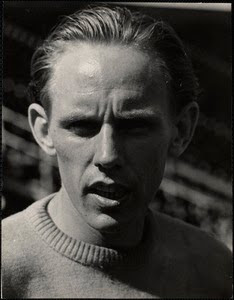
Fortune Gordien

On the afternoon of April 28 he tangles with world record holder Jay Silvester in the Mt. SAC Relays. Silvester throws 195-7, good enough to win nearly any time, anywhere, but not today as the Olympic champ slings one 198-6, the second best throw ever.
Three weeks later on the evening of May 18, Big Al is giving it a go again in the Coliseum Relays. Silvester and past world record holder Rink Babka are the prime competition. After a fling of 186-9 in the first round, Oerter gives warning of what is about to happen. His throw of 198-7 is a personal best, just inches from Silvester's record. Finally on his fourth effort history is made. He becomes the first to surpass the 200 foot barrier. It is measured at 200-5½. The throw is witnessed by three former record holders, Sylvester, who instantly gained that status, Babka and Fortune Gordien who is the official. Babka's 193-9 edges Silvester for second by 5 inches but no one notices.

Now to less weighty matters, in particular Dallas Long. The SC star finished last season at 274. Today as he steps into the shot put ring at the Coliseum he is a trim 246. This is the long awaited match with Gary Gubner.

Gary Gubner
In the second round, with retired record holder Bill Nieder standing nearby, Long puts together the second record breaker of the night, a 65-10½ throw which better's Nieder's record by half an inch. He finishes with throws of 63-11½, 64-10, 65-0 and 64-6. Gubner is never close, but has no reason to be disheartened. In the last round, he drops one 64-11, good enough to win nearly any other place, any other day, but not here and not today. Rest assured they will meet again.


Paul Drayton


Frank Budd
The throwers aren't the only guys setting records. On May 12 in a dual meet with the Quantico Marines Frank Budd of Villanova ties Dave Sime's 20.0 WR in the 200 (straight). Teammate Paul Drayton is second at 20.1. Budd, the 100 yard WR holder at 9.2, wins that race at 9.3 to tie Sime's 1958 performance in Sanger, CA for the best sprint double, 9.3 and 20.0.


John Uelses and Dave Tork
Dave Tork
How about a jump world record? Hey, we got that too. On April 28 at the Mt. SAC Relays Marine lieutenant Dave Tork vaults 16-2 to steal the record from fellow Marine John Uelses.

(U. of Oregon Library)
Okay, WRs in the throwing events, sprints and jumps, but what about the distances? Just a minute, let me look. Yep, we have one of those also. It is the noon May 12 and we are in Fresno for the West Coast Relays. The Oregon Ducks are taking a crack at the 16:23.8 WR held by Peter Snell's New Zealand national team. Archie San Romani leads off. His opening go round of 60.2 is followed by a 64.0. This is cause for concern as San Romani is a great talent, but he has been erratic. Not to worry. The sophomore rights the ship and cranks out final laps of 58.1 each for a 4:03.5. Canadian Vic Reeves is up next, but after a 58.5 opening, he too suffers from the second lap slows, clocking 64.6. Like San Romani, Reeves rallies to run 62.2 and 60.1 to finish at 4:05.4. With Keith Forman up and Dyrol Burleson waiting in the wings, the record is not in doubt. Now it is only a question of by how much. Forman is a model of consistency, lapping 60.7, 61.5, 60.7 and 59.4 for 4:02.3. Burleson is the American record holder at 3:57.6. As long as he is not struck down by lightning, there will be a new record. Burley demonstrates his resolve, running 56.4 for the first quarter. The pace slows to 61.1 and 62.0 before he kicks home in 58.2 for a 3:57.7 and a new world record of 16:08.9. Keith Forman is not content to bask in the afternoon's glory. He returns eight hours later to win the open mile in a PR of 4:00.7.
This issue of TFN, like the last, reports by the event rather than the meet, so we shall do the same. We have covered the highlights in the 100 and 220. The 440 leaders remain Adolph Plummer and Ulis Williams at 46.0. Only four tenths of a second separate the top five in the 880: Burleson 1:48.2, Jerry Siebert 1:48.4, John Bork 1:48.5 with Jack Yerman and Ray Van Asten both at 1:48.6. At Mt. SAC in a race not described, Jim Grelle becomes the fourth American to break four minutes with a 3:59.9 win. Burleson's 8:42.5 still leads the two mile.
 Buddy Edlen
The single outstanding American achievement in the distances comes from London. Minnesota graduate, Buddy Edelen, now teaching in England, becomes the first American to win an English distance run title since 1887 when he fights off challenges in the last mile to win the British AAA 10 mile track championship in 48:31.8, smashing Johnny Kelley's American record set in 1959 by 2:20 and moving to fourth on the all time list.
In case you're trying to remember more about Buddy Edlen, the following bio is taken from the South Dakota Sports Hall of Fame
 Sioux Falls (1955 Washington High grad). Minnesota. Edelen's success as a marathon runner inspired a generation of runners, including Frank Shorter and Bill Rodgers. Edelen taught in England from 1960-65 and while there entered cross country and marathon races around the world. He set a world record in the marathon (2 hours, 14 minutes, 28 seconds) on June 15, 1963. The 1964 Olympic marathon trial in Yonkers, N.Y., was run in such heat and humidity that seven out of every 10 entrants dropped out; the 5-10, 135 pound Edelen won by almost 20 minutes. Within a week he was having sciatic difficulties. Edelen was sixth in the marathon (2:18:12.4) in the Olympic Games in Tokyo, and his competitive career ended not long after that. At Minnesota he was Big Ten cross country champ as a junior and won the two-mile in track. As a senior at Washington High in the 1954-55 school year, Edelen set records in every cross country and mile race he ran and set state mile record of 4:28.8. Born in Harrodsburg, Ky., and reared in the Twin Cities area. Only lived in Sioux Falls one year.


In case you're trying to remember more about Buddy Edlen, the following bio is taken from the South Dakota Sports Hall of Fame
Buddy Edelen

Ok , so I got a bit carried away with Jerry Tarr pictures ed.


Jerry Tarr and Fran Washington lead the highs at 13.7. Don Styron has run 13.8 but leads the 220LH at 22.5, fitting since he holds the WR at 21.9. Dee Andrews of Long Beach State and Jay Luck of Yale have clocked 22.6 and 22.7. Oddly, while the highs and lows are run and recorded at yards, the intermediates are recorded in meters with three tenths subtracted for 440 races. Rex Cawley, Bruce McCullough and Russ Rogers are the leaders at 51.5. John Thomas, shown placing third in a dual meet 100 (9.9), has yet to get it going in the high jump. His 6-10 is 2¼ inches behind leader Joe Faust.
The junior college ranks have produced two national leaders. Larry Stuart of Santa Ana JC tops the javelin list at 256-2 and Mahoney Samuels of Foothill JC and the West Indies has triple jumped 51-10¾ to set the junior college and freshman records and lead the nation by nearly a foot. Evolutionary note here: This is the first time the hop-step-jump has been referred to as the triple jump by TFN. You might want to make note of this as it may come up as game show question. What was the triple jump first called, Alex?

Uelses Going Over
In an effort to preserve historical integrity, your diligent reporter presents information in the format used by the magazine. That means that we have “Late News” from meets run on May 18 and 19 in Los Angeles, Eugene and Lawrence.
Aside from the shot and discus records already reported, we have other results but no descriptions from the Coliseum Relays. Professor Peter Snell gives a lesson in miling to those upstart Americans. His 3:56.1 leaves Dyrol Burleson 15 yards in arrears at 3:57.9. The pace is beneficial for the rest of the field as Jim Grelle 3:58.9, Bob Seaman 4:00.6 and Cary Weisiger 4:01.5 all PR. Rex Cawley lowers his national leading time to 50.5 in the intermediates. The much anticipated match between 100 yard record holders Frank Budd and Robert (not Bob yet) Hayes over 100 meters is won by Hayes in 10.2. Budd's 10.3 is matched by third place finisher Henry Carr. John Uelses beats the man who took his record in the pole vault, Dave Tork, with a jump of 16-0¼, but Tork's 16-2 record still stands.
They are not called the Coliseum Relays for nothing. Each of the four relays is outstanding. Florida A&M and Texas Southern trade wins in the 440 and 880 relays. TSU takes the short relay at 40.3 with A&M two tenths back. The Florida kids rally to win the two lapper 1:23.4 to 1:23.7. One assumes that this Hayes kid ran in both races, but there is no narrative to confirm that.

Arizona State beat USC in the mile relay at Mt.SAC 3:07.5 to 3:08.0. These teams are back at it in the Coliseum. The result is the same, but the times are faster: 3:06.1 to 3:07.3 with Texas Southern third at 3:07.8. You want splits? Sorry about that. Texas Southern has a hell of a program. Here they are again in the two mile relay. Their 7:22.1 betters the 7:24.2 of national leader Missouri. What it doesn't better is the winning 7:20.6 of USC. The Trojans' previous best had been 7:28.1. Occidental also betters the national lead with a 7:22.8. Splits? We don hafta give you no stinking splits. Maybe more detail will come to light in the next issue.
In Lawrence, the Sooners of Oklahoma dominate the Big Eight meet with 101 points. Anthony Watson has a day to write home about. He broad jumps (no long jumping yet – this evolutionary process takes time) 25-8 and sprints 9.4 and 20.1 (20.0 in a heat). These marks are wind-aided, but nonetheless it is a pretty, pretty, pretty good day for the young man.
The big news from the Far West Championships is the national collegiate record in the high hurdles by Jerry Tarr who lowers his best from 13.7 to 13.3. To fill his afternoon he tours the intermediates in 52.0, perhaps a harbinger of things to come.
And yes, Clifford Severn Sporting Good and Adidas still lay claim to the back page. Assume this is the case in future issues until you are informed otherwise.
Hollywood Goes to the Track 1926
Who said that track and field was all work and no play? I found this series of publicity photos of +Greta Garbo and the USC Trojans. She allegedly was sent there by her publicist against her wishes and posed for a few shots with Dean Cromwell and some of the lads. This episode in her career probably was the part of her life experience that led to her famous line, " I want to be alone". Most likely the lads in the middle photo had to take cold showers afterward.
Hollywood Goes to the Track 1926
Who said that track and field was all work and no play? I found this series of publicity photos of +Greta Garbo and the USC Trojans. She allegedly was sent there by her publicist against her wishes and posed for a few shots with Dean Cromwell and some of the lads. This episode in her career probably was the part of her life experience that led to her famous line, " I want to be alone". Most likely the lads in the middle photo had to take cold showers afterward.

"Honey If you don't roll that silk stocking down, you'll never be a Trojan"

"I'll kill that damned publicist"

Let's see Javelin or Self Defense Training?