Once Upon a Time in the Vest

Showing posts with label Valeriy Brumel. Show all posts

Friday, May 17, 2013

Vol. 3 No. 31 October , 1963 , Tony Sneazwell Rediscovered

Our intrepid reporter uncovered a nice performance by one Tony Sneazwell, Australian of origin.  This a name I've long forgotten.  Sneazwell did a remarkable jump of 7' 2-5/8" straddling in a day when Brumel and Thomas were the only one's we heard about in High Jump competitions.  A number of things can be found about Tony's jumping career , even his old school logo, and  some video.  We'll connect you to that in this entry. He finished 13th at Tokyo in 1964 with a jump of 2.06 meters, and tied for 22nd at Mexico City with the same height.


OCTOBER 1963
Track and field in the United States has been washed, dried, folded and put away in a drawer until next year, but there is still action in the rest of the world. Two performances have captured this issue's front page mention and photos.

Czechoslovakia's Ludvig Danek has become the fifth member of the 200 foot discus club with a throw of 200-0½ or 60.97 meters in Prague September 8. A week later in Kiev he threw 60.96 to become the first to hit exactly 200 feet.
The other notable mark is that of Australia's Tony Sneazwell who high jumped 7-2 5/8 in Tokyo to move to third on the all time HJ list behind Brumel (7-5¾), John Thomas (7-3¾) and tie with China's Ni Chihchin.
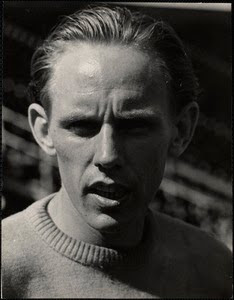
Tony Sneazwell

Ron Clarke and Tony

Old Boys Crest of
Parade College where Tony attended public school and is now a distinguished alum

Sneazwell can be seen jumping at the following site.  Your computer may or may not be able to open it.
http://www.t3licensing.com/video/clip/48050225_9300.do

There is emphasis on the Olympic Games, both '64 and '68. Mexico City has been awarded the '68 Games, edging Detroit and Lyon, France 30-14-12 in the International Olympic Committee voting. Tokyo just held a dry run meet to get the kinks out before hosting next year's Games.
The Tokyo meet, the highlight of Tokyo International Sports Week, was held in mid-October, the same dates as next year's OGs. As this meet was not the focal point of athletic competition this year, it was too late for most of the top athletes to either show up or perform well, Sneazwell being the obvious exception.
The correction department: Remember the problem TFN had getting Mike or Jim Wood's name right? When last we visited that issue the young man was Jim. Not so any more. Now we are back to Mike. Stay tuned for further developments. .....Bill Baillie's WRs at ten miles and one hour also bear some adjustment. The track world has been taken aback by the correction of time and distance. After some study, the New Zealand AAA changed his one hour distance from 12 miles 960 yards to 12 miles 961 yards and his ten mile time from 48:10 to 48:09. Honest. (Anything to get those numbers a bit further out in the "Twilight Zone").
Take this for what it is worth. Dick Drake's On Your Marks column includes mention of this paragraph from the March issue of Ontario Track Monthly. “A Japanese TV unit visited New Zealand to film an exhibition mile among Arthur Lydiard's four best milers, but everything went wrong. Halberg left his spikes at home, he and Baillie forgot to wear their NZ vests and Lydiard lost his stopwatch. Snell finished last. (ed note: Do you get the feeling that somebody isn't really trying here?) On top of that, the TV camera ran out of film after three laps and Baillie, the winner, missed the starring roll of his life.” As the old saying goes, some days you shoulda just stood in bed.

Jim Dunaway in his appropriately named “Jim Dunaway Says” column takes on the failure the United States has had with its 400 relay teams in recent big meets. Citing disqualifications in the recent dual with the Soviet Union and the 1960 Olympic final, along with our 1956 Olympic win by a scant three yards over a mediocre USSR team, he cites the lack of practice as the cause. We have the best sprinters in the world, yet they don't have the sufficient opportunity to work together to achieve flawless baton passing. He lists three possible solutions which don't sound bad. The first is to have the fourth through seventh place finishers in the 100 be the team. They would be able to work together on a daily basis to perfect their passing. Now that the NCAA has the 400 relay in its championship meet, his second suggestion is that the US team should be the winner of that meet, thus providing a proven product. His third proposition would be to qualify teams that have placed in the top two at a major relay meet (Mt. SAC, Penn, Drake, Modesto, etc.) and have a runoff the day before the AAU meet.
There are two pages of Letters to the Editor. They run the gamut from a coach who has a seven year old who has run the 220 in 36.4 and adds, “I challenge anyone to top this mark”, (picture 7 year-olds across the country, putting down their crayons, turning off Bullwinkle, lacing up their spikes yelling, "Oh, yeah, we'll see about that!") then says that he believes the kid could run 35.0 “with longer training”.
At the other end of the spectrum is a tongue-in-cheek letter in which the writer mentions that he has seen that next year's Olympic schedule includes something called the “long jump” and encourages the NCAA and the AAU “to schedule this event – whatever it is – so that athletes from the US will not be completely shut out”. Could it be that the broad jump will finally go the way of the hop-step-jump and be replaced by a spiffy new name?
A page and a half is devoted to an article by European correspondent, R.L. Quercetani entitled “Athletes of the Century”. The title might be more accurately “Athletes of the Decade”, as he has listed the top three for each ten year period from 1900. Here goes - 1901-1910: 1) Alfred Shrubb (distance, Great Britain) 2) Melvin Sheppard (distance, US) 3) Ralph Rose (shot put, US) 1911- 1920: 1) Hannes Kolehmainen (distance, Finland)

2) Jim Thorpe (decathlon, US) 3) Ted Meredith (440, 880, US) 1921-1930: 1) Paavo Nurmi (distance, Finland) 2) Charlie Paddock, (sprints, US) 3) William Dehart Hubbard (100, broad jump, US) 1931-1940: 1) Jesse Owens (sprints, broad jump, US) 2) Rudolph Harbig (800, Germany)

Rudolf Harbig

Harbig in Berlin
Harbig (coat slung over shoulder) on the streets of Budapest, 1940
He competed until 1942 when he went off to war. He perished
in the Ukraine in 1944.
 
 3) Matti Jarvinen (javelin, Finland) 1941-1950: 1) Gundar Haag (distance, Sweden)
 
Haag defeating Arne Andersson in a 4:02 mile
 2) Cornelius Warmerdam (pole vault, US) 3) Harrison Dillard (hurdles, sprints, US) 1951-1960: 1) Emil Zatopek (distance, Czechoslavakia) 2) Herb Elliot (distance, Australia) 3) Bobby Morrow (sprints, US). He lists as favorites for the decade of the sixties Valeriy Brumel, Al Oerter and Peter Snell. Obviously there were athletes whose greatest years were in two decades making it tough for them to be ranked higher than one whose career was mostly in the same decade. Bob Mathias, whose Olympic decathlon victories came in 1948 and 1952, would be a prime example.
Undoubtedly these rankings will be the subject of long and loud arguments when the gang gathers for the regular Friday night track gabfest at the Dew Drop Inn. Let your reporter start the ball rolling by respectfully inquiring how the hell Bobby Morrow got ranked ahead of Parry O'Brien. O'Brien won two Olympic gold medals in the shot put, dominated the event by breaking the WR 17 times in the six year period he was the record holder, and reinvented the method of shot putting. And Paddock over Hubbard? Are you serious? Don't get me started.......Okay, that should get you guys through the first pitcher. After that you're on your own.


Dehart Hubbard  first African American
Olympic Gold medallist
Dehart Hubbard's Gold Medal
Hubbard in Action for the US


Alfred Schrubb


Wanna know more about Mel Sheppard? This is from the website of Rebecca Jenkins,author
www.rebeccajenkins.com     excerpt from her book  The First London Olympics, 1908 .


The Almost Milers

Wednesday August 8, 2012

The 1,500 meter competition was one of the most exciting of the first London Olympics.   It took place in the opening week in the stadium on the 13th and 14th of July 1908.   The weather wasn’t good, but the field – for the time – was.  

The Brits expected to win easily.     They had a strong team led by George Butterfield, the holder of the AAA title from 1905-1907 and the man who ran the world’s fastest mile in 1906.   Butterfield, born in Stockton on Tees in the North East of England, was a 29 year old barman from Darlington who ran with Darlington Harriers.    The local press liked to tell how he once ran a race with a greyhound.  The dog came in second.

George Butterfield, however, fell foul of an issue that caused great controversy among the visiting athletes at the first London Olympics – namely, the British Athletics organisers’ insistence that only the winner of each heat should qualify for the final.    The American team protested from the very beginning this local quirk, for it meant that it came down to the luck of the draw as to whether a country's best medal hopes were pitted against one another in a first round heat.  (The draws were made in secret too – which didn’t help confidence.)
In the 1,500 contest, for instance, GB’s Joe Deakin, winner of Heat 6, got into the final with a time of 4:13.6 when George Butterfield was knocked out with a time of 4:11.8 because he had the misfortune to be drawn in Heat 2 alongside the US star of the Irish American AC, Mel Sheppard.  Unfortunately for George, in Heat 2 Mel Sheppard, a 24 year old from New Jersey, set a new Olympic record with a time of 4:05.0.
(This was all the more unfortunate, since Joe Deakin was running in the team race later that day and had been asked to save his energies for that - so he was never likely to do that well in the 1,500 m.)

Sheppard’s record didn’t stand very long that time.   In the very next heat, Britain’s Norman Hallows, a 21 year old from Doncaster studying at Oxford University, broke it with a time 4:03.4, only just defeating Italy’s Emilio Lunghi, whose time of 4:03.8 would have won any of the other seven heats.
The British, however, were still confident they would carry off gold.   Their bet was on little HA Wilson, a 5ft 4 tall, 22-year-old born in Horncastle, Lincoln who had won the British Olympic trials with a world record setting time of 3:59.9 that May.

Besides, numerically speaking, the odds were in favour of Team GB.   Among the eight runners who lined up for the final, at 17.20 on Tuesday, 14 of July, five were British.   They  faced one Canadian, John Tait and two American champions from the famous Irish American Athletic Club of New York: Mel Sheppard  and Jim Sullivan – knicknamed “4:22 Jim” by his team-mates for running the mile in 4:22.5 in 1905.   (For those, like me, confused by the difference – the mile translates as 1,609.35 meters and so takes a bit longer to run than the 1,500 meter race.)
The weather that Tuesday wasn’t conducive to great performances.   ‘The temperature was low,’ one sports journalist recorded, ‘and a strong wind, laden with moisture, blew across the field, where the athletes sat shivering in blankets.’   At the best count, only 18,000 spectators sat huddled on the benches of the 80,000 seater White City stadium braving the mizzle.
The race, however, was thrilling.   Irishman Ivo Fairbairn-Crawford, a student at Dublin University, led off, holding his lead until the last third of the race, pressed by Wilson and JP Sullivan.   Then, on the back straight Wilson pulled ahead with Norman Hallows at his heels.

 [Wilson] ‘led at the last bend, making the pace a cracker,’ wrote the Sporting Life reporter, ‘while Sullivan closed up with Hallows, but in the straight Sheppard came at a great pace, and, catching Wilson about 15 yards from the tape, won a grand race by about a couple of yards; Hallows, about 10 yards away, third.  Sullivan, who was lying fourth close to home, did not pass the judges.’
Mel Sheppard had matched Norman Hallow’s freshly made Olympic record with a time of  4:03.4.       Sheppard's gold medal was one of 8 Olympic gold medals won by members of the Irish American Athletic Club of New York that year.    8 medals out of  the 13  Olympic gold medals the track and field stars of the US team brought back from the first London Olympics (out of a possible 23 firsts open for contest in track and field that Olympics).  It was a glorious achievement.
Mel Sheppard with the US team manager, Matt Halpin, at the WhiteCity Stadium, July 14 1908


Tuesday, April 23, 2013

Vol. 3 No. 25 August , 1963 The European Tour


August 1963
Pack your bags and put on your traveling clothes. We're going on a two week tour of Europe with stops in the Soviet Union, Poland, West Germany and Great Britain.
But first let's chronicle the European efforts of Americans previous to the national dual meets. On July 13 in London's White City Stadium John Pennel betters Brian Sternberg's 16-8 world record by ¾ of and inch.
Buddy Edelen
In the same stadium on the previous day Buddy Edelen runs six miles in an American record 28:00.8 in finishing fourth in the AAA meet.


We have our first Willie Davenport sighting. He is described as “an American serviceman” who hurdles 14.0 and 14.1. Mention is made that he has run 13.9, but the magazine doesn't have the details yet.


An even earlier sighting , Willie Davenport's 7th Grade photo at Warren , OH , Howland HS 1958
He is in the middle row on the left

Last month's issue had an article on Steve Haas' great potential as a half miler. The Occidental student loses a couple tactical 800s then finishes his tour by dropping down to his former specialties, winning a 46.7 400 and losing a wind-aided 21.0 200.
And now, buckle your seat belts. We are off for Moscow for the long awaited dual with the Soviet Union where 140,000 watch the two day affair won by the US by the dangerously close score of 119-114.
If this meet is notable for a single event, it is the high jump where Russian hero Valeriy Brumel tacks half an inch on to his world record with a 7-5¾ jump. Two come through performances keep the US from an embarrassing defeat. Long jump world record holder Igor Ter-Ovanesyan has five jumps over 26 feet to two for Ralph Boston, but Boston hits the big one, 26-10½ to top T-O's 26-5¾.
The other athlete to put on his big boy pants is Hal Connolly. The WR holder in the hammer has been plagued by back pain that kept him from competing in the AAU meet. His back is better and he arrives as a late entry from Tampere, Finland where he has been teaching. After four rounds the Soviets are 1-2. Connolly and Al Hall trail. Given the 5-3-2-1 scoring system, if the event ends this way, the Russians will win 8 to 3, an advantage that would project the meet's outcome to a 117-116 Soviet victory. Not to worry. The Olympic champion steps into a phone booth to put on his Superman costume and returns to throw 219-0 to better the Ruskies by three feet.
Edvin Ozolin
The fact that the Russians were this close can be laid off to surprises in the sprints, hurdles and relay. Bob Hayes wins the 100 easily, but Edvin Ozolin 

catches Johnny Gilbert at the tape for second. Ulis Williams supplies the expected win in the 400 at 46.2, but Lester Milburn fades to third behind Russian Vadim Arkhipcuk whose 46.3 is a Soviet record.
Blaine Lindgren with his University of Utah coaches
Marv Hess and Gordon Mortenson
If there is any running event in which the US has a lock, it is the hurdles, but on this day the world is spinning off its axis. Hayes Jones is a tried and true veteran, the only American to compete in all five dual meets with the USSR, yet he is flustered. He false starts and stops although the starter has not recalled the field. Jones says, “I jumped. I was guilty, so I stopped. I told the starter and he fired the recall.” (You can do that?) In the meantime Russian Anatoly Mikhailov outleans Blaine Lindgren at the tape.

 The race is rerun later in the day to the accompaniment of the whistling crowd. A similar thing happens. Jones, thinking he has false started, slows at the second hurdle before changing gears too late. The starter is saved from a life in a Siberian gulag as Mikhailov once again beats Lindgren, 13.8 to 13.9, with Jones third at 14.0.

Hayes Jones at Pontiac HS in Michigan
Those upsets would have been unnoticed were it not for the major screw up in the 400 relay. The 10 meter run up zone before the 20 meter passing zone has just been legislated. Our team has had a year to become acquainted with the new rule, but instead treats it as if it has fallen from outer space. Johnny Gilbert makes a good pass to John Moon, but then the comedy of errors begins. Moon passes too soon to Paul Drayton who does the same to Bob Hayes. The US goes on to win in an unofficial 39.3, but there is no doubt the disqualification is warranted. The Russians earn five points for 40.2. Our guys had only three days to work on passes, but how tough is it to leave early enough that the incoming runner doesn't reach you in the run up zone? Drayton confuses the situation further with his explanation, “There is a new relay rule, and some confusion about it. You can get the baton in the first ten meters, but you can't run with it.” Paul, grab the other guys and come over here. We need to talk.
Fortunately no such problem presents itself in the 1600 relay. Ulis Williams, Ray Saddler, Lester Milburn and Rex Cawley put it together to thump the Ruskies by four seconds in 3:04.4.
The US has a problem in the 400 hurdles. Jim Allen is injured or Jim Allen is sick, depending on whose report you read. Whatever the case, Jim Allen is not competing. What to do? Wait a minute, Willie Atterberry is competing in Europe. Let's give him a call and see if he is busy. He is not. He arrives the day before the race. Good thing he did because he wins it, passing a went-out-too-fast Rex Cawley for a 50.4 to 50.9 victory.
The 800 provides an anxious moment. Valeriy Bulyshev catches Jim Dupree 30 meters from home, but Dupree holds him off for a 1:47.8 victory. Morgan Groth is third at 1:48.6.
Dyrol Burleson and Tom O'Hara go 1-2 in the 1500 at 3:41.0 and 3:41.2, but that is it for American distance running in this meet. The Soviets sweep the steeplechase, 5000 and 10,000. Same thing happens in the 20,000 meter walk.
Dave Davis and Parry O'Brien take the shot with Davis winning by a quarter of an inch at 61-11¼. Jay Silvester and Rink Babka do the same in the discus though the margin between them is greater. Silvester's 201-7 gives him a 16 foot advantage over his teammate.


There seems to be some disagreement over the way the team conducted itself off the track. Did they go wild under the bright lights and sinful offerings of 1963 Moscow? In his column Jim Dunaway takes on other journalists for erroneously reporting “loose living” and “wine, women and song” stories. On the other hand, Parry O'Brien says, “Some of our people were not a credit to the flag they represented.” Taking a moderate position is head coach Payton Jordan. “The team attitude was not unusual at the start of the trip when you consider all factors. We were together as a team for the first time – on a long trip, with new environment and food, and most important with basically a young team that had to adjust to many new and strange circumstances.”
Five days have passed and now we are in Warsaw to take on the Poles in a two day meet which plays out pretty much as expected. But that doesn't mean there is no drama and a modicum of frustration.
Josef Schmidt

John Pennel jumped 16-8¾ two weeks ago to better the world record. Now, with victory assured, he asks for the bar to be set at 16-9¼ (5.11 meters). The bar is placed and measured at that height. It appears that we are good to go. It is growing dark and for some reason not explained, there are no lights. What to do? That's right, cars are brought onto the field and the rest of the event is illuminated by their headlights. Pennel is a trooper. Down the runway he comes and over he goes with some to spare. A new world record! Not so fast, Bucky. We have to remeasure. For some reason known only to God and the Polish officials the bar is now at 16-9. Okay, still a world record! Once again you are jumping to conclusions. To be submitted for a world record the height must be in meters. Sixteen feet, nine inches converts to 5.105 meters, but only centimeters can be considered so the official height is 5.10 meters. Guess what that is in English measurement. Yep, 16-8¾, equal to his existing record. To recap. He thought he was jumping half an inch over his record, but it was only a quarter inch which turned into exactly the same height he had jumped before.
Fortunately the rest of the meet is less confusing. As expected, Hayes, Carr and Williams take the sprints in 10.2, 20.8 and 45.8, Jones and Cawley are hurdle winners in 13.6 and 50.8 and our relay teams win in 39.6 and 3:03.5. No splits are given.
The feature race for the Polish fans is the 1500 where local hero Witold Baran takes on Dyrol Burleson and Tom O'Hara. Nobody wants to lead so the race comes down to the last lap. Burleson takes over on the backstretch and holds off challenges to win in 3:50.0 to O'Hara's 3:50.2 and Baran's 3:50.4. No splits are given.
A couple collegiate records are set. Villanova's Pat Traynor wins the steeplechase and lowers the record he already owns to 8:43.6. Jim Keefe of Connecticut places a competitive third in the 5000 in 13:59.2, shaving 3.2 seconds off Julio Marin's collegiate record.
After last week's big match up with Igor Ter-Ovanesyan, Ralph Boston can't come within a foot of his mark that day and Darryl Horn tops him 25-10¾ to 25-9.
At the end of what had to be a long two days for the Polish fans, they can take pride in the performance of Josef Schmidt. The world record holder in the triple jump takes the event in 55-03/4, nine inches off his record to lead a Polish sweep. US 125 Poland 85.
If this is July 31 we must be in Germany. And indeed it is and we are, specifically Hanover, Germany where we will take on the West German team. Payton Jordan has shuffled his cards. Several athletes are running events in which they usually don't compete.
The spotlight is on Bob Hayes and Henry Carr. Hayes is moving up to the 200 and Carr to the 400. At the end of the two days Payton Jordan says he has witnessed “the greatest 100 meters ever run”. No, not the open hundred which Hayes wins in 10.2, but the anchor leg of the 400 meter relay where he takes the baton five meters down and blazes to a one meter victory. Not sure what Hayes Jones, John Moon and Paul Drayton were doing to produce such a deficit, but they all need to give old Bob a pat on the back.


John Moon in his coaching days at Seton Hall

 For a guy who doesn't train all that often, Hayes looks pretty good in the 200, winning by a meter over Drayton in 20.6.
And now to the 400. Arizona State teammate Ulis Williams has been given a day off and Henry Carr has a much awaited shot at the open 400, his first since high school. Running inside Manfred Kinder, Carr catches him in the 120 meters and pulls away for a 45.4 win, leaving Kinder well back at 46.2.
Think Hayes did well in his anchor leg? Well, so did Carr. With teammates Williams, Milburn and Cawley shooting for the world record in the 1600 relay, Carr sizzles a 44.3. No other splits are given.
Morgan Groth and Tom O'Hara switch events. O'Hara bests Jim Dupree in the 800, 1:49.3 to 1:49.7. Groth tops Cary Weisiger in the 1500 3:42.4 to 3:43.1. Again no splits are given nor are they in any race description on the tour.
A less than a week ago Jim Keefe broke the collegiate 5000 record. Today he adds the 10,000 with his 29:28.4 second place.
Jim Allen just keeps improving. Today he lowers his PR in the intermediates to 50.1 as he and Rex Cawley hit the tape together. Cawley gets the nod, but there is definitely a new kid on the block.
The final tally is US 141 WG 82.
Now the US team is in London for the dual with Great Britain at White City Stadium where the distances will be in English measurement. Like its predecessors, this is a two day meet. The oddity is that there is a day off between the days of competition. As with the other meets, there is no indication of which events are on which days.
Clearly our guys have stayed at the dance too long. They are tired and it shows. This not to say that those who paid their hard earned shillings for a ticket were disappointed. No, indeed, they saw a world record broken and another tied.
Not surprisingly, the broken record is the pole vault and John Pennel is the guy who does it. With two 16-8¾'s in the bank, Pennel decides to try a height high enough not to have the conversion problems of last week. The bar is set at 16-10¼. After two misses, he clears, but once again there are problems in converting. For a height to be recognized by the IAAF as a record the mark must be metric. Pennel's 16-10¼ equates to 5.136 meters. The more alert among you, cognizant of the situation in the Polish meet, realize that 5.136 will be submitted as 5.13 because marks are rounded down to centimeters. Therefore in English measurement Pennel's record is.....”unknown until made official, but perhaps it will be 16-10”. That is the exact quote on page five of this issue. This sort of sloppy math is unacceptable in the offices of OUTV. We put our top math guy on the problem. After hours of laborious calculations, our guy, who got a passing grade in high school algebra, had the solution. Five point one three meters equals 16 feet 9.96840 inches (he could have carried it out further, but didn't want to show off). In English measurement PV records are rounded down in quarter inch increments. Therefore 5.13 meters converts to 16-9¾. To review: 16'10¼” = 5.136 meters = 5.13 meters = 16 ft 9.96840 inches = 16' 9¾”. Yes, you will be responsible for this on the midterm.
Enough with this math mumbo jumbo, you may be saying. What about that tied world record? The US has been trying to break the 400 relay record with no success. Now our lads have a shot at the 440 relay mark, but there is some confusion as to what mark they are trying to break. The University of Texas has the official 440R record of 39.6, but that was run around one turn. Since 1960 the IAAF accepts only marks made around two turns. That record is 40.0 set last year by the University of Oregon.
Are our guys – Jones, Moon, Drayton and Hayes – ready to redeem themselves for the poor passing that required that superhuman effort by Hayes in the West German meet? The answer is a resounding NO! Last time they got Hayes off five meters down and he won by a meter. This time they mess up the passing sufficiently to create a six yard deficit of which Hayes gets five back and they finish in 40.1. The British team of Olympic silver medalist Peter Radford and three guys named Jones ties the record at 40.0. And no, the Jones boys, Ron, David and Berwyn are not related. Payton Jordan does not mince words in naming the culprit, “Our trouble was in passing, especially by Paul Drayton, who, after all, is not a relay runner.”
Credit has to be given to Ralph Boston, who does his impression of a utility infielder, winning the broad jump at 25-10, placing third in the high jump at 6-6 and fourth in the triple jump at 51-1. Guess there wasn't a lane available in the hurdles. Our guys win 120-91, not that anyone really cares.
Elsewhere in this issue we learn that on August 7 16 year old junior Jim Ryun ran two miles in a high school record of 9:13.8. Good as that is, there is a fasrter 16 year old. The wonderfully named Rex Montague Maddaford of New Zealand holds the 16 year old best of 9:09.3 set in March of this year just nine days after his birthday.  (Rex  Montague Maddaford would go on to make the finals of the 5000 and 10 ,000 meters at Mexico City in 1968 finishing 10th and 12th in those two races.  At least his folks didn't name him Reginald.  His best 10,000 was 28:17.8 on April 17, 1968  while finishing second at the New Zealand Olympic trials.   Speaking of names  Theordorus Jacobus Leonardus  Quax would shorten the whole thing to Dick Quax. ed.)

Jazy in a 1200 m training run prior to Tokyo games
Cordner Nelson predicts that Janis Lusis of Russia will soon break the world record in the javelin. He is more exact in his prediction that France's Michel Jazy will break Peter Snell's mile record. It will happen on August 16 in Goteborg, Germany. 

We'll find out how accurate he is on at least one of those predictions in the next issue.

Page 7 has a photo that causes you to look twice. It is a shot of the handoff to the anchorman in a 440 relay in Dublin, Ireland. Larry Questad is making the pass. The teammates previous to him were Steve Cortright and Steve Hass. Clutching the baton is anchorman Pat Boone. Yes, the singer, that Pat Boone. He holds a sizable lead at this point with no opposition in sight, and holds off “fast closing” Noel Carroll for a narrow win. No other information is given.  (I am looking for evidence of this relay with Pat Boone, and will publish any confirmation at a later date.  ed. 


Bill Crothers and Harry Jerome
Talk about provincial, until this year if a Canadian were to set a national record, it had to be on Canadian soil. Marks that didn't qualify are last year's 46.2 by Bill Crothers, Harry Jerome's 20.7 and Bruce Kidd's 13:17.4 3M. Imagine setting a world record and/or winning Olympic gold and not having it count for a national record. Silly Canucks.
Bruce Kidd

Each year Track and Field News publishes its national record relay rankings, a subjective listing of seven relays (440, 880, mile, 2M, 4M, sprint medley and distance medley) and awards points on a 10-8-6-4-2-1 basis. This year's winner is Texas Southern with 34 points, followed by Arizona State 26, Oregon State 20, USC 17 and the Striders 16. TSU is first in the 440 and second in the 880, mile and sprint medley. Arizona State and Oregon State are ranked first in two events: ASU 880 and mile, OSU 2M and DMR. USC and Fordham are the other first place winners in the SMR and 4M respectively.
As long as we are on the subject of relays, a round of applause is warranted for the NCAA rules committee's decision to include the 440 relay and the mile relay in future championship meets, an inclusion a long time coming. The committee also decided that the NCAA indoor meet will be held February 29 in Portland and Louisville “and perhaps elsewhere”. Not sure how that works.
Page 22 is filled with letters to the editor. We will close with the most poignant. Mrs. Dorothy B. Juola of East Lansing, Michigan writes “Enclosed please find $.50. Would it be possible to send the July, 1963 copy of Track and Field News to me as quickly as possible? You see, while cleaning house this morning, I misplaced my husband's copy. (“You threw it away.”) As you must know, that is practically grounds for divorce, and we have been married only four months. Please help me save this otherwise very short-lived marriage.” Questions abound. Did the brothers Nelson comply and eat the cost of postage? Did this save the marriage? Are the Juolas still together and living in a retirement community in Tarpon Springs, Florida?  (Mrs. Juola may want to pick up a copy of the 1962 best seller "Sex and the Single Girl" by Helen Gurley Brown, if she doesn't come up with the July issue.)

Here are two obituaries I found while researching this current issue.  Both Willie Davenport and Pat Traynor are mentioned in this posting. ed. 


Pat Traynor - obituary

Clinical pychologist and former track star who was an all-American steeplechase champion at Villanova University, died at home Saturday from apparent heart failure.
Mr. Traynor grew up in Havertown. He signed up for the track team at Monsignor Bonner High School to get in shape for basketball, his first love, his son Patrick Jr. said.
Mr. Traynor played both sports at Bonner, and was Catholic League cross-country and mile champion. After graduating from Bonner in 1959, he moved on to Villanova to run for famed coach Jumbo Elliott.
Elliott determined the 6-foot-2 athlete's strengths. "Traynor can't run very well indoors," he told a reporter in 1962. "He's like a big elephant, flopping around on the track."
Outdoors, though, Elliott said, Mr. Traynor could run anything from a mile on up, and the coach made him a steeplechaser. The event requires running and jumping hurdles and into puddles of water for nearly two miles.
In 1962, Mr. Traynor was voted most outstanding male college athlete at the Penn Relays, in which he won two long-distance races and came in second in the steeplechase to Deacon Jones, a former Olympian.
Mr. Traynor was an NCAA all-American in the steeplechase in 1961 and 1962, and won the national AAU steeplechase championship in 1962 and 1963. He also won the AAU's 10,000-meter cross-country championship in 1963.
"I never saw a kid with more determination," Villanova trainer Jake Nevin told a reporter in 1962. "Tell Pat to take it easy, and he says, 'No, I want to work out twice today.' You find guys who are big stars who don't work half as hard."
Mr. Traynor once told a reporter that he had read Alan Sillitoe's The Loneliness of a Long Distance Runner. "The guy in it was a nut," he said, "and all of us have some of him in us."
After graduating with a history degree from Villanova in 1963, Mr. Traynor ran competitively while teaching at Sayre Junior High School in Philadelphia. In 1964, he qualified for the Olympics in Tokyo, but came down with a case of food poisoning at the trials and was chosen as an alternate.
From 1965 to '69, Mr. Traynor served in the Air Force and competed with the track team. He hoped to run the steeplechase at the 1968 Olympics in Mexico City, but did poorly in high-altitude trials in Lake Tahoe. While competing as a member of the National Track and Field team that year, he ran a mile in just under four minutes (3:59.6).
After his discharge from the service, he returned to teaching and then counseled families and patients at health centers in Philadelphia for 30 years. At the time of his death, he was head administrator at the New Life Clinic, an outpatient mental-health facility in Northeast Philadelphia.
Mr. Traynor was a member of the Monsignor Bonner Hall of Fame and the Villanova University Varsity Club Hall of Fame. He attended the annual Penn Relays and was a fan of Villanova basketball and track and field.
He also enjoyed painting landscapes, Irish music, and spending time with his grandchildren, his son said.

Contact staff writer Sally A. Downey at 215-854-2913 or sdowney@phillynews.com.

Willie Davenport, 59; Olympic Champions
June 19, 2002|JOHN ORTEGA | LOS ANGELES


TIMES STAFF WRITER

    • Email
      Share


Willie Davenport, the 1968 Olympic champion in the men's 110-meter high hurdles and one of the first African American athletes to represent the United States in the Winter Olympics, has died. He was 59.
Davenport was changing planes at O'Hare International Airport in Chicago on Monday when he collapsed, apparently from a heart attack. He was pronounced dead at Resurrection Medical Center, a hospital spokesman said.


V 15 N. 10 Gunder 'The Wunder' Haegg Visits Cincinnati

Bob Roncker of Cincinnati, Ohio has sent in this account of one day on the 1943 tour that Gunder Haegg of Sweden made to the US to help rais...