SEPTEMBER 1962
The season has pretty much run its course in the US, so Mihali Igloi takes Jim Grelle, Lazlo Tabori, Bob Seaman and Jim Beatty on a European Tour. Let's see how it turns out.
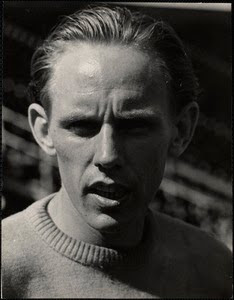
Igloi
Tabori
Beatty defeating Jazy at L.A. Times
Jim Grelle
Bob Seaman
The first meet on August 6 on London's White City track goes less than well. The four are entered in the 2000 meters, but there is no hope of a fast time because rain has turned the track into a sea of mud. Grelle, Beatty and Tabori drop out, deciding “not to risk injuries and jeopardize the rest of the tour”. Seaman toughs out a 5:20 second place behind Derek Ibbotson's 5:19.2. The British press is not kind. “This regrettable and most unheroic showing could be interpreted as underlying the need for a more Spartan American cross country season.” Ouch!
The second stop came three rainy days later on Oslo's famed Bislet track where the quartet is entered in the 1500. The sun makes an appearance by race time, but the track is anything but fast. Igloi wants a quick first lap and he gets it. Seaman takes it out in 56.4. Beatty is a tenth back before moving into the lead on the second lap and passing the 800 in 1:57.0 and the 1200 a minute later. Grelle makes it interesting, closing on Beatty on the final curve, but the American record holder lifts in the last 60 to win and take half a second off his record with a 3:39.4. Grelle and Seaman clock personal bests of 3:40.2 and 3:42.7 in second and third. Tabori, unsure of his fitness, surprises himself with a 3:43.9 for fourth.
If this is August 15 we must be in France, right? Avranches to be exact where it is cold, wet and windy. A match between Michel Jazy and Beatty has been anticipated, but for some reason doesn't come off. Jazy runs the mile. Beatty is entered in the 3000 with the goal of breaking Jazy's world record of 7:49.2. He is joined by Tabori and Grelle. The home country opposition will come from Michel Bernard. Tabori does the donkey work for the first two laps before Beatty takes over, closely followed by Bernard. The two of them quickly separate from the field. The 1000 passes in 2:36.0, but the second 1000, completed in 5:16.2, puts them 4.2 seconds behind Jazy's pace, eliminating any hope for the record. Bernard doesn't lack for courage, but Beatty pulls away on the last lap for 7:54.2 to 7:56.0 victory and the American record. Grelle is third in 8:13.8. Tabori injures his Achilles and finishes fourth in 8:21.0 and “is of little use the rest of the tour”.
Seaman takes on Jazy in the mile. After a slow 3:07.0 three quarters that costs Jazy his first four minute mile, the Frenchman goes to the afterburners that Seaman doesn't have and wins 4:01.4 to 4:03.6.
Michel Jazy
And now it is August 18 and we are back at White City where a dry track awaits. The goal is to show the British press what they can do in the feature event, the mile. Once again it is Seaman doing the work on the first go round at 57.5 and once again Beatty is a tenth back. Grelle takes over on the second lap with Beatty coming aside at the 880 in 1:58.2. Now Beatty is on his own. He completes three laps in 2:58.8 with Grelle in close attendance. In fact, Grelle is running the race of his life. With half a lap to go, he does the unthinkable, passing Beatty and taking the lead. However the North Carolina grad is not done. He rallies to pull even at the 1500 in 3:41.3. Surprisingly Seaman, also running the race of his life, is only six tenths back. Down the straight they come. Gradually, Beatty's strength begins to pay off. He hits the tape a couple yards ahead of Grelle in a US record of 3:56.5. Grelle runs 3:56.7. Britain's Stan Taylor catches Seaman at the tape with both being timed in 3:58.0. Smiles all the way around as the four have produced PR's. Taylor is the first Britain to break four on English soil. the editor must take umbrage with this fact. Obviously Bannister was the first Englishman to break four minutes on English soil. Checking the records Derek Ibbotson ran 3:57 in London in 1957. Other British runners who preceded Taylor in breaking 4 minutes, though not necessarily on British soil were Chris Chataway 3:59.8 one year to the day after Bannister's historic race on May 28, 1955, then Brian Hewson in the same race, Ibbotson 3:59.4 on August 6, 1956, Ken Wood 3:59.3 on July 19, 1957, and then Taylor appears to have been the next Brit to break 4 minutes on August 18, 1962, with a time of 3:58.01. ed.
Three days pass and now we are in Helsinki where once again the competition is at four laps. Guess who leads the first lap. If you said Seaman, you would be right. The problem is that he is too fast, 54.5. Beatty follows in 55.5. The pattern is that of the White City race. Grelle takes the second lap with Beatty passing him at the half mile with both at 1:55.6. The pace slows predictably on the third lap with the bell reached in 2:58.0. Although by himself at this point, Beatty has enough in the tank to close in 58.3 and finish in 3:56.3 thus breaking his own American record. Once again Grelle is second, this time in 3:58.8. Olavi Salonen delights the Finnish crowd with a 3:59.1 for a national record. Seaman and Tabori are fourth and fifth in 4:01.8 and 4:06.2.
Olavi Salonen
I call this the Flying Olavi's
Olavi Salonen 135 (2nd) 3:40..2 , Olavi Vuorisalo 221 (3rd) 3:40.3 , and Olavi Salsola 12 (1st) 3:40.2
all defeating Dan Waern 7 (4th) 3:40.8 in Turku, Finland July 11, 1957.
Obviously 'Olavi' loosely translates as 'fleet of foot' in Finnish. Of note in
this race, Matti Nurmi, Paavo Nurmi's son finished a distant ninth place 2.2
seconds slower than Paavo's personal record for 1500m.
Three days later and we are still in Finland, this time in Turku where the order of the day is a rainy 50 degrees. The feature race is the 5000 where Beatty is taking a shot at Vladimir Kuts' 13:35.0 WR. The track is wet and the competition less than competitive. Tabori takes the lead on the first and third laps with Beatty leading the second and fourth. From this point the LATC star is on his own. His kilometer splits are 2:40.6, 2:45.2 (5:25.8), 2:48.2 (8:14.0), 2:49.0 (11:03.0) and 2:42.0 for 13:45.0 and yet another American record. Oh, make that two American records while you are at it, as he passes three miles 13:19.2. One has to believe that, given competition, a dry track and proper rest, the world record is within his grasp next season.
Perhaps Igloli's boys stayed at the dance too long. There is one more meet. (“Another one? Aw, come on, coach.” ) Yep, we are in Borlange, Sweden, on a 382.5 yards to the lap track with three lanes on the backstretch, running 2000 meters. Beatty wins in 5:10.9, only nine tenths off Fred Dwyers' AR. Seaman is second in 5:11.6 with Tabori third at 5:17.4. One would have to think that there were four very relieved distance runners.
Other happenings covered in this issue include Italy's Salvatore Morale's 49.2 400 hurdle clocking, tying Glenn Davis's world record and Harry Jerome's two 9.2 100 yards, tying Bob Hayes and Frank Budd. Pytor Bolotnikov revises his 10,000 WR by six tenths with a 28:18.2 performance.
Do you consider cross country among Peter Snell's strengths? Me neither, but we are both wrong. He is the 1962 New Zealand cross county champion, covering a manly 6¾ mile course “with a tough hill on each of three laps and 33 obstacles, some of them over five feet high” in 35:36 to win by 41 seconds.
After much foot dragging, the NCAA has finally entered the 20th century, replacing the 220 lows with the 330 intermediates, adding the triple jump to all meets and the six mile to the championships and increasing the championship meet to three days. Equally important is the inclusion of tie breaking rules on misses and attempts in the high jump and pole vault, something that has been standard in the AAU meets for years.
Page 16 has the national relay rankings. Oregon shows pretty good range, winning the 440, the two mile, four mile and distance medley. Texas Southern tops the 880, Arizona State the mile and Santa Clara Valley Youth Village the sprint medley.
In Bert Nelson's “Of People and Things” column he makes two suggestions that sound reasonable. He proposes running the two mile in high school meets and, to spice up invitational meets and make the decathlon more popular, having half a decathlon (not a pentathlon, but the first or second day of a decathlon or any combination thereof) in major meets.
Odds and ends: John Uesles has been suspended by the Florida Gold Coast AAU for “demanding and receiving $185” for competing in a local meet......Former Texas sprinter Dean Smith has been given a feature role in the movie “PT 109”......Grace Butcher recently ran a 5:04 mile in practice, believed to be the fastest ever by an American woman......As the mile started in a meet in Branford, Canada an unidentified runner left the stands and jumped in the race, taking the lead by the half and winning in 4:46 only to keep running to a waiting car and driving off. Who was that masked man? We'd like to thank him. Hi-Yo, Silver, away!......An undocumented survey of top US athletes occupations reveals that the most common field of employment is teaching followed by sales. Among those with less common fields of endeavor are Parry O'Brien – banker
April 23, 2007
Parry O'Brien, whose fascination with the shotput and physics fueled a career in which he held the world record from 1953 to 1959 and won two gold medals and a silver medal in four Olympic games, has died. He was 75.
O'Brien, who revolutionized the sport by devising a new throwing technique, died Saturday while participating in a masters' swim meet in Santa Clarita. His wife, Terry, with whom he lived in the Rancho Belago section of Moreno Valley, said he had suffered a heart attack.,
Mike Herman – stock broker, Willie Atterberry – laboratory technologist, Jay Silvester – field engineer for a scale company, Pete Mundle – statistical consultant, Buzz Sawyer – draftman, Jim Beatty – insurance claim adjuster, Herm Wyatt – juvenile counselor, Phil Conley – mechanical engineer, Kent Floerke – claims adjuster, Doug Smith – bank employee, Herm Stokes – instructor at the Philadelphia Police Academy, Alex Breckenridge – career Marine officer, Ira Davis – personnel manager and Ron Ulrich – computing analyst. Some are still in school. Keith Thomassen and Jerry Siebert are graduate students in physics. Bob Vinton is in law school. John Gutknecht is a graduate student in biology. As satisfying as those sound, for pure sexiness none match the employment of Terry Beucher. He is a jet pilot in the Air Force......In case you thought track and field was over for the year, let me remind you that the British Commonwealth Games will be held Nov. 22 - Dec. 1 in Perth, Australia. Be sure to stay tuned.