Beginning our 14th year and 1,200+ postings. A blog for athletes and fans of 20th century Track and Field culled from articles in sports journals of the day, original articles, book reviews, and commentaries from readers who lived and ran and coached in that era. We're equivalent to an Amer. Legion post of Track and Field but without cheap beer. You may contact us directly at irathermediate@gmail.com or write a comment below. George Brose, Courtenay, BC ed.
Once Upon a Time in the Vest
Showing posts with label Vladmir Kuts. Show all posts
Saturday, February 22, 2014
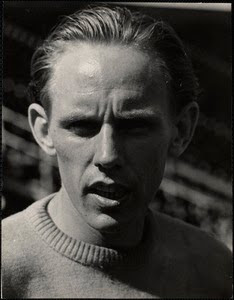
Vol. 4 No. 10 Death of Pytor Bolotnikov
We were recently informed of the passing of the Russian Olympic champion Pytor Bolotnikov, winner of the 1960 Olympic 10,000 meters. Born in 1930, he was orphaned by WWII and was on his own at the age of 14. He became an electrician , moved to Moscow, and to the good fortune of the Track and Field world, he was drafted into the Russian army where he discovered a liking for distance running and received his first coaching. By 1952 he was third in the Russian armed forces 10,000 meters. He was Russia's number two man at Melbourne in 1956 placing 16thin in the 10,000 and 9th in the 5,000 behind Vladmir Kuts who took both races for the Soviets.
The highlight of Bolotnikov's career was his dominating victory at Rome in the 10,000, dominating the field with a last lap 57.4 seconds run winning in 28:32.2. Later in his career he would break the world record for 10,000 twice in 28:18.8 and 28:18.2. source: racingpast.ca
Where is Bolotnikov's hometown? Several references list his birthplace at Zinovkino in Moldova, but there three Zinovkino's in geographical references, none of which is remotely near Moldova. If anyone has a better command of Russian geography and language, please help us out.
"He was a strong runner. It almost appeared he ran in place rotating the earth underneath him."
Richard Trace
IAAF
The athletics world is mourning the death of Russian long distance great Pyotr Bolotnikov at the age of 83 on Dec. 20, 2013
Born 8 March, 1930, in the Mordovian town of Zinovkino, Bolotnikov got the first of his 13 USSR national titles in 1957 when he won the 10,000m, causing a stir when he beat his fellow Soviet legend Vladimir Kuts, who was the world record-holder at the time.
At the 1960 Olympic Games in Rome, Bolotnikov hit the front with 700 metres to go and uncorked a last lap of 57.4 before crossing the line in an Olympic record of 28:32.2, less than two seconds outside Kuts’ world record of 28:30.4.
He was to improve that mark to 28:18.8 later in 1960 at the USSR Team Championships in Kiev and reduced the world record further to 28:18.2 at the 1962 USSR Championships in Moscow.
He won the 1962 European 10,000m title but was surprisingly beaten into third place in the 5000m in Belgrade.
Bolotnikov retired from international athletics in 1965 and became a well-known coach in the former USSR. source iaaf.org
Friday, August 23, 2013
Vol. 3 No. 50 Gordon McKenzie R.I.P.
A great tribute to Gordon McKenzie from Armorytrack.com and Elliott Denman July 24, 2013

Black Marathoners
Two-Time Olympian McKenzie Passes
by Elliott Denman — posted on 7/24/2013
Photo caption: Van Cortlandt Park in 1957, Gordon McKenzie is trailing legendary Ted Corbitt and just ahead of John Sterner.
They called Gordon McKenzie "the civil engineer with a fighting heart" when he ran off with his first American title nearly 59 years ago.
As Track & Field News wrote it in November 1954, "McKenzie won the AAU cross country crown in 29:27.5 at hilly Fairmount Park in Philadelphia, taking the lead a mile and a half from home."
Left in their tracks behind him were 1948-52 Olympic steeplechaser Browning Ross (later the founder of the Road Runners Club of America) and 1952 Olympic steeplechase champion Horace Ashenfelter, still the lone American to win the steeple at the Games in its current format.
Gordon McKenzie would fight on and fight on with the best of the best — nationally and internationally — in a brilliant distance running career that spanned the decades.
That "fighting heart" would carry on — in sport and in life — through July 19, 2013.
Great Neck, N.Y. resident McKenzie, age 86, at last reached his life's finish line after a bout of gall bladdertroubles led to a series of further medical complications.
All those laps McKenzie ran in his lifetime of achievement were surely for the best of purposes.
As an undergraduate, he'd circle the cinders of New York University's Ohio Field in the University Heights section of the Bronx in what seemed like an endless journey.
As a post-collegian, one of his tracks of choice was Macombs Dam Park — later to become the Joe Yancey Memorial Track — again in the Bronx, 161 Street at River Avenue, across the street from Yankee Stadium. And again the lap count seemed endless.
But they were to pay the greatest of dividends. Gordon McKenzie would run his way onto two USA Olympic Teams and much more.
Too few around the sport these days will remember his achievements, which is unfortunate, but some might say that's the way he liked it. The last thing you'd ever expect Gordon McKenzie to do was blow his cover in an outburst of immodesty. Never a full-time runner — as most world-class runners now are — McKenzie instead fit his running life around his job as a City of New York civil engineer, and as a family man.
"He was a very sturdy competitor, an honest competitor, a top-level guy and, most importantly, a very nice person," said Glen Ridge, N.J. resident Ashenfelter. "I'm very saddened to hear this news."
Yet that was the essence of this greatly unsung star of American distance running.
He made his first USA Olympic Team in 1956, running the 10,000 meters at the Melbourne Games, the first Olympics to be held in the Southern Hemisphere.
In those grueling Olympic Trials of 1956, staged in steamy Bakersfield, Calif., New Yorker and NYU alumnus McKenzie — a proud representative of the New York Pioneer Club — ran third in 31:06.8 back of Max Truex,the Indianan at the University of Southern California (30:52.0) and University of Pennsylvania grad Dick Hart(31:06.3).
As a warmup for those Trials, McKenzie lowered the American six-mile record to 29:18.6.
At the Games Down Under, the 10,000 meters was scripted to be a classic duel matching Russia's Vladimir Kuts and Great Britain's Gordon Pirie, but it didn't turn out that way.
Kuts — putting in a series of midrace bursts — would eventually prevail in the Olympic record time of 28:45.6, but Pirie faded to sixth.
Meanwhile, further back, the American trio was duking it out with some of the best of the rest of the world. McKenzie would claim 18th place as top American — his 30:34.3 was close to the USA record — with Hart 21st and Truex a DNF.
By 1960, McKenzie had switched focus from the longest Olympic race on the track to the lone Olympic run on the road.
Up front, this became the classic world-record marathon win by Abebe Bikila, amazingly running the streets of Rome barefoot in 2:15.16. Boston U. grad Johnny Kelley ran 19th, Villanova alumnus Alex Breckenridge30th and McKenzie 48th.
Later, McKenzie would call this "one of the worst races of my life." Never a major-mileage man, he'd seriously overtrained.
McKenzie had earned his trip to the 1960 Games by leading all American finishers at that spring's Boston Marathon in 2:22:18 (his career-PR, just 1:24 back of winner Paavo Kotila of Finland) and then running second to Johnny "The Younger" Kelley in the Yonkers Marathon five weeks later, 2:20:13 to 2:23:46.
With his consecutive Olympic appearances, McKenzie became one of the few Americans to represent the nation on the track and in the marathon in the Games.
It's a small group that has bridged the gap and includes the likes of Joie Ray, Billy Mills, George Young, Frank Shorter and, in recent years, Meb Keflezighi, Abdi Abdirahman, Dathan Ritzenhein and Dan Browne.
At the 1961 Boston Marathon, McKenzie ran fourth, as second American behind over-all winner Eino Oksanenof Finland.
Named to the 1963 USA Pan American Games team, McKenzie flew off to Sao Paulo,. Brazil where he ran a gallant second in difficult conditions, 2:27:55 to 2:31:17, back of winner Fidel Negrete of Mexico.
The McKenzie family and the running sport - they've always been perfect together.
In an AAU-sponsored track and field tour to England in the early 1950's, McKenzie met Christine Slemon, then an up-and-coming English runner considered one of her nation's most promising.
One thing led to another. Their romance bloomed. They'd marry, come to America and settle in Great Neck.
"We had 59 wonderful years together," said tearful Chris McKenzie. "The time's just flown. I don't know where it's gone."
In her English days, Chris McKenzie had been one of her nation's outstanding women runners and her Selsonia Ladies 3x880 relay team had set a world record.
As a new American, she continued excelling at races of all distances for the New York PAL team and for years the McKenzies were recognized as one of the sport's most renowned running couples.
Chris made some headlines of her own at the 1960 Boston Marathon.
As Boston historian Tom Derderian would write it, "Gordon McKenzie was surprised by his pretty English wife, Christine, who popped out of the crowd to yell encouragement at every point on the course she could get to. In her excitement, she kicked off her shoes and ran alongside her husband in her nylon-stockinged feet for distances as long as a quarter-mile.
"Her uninhibited zeal and ability delighted and impressed reporters in the press bus. The next day's papers carried detailed accounts of her running and grabbing motorcycle, police car, and subway rides to keep uip with her husband."
In Britain, she'd set records from the quarter-mile to the three-mile.
But her own bid to make the USA team at the newly-reinstated 800-meter distance in 1960 fell short, after she'd bowed out in the semifinals of the women's Trials.
The McKenzies would maintain their running lifestyle for years and years. Gordon McKenzie was in apparent excellent shape to the end. He'd maintained his running regime until knee problems set in some five years ago — but then switched to walking and he continued walking up to eight miles daily.
McKenzie was forever proud of his Pioneer Club affiliation. While well known for their exploits over shorter distances, and other branches of the sport, the Pioneers also fielded some of the best distance running teams of their day.
Olympic runners McKenzie, Ted Corbitt and Oscar Moore were Pioneer longer-distance greats and they had such illustrious teammates as Lou White, Rudy Mendez, John Sterner, John Conway, Tom O'Brien, John Connolly, Abe Fornes, Rod McNicholl, Charley Robbins, Al Williams and many more.
But the death of Pioneer teammate and training partner Austin Scott — who collapsed and succumbed to heat stroke while competing in the National AAU six-mile in St. Louis in 1954, a race staged in torrid conditions — was one of the saddest moments of his life in the sport.
Gary Corbitt, son of Ted, is one of the sport's most noted historians, and points out that "Gordon was an outstanding miler, too, before stepping up in distance. He'd run fourth in (a PR) 4:12.9 at the Wanamaker Mile at the 1953 Millrose Games and had always hoped to break four minutes.
"Gordon always had an interest in boxing, too; I guess the roadwork translated into his interest in track.
"He was a real student of the sport and a real stickler for time; sure, he always wanted to win and was often a great front-runner, but he always wanted to do the very best he could do timewise.
"He always wanted to push the pace. That was Gordon."
An active member of the Tri-States Olympians association, McKenzie maintained an active interest in the sport over the years.
Gordon and Chris McKenzie are parents of three — eldest son Adam is the long-time track & cross country coach at Great Neck North High School — and grandparents of seven.
Arrangements are by Fairchild Sons, Inc. Funeral Chapel, 1570 Northern Boulevard, Manhasset, N.Y. (Phone 516-627-2000).
Visitation is from 2-5 and 7-9 p.m. Friday, August 2. Burial will be Monday, Aug. 5 at All Saints Cemetery, 855 Middle Neck Road, Great Neck.
Vol. 3 No. 49 Photos from the 1950's
Some great photos from the 1950's, sent by Jerry McFadden , a 4:05 miler from U. of Missouri , 1963. He has contributed a number of pieces to the blog. We ran against each other when I was at the U. of Oklahoma. We both had served in the Peace Corps, he in Morocco, me in Tanzania, both married French women we met overseas. Two of the athletes Jerry coached in Morocco knew me when I lived in Quebec. For thirty years they always asked me if I knew Jerry and where he was. We finally reconnected two years ago. George Brose
George,
George,
I have no idea if these old time photos are of any interest to your blog or not but I thought I would send them along.
2 are of Vladimir Kuts when he set the 5,000 meter world record at 13:46.8 on September 18, 1956 at Belgrade.
Another is of Zatopek during the 10,000 meters at the European Championships at Bern in 1954
2 are of Roger Bannister winning the 1.500 meters at the European Championships at Bern in 1954
Another of Alain Mimoun in front of Becket in the 3 mile in the France vs. GB at White City in August, 1951 in 14.11.4
Finally, a photo of a "young" Michel Jazy defeating Michel Bernard at the French National Championships in August 1956.
All of these were taken from copies of the magazine Le Reflet du Sport that I found at the old booksellers along the river Seine in Paris.
Hope all is going well.
Jerry
![]() |
| Roger Bannister |
![]() |
| Bannister |
![]() |
| Michel Jazy leading Michel Bernard |
![]() |
| Vladimir Kuts |
![]() |
| Kuts |
![]() |
| Mimoun, note the low cut shoes |
![]() |
| Zatopek |
Friday, June 7, 2013
Vol. 3 No. 37 December , 1963
DECEMBER 1963
Last month we gave you the results of the IC4A and NCAA meets. This month we have the USTFF, AAU and NAIA meets, so sit back and enjoy the magic carpet ride back to a simpler time, nearly 50 years ago
Bruce Kidd is 20, but his third decade has not been as kind to him as the second. This year's track season was a disappointment because of a bone inflammation in his left heel which was caused by an accumulation of scar tissue.
He finally raced a bit in Europe at the end of the season with less than satisfying results. As he lines up for the AAU meet in Van Cortlandt Park, there is a question as to his fitness. Last year's winner, Pete McArdle, sees his chance of winning lies in a fast pace. He quickly separates himself from the field. By the 2 ½ mile mark of the 10K race he has 70 yards on Kidd. At 4 miles Kidd hasn't closed the gap and it appears that the handwriting is on the wall. But Kidd isn't done. At cemetery hill he makes his move and within a half mile closes the gap to 10 yards. Gradually he moves to within a yard of the 35 year old leader. In the last mile of hills Kidd repeatedly attempts to pass McArdle, but the game Irish born veteran fights him off until, with 400 yards left, Kidd opens up a three yard lead. McArdle is flat out, but the margin remains the same at the tape.
Kidd may have the championship trophy, but McArdle doesn't go away empty handled. As the first American finisher, his reward is the trip to Brazil for the midnight run through the streets of Sao Paulo, a journey he made last year after winning this race. Billy Mills, competing for the US Marines, takes third, 25 seconds back, his best finish in this race since 1959 when he was also third. Twenty two seconds behind him is Ron Larrieu in fourth, the first finisher for the victorious LATC.
Obituary for Pete McArdle
By The Associated Press
Published: June 27, 1985
Pete McArdle, a member of the 1964 United States Olympic marathon team and a familiar competitor in New York-area distance and cross-country races, collapsed and died Monday night during a cross-country practice run at Van Cortlandt Park in the Bronx. He was 56 years old.
Born in Ireland, Mr. McArdle came to the United States in 1956. He became a United States citizen in 1962 and worked as a mechanic for a New York bus company. He competed for the New York Athletic Club in the 1960's, establishing himself as one of the nation's top distance runners.
He finished 20th in the marathon in the 1964 Summer Games in Tokyo. In the 1963 Pan American Games at Sao Paulo, Brazil, he won the 10,000 meters and finished third in the marathon.
The USTTF meet is held in Chicago's Washington Park also at 10,000 meters. Local favorite Tom O'Hara of Loyola of Chicago won the NCAA championship last year but was ineligible (not explained) this year. It is only his fourth cross country race of the season, but no rust is showing. Polish born John Macy of the Houston TC leads through three miles, but teammate Jim McClatchie from Scotland, another of Johnny Morris' foreign contingent, takes over in the fourth mile.
At this point McClatchie, Macy, Jeff Fishback of the San Jose State national champions, HTC/Australians Geoff Walker and Laurie Elliot (yep, Herb's brother), USC's NCAA 5000 and 10,000 champion Julio Marin and O'Hara are the lead pack within four seconds of each other. But there is only one 3:56 miler in the group and with half a mile to go, it becomes apparent that it is O'Hara. He glides to victory in 30:12 with McClatchie five seconds back and Fishback another five seconds in arrears, eight seconds ahead of hard charging Doug Brown of Montana. San Jose State runs well, but their 34 points are trumped by the international contingent of the Houston TC that scores 25.
The NAIA meet is held in Omaha, Nebraska, but the team battle is between Kansas powerhouses defending champion Emporia State and Fort Hays State.
Last year Ireland Sloan of Emporia was the individual champ. This year he settles for second behind teammate John Camien who runs 20:23.7 to edge him by seven second on the tough four mile course. Emporia's 1-2 finish isn't enough to overcome the depth of the Fort Hays squad which takes its first national championship 53-63.
Obituary Ireland Ulrick Sloan June 28, 2010
Ireland Sloan passed away on this date in Roanoke VA, where he had retired after many years working in the life insurance business. He had also been a teacher in the Roanoke area. He still holds several track records at Emporia State. He was the first Kansan under 9:00 minutes for 2 miles eventually having a personal best of 8:31.3. He was an alternate on the US Olympic team in 1964 in the Steeplechase.
![]() |
| John Camien |
![]() |
| Ireland Sloan |
Obituary Ireland Ulrick Sloan June 28, 2010
Ireland Sloan passed away on this date in Roanoke VA, where he had retired after many years working in the life insurance business. He had also been a teacher in the Roanoke area. He still holds several track records at Emporia State. He was the first Kansan under 9:00 minutes for 2 miles eventually having a personal best of 8:31.3. He was an alternate on the US Olympic team in 1964 in the Steeplechase.
It Happens to Us All Department: Remember Vladimir Kuts, the running machine who destroyed the fields in the 1956 Olympic 5,000 and 10,000? Gabriel Korobkov, head Russian track coach says, “You ought to see Vladimir Kuts now. He is up to 198 pounds. Yuriy Lituyev, our former 400 meter hurdle champion, and Kuts had a race. Lituyev ran 400 meters in 52.0 while Kuts couldn't finish 350 meters. He fell down.”
The high school record has been transferred within the family, well, sort of. On December 6 the record belonged to Jim Ryun of Wichita, Kansas who ran 9:11.5 earlier this year. On December 7 in a special meet in Woodside, California, Mike Ryan of Wilcox High in Santa Clara runs 9:09.8 to write his name first in the record books. Perhaps more significant is the performance of second place finisher, Ralph Gamez, a 15 year old sophomore, who places second in 9:13.8 and now is fourth on the all time list behind Ryan, Ryun and Tracy Smith who ran 9:11.6 this summer.
![]() |
| Ralph Gamez (Belmont HS , Berkeley CA) |
On page 11 is a report on the college freshman two mile postal race won easily by San Jose State. That would be the same San Jose State that won the NCAA cross country championship. Don't look for a let down any time soon.
For more on a gathering of former California high school distance greats , see the following link from Track and Field News.
http://www.trackandfieldnews.com/asset/special/2009/California_Distance_Reunion/Golden_State_Distance_Reunion.html
In Dick Drake's “On Your Marks” column we learn that 1960 880 national champion Jim Cerveny is back in training.......The United Press has named Valeriy Brumel “Sportsman of the Year” (apparently this means track and field) for the third consecutive year.....Cliff Cushman's Air Force assignment is now in Washington where he is has been given sufficient time to workout after two years of pilot training......Two who should and one who shouldn't: Oregon's Mel Renfro and Ohio States' Paul Warfield have signed contracts to play professional football. We'll see how that turns out. Football, hey, that sounds like fun said Jim Keefe, Cenral Connecticut's fine distance man. Unfortunately for Jim, all he got out of an inter-fraternity touch football game was a dislocated shoulder. He will be out six weeks.
For more on a gathering of former California high school distance greats , see the following link from Track and Field News.
http://www.trackandfieldnews.com/asset/special/2009/California_Distance_Reunion/Golden_State_Distance_Reunion.html
In Dick Drake's “On Your Marks” column we learn that 1960 880 national champion Jim Cerveny is back in training.......The United Press has named Valeriy Brumel “Sportsman of the Year” (apparently this means track and field) for the third consecutive year.....Cliff Cushman's Air Force assignment is now in Washington where he is has been given sufficient time to workout after two years of pilot training......Two who should and one who shouldn't: Oregon's Mel Renfro and Ohio States' Paul Warfield have signed contracts to play professional football. We'll see how that turns out. Football, hey, that sounds like fun said Jim Keefe, Cenral Connecticut's fine distance man. Unfortunately for Jim, all he got out of an inter-fraternity touch football game was a dislocated shoulder. He will be out six weeks.
There are profiles on distance runners Pat Traynor and Bob Schul. Neither set the world on fire as high school kids. Traynor's best marks were 2:00 and 4:26. Schul ran 4:34.5 and 9:59. Both are a whole lot better now.
In the “Letters to the Editor” column is a epistle from Jerry Nason, the sports editor of the Boston Globe “in Boston, Massachusetts” (Oh, that Boston!) Remember the hypothetical 880 race created by Roberto Quercetani in last months issue? Well, apparently it rattled Mr. Nason's cage to the extent that he felt compelled to defend the chances of John Woodruff whom Quercetani had finishing fourth in the field of six. Nason doesn't question the final placing, instead he is concerned about where the former Pittsburgh star would be entering the backstretch on the first lap. Nason says Woodruff had sprinter's speed, citing a 21.1 220 relay split in the Penn Relays. Quercetani had Tom Courtney leading and Woodruff boxed on the first turn. “Rather than be hopelessly boxed, it is more likely that Woodruff would have come off the turn leading the race.” Jerry, you are the sports editor of the Boston Globe. You have bigger problems to worry about. The Red Sox just finished in seventh place, 28 games behind the Yankees and this is what has your panties in a bunch?
We have to remember that only in the last couple years has the broad jump become the long jump. And now in 1964 the hop-step-jump will join its horizontal cousin on the journey into the twentieth century becoming henceforth the triple jump. Not if concerned letter writer Pete Hopkins of Chatham, Virginia has a say about it. “It seems unfortunate that the term 'triple jump' has gained such widespread acceptance. The term is a complete misnomer and we should forget it. There is nothing wrong with calling it the 'hop-step-jump', which is what it really is and the abbreviation HSJ, surely belongs as much as BJ (Pete, we're guessing news travels slowly in Virginia), HJ and PV. 'Triple jump' is pure slang and distorts the picture.” OK, Pete, we'll go over this again, very slowly. Bigger things to worry about. For one, the Red Sox finished 28 games back of the Yankees.
Subscribe to:
Posts (Atom)
V 15 N. 10 Gunder 'The Wunder' Haegg Visits Cincinnati
Bob Roncker of Cincinnati, Ohio has sent in this account of one day on the 1943 tour that Gunder Haegg of Sweden made to the US to help rais...
-
Noting the passing of Brian Oldfield on March 26, 2017. Oldfield came from Elgin, IL and left the world from that same town. He was 71 y...
-
JUNE 1963 The top half of the first page of this issue is devoted to a photo of a powerfully striding Adolph Plummer nearing the finish...