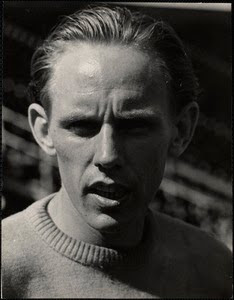
JULY 1961
Let's go back less than a year to the end of the Rome Olympics. World record holder Rafer Johnson had won a tight dual with close friend and former UCLA teammate, C.K. Yang for the decathlon gold medal. Johnson officially retired from competition and signed on as an assistant coach at UCLA where he would coach Yang in an effort to break his own world record, the passing of the mantle from one good friend to another, a feel good story any way you look at it.
(Yang leading Johnson in 1500m at Rome)
Problem was that nobody told Phil Mulkey about that. Phil Mulkey, the guy who had failed to finish at Rome and was never considered a threat for a medal, that Phil Mulkey?
(Phil Mulkey getting treatment at Rome from Cliff Cushman and Tom Murphy during the decathlon).
The guy whose best is over 1000 points from the record, that guy? The guy who teaches school in Memphis, that one? The guy who has been doing this for years without any visible sign of great improvement, that fella? Yep, and this is where things get interesting. Apparently home cooking provides Mulkey an advantage because on June 16-17 in the Southeastern AAU meet, held in his hometown, he shocks the track world (and himself) by breaking Johnson's record by 46 points with a total of 8709.
How is this possible? If Yang doesn't break the record, the only other athlete in the universe with the potential to do it is the USSR's Vasiliy Kuznyetsov. Others need not apply. No one, certainly not Mulkey is thinking about a record when the competition begins. Mulkey does not have the individual event greatness of Johnson or Yang, but he has no holes either. His day one performances of 10.7 (PR), 24-1, 50-3¼, 6-6½ (PR) and 51.0 total 4667. A very good score is in the making, but at this point no one is thinking of a WR.
The second day opens with a 14.6 clocking in the hurdles. The discus is up next and he hits 154-3½ for his third PR of the meet. In those events in which he doesn't PR, he is close. Although bothered by a hamstring injury, he vaults 14-4¾, only 2¾ inches short of his best. With only two events remaining, still there is no thought of breaking Rafer's record. Mulkey is a good javelin thrower for a decathlete, but it is not his strength. He occasionally hits 200' in practice and his first two throws today are no exception: 201-3 and 199-4. His third throw puts a different perspective on things. He launches his wooden Held a surprising 221-3½ and suddenly the possibility of a world record comes into focus. Run a 4:47.0 1500, Phil, and you break Rafer's record by one point.
Decathletes being what they are, the rest of his competitors huddle with him to plan out the race, breaking it down to 220 segments. Decathlon fans being what they are, there aren't many in attendance. Darkness has overtaken the stadium and the field is illuminated by automobile headlights. A crowd of 40 watches from the shadows. No split times are given except that Mulkey hits three laps three seconds ahead of schedule. The last three quarters of a lap had to be agonizing to watch with one eye on Mulkey and one eye on the stopwatch. He crosses the finish line in 4:43.8. He has improved his personal best by a stunning 1059 points and the record is his.
Ron Barbee writes, “Mulkey was so exhausted after the 1500 that he was unable to walk for 30 minutes after the race. A doctor present took Mulkey's pulse and it registered 210, compared to his normal 42.” Mulkey is quoted as saying, “I don't think I'll ever hit that score again.” You don't have to, Phil. Once is enough. Wonder if he went to school Monday?
(Phil competed in Masters Track and Field beginning in 1975, and won the world Masters decathlon in 1993).
This same weekend the NCAAs are being held in Philadelphia's Franklin Field. West coast schools dominate as SC takes the title over Oregon 65-47 in a meet that saw very few match ups between the two schools, indeed both score vis-a-vis each other in only one event. SC doesn't score in any flat race and Oregon gets zip in the field events. Villanova pleases the hometown fans, placing third with 40 points. High point men are Villanova's Frank Budd whose 9.4 and 20.8 victories make him the only double winner of the meet. SC's Luther Hayes just misses, winning the HSJ at 51-2, breaking his own meet record in the process and placing second in the broad jump at 24-9 behind the 25-2 of Colorado's Don Meyers.
The one event where the Trojans and Ducks go head to head doesn't provide serious scoring drama. Oregon's Jerry Tarr takes the hurdles in 13.9 but SC's Bob Pierce is second at 14.0, a time shared with third placer Blaine Lindgren of Utah.
The intermediate hurdles are delayed five minutes while meet director Ken Doherty shovels dry cinders onto the two outside lanes which are soaked with water from the adjacent steeplechase water jump.
That done, Occidental sophomore Dixon Farmer takes advantage of the absence of injured Rex Cawley to dominate in 50.8, a mark only ten have bettered. Bobby Staten of SC, a senior who had never scored in the NCAA meet, makes up for that in 51.4 seconds, placing second and earning 8 points. Oh, we may have found an event for that Toomey kid from Colorado. He makes the final with rounds of 53.4 and 52.7 and, although seventh in the final, he continues to improve, running 52.5. There may be hope for this kid after all.
Thirty of Villanova's points come in the sprints as Paul Drayton takes second in the 220 in 21.2. But what of Texas Southern's Charles Frazier you may be asking. He is a world class 220 man. Where did he finish? He didn't. In fact he didn't run. He wasn't at the meet because .....are you ready?....because his Texas Southern team was barred from competition by their local AAU “for a strike called by the NCAAP”. Your reporter is stunned. How does the AAU have jurisdiction over an NCAA school?
(Charles Frazier at Texas Relays 1962. Texas sprinter is Ralph Alspaugh)
When this picture was taken the university had just painted over the “Whites Only” signs on the restrooms in the stadium. Integration hadn’t arrived as teams with black athletes stayed at an army barracks outside Austin, because hotels would not accept blacks. Ed.
The three givens are death, taxes and Dallas Long winning the shot put. Yep, the SC soph wins by exactly five feet at 63-3½ before being relegated to the role of normal regular guy in the discus where he places 11th with 163-7. Wonder if the other throwers asked, “Hey, didn't you used to be Dallas Long?” or “You're somebody, aren't you? Don't tell me. Let me guess.”
In the 440 Adolph Plummer of New Mexico and Earl Young of ACC trade wins. Unfortunately for Young, his win comes in the semis where he edges Plummer 46.6 to 46.8. Plummer takes the final, 46.2 for both, when he holds off a spirited finish by the Olympic veteran.
The mile doesn't become a race until the 1320 is reached in 3:05.8. At this point Dyrol Burleson separates the college men from the college boys with a 54.7 final go around for a 4:00.5. Bill Dotson of Kansas breaks Ron Delany's meet record with a 4:02.9, but in the photo on page 9, is no more than a dot in the distance as Burly crosses the line with both hands giving the “V” for victory sign.
Burleson and Dallas Long are dominant in their events, but John Bork of Western Michigan is right there with them. The Western Michigan senior was a quartermiler as a soph and an intermediate hurdler last year. This year he settled on the 880 and it looks like a good choice. Trailing the field through a pedestrian 54 opening lap, he waits until the backstretch before going to the afterburners. His spurt puts the field in his rear view mirror and he powers through a sizzling 24.7 finish to win by over ten yards in 1:48.3. Europeans turned Canadian turned college runners Sig Ohlemann of Oregon and Ergas Leps of Michigan finish in 1:49.7 and 1:49.8.
I REMEMBER SEEING BORK WIN THE 880 IN THE MID AMERICAN CONFERENCE MEET HELD AT BOWLING GREEN , OH IN 1961. I WAS A SENIOR IN HS, GOT A SPEEDING TICKET ON THE WAY HOME FROM THE MEET. HE WAS SUCH AN OVERPOWERING RUNNER THAT YEAR. VERY STRONG IN THE SHOULDERS, AND THE PICTURE OF THE FINISH OF THAT RACE MORE THAN DEMONSTRATES HIS STRENGTH.
Bob Avant of USC has become a regular 7 foot jumper, but today that height leaves him two inches behind American record holder John Thomas. George Davies of Oklahoma State, Jim Brewer of USC and surprising Dick Gear of San Jose State tie for first in the pole vault at 15-4. A quick study of the vertical jump results provides ample evidence that the NCAA has yet to embrace that misses and attempts thing that the rest of the world uses. Ties abound, including nine high jumpers tied for 8th.
Throwers from less prominent California schools have their moment in the sun. Tom Pagani of Cal Poly San Luis Obispo wins the hammer and Redlands' Chuck Wilkinson takes the javelin, but the opportunity to share this achievement with their grandchildren has been skewed. They are both pictured on page 11, but misidentified. If the captions are to be believed, Pagani is smiling while holding a javelin and Wilkinson is in full wind up with the hammer.
As we leave the NCAA meet in search of next week's AAU championship, we can only bemoan the fun we missed because the NCAA does not see fit to hold the two relay events. Not sure when this finally comes about, but it isn't 1961.
Now a week has gone by and we are in Downing Stadium on Randall's Island in New York City. The weather is overcast, but rain doesn't fall on Saturday's crowd of 10,000 or Sunday's gathering of 20,000. Spots on the US team which will compete with the Soviet Union are on the line as only the top two qualify.
There is no denying that the event everyone was talking about the next day is the 100 where Villanova's Paul Drayton equals the world record of 9.3. To emphasize the credo that timing is everything, Drayton is a tenth of a second too late to claim a share of the record. Teammate Frank Budd has crossed the line in 9.2 and is now the world record holder and possessor of the title world's fastest man. Positions are reversed in the 220 where Drayton overcomes the challenge of running three 220s in one day to edge Texas Southern's Charles Frazier, 21.0w for both, with Budd a tenth back. At this point we have to go back to the NCAA meet where Frazier's Texas Southern team was barred from competing by the local AAU. They keep them out of the NCAA meet, but allow them to run in the National AAU? Your reporter would appreciate an explanation if anyone has one.
The mile promised to be the feature race of the meet. Dyrol Burleson vs. Jim Beatty. Throw in a dash of Jim Grelle, mix and you have fun for the whole family. Didn't work out that way. With Keith Forman leading, the first lap goes off in 67.2 and the pace doesn't quicken until the backstretch of the second lap. Boos rain down upon the runners. The pace quickens and the half passes in 2:09.2. “Burleson, whose confidence is exceeded only by his ability, has stated that nobody can beat him over the last quarter mile” (Cordner Nelson's words). He is sitting in good position in second. Bill Dotson is on his shoulder. They are followed by Grelle on the outside and Beatty on the pole. As the field enters the straight before the final lap, Burly goes. By the time Beatty can extricate himself, he is eight yards down and it is over. Burleson opens the margin all the way to the tape, winning easily in 4:04.9 to Beatty's 4:06.5. Grelle is out of the money at 4:08.0. Burleson's final lap is 55.3, his last 880 is 1:55.7.
Apparently there is no love lost between Burleson and Beatty. CN writes, “Burleson, almost arrogant around the curve, looked back at Beatty as he finished, and laughed.”.... “Beatty was bitter about his defeat. After congratulating Burleson, he added. 'Congratulations to you teammate, too for boxing me in'”. The last apparently a reference to Grelle. Think twice befor inviting both of them to the same party. Beatty's coach, “Mike” Igloi said, I think he did a big mistake.”
Jay Silvester and Rink Babka have been having a fine old time of it in the discus on the West Coast, but now we are in New York, the realm of Olympic champion Al Oerter. This doesn't seem to matter to Silvester. He powers one out 195-8 on his first throw, within a foot of the WR. Oerter can't get within five feet, but his 190-5 does earn a place on the team. Babka is third at 186-6.
The 440 may represent the changing of the guard. Twenty-nine year old Otis Davis barely holds off high schooler Ulis Williams 46.1 to 46.3. The future may belong to Williams, but the moment is Davis'. “He leaps for joy, almost as happy as he was in Rome.”
Ben McRae and Jerry Tarr win the hurdle semis and run 13.8 in the final, but it isn't enough to earn a ticket to Europe. Hayes Jones nips Fran Washington, 13.6 for both.
The shot put competition is lackluster. Dallas Long tops Parry O'Brien 62-2 to 61-3. Then both announce they will not be joining the team. Gary Gubner and Jay Silvester will be our guys.
Don Styron has his spot on the team wrapped up as he approaches the final barrier in the 440 hurdles. Unfortunately that last hurdle jumps up and gets him and down he goes. Cliff Cushman (50.9) and Dixon Farmer (51.2) say thank you. That Toomey kid is a plugger. He reverts to 53.7 and doesn't make the finals, but you have to appreciate a no talent kid like that trying so hard. Were this little league, he would be going home with a three foot tall most inspirational trophy at the end of the season.
As mentioned earlier, Bob Avant has become a regular member of the seven foot club. He clears 7-0 today and it is enough. John Thomas clears 7-0, but loses on misses, his first loss to an American. CN says on Avants' clearance that there was too little padding in the pit and that Avants had landed heavily on his shoulders. I guess so. There is a photo of Avant dropping into the pit. He is straight upside down about to make a dent with his head.
Jesse Owens and Ralph Boston
The broad jump belongs to Ralph Boston. He soars 26-11½ to win easily. The real competition is between Anthony Watson and Bo Roberson for the second spot on the team. Trailing Roberson after four rounds, Watson joins the exclusive 26 foot club on his fifth jump with a leap of 26-1¼ to top Roberson by two inches.
Washington sophomore John Cramer may have lost his spot on the US team while standing at the top of the runway getting ready to vault at 14-6. A stray discus strikes him on the foot. He gets treatment, but by the time he returns the bar is at 15-0. With his foot badly swollen, he misses twice at this height before clearing on his third attempt. Along with Ron Morris, John Uelses and Henry Wadsworth, Cramer clears 15-4, but his misses relegate him to fourth. Only Morris improves, clearing 15-8 before a couple good misses at a world record height of 15-10¾. Morris will not be contesting the Russians. He is building a house and attending summer school. Uelses and Wadsworth will be our vaulters in Europe. All John Cramer has to show for his efforts is a swollen foot.
Aside from the mile, the one race track aficionados anticipate is the 880 which contains a strong field of proven quality. Jim Dupree leads Jerry Siebert, John Bork and Jim Parr across the line in the first semifinal. Ernie Cunliffe takes the second semi, followed by George Kerr, Archie San Romani and Kirk Hagan. To the surprise of no one, Ernie Cunliffe takes the lead immediately in the final. His 26.3 at the 220 gives him a five yard lead which he holds through a 53.3 440 and a 1:20.0 660. Now the field closes. Bork pulls up to Cunliffe's shoulder only to have the both of them be passed by Dupree. Bork gives chase, but here comes George Kerr. Now it Dupree, Bork, Kerr and Cunliffe as they are in the middle of the curve. At this point, Jerry Siebert comes to life. One by one, he passes Cunliffe, Kerr and Bork. He gains on Dupree down the stretch, but just misses catching him. Dupree and Siebert, both 1:48.5, are on the team. Bork finishes third at 1:48.8 ahead of Kerr, 1:49.2, and Cunliffe, 1:49.5. Hagan is a close sixth at 1:49.6.
Just when it would seem that T&FN has moved into an era of racial enlightenment, it is back to outing Negroes. Charles Durant is a tall Negro. Winston Cooper is a short Negro, Jim Dupree and Gerald Pratt are slim Negroes and Ben McRae is a Negro halfback.
Clifford Severn Sporting Goods and Adidas still hold down the traditional spot on the back page, but other advertisers are coming on. Turftex, Inc. which builds “Dura Track” (Grasstex Firbrous Tracks, Runways, Jump Areas) has a full page ad. Dreske shoes (a fine, new track shoe) has half a page as does Adidas. Spot-Bilt (with all-kangaroo uppers) and New Balance (Track Shoes of the Future) each have popped for a quarter page. The Nelson brothers have to be rolling in dough.
Beginning our 14th year and 1,200+ postings. A blog for athletes and fans of 20th century Track and Field culled from articles in sports journals of the day, original articles, book reviews, and commentaries from readers who lived and ran and coached in that era. We're equivalent to an Amer. Legion post of Track and Field but without cheap beer. You may contact us directly at irathermediate@gmail.com or write a comment below. George Brose, Courtenay, BC ed.
Once Upon a Time in the Vest
Showing posts with label Bill Toomey. Show all posts
Monday, April 30, 2012
Friday, April 20, 2012
Vol 2 No. 37 June, 1961
--------------------------------------------------------------------------------
JUNE 1961
If you are a track fan of a certain age, this issue of T&FN will make you feel warm and fuzzy all over. We'll take it chronologically beginning May 20.
The Big Eight Championships are held in Boulder, Colorado. Oklahoma upsets perennial champ Kansas 99-88¼ with Oklahoma State right there at 84½. This is the first time Kansas has not won the championship since 1951. It is the first Big Eight championship for Oklahoma since.....are your ready?....1935. If you want to take a moment to sing a few verses of Boomer Sooner, we'll wait.
Oklahoma University Big 8 Champions , Boulder, Colorado 1961
Front Row: Mike Lindsay, Cal Sharpe, Neville Soll, Mark Sullivan, Tim Leonard, Paul Ebert, Don Warrick, Lee Smith, Buddy Stewart
Top Row: Bob Wilcox, Walter Myers, Richard Sinclair, Bill Noble, J.D. Martin, Coach Bill Carroll, Mark Brady, Tom Raley, Steve Swafford, E.H. Miles
(Click on photo to enlarge)
But team scores pale when compared to the world record vault of Okie State's George Davies who, after two misses at 15-10¼, clears to raise Don Bragg's record by an inch.
An aside here. There is a photo of Davies, who is 6-3, 190 and blessed with movie star good looks. Have you ever noticed that pole vaulters are the quarterbacks of track? More often than not they are broad shouldered good looking guys. Not that we have a 50 year old man crush on the guy. Just making an observation.
Given the importance of the meet, the marks are not outstanding. The best marks on the track are a conference record 46.5 440 by Colorado's Jim Heath, a 1:49.2 880 by Kansas' Kirk Hagan.
and a 14.1, 22.8 hurdle double by Kansas State's Rex Stucker. Apparently the altitude takes its toll in the distance events as Bill Dotson and Billy Mills run only 4:14.5 and 9:31.2, just good enough to win.
The Sooners, led by Mike Lindsay's weight double, 57-5½ and 164-2, garner 54 of their points in the field events.
Aside number two: Perhaps this kid, Toomey at Colorado
should find a sport better suited to his talents. He places fifth in the lows at 24.1 and fails to score in the long jump. Maybe tennis, golf or croquet would be a better fit.
Bill Toomey and Coach Frank Potts , after they figured it out. On this same day the Far West Championships are held in Corvallis, Oregon. Oregon's Harry Jerome runs 9.3 to grab a share of the 100 WR. Dyrol Burleson miles in 4:05.6 and returns to run a PR of 1:48.7 in the 880.
Four days later in Eugene Archie San Romani leads through splits of 59.0 and 1:58.5 before Burleson takes over, hitting the 1320 in 2:58.0 and hanging on to finish in 3:57.6 to break Jim Beatty's American mile record of 3:58.0. In another three days Beatty and Burleson will be in Modesto for the California Relays, but the long awaited match between them won't come about. Beatty is running the mile and Burleson is anchoring the Oregon 4 mile relay.
Now it is Saturday evening, May 27 and we are in Modesto. This meet will be remembered because it is tonight that the 27 foot barrier is broken with half an inch to spare by Ralph Boston. Each member of the overflow crowd of 11,100 has an I-was-there story to tell. Overshadowed are great performances. Hal Connolly experiments with four turns instead of three in the hammer and it pays off with a prodigious 226-0½, the third longest throw in history, only five feet short of his WR. Hayes Jones nips Don Styron in the highs, 13.6 to 13.7, but Styron returns to edge Bo Roberson in the lows 22.1 to 22.3. Dennis Johnson, Harry Jerome and Dave Styron cross the line in that order in the hundred, all running 9.4. Like his twin, Styron is not done. He returns to win the 220 in 20.7. The 880 goes out in 55.5. Jerry Siebert takes the lead into the final straight only to be passed by George Kerr. But Siebert isn't through. He regains the lead and powers to a three yard win over the great Jamaican in 1:50.2.
Dale Story of Oregon State has only been training for eight weeks after coming off an injury, but he has enough in the tank to finish the last half of the two mile in 4:17.9 to win in 8:46.9 and leave Doug Kyle and Charley Clark behind. Jim Beatty is stalked by Jim Grelle through laps of 58.2, 2:00.2 and 3:02.2. The pace doesn't pick up until the backstretch when Beatty drops the hammer and pulls away for a 3:58.8 to 4:01.3 win. His 56.6 last lap is even more impressive considering his delayed late sprint. Cordner Nelson says Beatty's last 220 had to be 26 flat.
Since the meet is the California Relays, yes, there are relays. Texas Southern wins two close ones, upsetting San Jose State in the 440, 40.2 for both, then returns to edge Abilene Christian in the 880, 1:23.6 for both.
Oregon State also wins a couple impressive races. Norm Hoffman, given a slight lead on the anchor leg, brings the baton around in 1:48.8 to cement the second fastest sprint medley ever run, 3:18.4. In the two mile relay the Beavers gamble, holding Norm Monroe out of the 880 relay and inserting him on the third leg. It pays off. OSU has a tenth on the Santa Clara Valley Youth Village and the pressure is on Monroe to open a gap because Ernie Cunliffe will be anchoring for SCVYV. He comes through. His 1:50.8 produces a three second gap for Hoffman who needs it. Though Cunliffe runs 1:48.1, the fastest two laps of the evening, Hoffman's 1:50.1 is enough to bring the Beavers home in 7:27.3.
The WR in the 4 mile relay is 16:25.2 by the Hungarian national team. Oregon plans to break it, but after two disappointing legs, it is obvious this will not happen. Indeed they may not win. Dyrol Burleson is 12 yards down to Southern Illinois' Englishman, Mike Wiggs, at the start of the anchor leg. His 57.7 opening lap closes the gap. With no chance at the record, Burley is content to follow before blowing by in the final straight. His 4:00.5, three seconds faster than Wiggs, gives the Ducks a bittersweet victory in 16:32.8.
Now it is June 2 and we are at the Compton Invitational where a crowd of 7800 sees Herb Elliot take a beating. Okay, not Herb himself – he wasn't there – but his records. Jim Grelle wins the mile in 4:02.7, but the crowd is cheering for 18 year old high school senior Tom Sullivan who breaks Elliot's world junior record (4:04.3), finishing second in 4:03.5. The assault on the great Aussie's records continues. Seventeen year old Bruce Kidd races to, in Cordner Nelson's words, “the most amazing performance, by age, of any runner in history”, a 13:56.4 5000 victory over Max Truex and Lazlo Tabori. After following Truex through mile splits of 4:28 and 9:00, with a lap and a half to go, the young Canadian takes off and leaves the Olympic veteran in his wake. His three mile time obliterated Elliot's WJR of 14:02.4. His final time lowered Kidd's own record of 14:29.9.
Abilene Christian ties USC's collegiate mile relay record as Earl Young's 46.0 brings the Texans home in 3:07.6. Ernie Cunliffe has a big evening, breaking the meet record at 800 meters (1:47.5) en route to a convincing 1:48.2 victory in the half mile. Among the scalps he collects this evening is that of Jim Beatty who finishes sixth in 1:50.2.
If you are a meet director, you want to invite Bo Roberson. He definitely gives you your money's worth. In addition to broad jumping, he ran the lows at Modesto last week. Tonight he wins the broad jump at 25-9¾ and fills his idle moments placing second in the 100 and fourth in the 200. Last seen, he was sweeping out the stands after the crowd left.
Ron Morris wins the pole vault at 15-4 as new world record holder George Davis and previous record holder Don Bragg can do no better than a tie for fourth at 15-0¾. Dallas Long bests Parry O'Brien 62-3¾ to 61-7¼ in the shot. Hal Connolly, once again proves that his performance in Rome was an aberration. His 221-1 wins by 26 feet.
Great discus competition does not required the presence of Olympic champ Al Oerter. Rink Babka and Jay Silvester are doing just fine without him, thank you. On his second throw Silvester spins a world record distance of 198-0½, but loses his balance and steps on the ring. (Why a foul is measured is not addressed.) Still he leads through five rounds with 194-1½. Babka has been throwing well all night, but now, up for the final time, it is for all the marbles. The big guy, “his injured knee encased in plastic”, readies himself, takes a deep breath, spins and fires. The spot is marked, the tape stretched out, the measurement taken and announced: 194-4½ and a three inch victory. Who needs Al Oerter to have a good time?
Now you may be saying what a great meet, but where was Ralph Boston? That would be at the NAIA championship in Sioux Falls, South Dakota supporting his team, Tennessee A&I. Well, if we are to be totally forthcoming, he is the team. He wins the broad jump at 25-6½, the hop-step-jump at 48-10¾, the highs in 13.7 and the lows in 23.2 and finishes in a tie for second in the high jump at 6-6 for TA&I's 47 points, two behind Texas Southern. Ralph earned his scholarship this day, but he doesn't get the headline in the article. That goes to a Florida A&M freshman, Robert Hayes, who adds his name to the long list of those who hold the 100 record at 9.3. For record purposes the track is measured: 100 yards and a half inch. There was some mention that he also participates in football.
Listed under Late News there are a couple AAU meets of interest. In the Middle Atlantic AAU at Villanova Frank Budd runs his second 9.3 100. The Southern Pacific AAU showcases young talent. Dallas Long, still only 20, puts it all together and comes up with three puts over 64 feet with a PR of 64-7¾. Only Bill Nieder has thrown further. High school boys give their elders a lesson. Ulis Williams of Compton HS takes the 440 in 46.5. Ralph Turner of Burroughs edges Forest Beaty of Glendale Hoover in the 220 on a curve as both run 21.0.
Inexplicably, though the AAU meets just mentioned were run on June 9 and listed under Late News, the Pacific Association AAU meet run the following day at Stanford is front page material...and justly so. Oregon failed in an attempt to break the WR in the 4 mile relay. Now it is the Santa Clara Valley Youth Village's turn. The problem is that they have virtually no competition. US 10,000 record holder Max Truex will lead off, followed by Lazlo Tabori, Ernie Cunliffe and Jim Beatty. Truex figures to be the slow leg and he is. After two laps in 2:03.1, the pace slows dramatically and he hands the baton off in 4:10.8. Tabori, after 59.7 and 2:01.0 splits, also suffers a case of the slows in the second half mile and finishes in a disappointing 4:08.9. Still with Cunliffe up and Beatty on deck, 16:25.2 looks beatable. Ernie C. does his job, splitting 58.9, 2:00.0 and 3:01.9 and kicking home in 61.1 to run 4:03.0. All that is needed now is a 4:02.4 from Beatty. The recently dethroned American record holder at this distance is out well, 58.6, but a 62.7 puts him at 2:01.3. The third lap is even slower, 63.2 (3:04.5) and now the typical Jim Beatty kick is needed. His “usual blazing surge” isn't there and the last go round takes 59.3, producing a 4:03.8 leg and a 16:26.5 final time, an American record, but a disappointment just the same.
The season is heating up in Europe. Two world records are broken. The USSR's Grigoriy Taran runs the steeplechase in 8:31.2 and Italy's Carlo Lievore throws the javelin 284-7 (or 84.74 as they say in Europe).
We here at the Vest would be remiss were we not to give you an informational advantage the next time the conversation at the Dew Drop in turns, as it inevitably will, to track and field. Ask your buddies if they can recall the last time a major invitational had sprint fields consisting only of white guys. Oh, what the heck, all events having only white guys. Allow sufficient time for the significance of this to set in while they ponder. The answer would be the 1961 Meet of Champions in Houston held on June 9, well before racial enlightenment. When black athletes found that seating would be segregated, they boycotted the meet. Being the possessor of this sort of inside information means you will not have to pay for a round the rest of the evening.
JUNE 1961
If you are a track fan of a certain age, this issue of T&FN will make you feel warm and fuzzy all over. We'll take it chronologically beginning May 20.
The Big Eight Championships are held in Boulder, Colorado. Oklahoma upsets perennial champ Kansas 99-88¼ with Oklahoma State right there at 84½. This is the first time Kansas has not won the championship since 1951. It is the first Big Eight championship for Oklahoma since.....are your ready?....1935. If you want to take a moment to sing a few verses of Boomer Sooner, we'll wait.
Oklahoma University Big 8 Champions , Boulder, Colorado 1961
Front Row: Mike Lindsay, Cal Sharpe, Neville Soll, Mark Sullivan, Tim Leonard, Paul Ebert, Don Warrick, Lee Smith, Buddy Stewart
Top Row: Bob Wilcox, Walter Myers, Richard Sinclair, Bill Noble, J.D. Martin, Coach Bill Carroll, Mark Brady, Tom Raley, Steve Swafford, E.H. Miles
(Click on photo to enlarge)
But team scores pale when compared to the world record vault of Okie State's George Davies who, after two misses at 15-10¼, clears to raise Don Bragg's record by an inch.
An aside here. There is a photo of Davies, who is 6-3, 190 and blessed with movie star good looks. Have you ever noticed that pole vaulters are the quarterbacks of track? More often than not they are broad shouldered good looking guys. Not that we have a 50 year old man crush on the guy. Just making an observation.
Given the importance of the meet, the marks are not outstanding. The best marks on the track are a conference record 46.5 440 by Colorado's Jim Heath, a 1:49.2 880 by Kansas' Kirk Hagan.
and a 14.1, 22.8 hurdle double by Kansas State's Rex Stucker. Apparently the altitude takes its toll in the distance events as Bill Dotson and Billy Mills run only 4:14.5 and 9:31.2, just good enough to win.
The Sooners, led by Mike Lindsay's weight double, 57-5½ and 164-2, garner 54 of their points in the field events.
Aside number two: Perhaps this kid, Toomey at Colorado
should find a sport better suited to his talents. He places fifth in the lows at 24.1 and fails to score in the long jump. Maybe tennis, golf or croquet would be a better fit.
Bill Toomey and Coach Frank Potts , after they figured it out. On this same day the Far West Championships are held in Corvallis, Oregon. Oregon's Harry Jerome runs 9.3 to grab a share of the 100 WR. Dyrol Burleson miles in 4:05.6 and returns to run a PR of 1:48.7 in the 880.
Four days later in Eugene Archie San Romani leads through splits of 59.0 and 1:58.5 before Burleson takes over, hitting the 1320 in 2:58.0 and hanging on to finish in 3:57.6 to break Jim Beatty's American mile record of 3:58.0. In another three days Beatty and Burleson will be in Modesto for the California Relays, but the long awaited match between them won't come about. Beatty is running the mile and Burleson is anchoring the Oregon 4 mile relay.
Now it is Saturday evening, May 27 and we are in Modesto. This meet will be remembered because it is tonight that the 27 foot barrier is broken with half an inch to spare by Ralph Boston. Each member of the overflow crowd of 11,100 has an I-was-there story to tell. Overshadowed are great performances. Hal Connolly experiments with four turns instead of three in the hammer and it pays off with a prodigious 226-0½, the third longest throw in history, only five feet short of his WR. Hayes Jones nips Don Styron in the highs, 13.6 to 13.7, but Styron returns to edge Bo Roberson in the lows 22.1 to 22.3. Dennis Johnson, Harry Jerome and Dave Styron cross the line in that order in the hundred, all running 9.4. Like his twin, Styron is not done. He returns to win the 220 in 20.7. The 880 goes out in 55.5. Jerry Siebert takes the lead into the final straight only to be passed by George Kerr. But Siebert isn't through. He regains the lead and powers to a three yard win over the great Jamaican in 1:50.2.
Dale Story of Oregon State has only been training for eight weeks after coming off an injury, but he has enough in the tank to finish the last half of the two mile in 4:17.9 to win in 8:46.9 and leave Doug Kyle and Charley Clark behind. Jim Beatty is stalked by Jim Grelle through laps of 58.2, 2:00.2 and 3:02.2. The pace doesn't pick up until the backstretch when Beatty drops the hammer and pulls away for a 3:58.8 to 4:01.3 win. His 56.6 last lap is even more impressive considering his delayed late sprint. Cordner Nelson says Beatty's last 220 had to be 26 flat.
Since the meet is the California Relays, yes, there are relays. Texas Southern wins two close ones, upsetting San Jose State in the 440, 40.2 for both, then returns to edge Abilene Christian in the 880, 1:23.6 for both.
Oregon State also wins a couple impressive races. Norm Hoffman, given a slight lead on the anchor leg, brings the baton around in 1:48.8 to cement the second fastest sprint medley ever run, 3:18.4. In the two mile relay the Beavers gamble, holding Norm Monroe out of the 880 relay and inserting him on the third leg. It pays off. OSU has a tenth on the Santa Clara Valley Youth Village and the pressure is on Monroe to open a gap because Ernie Cunliffe will be anchoring for SCVYV. He comes through. His 1:50.8 produces a three second gap for Hoffman who needs it. Though Cunliffe runs 1:48.1, the fastest two laps of the evening, Hoffman's 1:50.1 is enough to bring the Beavers home in 7:27.3.
The WR in the 4 mile relay is 16:25.2 by the Hungarian national team. Oregon plans to break it, but after two disappointing legs, it is obvious this will not happen. Indeed they may not win. Dyrol Burleson is 12 yards down to Southern Illinois' Englishman, Mike Wiggs, at the start of the anchor leg. His 57.7 opening lap closes the gap. With no chance at the record, Burley is content to follow before blowing by in the final straight. His 4:00.5, three seconds faster than Wiggs, gives the Ducks a bittersweet victory in 16:32.8.
Now it is June 2 and we are at the Compton Invitational where a crowd of 7800 sees Herb Elliot take a beating. Okay, not Herb himself – he wasn't there – but his records. Jim Grelle wins the mile in 4:02.7, but the crowd is cheering for 18 year old high school senior Tom Sullivan who breaks Elliot's world junior record (4:04.3), finishing second in 4:03.5. The assault on the great Aussie's records continues. Seventeen year old Bruce Kidd races to, in Cordner Nelson's words, “the most amazing performance, by age, of any runner in history”, a 13:56.4 5000 victory over Max Truex and Lazlo Tabori. After following Truex through mile splits of 4:28 and 9:00, with a lap and a half to go, the young Canadian takes off and leaves the Olympic veteran in his wake. His three mile time obliterated Elliot's WJR of 14:02.4. His final time lowered Kidd's own record of 14:29.9.
Abilene Christian ties USC's collegiate mile relay record as Earl Young's 46.0 brings the Texans home in 3:07.6. Ernie Cunliffe has a big evening, breaking the meet record at 800 meters (1:47.5) en route to a convincing 1:48.2 victory in the half mile. Among the scalps he collects this evening is that of Jim Beatty who finishes sixth in 1:50.2.
If you are a meet director, you want to invite Bo Roberson. He definitely gives you your money's worth. In addition to broad jumping, he ran the lows at Modesto last week. Tonight he wins the broad jump at 25-9¾ and fills his idle moments placing second in the 100 and fourth in the 200. Last seen, he was sweeping out the stands after the crowd left.
Ron Morris wins the pole vault at 15-4 as new world record holder George Davis and previous record holder Don Bragg can do no better than a tie for fourth at 15-0¾. Dallas Long bests Parry O'Brien 62-3¾ to 61-7¼ in the shot. Hal Connolly, once again proves that his performance in Rome was an aberration. His 221-1 wins by 26 feet.
Great discus competition does not required the presence of Olympic champ Al Oerter. Rink Babka and Jay Silvester are doing just fine without him, thank you. On his second throw Silvester spins a world record distance of 198-0½, but loses his balance and steps on the ring. (Why a foul is measured is not addressed.) Still he leads through five rounds with 194-1½. Babka has been throwing well all night, but now, up for the final time, it is for all the marbles. The big guy, “his injured knee encased in plastic”, readies himself, takes a deep breath, spins and fires. The spot is marked, the tape stretched out, the measurement taken and announced: 194-4½ and a three inch victory. Who needs Al Oerter to have a good time?
Now you may be saying what a great meet, but where was Ralph Boston? That would be at the NAIA championship in Sioux Falls, South Dakota supporting his team, Tennessee A&I. Well, if we are to be totally forthcoming, he is the team. He wins the broad jump at 25-6½, the hop-step-jump at 48-10¾, the highs in 13.7 and the lows in 23.2 and finishes in a tie for second in the high jump at 6-6 for TA&I's 47 points, two behind Texas Southern. Ralph earned his scholarship this day, but he doesn't get the headline in the article. That goes to a Florida A&M freshman, Robert Hayes, who adds his name to the long list of those who hold the 100 record at 9.3. For record purposes the track is measured: 100 yards and a half inch. There was some mention that he also participates in football.
Listed under Late News there are a couple AAU meets of interest. In the Middle Atlantic AAU at Villanova Frank Budd runs his second 9.3 100. The Southern Pacific AAU showcases young talent. Dallas Long, still only 20, puts it all together and comes up with three puts over 64 feet with a PR of 64-7¾. Only Bill Nieder has thrown further. High school boys give their elders a lesson. Ulis Williams of Compton HS takes the 440 in 46.5. Ralph Turner of Burroughs edges Forest Beaty of Glendale Hoover in the 220 on a curve as both run 21.0.
Inexplicably, though the AAU meets just mentioned were run on June 9 and listed under Late News, the Pacific Association AAU meet run the following day at Stanford is front page material...and justly so. Oregon failed in an attempt to break the WR in the 4 mile relay. Now it is the Santa Clara Valley Youth Village's turn. The problem is that they have virtually no competition. US 10,000 record holder Max Truex will lead off, followed by Lazlo Tabori, Ernie Cunliffe and Jim Beatty. Truex figures to be the slow leg and he is. After two laps in 2:03.1, the pace slows dramatically and he hands the baton off in 4:10.8. Tabori, after 59.7 and 2:01.0 splits, also suffers a case of the slows in the second half mile and finishes in a disappointing 4:08.9. Still with Cunliffe up and Beatty on deck, 16:25.2 looks beatable. Ernie C. does his job, splitting 58.9, 2:00.0 and 3:01.9 and kicking home in 61.1 to run 4:03.0. All that is needed now is a 4:02.4 from Beatty. The recently dethroned American record holder at this distance is out well, 58.6, but a 62.7 puts him at 2:01.3. The third lap is even slower, 63.2 (3:04.5) and now the typical Jim Beatty kick is needed. His “usual blazing surge” isn't there and the last go round takes 59.3, producing a 4:03.8 leg and a 16:26.5 final time, an American record, but a disappointment just the same.
The season is heating up in Europe. Two world records are broken. The USSR's Grigoriy Taran runs the steeplechase in 8:31.2 and Italy's Carlo Lievore throws the javelin 284-7 (or 84.74 as they say in Europe).
We here at the Vest would be remiss were we not to give you an informational advantage the next time the conversation at the Dew Drop in turns, as it inevitably will, to track and field. Ask your buddies if they can recall the last time a major invitational had sprint fields consisting only of white guys. Oh, what the heck, all events having only white guys. Allow sufficient time for the significance of this to set in while they ponder. The answer would be the 1961 Meet of Champions in Houston held on June 9, well before racial enlightenment. When black athletes found that seating would be segregated, they boycotted the meet. Being the possessor of this sort of inside information means you will not have to pay for a round the rest of the evening.
Subscribe to:
Posts (Atom)
V 15 N. 10 Gunder 'The Wunder' Haegg Visits Cincinnati
Bob Roncker of Cincinnati, Ohio has sent in this account of one day on the 1943 tour that Gunder Haegg of Sweden made to the US to help rais...
-
Noting the passing of Brian Oldfield on March 26, 2017. Oldfield came from Elgin, IL and left the world from that same town. He was 71 y...
-
JUNE 1963 The top half of the first page of this issue is devoted to a photo of a powerfully striding Adolph Plummer nearing the finish...