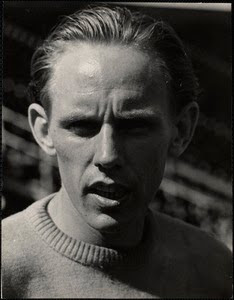
Putting this article in today's blog was inspired by the events in the Tennessee state legislature today.
George Brose
The Drake Relays will be upon us in a matter of a week or so. I did some virtual looking around in the the Cowles Library archives on the Drake campus a few months ago. They have an extensive collection of photos from the Relays going right back to the beginning. It is claimed that in the 1920's Knute Rockne helped make the Relays famous by bringing his football players there to compete as track men, and the crowds came to see them. His first job at Notre Dame was as their track coach. For his efforts, Rockne was voted into the Drake Relays Hall of Fame.
While scouring through the photo collection I noticed the picture below of a relatively unknown African American pole vaulter Johnny Bright taken in the early 1950's. He's seen jumping indoors on what appears to be a steel pole. No other reference to Bright's track exploits, but the photo makes him eligible for discussion on this 'track and field' blog. Another sport made him famous. What it was was football, as Andy Griffith once said, and a very ugly incident that happened on the field.
In 1951, Johnny Bright was the leading passer and rusher in the nation as the tailback in a single wing formation at Drake University. He would be the first black football player to play in Stillwater, OK in their midseason game. In the run up to the game against Oklahoma A&M the Aggie coach encouraged his defensive players to focus on Bright and do everything in their power to take him out of the game. They succeeded and broke Bright's jaw, but he still completed a touchdown pass before leaving the game. Below is the Blake Sebring's story about Johnny Bright. The photo sequence earned a Pulitzer Prize. After college Johnny Bright emigrated to Canada and played in the CFL for the Edmonton Eskimos (now Elks) and retired as the leading rusher in the CFL and is in their Hall of Fame. The rest of his life he stayed in Edmonton as a school teacher and eventually a middle school principal.
Competing in PV his freshman year at Drake
The following article tells us a lot more about Johnny Bright
Johnny Bright could do it all
By BLAKE SEBRING of the Ft. Wayne, IN The News-Sentinel
After Johnny Bright died from a heart attack in 1983, his many friends tried to accurately portray his abilities and essence, but perhaps former Central High School (Ft. Wayne, Indiana) quarterback and teammate Ned Brenizer said it best.
"He was a man playing boys games," Brenizer said.
There were very few things Bright could not do on an athletic field in an era when there were many things he was not allowed to do off it because he was black. His race affected his choices throughout his life.
"I remember him being indestructible," former News-Sentinel Sports Editor Bud Gallmeier wrote. "He had the body of Jim Brown."
When Bright attended Central, he led the football team to a city title in 1945, and the basketball team to a pair of state tournament Final Four appearances. He was also a one-man track team, often winning as many as five events during a meet, including clearing 12 feet in the pole vault using a bamboo pole.
Though Bright was only 5-foot-10 and 180 pounds, former Central Catholic quarterback Tom Jehl remembers Bright could touch the rim with his elbow.
"He was so competitive and so confident that he would be taunting you before the game," Jehl said. "He was the kind of guy that if you were playing him in basketball he'd say, 'We're going to beat you by 20, and I'm going to make them.' And then he would back it up. He was friendly, and he was being John Bright, smiling and letting you know that he's going to do his best against you and you're not going to stop him. You made up your mind that you wanted to play your best to stop him."
Bright was as well-known for his attitude as for his abilities.
"He was a good kid. A lot of people misinterpreted it as cockiness, but I encouraged him to feel proud of what he could do," longtime Central coach Herb Banet said.
And Bright was simply that good.
"He could palm a basketball and dunk," Brenizer said. "I don't recall anyone else ever doing it at that time. We had a little under-the-basket play where I would be the inbounds passer and John would stand casually under the basket. I would casually loft it up and he would go up and grab it and put it in over everyone. No one could get up with him."
And Bright could do just about anything. Besides football, basketball and track, he was also an outstanding boxer and softball pitcher. Despite Bright's accomplishments, Purdue never showed any interest in recruiting him for football, Notre Dame did not recruit blacks at that time, and Indiana University coach Clyde Smith told Banet he "already had enough black running backs," according to Banet.
So Bright took a scholarship at Drake University to run track, with the condition that he could try out for the football and basketball teams. After sitting out the mandatory year of freshman ineligibility, Bright tried out for the football team and made the squad after two days. A few days after that he became the focus of the offense.
"He lettered in three sports as a sophomore -- track, basketball and football and then decided to concentrate on football," longtime Drake sports information director Paul Morrison said. "He was a great athlete really, just a natural athlete. He could be good in any sport he wanted to participate in."
As a sophomore, Bright rushed for 975 yards and threw for 975 yards to lead the nation in total offense as the Bulldogs went 6-2-1. He followed that with 1,232 yards rushing and 1,168 yards passing as a junior to set an NCAA record for total offense. The next season he was leading the nation in rushing and total offense with 821 and 1,349 yards respectively when the Bulldogs played at Oklahoma A&M on Oct. 20, 1951.
Though Bright was not the first black player at Drake, this would be the first time a black opponent played at Oklahoma A&M (now Oklahoma State). On a late hit early in the game by Aggies defensive lineman Wilbanks Smith, Bright suffered a broken jaw. After picking himself off the turf, Bright came back to throw a touchdown pass on the next play, but another hit knocked him out of the game a few plays later.
Immediately after the game, Drake officials accused Oklahoma A&M of dirty play and being out to "get" Bright. Photos from the game by John Robinson and Don Ultang of the Des Moines Register showed the severity of the late hit and won a Pulitzer Prize. Drake protested and eventually left the Missouri Valley Conference as a result, and the NCAA soon required players to wear face masks and mouth guards.
Bright came back to play one more game two weeks later, rushing for 204 yards against Great Lakes Naval Station, to finish with more than 6,000 yards in total offense. He averaged 236 yards per game and scored 384 points in 25 games. As a senior he earned 70 percent of the yards Drake gained and scored 70 percent of the Bulldogs' points -- despite missing three games.
Though the Philadelphia Eagles drafted Bright with their first pick in 1951, he was wary of playing in the NFL.
"I would have been their first Negro player, but there was a tremendous influx of Southern players into the NFL at that time, and I didn't know what kind of treatment I could expect," Bright said.
Instead, Bright decided to play in the Canadian Football League. He was signed by the Calgary Stampeders in 1952 as a linebacker, but shoulder injuries led the team to write him off in 1954 when he was traded to Edmonton.
The trade gave Bright's career new life and sparked a dynasty in Edmonton as the Eskimos won Grey Cup titles in 1954, 1955 and 1956. Bright's best individual seasons were still coming as he rushed for 1,722 yards in 1958 to earn CFL Player of the Year honors. Four times he was the CFL's top rusher.
The NFL approached Bright about signing several times, but he always declined. He had already started his teaching career in Edmonton.
"I might have been interested," he once said, "if the offers could have matched what I was making from both football and teaching."
Bright's football career ended in 1964 after 10,909 yards rushing in 13 seasons. He still holds CFL records for most career playoff touchdowns, most yards gained in a Grey Cup game and for playing in an amazing 197 consecutive games as both a linebacker and a fullback. Bright was inducted into the CFL Hall of Fame in 1970 and the College Football Hall of Fame in 1984.
After he retired from football, Bright became an often-honored teacher in Edmonton, and eventually the principal of D.S. MacKenzie Junior High School, where he received numerous honors.Drake had won five straight games before heading to Stillwater and the outcome of the game probably would decide the Missouri Valley Conference championship that fall.
Bright was an established star coming into the contest, having led the nation in total offense in 1949 (the first sophomore in history), again in 1950 and again was leading the NCAA national statistics in total offense, rushing and scoring.
It was obvious that Bright was a “marked man” at the start of the game. He was knocked unconscious three times in the first seven minutes by Oklahoma tackle, Wilbanks Smith. While the final blow broke Bright’s jaw, he was able to throw a 61-yard touchdown pass a few plays later before the injury finally forced him to leave the game.
Fortunately, for Drake (and history) the Des Moines Register had decided to send a photo crew to the game. Although they were using a new, faster plane, the crew would be able to shoot only the first few minutes of the game in order to get back to Des Moines and have the photo coverage in Sunday’s edition. Cameramen, Don Ultang and John Robinson captured the assault on Bright in machine gun camera sequence that would later win them a Pulitzer Prize. The photo sequence received world-wide exposure and was also reprinted in Life Magazine.
Because of this incident and because the Missouri Valley Conference refused to take any action, Drake University withdrew from the conference for several years before resuming conference membership in 1955.
Bright was a great all-around athlete. He lettered in football, basketball and track as a Drake sophomore, before deciding to concentrate on football in his next two years of competition. He was also regarded as one of the state’s best softball pitchers at the time and is in the Iowa Softball Hall of Fame. Bright was drafted No. 1 by the Philadelphia Eagles of the NFL, but instead went to Canada where he played for Calgary in 1952, 1953, and part of 1954, before moving to the Edmonton Eskimos where he won numerous CFL honors in a 14 season career. Bright was revered in Canada not only for his outstanding football career but for his work as a junior high school principal and for work with youth.
Bright is also in the Des Moines Register’s Iowa Sports Hall of Fame, the National Football Foundation’s College Football Hall of Fame, as well as the Canadian Football Hall of Fame and the Edmonton Sports Hall of Fame. He also received the Swede Nelson Award (Gridiron Club of Boston) in 1951, signifying outstanding sportsmanship. That same year he was fifth in the balloting for the prestigious Heisman Trophy. He also played in the Shrine East-West game and the Hula bowl.
Bright, ED’52, was honored in 1969 as the greatest Drake football player of all time. He was also one of the first recipients of the Drake National D Club’s Double “D” Award.
Johnny Bright died December 14, 1983, of a massive heart attack while undergoing an operation to correct a football knee injury. The incident of 1951 brought about changes in football rules regarding blocking and also more protective helmets, with face guards. The incident was also a part of a TNT 90-minute feature “Moment of Impact: Stories of the Pulitzer Prize Photographs” in the summer of 1999.
Photographic sequence[edit]
A six-photograph sequence of the incident captured by Des Moines Register cameramen John Robinson and Don Ultang clearly showed Smith's jaw-breaking blow was thrown well after Bright had handed the ball off to Drake fullback Gene Macomber, and was well behind the play.[6] Robinson and Ultang had set up a camera focusing on Bright before the game after the rumors of his targeting became too loud to ignore. They rushed the film to Des Moines as soon as Bright was knocked out of the game.[3] Ultang said years later that they were very lucky that the incident took place when it did; they had only planned to stay through the first quarter so they could have enough time to develop the pictures before the deadline.[7] The sequence won Robinson and Ultang the 1952 Pulitzer Prize for Photography, and eventually made it into the November 5, 1951, issue of Life.[8][9]
The Pulitzer Prize–winning sequence of photos showing the first hit on Johnny Bright by Wilbanks Smith
You can slide this sequence from left to right with the bar just below the picture

Johnny Bright was also good enough to play basketball for Drake as well.
I believe that PV picture was taken at the Drake Fieldhouse, adjacent to Drake Stadium. They used that for the PV and LJ when the weather was bad at the Relays.
I had heard that story before but just like with today's many photos, it did not happen unless it was documented by a picture. In this case, a sequential picture was still not enough which says a lot about the MVC.
He did the right thing to go to Canada. Bill Schnier
This is truly top shelf writing George! Still difficult to believe that this type of behavior was going on back then. Both thumbs up to you for introducing us to a real American hero! Darryl Taylor
As a long-time subscriber to LDL, I felt that I knew him pretty well. Sorry to hear about his passing.
Dennis Kavanaugh


.jpg)