Once Upon a Time in the Vest

Sunday, February 15, 2015

v 5 n. 10 Art Garcia and Franjo Mihalic RIP

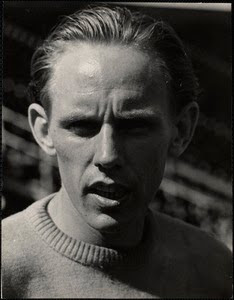
In an earlier blog posting we brought you a rememberance of times when Franjo Mihalic was on or near the top of world class marathoning in the mid 1950's.   He passed away recently at the age of 95,  winner of silver at Melbourne behind Alain Mimoun in 1956.  He was also the winner of the Boston Marathon in 1958 and the Cross de Nations in cross country along with the Sal Silvestre race in Brazil and many other races.  Also passing away recently was Art Garcia, former USC captain and Pacific Coast Conference champion in the mile in 1952.

Former USC Distance Runner Garcia Passes Away
Art Garcia
Art Garcia
Feb. 12, 2015
Art Garcia, co-captain of the 1952 USC national champion track and field team, passed away at the age of 84 on Feb. 2, 2015 in Culver City, Calif. Services are being held today at the Bobbitt Memorial Chapel in San Bernardino, Calf.
Garcia was a distance runner who specialized in the mile and two-mile races, winning the Pacific Coast Conference Championship in the mile with a time of 4:12.5 in 1952.
Garcia was also the captain of the 1951 USC cross country team which won the school's first-ever conference title. Garcia went undefeated that season, winning the PCC and the Southern Pacific AAU cross country titles.
Garcia was known for his leadership, work ethic and tremendous competitive spirit. He went on to become a captain in the U.S. Marine Corps and a successful business man who served on numerous boards. Garcia also served as vice-president of the Trojan Force and volunteered at USC home track and field meets. 


Earlier posting from :  Vol 3 No. 67


Two more photos, rarely seen,  from Jerry McFadden

George,
Here are more of the old photos I promised you last week


Photo 1. shows Gordon Pirie (1) leading in the March, 1953, "Cross Des Nations" (precursor to the modern International XC Champs) at Vincennes, France, in front of Thys (15) and Van Wattyene (16). The Englishman Pirie was the favorite but faded. Mihalic from Yugoslavia won. Pirie set 5 world records in his prime, including 5K in 13:36.8 and 3K in 7:52.7 in 1956. He also took a silver medal in the 5K in the 1956 Melbourne Olympics.  Mihalic took the silver in the marathon at Melbourne and won Boston in 1958.


Photo 2. shows the XC hurdles in the middle of the same race. Mihalic (135) eventually won, Surprisingly, the final distance was not listed in newspaper article, although the winning time was 47:53.1. 

Jerry

A clear view of Mihalic the winner is not evident in these pictures
but his head is partially seen behind Gordon Pirie's head.
Note the close distance between these barriers

Click to see enlarged copy of meet results

More about  Franjo Mihalic (Yougoslavia) the winner of Cross des Nations  1953

Who was Mihalic?  Probably you have forgotten that Franjo Mihalic won the Boston Marathon in 1958 and a silver medal in the marathon in 1956 behind Alain Mimoun in the Melbourne Olympics. 

A brief youtube clip can be seen at  http://www.youtube.com/watch?v=RyU9VtZi_D0
Longer and rather bizarrely edited clips also show up on youtube if you type in Mihalic's name.  What is remarkable is that the man was such a good international runner for a long period of time.  Born in 1920, he would have spent his best years surviving Nazi occupation during WWII and probably not being able to do much training.  A twenty years old healthy male most likely spent a lot of time in the military.  If you speak Serb or Croatian,  you  may be able to learn more about him on the youtube clips, some of which are over 20 minutes long.   At 93 years of age he is still alive today.   An interesting thing that came up in googling his name is that he ran in the Sao Sylvestre New Year's Eve run with Zatopek in Brazil in the 1950's.   A picture of him on the podium with Zatopek can be seen at the following website, and more interestingly you will have a history of that famous race.  It has been computer translated from Portugese to English, so there are some glaring translation mistakes, but you can still get this gist of the story.


Mihalic in Europe

Mihalic and some of his hardware

Mihalic counseling  French singer and actor Charles Azanevour who played a Czech marathoner (Zatopek?)
in the film "The Games". 
With Veikko Karvonen, and Alain Mimoun in Melbourne after the Marathon

Tuesday, February 10, 2015

V 5 N. 9 Gathering of Oldtimers in San Diego

The San Diego Times recently reported on a gathering of track old timers at Spaghettini restaurant.  Lots of good pictures of these guys though many in the photo gallery leave the persons unidentified.  Easily found and listed are Bob Seagren, Billy Mills, Lazlo Tabori, Bob Covey, Bill Dotson, Martha Watson, Ernie Shelby, Ron Morris, Jim Bush, Ron Allice, Doug Nordquist,  and many others  If you go about half way down through the article there is a note you can click on to open a bigger picture gallery.   None of those individuals in these photos are identified, but if you enlarge the pictures, sometimes you can read the name tags people are wearing.  Thanks to Mike Solomon for sending this our way.

http://timesofsandiego.com/sports/2015/02/09/billy-mills-just-one-of-the-famous-guys-at-track-reunion/
Ron Morris

Ron Allice

Bob Seagren and Casey Carrigan

Lazlo Tabori

Sunday, February 8, 2015

V. 5 N. 8 Watergate and Track?

A Winter’s Tale of Paths Converged”

This is a tale of two friends of mine whom I met at different times in my life. The first person is Roy Mason who writes the Track and Field News synopses on the pages of this blog. I first became acquainted with Roy in 1983 while I was living in Zimbabwe. Roy was and still is situated in Ukiah, CA. A mutual friend, Steve Price, who was coaching track in Bahrain, used to forward Roy’s letters on to me, because Roy’s writing was so good, and Track and Field was an interest to all three of us. Roy and I started our correspondence out of Steve’s having sent those letters on to me from Bahrain. When one lives overseas in the Third World, writing can become a very important part of your daily life.

Nineteen years later Roy wrote this account of running track at a small Christian Science College, Principia in Western, Illinois. And thirty two years later we feel it is time to tell this tale. 

One of Roy's  teammates at Principia was Egil ‘Bud’ Krogh who later went on to Watergate ill fame as a member of the co-conspirators.

In these letters you will see a dislike for the coach, a stifling collegiate atomosphere, and a love of the sport. The Christian Science faith plays a  part in this as well. Roy's mother was a CS practitioner and wanted him to start college in a CS school.  I remember Roy once mentioning about going out for football at Principia his freshman year and looking for the training room to tape his ankles. He soon found out that athletes of the CS faith didn’t use trainers they as they relied on faith to be healed of their injuries. Thus there was no training room, and Roy quickly became a cross country runner. It was a time when many of our readers were competing on a higher level of the sport, but the universality is there to behold.

letter from Roy

I left Principia after my soph year in '59.  Bud Krogh was a year behind me.  I first saw him as a Principia HS senior at the Ozark AAU meet in St. Louis where he won in 1:57.  We ran XC his freshman year.  He had gone to Europe and put on 15 pounds that summer, so I was able to whop him pretty good for most of the season.  As the pounds came off he got closer until the last meet when he beat me.  In track that year I had to double  (M, 2M) in every f----g meet while Bud ran 880 and MR.  Pissed me off because the 2M was last and that was the event I was trying to break the school record in.  "Oh, well", thought I, "at least I'll get two firsts in the conference meet".  Nope, in that one Bud got to run the mile.  Pissed me off, but he was a faster miler.  Bud was the AD/football coach/track coach's boy.  Crafton, the coach, had been at Krogh's high school the previous year, so that was understandable.  Also he didn't like me.  (Ask me about the Not Going To The Drake Relays Story.)  Personally, you couldn't find a more straight arrow guy than Bud Krogh.  He was the epitome of what a young CS kid should be: honest and religious as hell.  Very admirable guy with a good sense of values.  Can't say anything bad about him.  That is why I was floored by what happened to him.

I googled Egil Bud Krogh and a lot of little bio's came up.   Sounds like Nixon aid John 

Ehrlichman , friend of the family, dragged him right out of law school into the White 

House and gave him more responsibiltiy than the kid could manage.  His loyalty to Nixon 

enabled Ehrlichman to get him to do the nasties, then his conscience got to him.  He was 

the first to spill the beans and got 4 1/2 months in the joint.   GB


I

To say Principia was "stifling" is putting it mildly.   The school had the most beautiful campus I have seen, but was in the middle of nowhere.  As I remember it was 13 miles to Jerseyville, the closest spot to get a hamburger.  As freshmen and sophomores were not allowed to have a car, those 13 miles might as well have been 1000.  I only got there once and then it was for a funeral of a kid who drowned in the Mississippi

Another source reported the following about that incident:
I remember it was two boys drowning in the Mississippi in late Winter, early Spring.  One was from Cleveland.  He and the other boy had borrowed a kayak that belonged to some very advanced boy in Buck House that had ridden across the U.S. on a small motorcycle the summer before.  It was a cold Saturday, they had warm clothing, the kayak tipped, and they went over in the cold fast river with lots of ice in it from the Spring flood.  There were students on the bluff who saw them go over.  Later, the guy from Buck House who owned the kayak went out in the river with the men’s dean (John Rawsthorne) to look for them.  One of the boys’ bodies washed up in the locks at Alton.  The other boy’s body was never found.

When you were at Principia the rest of the world ceased to exist.  The town of Elsah was maybe two miles down the road, but there was nothing there to attract a college kid. 


There was a small general store with a gas pump in front.  That was it for commerce.  Most of the professors lived there.  It was a beautiful little town on the bank of the river, but time had passed it by as far as a college student was concerned.  This lifestyle was culture shock in the first degree for a kid from Long Beach, California..........
You were assigned to a dorm when you arrived.  There was no changing.  You were in Rackham East or West, Brooks North or South or Buck House.  You were a Buckie or a Westie for the rest of your life.  I was a Rackham Eastie.  The Rackham house (East and West adjoined) was a very impressive building, almost castlelike.  I was always in awe of it.  The advantage Rackham guys had was that you didn't have far to walk to sign up for the barber.  The barber shop, located in the bowels of Rackham East, was a regular dorm room with a barber chair or two, and was in use one, maybe two days a week when a barber (or two?) came in from Jerseyville.  The rest of the time it was used by guys pulling all nighters..........When I think of my time at Principia, the overwhelming image was money.  Nearly everyone there came from wealth or at least from my impoverished background that was the impression.  I had never associated with kids who had financial resources.  These were people with vacation homes, families who traveled to Europe, connections in business.  Although many of the guys there were arrogant assholes, I was surprised to find that many of them were nice guys.  The expectations of many were completely different than mine.  A B.A. was only a step along the way to success.  They talked about graduate school.  I remember being shocked to find out that when you graduated, you went on to do more college.  There is more?  I had no idea.  I had a roommate who, when he saw how few winter clothes I had, took pity on me and traded me several items of winter clothing for a sweater that he admired......Freshmen were to room with upper classmen.  Each quarter roommates would change.  The spring quarter there was a foul up and I got to room with another freshman, a guy from So Cal, Orlo Harvison (Bud) Pool.  Bud and I very quickly figured out that we were the two poorest kids on campus.  It was a bond that continued through our sophomore year, after which we left.  (Bud worked for a couple years and then reenrolled and graduated with a 4.0.)  No money?  Not to worry, Principia provided for those who needed to work.  I had a job filling the soft drink machines in the dorms.  It paid a whopping 59 cents an hour.  Thank you.  That evens things up.  Pretty much covered toiletries.  I got to drive a truck which in itself was pretty exciting.  I would assess what needed to be replaced then load the cases of pop on the handcart and haul them into the dorm.  When I serviced the women's dorms I was supposed to yell, "Man on the floor!" so that the bevy of women who run around naked at 4 PM would know I was there.  Though I was reprimanded by house mothers for not yelling loudly enough, I never saw a naked girl.............I mentioned cross country in the last email, making it sound like a regular team.   It wasn't.  We had one meet.  The rest were time trials on "our course".  The one meet was at Greenville I believe.  I won by a minute or so over four miles.  Bud Krogh was second.  The AD/football coach, Jim Crafton, didn't care about distance running in general and cross country in particular.  He let us have our "sort of" team with Bud acting as the facilitator/coach.  We would ask if we could please have another meet, but he never scheduled one for us.  Very disappointing.  Crafton was a good ole boy from Louisiana who had once put the shot 54' or some such at LSU, I believe.  He was a big guy who talked very slowly, very intimidating for a 19 year old kid.......This brings us to the story to which I referred in the last email.  The Drake Relays were on our schedule.  I knew the whole team wasn't going, but I thought I would be picked to run a slow heat of the 5000.  Nope.  The only guys to go were "Crafton's boys".  You were either one of his boys or you were an outsider.  If you were a football player or had been on one of his teams at Principia HS (St. Louis), you were his boy.  I definitely wasn't.  A couple station wagons were loaded up with about eight guys and off they went to Des Moines.  What were the rest of us to do?  As he left, Crafton posted Saturday's workout on the bulletin board.  My workout: run a mile time trial wait 20 minutes and run a two mile time trial.  Great workout, coach.  Thanks.  The rest of the stay-at-homes were given similar assignments.  We were disappointed with his lack of interest.  Another guy and I got the idea of seeing if we could do our time trials as nonscorers in a local meet somewhere.  The coach at Greenville had been friendly at the XC meet.  I called him.  Sure you guys can run.  Come on over.  We went to the dean of men who authorized a station wagon for us and we were off.  At the meet we turned our jerseys inside out so it would be obvious that we were competing unattached.  We had a good day with several PRs (not me, but I paced our #2 guy, Pete Martin, to his fastest 2M).  In general we were proud of our efforts.  I posted our times on the b-board next to Crafton's office, thinking that he would be happy we had done so well.  BIG MISTAKE!  About 4:00 the next morning several guys that had just returned from Drake came into my room to warn me that Crafton was furious at all of us, but me in particular.  They had never seen him so mad.  The reason: we had competed and hadn't won the meet.  Principia had some sort of win streak and he felt we had broken it.  I didn't understand.  In the note I had explained that we had reversed our shirts.  The scary thing about it was that the Drake guys bought his line of thinking.  At least they warned me that he might come looking for me.  I grabbed my mattress and dragged it down the hall to a friend's room so that if he did try to find me before the sun came up I wouldn't be there.  Sunday morning was always doughnuts and cocoa in the dorm, then church at 11:00 followed by lunch in the dining room.  No word from Crafton.  That afternoon we all got the word that we were to meet individually with Crafton in his office above the gym.  My appointment was for 7:45 (not sure how I remembered that).  I was sick with fear when I climbed the stairs.  Coach Crafton was very calm as he told me that I and the others were off the team, done, finished, through.  I was crushed.  How could this happen?  My one goal in life had been to set the 2M record, something I knew I could do if I had competition and didn't have to run the mile before.  Now that was gone.  The next day the situation changed slightly.  The team would vote on reinstatement.  The kicker was that it had to be unanimous.  That was followed by the information that Rich Overby, definitely a Crafton boy, one of the two good athletes on the team (21.5 straightaway, 49.5), with Bud being the other, was going to vote no.  This was a crusher as I considered Rich a good guy and had even gone on winter runs in the snow with him.  The vote was scheduled for Wednesday.  Needless to say Monday and Tuesday dragged on forever.  When practice finally rolled around I watched from a hill perhaps 100 yards away as they voted.  We were back on the team, but the message had been sent.  I knew I wasn't coming back for my junior year.  I did get the record and the Prairie College Conference (think that was the name) championship in the 2M, but the last meet was the Ozark AAU in St. Louis and everyone was entered as individuals.  Really enjoyed that week because I didn't do Crafton's workouts.  Fuck you, asshole.  He didn't care, because he didn't care during the regular season.  Even then, in my second year of running, I knew I knew more about distance running than Crafton.  Can't say that I hated the guy (feared, yes), but I harbored a healthy dislike.  
Coach Crafton Athletic Center
Once we went to Washington University in St. Louis.  It had one of the strangest tracks I've ever seen: three laps to the mile.  As I recall, it was built for the 1904 Olympics.  The guy giving 440 splits had to be in pretty good shape since the track was 586+ yards.  He had to move clockwise 146 yards every lap with the result that only the leaders got lap times.  I vividly remember the meet my sophomore year.  Washington's best runner was a small black kid who spit when he ran.  The second time I got hit I complained.  He apologized and aimed a different direction.  The memorable part of this wasn't that I beat him twice, it was that I OUTKICKED him both times.  I had never outkicked a white kid, let alone a black.  I thought I was Superman that day.

Another Student remembers fondly his last days at Principia:
  In the Spring, my roommate and others in Brooks South had a hard time sleeping, so we would go up river to Chubby’s all night café in Grafton, where we would eat hamburgers and play the pinball machine.  On the way back, we would stop at a summer resort on the river called Chatauqua, and go for a swim.  The river was warm, but the current was about 7 knots or better.  We would keep abreast of the peer we swam from with some good swimming, but then the river would win.  We would float downriver, and eventually have to walk back upriver in the sucking silt at the edge of the river.  My last year there the state began building an interstate up our side of the river, under the bluffs, using the old railroad line.  One night, at the riverside in Elsah, we found an aluminum workboat that was unchained.  We rowed across the river to a small town called Portage de Sioux (I believe).  We walked around town in the stillness of the night, and I distinguished myself by flicking the remains of a filter cigarette to the pavement, and it landed standing up on its filter tip.  We took that as a sign of ‘mission accomplished’, and rowed back over to Elsah You can see why I moved on.  Too bad they didn’t have any competitions on flicking cigarette butts.


So fifty-six years later, our young hero now an aged and surly old curmugeon sits in his mountain retreat regarding those days not so fondly.  Congratulations, Blog Buddy, you got the 2M record despite the poor, make that no coaching you received.  Crafton may have gotten a cement slab named after him  on the campus, but you got the record. Amen and pass the liniment.  George
The bluff road now an interstate


The photos add to the story.  Elsah looks like a European town in those shots.  Now it is more in touch with the world because it has to be a freeway off ramp.  The freeway replaced the dirt road that had been the railroad tracks long before my time.  It was a beautiful place to run.  Tugs pulling barges going upriver were fun to race.  The tug operator would toot his horn at us.  Then the freeway went in and I'm sure Elsah entered the 20th century.....Roy


Wednesday, January 28, 2015

v. 5 n. 7 Steve Price, Ohio Track Coaches Hall of Fame

                                Steve Price
Not Your Ordinary Track Coach

Steve Price pickin' a few Bluegrass gospel  licks
near Middletown, Ohio


This Friday January 30, 2015 my two best friends in Track and Field and in life will be involved in a ceremony honoring one of them.   Steve Price will be inducted into the Ohio Track and Field Coaches Hall of Fame.   Bill Schnier, already a member, will be making the presenting speech for Steve.
Bill Schnier

Steve is an Ohio boy, born and bred.  Because his family was somewhat itinerant in his formative years, Steve attended a lot of public schools growing up.  He was in four or five schools in the fifth grade and had to fight to defend his four sisters' honor in every one of those schools.  He finally ended up graduating from Lemon Monroe High School half way between Cincinnati and Dayton.  From there he went on to college at 'the cradle of coaches'  Miami University in Oxford, Ohio where he was a 'modest' talent on the cross country team. But watching all those good runners from behind he obviously picked up a lot of ideas about running.  Soon after graduation he began teaching in Kettering Public Schools and got very involved in road racing in the early 1960's competing around the Midwest and running a 2 hour 57 minute marathon at Boston in 1964.  Hitchhiking to races was common place for young runners in those days.  He told me once about hitching from Oxford to the Around the Bay Race in Hamilton, Ontario with his roommate, who was from Hamilton.   After the race his roommate decided that he was not returning to Miami, because of a girlfriend problem in Hamilton.  So Steve had the thrill of hitching alone back to Ohio in the winter.

In the late 60's Steve became one of  the co-founders of the Ohio River Road Runners' Club (ORRRC) and began organizing marathons, 24 hour relays,  and shorter races in the Southwest Ohio area.  He was race director of the first Monroe Marathon which  rolled past his mother's house and tragically resulted in one of the participants passing away on his mother's living room floor after collapsing near her house.

While teaching physical education at Southdale Elementary School in Kettering,  Steve founded the Kettering Striders Track Club. For several years he had been holding 'field days' at the school to introduce Track and Field to the kids.   Initially it was an opportunity for elementary school girls to participate in Track and Field and later boys were also invited to participate.  Many of the Kettering Striders girls moved on to run track in their high schools once those programs were open to girls, and many of them had already won national age group titles before starting their high school careers.   The ones who were at the top of the pyramid went on to college.   Brenda Webb was one of the Striders' first  national class runners, then came Terri Siepel , Cindy Brown, Laura Kirkham, Susan Ruiz, Kathy Welch and many others.   On the men's side Joey Greene became an Olympic medalist twice  in the long jump at Atlanta and Barcelona.  Phil Scott was a national champion in the indoor pentathlon and outdoor JUCO decathlon champion one year.  There were a number of people who helped coach the Striders during that time, but Steve was the driving force behind that successful club. They also hosted the women's national cross country championships in 1974.  Because of the Striders' success, Steve was named to several national coaching staffs including a world race walking championships in Dusseldorf 1977 and to the US team for  the 1974 Russian dual meet in Moscow.  Twice he was on the coaching staff at the US Sports Festival.

The club started to wain once high schools began incorporating Track and Field into their extra curricular programs for girls.  This left Steve out of a coaching job, but not for long.   He went on to work for the United States Sports Academy and was posted to Bahrain in the Persian Gulf where he served as head distance coach under Vic Godfrey who was in charge of that program.  He traveled throughout the Middle East during that year and a half going to international meets with his runners.   Then he returned to the States and back to his job teaching in Kettering.  He soon took up the reins of the University of Dayton Flyers  in 1983 when that school started men's cross country.  He operated for several years on a minimalist budget (including a $500 salary), getting a bus that he drove, a few uniforms and a bunch of walk ons and started the program that is still going today.  However  today's team is no longer allowed to take a few cases of beer along on in their vehicle.

During those years Steve developed a friendship with Bill Schnier who later  became the head coach at U. of Cincinnati, and I got to meet Steve about 1973 when I brought a Canadian runner down to Ohio during spring break to do some warm weather training. We've been friends ever since.  Steve and Bill reportedly bonded  during a night of heavy partying when the two of them decided to start their own highway beautification project, choosing as a target, the 6 miles of Rte. 73 running east out of Oxford, Ohio.  With a two-man cross cut saw they removed all of the unsightly billboards along that stretch of  road.  Later when they were both employees of the state of Ohio, that story was told only in strictest confidence.  Now it seems possible that it can be openly mentioned once more.  By the way, within a few weeks all the billboards were put back up with steel support posts.  After this was posted , it has been brought to my attention that this action of eco terrorism was not alcohol fueled but a cold blooded, pre-meditated act.  As I recall the signs were definitely not replaced very soon but came back little by little over a year or so.  After 4-5-6 years they had matal supports.  However, our work did last for some time.  Bill
According to Steve:  "Unlike friend George's recollection, those signs were not replaced for months...and sometimes never as I remember."  These boys never let a stone go unturned or a misstatement go uncorrected.  George

In 1989 Steve became the women's  coach at Bowling Green State University.  He had some tremendous women's cross country teams and won the All Ohio cross country meet one year with a near minimal 22 points, against the likes of Cincinnati, Ohio State, Ohio U., Toledo, Miami, Akron, and Kent State.  His teams  became a spoiler in the tough Midwest Cross Country Regional as well, once qualifying as a team for the Nationals.   That team consisted of girls who were not stars on their high school teams, but middle of the roaders who really developed under Steve's tutelage.   To be on Steve's teams was more than just training and racing.  Steve enjoyed the 'good life', and he wanted his teams to do so as well, if they stayed within their budget.  A trip to New York City was a must every year as well as a lunch at the Stage Deli.  He once arranged a triangular cross country meet with Yale, North Carolina, and Bowling Green at New Haven.   You never ate in a fast food restaurant if it could be avoided.  You went where there was a wait staff,  and no one began eating until the last person was served and grace was said. Those were house rules growing up in Steve's family and they were team rules.  If there was a piano in the restaurant, Steve would be at the keyboard  entertaining the kids with his blues and boogie woogie repertoire.

Shortly after Steve went to Bowling Green in 1989 he contracted a malignant cancer in his throat and underwent a lot of heavy duty radiation and surgery which damaged his esophagus, his salivary glands , and vocal chords making it very difficult for him to talk, but he never lost his zest for coaching or living.  Just before he got ill he married Christine Jacomet , and she has been an incredible support to him all these years.

I remember once visiting Steve in the hospital when he  had a portion of his tongue removed due to the cancer spreading.  He had to miss the Miami Invitational Cross Country meet.   In one of the nicest acts of a rival,  Rich Ceronie, the head coach at Miami,  got on the phone to Steve at the start of the meet and gave him a running account of the race as it progressed.   I think Rich thought Miami would prevail, but Steve's team ran a great race that day and Bowling Green dominated.   Rich, to his credit, never hung up the phone and announced to  Steve that Bowling Green had won the meet.

Steve was on a feeding tube for awhile, and we would go out to parties or to clubs to hear music.  His will to enjoy life often led to his pouring a few shots of liquor into his feeding tube to get in the right mood to listen to some hard driving blues or bluegrass of which he is also fond.  Steve made it to retirement age and eventually left Bowling Green.   He  and Chris moved back to her home town of Piqua, Ohio a few years ago, but he couldn't leave the coaching game.  Marc Arce, who coaches at the University of Findlay,  not far from Bowling Green, contacted Steve about coaching up there, and Steve jumped on it.  He would commute the ninety miles each way three times a week to coach and attend meets on weekends.   With his musical talent he would keep a regular schedule  playing the piano in nursing homes on the the way up I-75 to Findlay.  While at Findlay, where he is still coaching,  he developed hurdler Kirby Blakley into the NCAA DII Women's Athlete of the year in 2005.

I recently asked Phil Scott who was coached by Steve for several years , why he thought Steve was such a successful coach.  Phil answered, that "Steve was the kind of person that inspired, was knowledgeable, caring , and whom you always wanted to do well for."  It's as simple as that.

Ultimately the problems with his throat and losing the ability to swallow, put him back on a feeding tube for the past 5 years.  His weight has gone down to 115 pounds at one time, but recently it is back up to 135, and he is feeling well at last report and ready to go get his award this Friday as the latest member of the Ohio Track and Field Coaches Hall of Fame.    Best wishes, Steve , from all of us down at the OUTV offices.    Steve,  Keep it warm and wrapped up, and don't put your saddle on the wrong horse.

Thursday, January 22, 2015

V. 5 N. 6 Ernie Shelby Returns to Kansas University


Some of you old timers probably remember Ernie Shelby of University of Kansas, an All American Long Jumper in the late 1950's,  teammate of Wilt Chamberlain, today a jazz singer and composer.  This article appeared in KU's Alumni Journal this past week.  

Alumni return for KU’s King celebration

Posted on Jan 20, 2015 in Campus News


Homer Floyd, d’61, KU’s first African-American football team captain, and Ernie Shelby, f’59, KU’s first African-American track team captain, returned to Mount Oread for Martin Luther King Jr. Day events Jan. 19 in Lawrence.
After a program in Strong Hall, the two participated in a candlelight walk with about 125 students and faculty members to the Kansas Union for a Social Justice Celebration. Later that evening, Floyd and Shelby were honored during the Jayhawks’ rousing 85-78 victory over Oklahoma.
Floyd was an all-conference running back, and Shelby was a national-champion long jumper. In 1957, the two, along with All-America men’s basketball team captain Wilt Chamberlain, ’59, and All-America sprinter Charlie Tidwell, ’61, met with Chancellor Franklin Murphy to ask for his help in changing the discriminatory practices of Lawrence businesses.
At their urging, Murphy, c’36, convinced local businesses to provide equal service and access to African-Americans.
Floyd (left in photo below), who now lives in Harrisburg, Pennsylvania, led the football team as co-captain in 1958 and went on to a distinguished career as a civil rights leader. Shelby (right), of Los Angeles, led the track team as captain in 1959, when the men’s team won the NCAA Outdoor National Championship. He won the national championship in the long jump in 1958 and ’59 and earned All-America honors. Shelby is a jazz composer and singer.
—Jennifer Jackson Sanner
Homer Floyd and Ernie Shelby | photo by Steve Puppe | www.kualumni.org
These lines are from a Sports Illustrated report on the 1959 NCAA meet at Lincoln, Nebraska.

The University of Kansas, led by versatile athletes like Ernie Shelby (right), whose leap against the Nebraska sky gave him first place in the broad jump and who finished third in the low hurdles and fifth in the hop, step and jump, won the National Collegiate track and field championship last weekend at Lincoln in a two-day meet studded with bizarre and unlikely happenings.

Here's a youtube link to a recording of "Summertime", by Ernie Shelby.
https://www.youtube.com/watch?v=Id2cAndg0xI

Maybe he and Marty Liquori need to get together for a session.


Wednesday, January 21, 2015

V. 5 N. 5 Gordon Dickson , Canada, RIP


January 20, 2015


Orville Atkins sends us this message and tribute to his friend Gordon Dickson former Canadian Marathon
champion and national record holder.
Gordon Dickson

Gordon Dickson, my friend and lifetime Idol passed away yesterday after a short illness.
Gordon was one of the best distance runners on the continent during the late 1950s and early  1960s.
He was 3rd in the Pan Am Games and 3rd in the Boston Marathons in 1959, a 1960 Olympian and carried 
the Canadian Flag in the 1962 Empire and Commonwealth Games.  He won both the Canadian Marathon 
and Hamilton's Around the Bay race (The oldest race on the continent) at least 6 times.  He won other 
Canadian Championship races.  Gord was a wonderful friend.  He was very unassuming. Only a couple 
runners on this continent could match him when he was not injured.

He gave away nothing about training but I just watched.  He was a great friend.  We ran together a number 
of times.  Once he brought Jim Green  with him and another time we were joined by Bruce Kidd who was a 
lot younger than we were.  Very memorable runs.  Gord was ahead of his time and studied the sport.  

At one point in his life he spent time in Kenya training distance runners.

I know he sometimes swam at noon.  Gord was very proud that he had beaten former Boston winner (1954) Veikko Karvonen in his 1959 Boston 
Orville Atkins

Sports Reference has a brief biography of Gordon Dickson

Gord Dickson started out as a high school miler, earning a track scholarship to [Drake University].
He attended graduate school at NYU, where he ran with the [New York AC]. Returning to Hamilton,
Ontario, Dickson moved up in distance, winning the 19+ mile Around the Bay Race in 1956-59 and
1964. He was Canadian marathon champion in 1957-60, 1962, and 1964, and Canadian cross-country
champion in 1957-59, also winning a national title on the track in the 6-mile in 1958. Dickson ran at
both the 1958 and 1962 Commonwealth Games, placing 5th in 1958 and 12th in 1962 in the marathon.
He won a bronze medal in the marathon at the 1959 Pan American Games. Dickson raced many times at
the Boston Marathon, with a best finish of third in 1959. His career was shortened by Achilles' tendon
problems, but in 1991 Dickson was made an inaugural member of the Canadian Road Running Hall of
Fame. His business career was in the business administration department of the Halton Board of
Education, where he worked for 25 years.
Personal Best: Marathon – 2-21:51 (1958).


Here is the progression of Canadian Marathon Records for both Men and Women.  Gordon held the Canadian record for over 7 years.

Canadian Men

Jerome Drayton2:10:08FukuokaDec 75
Jerome Drayton2:11:12FukuokaDec 69
Jerome Drayton2:12:00DetroitOct 69
Robert Moore2:18:55TorontoSep 69
Ron Wallingford2:19:24St HyacintheSep 66
Ron Wallingford2:21:27DetroitNov 65
Gordon Dickson2:21:50HamiltonMay 58
Walter Fedorick2:28:04HamiltonJul 51
Gerard Coté2:33:42Salisbury Beach, MAMay 41
Gerard Coté2:34:06YonkersNov 40
Walter Young2:34:47VerdunOct 38
James Bartlett2:36:35HamiltonSep 38
Harold Webster2:37:36HamiltonSep 31
Cliff Bricker2:39:24AmsterdamAug 28
Cliff Bricker2:40:05Buffalo NYMay 27
Percy Wyer2:51:10MontrealSep 26

Canadian Women

Lanni Marchant2:27:59Toronto WaterfrontOct 13
Silvia Ruegger2:28:36HoustonJan 85
Silvia Ruegger2:30:37OttawaMay 84
Jacqueline Gareau2:30:58TokyoNov 80
Jacqueline Gareau2:31:41MontrealSep 80
Linda Staudt2:37:39LondonAug 80
Christine Lavalee2:42:50OttawaMay 80
Gayle Olinekova2:44:04Waldniel, GermanySep 79
Gail McKean2:44:53VancouverMay 79
Christine Lavalee2:47:39OttawaMay 78
JoAnn McKinty2:57:40KitchenerOct 75
Maria Brzezinska3:03:15VancouverMay 74
Maureen Wilton3:15:22TorontoMay 67

V 15 N. 10 Gunder 'The Wunder' Haegg Visits Cincinnati

Bob Roncker of Cincinnati, Ohio has sent in this account of one day on the 1943 tour that Gunder Haegg of Sweden made to the US to help rais...