Once Upon a Time in the Vest

Tuesday, August 25, 2015

V 5 N. 81 Some Stories about Marty Glickman

Many of you may remember Marty Glickman, radio and TV sports announcer way back when, and you probably know that he along with Sammy Stoller were the two Jewish sprinters who went to the 1936 Berlin Olympics to run on the 4x100 relay.  They were taken off the team at the last minute due to pressure from the Nazis and kowtowing of US team managers and coaches.      We recently received the following stories from the New York Times from our friend Stephen Fisher, now living in Dar Es Salaam, Tanzania.   Steve once wrote sports for the Times, and interviewed Filbert Bayi in Swahili after Bayi's  appearance at Madison Square Garden.   Steve said he was looking up articles by Arthur Pincus one of his colleagues at The Times when he found these stories about Marty.  The Times stories were actually found on a WILI radio   website.  WILI covers UConn basketball and football games.

Marty Glickman and Sammy Stoller

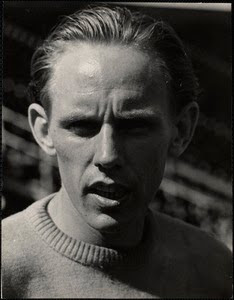
Glickman in his broadcasting years

MORE NEW YORK TIMES ARTICLES ABOUT MARTY GLICKMAN
50 YEARS LATER, BITTER MEMORIES OF THE BERLIN GAMES
By Arthur Pincus
Copyright New York Times Company Aug 10, 1986
WHILE others marched, Marty Glickman, Sam Stoller and 381 other American athletes sauntered into Berlin's Olympic Stadium on Aug. 1, 1936, in the parade of nations opening the Games of the XIth Olympiad. For Glickman, Stoller and all the athletes, the Olympics proved that the practice time and the games of youth were worthwhile, a chance to meet and maybe beat the world's best.
Perched in his box, wearing his gray storm trooper's uniform, Adolf Hitler looked on and the Games began. There were 120,000 people in the stands; overhead the Hindenburg sailed in an overcast summer sky. Richard Strauss led an orchestra and a chorus of 3,000 in a new Olympic hymn that Strauss had written for the occasion.
The Summer Games of 1936 were to be a testament to German recovery from the devastation of World War I, a chance for the Nazis to show their industrious face to the world.
The stadium was the centerpiece of a huge Olympic complex; the grass on the infield was clipped to perfection; the red clay track contrasted brilliantly with the arena's gray concrete. Although the months preceding had brought talk of an American boycott to protest German persecution of Jews, the Americans were there that day.
Teams enter the Olympic stadium alphabetically; the host nation comes in last. So the German language put the United States (Vereinigten Staaten) just before the Germans. The Americans' lack of military precision in their stride and their tradition of not dipping the Stars and Stripes to a foreign leader brought hoots and catcalls.
The track and field competition began the next day; when it ended a week later, Marty Glickman and Sam Stoller, the only Jews on the track team, were the only members of that team who hadn't competed. On the day they were to begin trial heats in their event, the 400-meter relay, they were pulled from the competition. Jesse Owens and Ralph Metcalfe replaced Glickman and Stoller, and the Americans won the relay in record time. But they would undoubtedly have won anyway had Glickman and Stoller been allowed to run; there were no super runners for other teams.
The pain of his chance denied still singes the memories of Marty Glickman, whose voice is so well-known to New York sports fans for his years broadcasting college basketball, the Knicks, the Giants and the Jets but whose athletic skill has faded in memory. He was back in Berlin last summer for the first time since 1936, serving as a consultant for the Jesse Owens invitation track meet this weekend.Despite having talked about the incident many times over the years, Glickman was unprepared for what happened that day he returned.
''My anger was overwhelming,'' says Glickman, now 68 years old. ''When I walked out of the tunnel under the stands I began looking around, looking at this powerful place, looking at the box where Hitler sat. And then I started to shake, found myself wanting to shout out at the people who took away my chance and Sam Stoller's chance to win an Olympic gold medal. I almost passed out with the rage.''
There were nine Americans in a bungalow in the Olympic Village in Berlin on Aug. 8, 1936 - two coaches, seven athletes. The coaches had made a decision and were letting their sprinters know that the American 400-meter relay team was being changed.
Glickman, born in Brooklyn to Rumanian immigrant parents, believes that their religion was the reason he and Stoller were denied their chance. The switch enabled Owens, a black American, to win his fourth gold medal.
''We thought we were going to go over the order and strategy for our race,'' Glickman recalls. ''But Lawson Robertson, who was the head coach of the track team, said he had been hearing rumors that the Germans were hiding great runners to stop us in the relay.
''Well, Jesse had already won the 100 meters and the 200 meters; Ralph Metcalfe had finished second to Jesse in the 100 and Mack Robinson had finished second to Jesse in the 200. How could the Germans have any runners to beat us?''
Glickman, about to enter his sophomore year at Syracuse University, and Stoller, soon to be a senior at the University of Michigan, were stunned. They had finished fifth and sixth in the United States Olympic trials, and tradition said that the first three sprinters in the 100 at the trials would compete in the Games in the 100; the next four would make up the 400-meter relay team.
That was the assumption after the trials; that was the assumption as the team traveled to Europe on the luxury linerManhattan; that was the assumption as they trained throughout those days of pomp and circumstance in Berlin. Stoller and Glickman had practiced in the relay with Foy Draper and Frank Wykoff, both products of the University of Southern California, where the coach was Dean Cromwell, who was serving as Robertson's assistant.
In a practice 100-meter race to set the relay team, Stoller was first, Glickman second, Draper third. It seemed that if anyone needed to be replaced it was Foy Draper.
When Robertson announced his decision, Owens, who had already won the 100 and 200 meter dashes and the broad jump, stood up to speak.
Glickman recalls him saying: '' 'Coach, I've won three gold medals. I'm tired. Let Marty and Sam run. They deserve it.'
''Cromwell pointed his finger at Jesse and said 'You'll do as you're told.' ''
That was the end of it. Owens and Metcalfe replaced Stoller and Glickman on the 400-meter relay team. They won by 15 yards with the Germans third. They set a world record despite having the two faster runners, Owens and Metcalfe, run the first two legs and the two slower runners, Draper and Wykoff, finish the race. Owens and Metcalfe were black; Draper and Wykoff were white.
Mack Robinson, the only other person at that meeting still alive, wonders, too, about the motives. ''They had the two fastest runners in the world, Jesse Owens and Ralph Metcalfe,'' he said in a phone conversation from California. ''But Wykoff ran across the finish line. What does that tell you?''
Two days before the meeting in the bungalow, Robertson had been asked who would make up the relay team. Would Jesse Owens get a chance to win his fourth gold medal and the little oak tree seedling given to each winner?
''Owens has had enough glory and collected enough gold medals and oak trees to last him a while,'' Robertson had said.
Then Robertson named his relay team: Marty Glickman, Sam Stoller, Frank Wykoff and either Foy Draper or Ralph Metcalfe. So what happened? Were the American coaches forced to make a change to keep two Jewish runners from the victory stand in Berlin? Did the change also enable a white American to flash across the finish line and take a little of the sting away from the Nazi hosts? They had already seen Owens win the broad jump, the 100 and the 200. There were other black American gold medalists: Cornelius Johnson, Archie Williams and John Woodruff.
For what purpose were Marty Glickman, an 18-year-old from Brooklyn, and Sam Stoller, on his 21st birthday, denied the chance they believed they had fairly won?
Stoller seemed more serious than Glickman. Photographs of the two together from 1936 show the difference. Glickman was a wavy-haired 18-year-old who had experienced almost nothing in his life to stifle the ever-present wide-mouthed grin. Stoller's look is determined, almost grim.
''This is one day in my life that I'll remember to my dying days,'' Stoller wrote in a diary that he shared with William O. Johnson in Johnson's 1972 book, ''All That Glitters Is Not Gold.'' Stoller, who died in May 1985, called the incident ''the most humiliating episode in my life.''
The Olympic Games would never be the same after Berlin. They became an opportunity for nations to prove something to the world, even if that proof came in so simple a form as who won a foot race.
There had been questions whether the United States would even take part. The Germans had adopted the Nuremburg laws in September 1935, limiting Jewish citizenship rights, and in the States there was a call to boycott. The dispute centered on whether the Germans had accepted all the Olympic codes for their grand show, including a guarantee that all athletes could compete for a spot on their teams.
Avery Brundage, president of the American Olympic Association, praised the German methods and accepted their propaganda. He said he was given assurances that ''there will be no discrimination against Jews.''
But there was. The best women's high jumper in Germany those years was a 21-year-old named Gretel Bergman. On June 30, 1936, she tied the German high jump record at 5 feet 3 inches; that height would have earned her a silver medal in the Olympics. But she was Jewish and she didn't compete.
Brundage cast pro-boycotters as radicals with ''Communistic antecedents.''
When the American Olympic Association met in New York in December 1935, Brundage carried the day, albeit by the slim margin of 58 1/4 votes to 55 3/4.
Dean Cromwell, the assistant coach who Glickman believes was the instigator in the change, came in for criticism just weeks after the Games when in a speech he made a complimentary reference to Hitler that was taken seriously by many. But, according to Cromwell: ''It was all said with a laugh and received in the same mood. If I referred to Hitler as that 'handsome boy,' it was poetic license and jovially received by my listeners as such.''
Was it Brundage who forced the hand of the American coaches? Or did Cromwell act on his own? In effect he was running the American track team as the assistant to Robertson, an older man in ill health.
The day after the relay team won the gold medal, Glickman was walking across the immaculate lawn of the village, which was to become housing for Wehrmacht troops. He heard someone call.
''I turned and saw Lawson Robertson lumbering towards me,'' Glickman says. ''He walked with a cane and moved very slowly. He came up to me and said, 'I just wanted to apologize to you. We have caused a terrible injustice. I'm sorry.' ''
Stoller's diary recalled a conversation he had with Robertson on board the Roosevelt on the trip home: ''Coach Robertson came up to me today on board ship and very apologetically admitted that he had made a terrible mistake not letting me run -in place of Metcalfe!''
But Robertson had given neither man a reason for the shift.
Glickman watched the 400-meter relay heats and final from the stands and from the press box. There he told the American press his story, saying politics and favoritism for the two Southern California sprinters was the overriding reason for his removal.
''I told the coaches there would be a big stink over Sam and me being pulled since we were the only Jews on the track team,'' Glickman says.
''Cromwell said: 'We'll worry about that.' ''
But there was virtually no furor. The reporters were more interested in covering the event than the people involved. The only non-competition story that got much mention in the American press during the games was Eleanor Holm's removal from the swimming team by Brundage. She had been seen sipping champagne on the voyage to Germany.
Sam Stoller left Berlin saying he would never run again. But in fact he did, competing for Michigan and winning the college sprint championship. He had a fling at the movies, known as Singing Sam Stoller, and became a broadcast executive.
Owens became an American hero. During a ticker tape parade in New York, someone ran up to him and pressed an envelope into his hand. Hours later he opened it and found $10,000. He brought his seedlings home to Ohio.
Glickman figured: ''I'll show these guys in 1940.'' But by 1940, World War II had begun and the Games, scheduled for Tokyo, were canceled. In the fall of 1936 he returned to Syracuse where he became a football star. One day a local haberdasher asked him to do a radio program sponsored by his clothing store, hoping to cash in on the football player's notoriety, and Glickman became a broadcaster. Over the years he became the most familiar voice to New York sports fans. He maintains the tightly wound athleticism of his youth by skiing and sailing. His home is filled with mementos of his success as an athlete and broadcaster; there is no Olympic medal. He remains a consultant to HBO as well as NBC Sports.
''I still firmly believe the Olympics is one of the most important methods of bringing together the youth of the world to know each other, to love each other and understand each other,'' Glickman says. ''I did that. But Sam and I became the unfortunate object of bigotry.''


WHY JESSE OWENS WON 4 GOLD MEDALS
By Bud Greenspan
Copyright New York Times Company Aug 9, 1981
FIVE years ago today, Jesse Owens won his fourth gold medal at the 1936 Berlin Olympic Games when he led off the victorious 400-meter relay team that included Ralph Metcalfe, Foy Draper and Frank Wykoff. It was a race Jesse Owens was not supposed to run.
Forty-five years ago today, Marty Glickman and Sam Stoller, both Jewish, lost their chance to win an Olympic gold medal when they were told in a meeting before the qualifying heat of the 400-meter relay that they could not run. The meeting was called by the United States Olympic track coach, Lawson Robertson, and his assistant, Dean Cromwell, who was also head track coach at the University of Southern California. All six sprinters involved attended the meeting.
Much has been said about what transpired during that prerace meeting. The most dramatic story was that the president of theUnited States Olympic Committee, Avery Brundage, along with Robertson and Cromwell, had bowed to pressure from Nazi officials to remove the Jewish runners so as not to embarrass Adolph Hitler's regime.
For many years, stories circulated that the Nazi minister of propaganda, Joseph Goebbels, had appealed to the American officials not to enter a relay team that consisted of two black and two Jewish runners. The fact that Brundage later became associated with the America First Committee, a group that many believed was sympathetic to Hitler and the Nazi regime, only added strength to the reports.
Glickman vividly remembers the Berlin meeting. Over the last decade while filming ''The Olympiad'' television series, I also interviewed Owens, Metcalfe and Wykoff for their recollections of the circumstances.
''We were told,'' says Glickman, ''that the first three finishers in the 100-meter final tryout at Randalls Island in July 1936 would run the 100 meters in Berlin. We were also told that the runners who finished fourth, fifth, sixth and seventh in the 100-meter final tryout would make up the 400-meter relay team in Berlin.''
Owens, Metcalfe and Wykoff confirmed that this was their understanding, too. ''Owens, Metcalfe and Wykoff finished 1, 2, 3 in the final Olympic tryout,'' recalls Glickman. ''Foy Draper was fourth, I was fifth, Sam Stoller sixth and Mack Robinson, Jackie's brother, was seventh.''
Glickman maintains that only he, Stoller and Draper were certain to run on the relay team because they were not competing in the individual events.
Owens should have been the last of the seven considered. He would have to run four races in the 100 meters, four in the 200 meters, and do extensive jumping to qualify in the long jump. In order to reach their finals, Metcalfe and Wykoff would each run four races in the 100 and Mack Robinson would have to run four in the 200. Owens, Metcalfe, Wykoff and Robinson made it to the finals in their events.
Metcalfe died in 1978. In his interview with me, he said: ''Marty Glickman is right: You'll recall that in the 1932 Olympics, when Eddie Tolan, George Simpson and I each qualified for both the 100 meters and 200 meters, the coaches reasoned that it would be better to have four fresh sprinters run the relay who would have the benefit of practicing their baton passes while we were running the individual races. Neither Tolan, Simpson or I were even mentioned about running in the relay in 1932.''
Glickman, Stoller and Draper appeared certain to run the relay. It was assumed that Wykoff would be the fourth runner even though he was competing in the 100 meters. Wykoff was on the previous United States Olympic 400-meter relay teams that won gold medals in Amsterdam in 1928 and in Los Angeles in 1932.
This belief was confirmed by an Associated Press dispatch in The New York Times on Aug. 5, three days before the qualifying heats of the 400-meter relay.
On Saturday morning, Aug. 8, a few hours before the qualifying trials of the 400-meter relay, the pre-race meeting was held. ''Lawson Robertson announced that because of the rumors that the Germans were hiding their best sprinters in preparation for the relay, Jesse Owens and Ralph Metcalfe would replace Sam Stoller and me on the relay team,'' recalls Glickman. ''We were shocked. I remember saying, 'This is ridiculous, how is it possible to hide world-class sprinters?' ''
Before he died last year, Owens told me that he felt terrible for his friends Glickman and Stoller. Glickman confirms Owens's recollections of the meeting.
''Jesse was magnificent,'' says Glickman. ''He said, 'I've had enough. I won three gold medals. Let Sammy and Marty run.' '' Glickman remembers that Robertson and particularly Cromwell were adamant. ''Cromwell would not accept Jesse's offer,'' says Glickman. Glickman and Metcalfe have different versions of Metcalfe's participation in the meeting.
''Metcalfe was fairly quiet,'' says Glickman. ''He had two silver medals in the 100 meters in both Los Angeles and Berlin. Apparently he was hoping for a shot at a gold medal.''
However, Metcalfe reacted angrily when recalling his reaction to the 1936 meeting. ''I thought at the time it was terrible,'' he said. ''It was unjust to leave two athletes off the team just because they were Jewish.''
Wykoff, who died in 1980, said: ''We hadn't worked with Jesse or Ralph at all. I think that if Glickman and Stoller had run, we would have had just as fast a time, if not faster.''
''The decision to keep the only two Jewish athletes on the United States team out of the competition was made by American Nazis,'' Glickman says, ''Both Avery Brundage and Dean Cromwell were members and supporters of the America First Committee who were sympathetic to the Nazis.''
I spent five years researching the 1936 Games for my film, ''Jesse Owens Returns to Berlin.'' The United States came close to boycotting the Berlin Games because of Hitler's Nuremberg laws, which deprived German Jews of their citizenship and protection under the laws of the Third Reich. The anti-Olympic feeling forced Brundage to make a pre-Olympic visit toGermany. His conclusions decided the matter. He reported that Germany had fulfilled all the obligations required under the Olympic charter. So sensitive were the Nazis to the protests from the United States that they bent over backwards to quiet stories of Jewish persecution in the months preceding and during the Games. Several Jewish athletes competed for Germanyin the 1936 Olympics.
The real culprits in the Glickman-Stoller affair appear to be Robertson and Cromwell, in deciding to eliminate the two qualified Jewish runners, and then, in giving the shameful explanation that their decision was made to protect an American victory against a mythical superteam of German sprinters.
Glickman, who was an 18-year-old freshman at Syracuse University in 1936, later gained national fame as a sportscaster. He'll never forget Aug. 9, 1936.
''I remember watching the 400-meter Berlin final,'' Glickman says, ''and I still have a feeling of frustration and sadness that I was not out there, was not running. Something I had pointed to all my young life. When they mounted the victory stand and they played the National Anthem, I thought, I ought to be out there, I should be out there ... and I wasn't ...'' 

Bud Greenspan won an Emmy Award for ''The Olympiad'' television series. His production, ''The Heisman Trophy,'' will be shown in December.


Another view on the same story about the selection process for the 4x100.   This comes from Tom Trumpler.
In the above accounts, Glickman or the writer claim that in 1936 it is was standard operating procedure  to take a number of extra sprinters ie. 5th and 6th in the trials) to make up the 4x100 as the US had done in 1932 which would argue the case for Marty and Sam.  However in modern times we know that the relay is generally made up of the top three in the 100 and the fourth finisher in the trials.  There would be no 5th , 6th 100 meter runner making the trip. Saves on plane fares or boat cabins.   If necessary extra sprinters would be recruited from the ranks of the 200 meter runners.  A further question left hanging then would be why did Lawson Robertson , the head coach, apologize separately to both Glickman and Stoller?
Anyway, here is Tom's view.

OWENS - METCALFE - WYKOFF - DRAPER - GLICKMAN - STOLLER

Much is made about Marty Glickman and Sam Stoller being left off the 1936 Olympic 4x100 relay team because they were Jewish.
This makes a good story for those who want to feel victimized, however, Glickman and Stoller were just alternates who only finished fifth (Glickman) and sixth (Stoller) in the Olympic trials 100 meters trials.

Dean Cromwell, the coach at the University of Southern California, selected the 4x100 relay team, and he selected, no surprise here, the top four finishers from the Olympic trials 100 meters:
1) Jesse Owens, 2) Ralph Metcalfe, 3) Frank Wykoff, and, 4) Foy Draper.  This foursome set the world record in the 4x100 in winning Berlin Olympic gold.  It also didn't hurt the chances for Wykoff and Draper (no surprise here) that they ran for Dean Cromwell at U.S.C.  Cromwell not only had his two runners help set a world 4x100 relay record and win Olympic gold, he also had his boy Wykoff run the final leg and break the tape in glory.

If Glickman and Stoller wanted to be guaranteed a place on the relay team, they could have earned it by finishing in the top four at the 100 Olympic trials. 

Excepts from the NY Times article:

Stoller and Glickman had practiced in the relay with Foy Draper and Frank Wykoff, both products of the University of Southern California, where the coach was Dean Cromwell, who was serving as Robertson's assistant.

Or did Cromwell act on his own? In effect he was running the American track team as the assistant to Robertson, an older man in ill health.

''Owens, Metcalfe and Wykoff finished 1, 2, 3 in the final Olympic tryout,'' recalls Glickman. ''Foy Draper was fourth, I was fifth, Sam Stoller sixth and Mack Robinson, Jackie's brother, was seventh.''
***************

Also, if interested: 
In the 1935 AAU national championships, the results in the 100 meters placed:  Eulace Peacock first, Ralph Metcalfe second, and Jesse Owens third.
Unfortunately Eulace Peacock injured his hamstring early in 1936 and he wasn't able to compete in the Berlin Olympics. There is a strong likelihood that a healthy Peacock would have challenged Owens and Metcalfe, but, as the history of the Berlin Olympics played out, Jesse Owens became a legend.

For some history of Eulace Peacock and Jesse Owens:


A follow up from Tom Trumpler
Gents -

- Conspiracy or he said vs. he said:  The claim that Owens was generous enough to offer his relay slot to another athlete is irrelevant.
Since when have Olympic track coaches ever let the athletes hold veto power over their choice for relay teams?  Never.
- Who could imagine Dean Cromwell, then the coach at U.S.C., not selecting his top four sprinters to run in the NCAA championship 4x100, let alone the Olympic championship 4x100.
- Who could imagine coaches Robertson and Cromwell both passing up a chance to have the U.S.A. set a world record in the Olympics 4x100 just so a "number 5 and a number 6" runner could run. The Olympics aren't AYSO, sorry not every one gets to play.
- There are two considerations for the relay order of Owens-Metcalfe-Draper-Wykoff.
  - One is, who was the fastest sprinter out of the blocks? If it was Jesse Owens, then it's a no-brainer, Owens has the baton to start and every one else has a running start to their relay legs.
  - Second is, who was the slowest? That was Draper, so another no-brainer, Mr. Draper runs the third leg.
  - So that only leaves the choice for Metcalfe and Wykoff to run either leg two or anchor. Flip a coin, or maybe Dean Cromwell wanted his U.S.C. runner to anchor. Doesn't make much difference. What does make a difference was that the U.S.A. set a world record and took home Olympic gold.

---  Tom T. (the other Tom!)

Another Comment:

Wow, this piece has stirred some discussion

From Thomas Coyne:
Gentlemen:

I'm inclined to believe there is more truth than fiction to the Glickman/Stoller claims.  This is not a new story. I've been hearing it since before I started running track in 1947.  I  don't know about Cromwell but Avery Brundage had the reputation of being a petty dictator in sports and he led the fight to keep the United States from boycotting the 1936 Olympics and was an America First member.  

I guess I would focus on what Owens and Metcalfe said happened.  They were there. They said they wanted Glickman and Stoller to run and were overruled.  Why either one of them was not picked to run the anchor leg is also a good question.

Lastly, Glickman and Stoller were the only athletics who didn't get to run but they were the ones practicing handoffs.  With all the talent on the United States team they probably could have left both Owens and Metcalfe off and still won but I can certainly understand why Metcalfe wanted to go home with a gold medal.

The sports historians will be talking about this long after we are gone...................along with, did Al Sal use doping techniques or not and would Tiger Woods have broken Jack Nicklaus's major tournament record if his sex scandal had not erupted.

Can't keep a good conspiracy theory down.

Take care,

Tom

From Bill Schnier, U. of Cincinnati Track and Field Coach ret'd.
George,
   Attached is my induction "notes" of Sam Stoller into the Greater Cincinnati Running Hall of Fame two years ago.  He was a graduate of Cincinnati Hughes High School and the University of Michigan.  My research pretty much paralleled that of the writers you featured on your blog which makes me feel good.  Viewing the story using today's standards, the top four at the Olympic Trials would run the 4 x 400 relay with five and six serving as alternates but possibly running in the prelims.  In 1936 they did not allow alternates to run in the prelims and others to run in the finals.  Living in 2015, we would question using Sam Stoller and Marty Glickman instead of Jesse Owens and Ralph Metcalfe so the story appears to be Jewish sour grapes.  However, in 1936 the tradition was to have the 4 x 100 relay comprised of four athletes who would devote themselves to handoffs and relay precision.  Even though we tend to get the four fastest runners in the relay these days, we often drop the baton and fail to finish the race, hence the rationale in 1936.
   I am quite convinced that Lawson Robertson and especially Dean Cromwell caved into Nazi pressure to replace Stoller and Glickman.  I am also convinced their bias towards blacks was much the same as their bias toward Jews since they put Owens and Metcalfe in the first two positions and Draper and Wykoff running three and four, allowing a white man to finish the race and be in all the pictures from then into eternity.  Furthermore, Draper and Wykoff were coached at Southern Cal by Dean Cromwell, another example of favoritism.
   It is interesting to note that Charles Lindbergh was an avid supporter of the America First movement intended to keep America out of the war but also rubber stamp the Nazi's persecution of Jews.  Many in America thought Hitler was going down the right road but faded into silence once the war began.  History is just as fascinating from a distance and once the story is over.  In that respect we can see the entire picture without having it clouded by current bias as well as lack of knowledge.  The problem is often the players are dead and cannot comment.       Bill

SAM STOLLER – HUGHES HIGH SCHOOL

When Jackie Robinson was elected into the National Baseball HOF . . . . .
What about Sam Stoller?
Champion & Runner-up
Olympian & non-Olympian
Athlete & Singer
High School: Ohio – Hughes, East Tech
College: Michigan Ohio State
I’m the fellow you see in the movies of Jesse Owens’ footraces
And in second place . . . Raced 20 times, always very close, Stoller won once
1936 Olympic Trials – Randall’s Island – NYC – very hot
Prelims (1st) -- No semifinals, Stoller (only a few minutes to warm up, usually took 10 minutes).
Owens, Metcalfe, Wykoff, Draper, Glickman, Stoller, Glickman, M.Robinson
Based on the convention of the time: 4 relay men: Stoller, Glickman, Draper, Wykoff
They were on the boat, promised they would run
A good idea? LSU (38.38) -- 5th in the 2008 Beijing Olympics
USA -- Men & Women – dropped the baton
Race in Berlin to determine order: Stoller, Glickman, Draper
August 8, 1936 Sam’s 21st birthday, Meeting: Lawson Robertson, Dean Cromwell, 7 US sprinters
Germans were hiding their best sprinters, Owens & Metcalfe would replace Stoller & Glickman
Glickman: You can’t hide world-class sprinters
Owens: I have my 3 gold medals, I’m tired, Let Sam & Marty run
Cromwell: Pointed finger at Owens, you do as you’re told!
4 x 100: Owens, Metcalfe, Draper, Wykoff
US 4 x 400 relay: Did not include 1st & 2nd (400 M.) 1st (400 Hurdles)
1st place, WR, 39.8 Won by 12 yards. Owens: we would have won with Sam & Marty
Sam Stoller did not go to the Stadium, did not see the race, vowed never to run again.
Ironically: German Olympic team (2 Jews) US Olympic team (no Jews)

THE STORY BEHIND THE STORY:
Avery Brundage – Along with Charles Lindbergh, founder of the “America First Committee”
Oliver Cromwell – Member of the America First Committee in California.
Avery Brundage: 1936 Benched Stoller & Glickman Athletic competition
1936 German embassy – NYC – Brund. Comp. Conflict of interest
1968 Sent Tommie Smith & John Carlos home Patriotism
1972 Insisted the OG continue (Israel wrest) Olympic spirit
1970s Kept US athletes down (S. Prefontaine) Amateurism
(Justice is served) Late in life, younger woman, swindled him out of his money
Like most of us: Angry, would never run again
Like the best of us: Ran his senior year at Michigan; Big Ten & NCAA Champion (100 Yd.)
Tied the WR, 60. Yd.

After the NCAAs -- Singing & movie career as Singin’ Sammy Stoller
Color broadcaster, Washington Senators
Radio executive in Florida

Died in 1985 – 69 years
USOC, Gen. Douglas McArthur Award, to make up for the injustice at the 1936 OG.

Was it his running ability or his fascinating story? Both
SAM STOLLER: Hughes HS, U.of Michigan, 1936 Olympic Team, Big 10 champ, NCAA Champ, WR

BROTHER: Harry Stoller, (Peggy) Would like to say a few words.


From Richard Mach:

The mirroring of what was taking place in the US around the black minority and what was taking place in Germany at the same time with the Jewish minority was unmistakable.  One could make a case that Jesse Owens "saw" the tremendous impact a win along with Metcalfe, Glickman and Stoller would have had on both spheres, the synergism, if you will, each could have on the other in the press and with the public.  And for all the right reasons.  If the Americans were on paper that superior to the rest of the world, perhaps Owens wasn't really taking all that much of a chance.  But it seems T and F was under the thumb of so many men -- at least in the US -- who were finally getting validated as powerful persons after having been -- at best -- second tier athletes.  Power corrupted.   This was so clearly the case within the AAU during the 50s and 60s.

From George Brose

Guys:  Thanks for all your fervent and heartfelt commentaries on this story.  I had no idea the response would be like this.   Our readership spiked for a few hours because of it.  I guess that's where the term in journalism states,  "It sells newspapers" comes from although that may be a bit anachronistic now.     I would like to add some more of my own comments  for you to analyze if you care.   

One,  the system seems to have evolved since 1936.  There was some precedent in place from the 1932 Olympics where 'reserves' were used in the 4x100. 
Bud Greenspan interviewed Metcalfe in the article above:

(Metcalfe died in 1978. In his interview with me, he said: ''Marty Glickman is right: You'll recall that in the 1932 Olympics, when Eddie Tolan, George Simpson and I each qualified for both the 100 meters and 200 meters, the coaches reasoned that it would be better to have four fresh sprinters run the relay who would have the benefit of practicing their baton passes while we were running the individual races. Neither Tolan, Simpson or I were even mentioned about running in the relay in 1932.'').  Greenspan

One of the contentions in our stories is that this was a 'coaches decision'.    I would speculate that this was probably not a coaches' decision but instead came down from Avery Brundage.   Brundage was in bed with the Nazis and warmly snuggled.   Lawson Robertson, old and in ill health and Dean Cromwell, a relative newcomer, could easily have been influenced by Brundage with threats or promises of better things to come for them.   Who will ever know?  Cromwell, along with many others of good intentions in the 1930's became a member of America First.   These people fell under the spell of the Nazis and/or were concerned about another American entry into a European conflict.  In any case the America First gang either wittingly or unwittingly served the Nazi cause.  

Coaches in the upper echelons of world track and field are not very powerful when the decisions are to be made as to who will step on the track and  who will be removed from competition.   It's not the coaches who decide, it's the 'officials'.     Furthermore, the national team coaches seem to be more figureheads than actual coaches at any international gathering. It's an honorary title more than a coaching assignment.  It is the personal coach of the athlete who is on the sidelines consulting with their protege, especially during field events.  Also can you see the national coach telling a  runner he or she has never worked with how they are going to run their race?    The national coach is there more as a manager.   I've heard indirectly that in 2008 at the Beijing Olympics, the selection process prior to the women's 4x400 went down to the wire with athletes' personal agents  involved to the point that at least one of the runners did not know if she was running in the finals until an hour before the event.  This year (2015) it was not a coach's decision to remove Nick Symmonds from the team.   In 1936 Brundage personally kicked a young swimmer off the team for drinking champagne on the trip overseas.   Why he didn't kick Louis Zamperini off the team for stealing a Nazi flag from the street is anybody's guess. it wasn't a secret.   Brundage was instrumental in  taking down Tommie Smith and John Carlos in 68 and Wayne Collett in 72.  And he was the deciding force  in keeping the Games going after the massacre in 1972.   A lot can be read into that decision with the victims being Israeli and the hosts being German.  

How true or not it is, Phillip Kerr in his series of novels about Bernie Gunther a fictitious half Jewish detective in Berlin in 1936 takes Brundage to task.   Kerr's research on modern German history seems to this amateur reader to be thoroughly authentic, claiming in the first book March Violets  that the Nazis knowing that Brundage was an avid collector of Asian art, presented him with objets d'art confiscated from Jewish families, and after the Olympics awarded Brundage's construction firm the contract to build the new German embassy in Washington.  For more on this fascinating series of novels see:  http://berniegunther.com/.

Anybody remember Jesse Owens running again in the US after the Berlin Olympics?  Didn't happen.  After the Olympics he was told by 'officialdom' that he would be going on a European tour to run races.  What they didn't tell him was that expense money for food would be a pittance.  After a few weeks of this Jesse jumped ship and went home.   For his insubordination, he was banned from competing again by the AAU.  I'm not sure who made that decision, but you can be pretty sure Brundage had some role.  That's when Jesse started racing horses for money, doing vaudeville, and other stunts.   I recall seeing him once in an all black cowboy movie and an ad touting cigarettes.   Accounts of this can be seen in an OSU made documentary at Jesse Owens.  That part of the story can be seen at the 15:00 minute mark of the doc.  Also at 10:19 you can see a brief clip of Louis Zamperini and Jesse Owens standing together.


From Mike Solomon:
George,
Hope you are fine.
you remember when avery brundige kicked wayne collett out of the olympic village in the 72' olympics?
wayne, about as conservative guy ( later became a lawyer ) as you get was on the medals stand and daydreaming when the national anthem was being played.   So brundige kicked him out of the village for supposedly being disrespectful.
he competed the same year as me in high school....won the california state 440 his junior year and later ran for ucla.
passed away a few years ago from cancer.... Great Guy.
Mike

From: Stephen Morelock, former Oklahoma hurdler:
George –
A personal note about Marty Glickman, having nothing to do with track. I knew him when he was an executive at Manhattan Cable, which televised the events at Madison Square Garden.  These included the home games of the 1970 NBA Championship, won by the Knicks.
I was the Account Executive on Wheaties at the time, and of course we sponsored a lot of sporting events, so I was invited to Glickman’s apartment to watch the Knicks’ home games, with other sponsors and sports celebrities. It was a great experience.
It was also a magnificent NBA Championship Series that went to the seventh game, with Willis Reed, Dave DeBuschere, Bill Bradley, Dave Barnett and Walt Frazier for the Knicks, and an L.A. Lakers team that included Jerry West Wilt Chamberlain and Elgin Baylor.
What I remember most about the series happened in game seven. Reed was injured, and not even expected to play, but he limped onto the floor at tip-off, to thunderous applause scored the first two baskets, and the Lakers were completely psyched out. By halftime, the game was over.


If there is a belief that injustice will be followed by some consequence or retribution, one could see some hope when Brundage's much younger golddigging European princess wife took him for most of his fortune a few years before he died.  Amen.

GB


Saturday, August 22, 2015

V5 N. 80 Old School v. New School Cross Country

The following post first appeared in 2012 on the Penn State Track Alumni Blog
penned by David Baskwill.  We are printing it with David's permission.  We've also added some of our own thoughts on the subject.


Cross Country for high school athletes sure has changed from what I remember.

Old School (1970s): Practice right after school.
New School (2012): Practice at 5:30PM, just 1 1/2 hours after they get home from school.

Old School: Practice lasts 1 1/2 hours, team meeting included. Ends on time.
New School: Practice lasts 2 1/2 hours, followed by a team meeting. Never on time.

Old School: Practice at high school, trip home by school bus.
New School:  Practice at numerous variable sites, transportation necessary both to and from.

Old School: Dual Meets twice weekly.
New School: Quad or Quintuple Meets once weekly.

Old School: Tattoos only on a spectating ex-Marine Uncle from out of town.
New School: Neck tattoos on Freshman runners.

Old School: No sunglasses.
New School: Sunglasses on an overcast day as essential running equipment.

Old School: Nike Waffles.
New School: "Barefoot" Shoes.

Old School:  Winner at about 16:00 for boys 18:00 for girls.
New School: Winner at about 16:00 for boys 18:00 for girls.

Old School:  No idea what friends are up to during practice.
New School: Tweets and Facebook updates during practice to know that friends are "chillin".

Old School: Coach is basketball coach and high school math teacher.
New School: Coach is 6-time All-American and stay-at-home-dad.

Old School: 0 assistant coaches.
New School: 6 assistant coaches.

Old School: 1 Newspaper article a year, with many facts wrong.
New School:  Blog with daily updates on minutiae of every runner's life.

Old School: Quarter mile or half mile repeats a staple.
New School: Don't know what a quarter is.

Old School: One runner with a VW van on its last legs takes a few people home.
New School: Each runner over 16 drives their own BMW, Lexus or Mercedes home.

Old School:  Cotton
New School: Lycra

Old School: Stretch
New School: Core

Old School: Fartlek
New School: Lactate-Threshold or Tempo

To the above we have added:

Old School:  Kids arrive start of the season half in shape due to general activity.
New School: Kids arrive completely out of shape due to playing video games all summer.


Old School:  In most of my years at UC I would go around in a van and give people mile splits, just to get a sense of pace. 
New School:  Toward the end they would correct me as to where the mile split actually was based on their GPS.  I began to wonder why I was even out there.  The same was true for bus trips where I formally enjoyed talking with team members on the bus.  Toward the end they were all texting and there was essentially nobody to talk with.  Once again I began to wonder why I was even on the bus.
   Bill
Courtesy of Bill Schnier

Old School:  Running comes first , so drop a class so as not to miss practice.
New School: School comes first, so skip practice so as not to miss class.
Courtesy of Phil Scott

Old School: Start a run down any country road or trail and run for 60-90 minutes, guesstimating the distance and pace.
New School: GPS tells you exactly where you are, how far and how fast your pace. 
Courtesy of Susan Abuasba

Old School:  Cross Country was Blue Collar kids of factory workers, living in the city.
New School: Cross Country is Upper Class kids of college grads, living in the suburbs.

Old School: Cross Country team was mainly basketball players getting in shape before their season, lucky if there were 8 or 9 kids on the team. Many ran in Converse All-Stars high tops.

New School: Cross Country team has 5-10 serious runners and 30-50 kids trying to boost their resumes for getting accepted to college.  George Brose


On a similar note,  I found a recent photo of Tom Farrell, 1964 Tokyo 800 runner 5th place, and bronze medallist in Mexico City, 1968.  Tom spends several months a year away from home in California coaching at his alma mater
St. Johns University in New York.  

Tom Farrell volunteering to coach at St. Johns. Note runner texting on the 

track instead of listening to sage advice.


This is  one of the many reasons I would have trouble coaching these days.
David Baskwill stepped up with this comment:

I must be prescient!  I'll bet the text she is reading says...  "Nuthin, how bout U? Talk 2 U L8er."  
The kind of thing critical to endurance training.
hee hee hee  I will probably use that photo in a follow-up post to show how right I was.


Dave.
Absolutely brilliant.  I think that line could be used in hundreds of situations where some young person, ie. White House intern, surgical assistant, young lieutentant in a combat zone, nanny,  daycare center worker, school bus driver,  hacker etc. is seen texting during a critical situation. 

Friday, August 21, 2015

V 5 N. 79 Looking to Preserve Our History

To Our Once Upon a Time in the Vest Followers:

Below we've posted a letter from Gary Corbitt, son of long distance running legend Ted Corbitt.
Gary is starting a project and discussion looking at how to preserve the heritage of our sport of track and field and long distance running for future researchers.  If you would like a copy of the full 29 page document you can contact Gary at  corbittg@comcast.net
  I'm sure a lot of you have wondered what is going to happen to all those programs, pictures, track shoes, vaulting poles, uniforms etc. in that box in your attic.  Maybe you should start going through it and cataloging everything before it's too late.  There are a number of small track museums around the country that might accept those things if your kids don't want them.  But first this project might be able to organize a means of preserving your stuff and your memories.   We'll stay in touch with Gary to let you know how it is progressing.  You can also stay in touch directly with Gary at the suggested email address.


Ted Corbitt
picture from Snipview
To: The Track & Field and Long Distance Running Community

I’ve just completed a document called “The State of Track & Field and Long Distance Running History Preservation in the United States.” Eighteen recommendations are listed below and attached. If you would like the full 29 page document, please let me know.

It is my wish to work with a team of people to advance this history preservation agenda. I’m in discussions with Wayne Baker and Mike Fanelli on how we can initiate some on-line discussions about this topic on Facebook.

I hope to hear back from many of you with your thoughts on how we can advance the history preservation of our sport. In the meantime I will continue my work with the Ted Corbitt Archives. I plan to coordinate the following conference calls in the coming months and do a number of one-on-one oral history interviews with the pioneers of our sport.

Upcoming Conference Calls:
*Women Pioneers of Ultramarathons Part 2 & 3
*Participants in the 1964 Yonkers Marathon & 1967 Holyoke Marathon
*Participants in the 1970 Rocklin National 50 Mile Championship

Best Wishes!
Gary Corbitt
Curator: Ted Corbitt Archives
www.tedcorbitt.com
Like – Ted Corbitt – Pioneer on Facebook
Twitter - corbittg


Running History Preservation

Recommendations

1. This project needs to start small and build locally, regionally, by the types of running collections available.

2. Develop a team of 12 – 15 committed individuals working towards building a sustainable running history agenda.

3. Use crowdsourcing as a means of building this team by exchanging ideas and finding leaders online.

4. Develop a website, Facebook, and Twitter presence to build a community of running history leaders.

5. Both track & field and long distance running communities should work together as one team in developing a plan.

6. Once a committed team is established, a non-profit corporation should be started to develop and implement a plan and budget for track & field and long distance running history preservation.

7. Our sport should support all existing running history initiatives with funding and development ideas.

8. Develop a formal and coordinated process of targeting colleges to house collections.

9. Establish endowed funds tied to a specific collection at a universities for long term custodianship.

10. Develop a network of regional repositories among colleges, public libraries, athletic departments, and non-profits.

11. These track-and-field and long distance running libraries around the U.S. could be tiered two ways:

-Archival unique materials for research scholars.

-Materials that would circulate to broader group of interested readers.

12. Develop a systematic approach to working with estates to make it easy on families to donate collections and receive tax benefits.

13. Establish regional clearinghouses where families can send materials for review.

14. Make contact with estates of deceased individuals with private collections and attempt to form an alliance and plan.

15. In many cases there would be a separation between track and long distance running repositories. We’d define distance running as 1500 meters and up on any surface but not multi-sport variants like triathlons.

16. Learn from the successful history preservation models in other sports.

17. People with curator skills need to be found.

18. Encourage the Road Runners Club of America (RRCA) chapter clubs to work on their own history preservation and report back to the national office.


Wednesday, August 19, 2015

V 5 N. 78 Review of Bill Rodgers Biography


Going through our local library the other day among the myriad of books on how to run your first marathon, triathlon and God knows what else there is to know about running, I found a noteworthy tome in that pile of rehashed drivel.  I'm staggered by all the books that have been produced about the sport geared for the newcomer.   Glad I'm not starting out now, because I wouldn't know where to begin.  I might have to resort to a personal trainer/guru to inform me on how to get started, buy five pairs  of shoes, learn the proper diet, receive online updates and encouragement, get a therapist, and masseur/masseuse, select several thousand dollars of running clothing, and inspirational tapes to listen to while torquing down the pike and then wonder if I'm running at my lactate threshold often enough, so that I can go with confidence into my first $200 dollar entry fee marathon.   A marathon weekend can go well over $1000 with plane tickets, hotel, food, taxis and double that if you are traveling with  an attendant groupie, kennel fees for your dog and possibility of losing your smart phone while checking on your Garmin wristwatch to know if you are maintaining your $5,000 guru's recommended pace and keeping up with your in race hydration and nutrition plans.

.   Fortunately I did find one book that an oldtimer could get his head around.    It's by Bill Rodgers with the help of Matthew Shepatin titled,  "Marathon Man, My 26.2 mile journey from Unknown Grad Student to the Top of the Running World".    I've found the book to be a most enjoyable read about a guy who was inspired by Frank Shorter's monumental 1972 Olympic gold medal performance in Munich.  In 1972 Bill was a 'former runner' albeit not a bad one having run an 8:58  indoor 2 mile his senior year and then abruptly hanging up his spikes to be a smoker, drinker, motorcycle riding  and somewhat aimless individual who was serving a two year hitch as a conscientious objector to the Viet Nam War working as a hospital attendant and trying to organize a union in that hospital.   Bill describes what changed in him when he saw Shorter's win on TV.  He had grown up an ADHD kid who liked to chase butterflies and struggled with his studies at Wesleyan University in Connecticut.  He had been a state cross country champ in high school but never took running  or himself very seriously.  Ironically his small college team had two pretty decent runners his freshman year,  Jeff Galloway, who would become a 1972 US Olympic team marathoner and Amby Burfoot.   Galloway graduated after that first year that Bill was there, but Bill would go on to room with Burfoot for two years.  Burfoot, a dedicated runner to the extreme, introduced long runs to Bill, but often went without him because Rodgers couldn't get up in the mornings due to  his fondness for partying on the weekends.  In fact Burfoot couldn't convince him to run five miles a day in the summer to get ready for cross country season.   Nevertheless, Rodgers was able to witness what it took to be a champion when Burfoot won the Boston Marathon while still a senior at Wesleyan.

After deciding that he did want to be a born again runner, it took Rodgers three years of dedication and 'learning by doing' to win his first Boston Marathon in an American record 2 hours 9 min. 55 sec, after two failures in his first attempts.   The main part of the book describes his first Boston attempt in 1973 when he dropped out and his win in 1975.  It flips back and forth between those two races detailing what was going on in both races and in his head as each race progressed.  Once I got into the routine of reading the jumps back and forth I began to enjoy the book more and more as we moved toward the finish line in 1975.   Rodgers didn't make it to the finish line in 1973 and instead had to walk off the course to his apartment a few blocks away.

The book also details the years after 1975 as the running boom took off in America and how this unassuming individual dealt with his fame and how it was still a struggle to make ends meet with the amateurism rules that were in place in those days.  Bill also pays hommage to the Fukuoka Marathon that in the 1970s  was the major marathon along with Boston,  and how he wishes today's runners would start going back there.  It was an elite marathon limited to about 80 runners, and  they were all very good runners..no wonks lining up behind the studs.

Bill describes his relationships with Shorter, Burfoot, Tom Fleming, Jock Semple, Billy Squires and his two best friends his older brother Charlie and Jason Kehoe.  Charlie, Jason, and Bill were inseparable as children and as adults running the Bill Rodgers Running Center for 35 years in Boston.  Tales of the Eliot Lounge and Tommy Leonard, the Eliot's bartender and founder of the Falmouth road race are found throughout the book.  Bill also speaks briefly about the break up of his two marriages and about his current prostate cancer situation that he is dealing with.   I can highly recommend the book , published in 2013, to anyone who was  running before and  during the 1970s and 80s.    It also might not hurt the recent converts to the 'new running boom' to drop their I Pads and stick their noses into this book while they sip their chai lattes.   Below are a few quotes that I bookmarked, more to show what was going on in Bill's head during his races and in some other aspects of his life.

About the 1975 Boston Marathon (his first Boston win)

I crossed the train tracks, waving happily to the crowd gathered outside the train station.  Funny thing, I don't remember doing that.  This was the other side of my ADHD, the good side, especially if you happen to be a distance runner.  Most normal people could not run for over two hours without a single break in concentration, but my condition gave me an abnormal talent for immersing myself in a single activity I enjoyed, in this case running (like he did chasing butterflies as a kid ed.).  Once I went into this zone of hyperfocus, I shut out the rest of the world.  I could have been running through an artillery range with live mortars going off around me and it wouldn't have bothered me.  Being able to lock it down for 26.2 miles while disregarding the messages of worry, confusion, and insecurity that can infect the mind and deplete the body gave me a special edge.  Which was kind of funny because, the rest of the time when I wasn't running, my mind was all over the place.  Everything has a flip side, I suppose.

On your opponents' effect on you:

It only takes one man to out run you and you've lost.  Just ask the hundreds of runner-ups in this race.  All of them at some point along the 26.2 miles of road, had the same thought:  I'm going to win the Boston Marathon.  Maybe the thought only lasted a brief , intoxicating moment, but that's all it takes for hope to take hold.  And hope is a dangerous thing to have as a marathon runner because all it takes is one man, at any time, at any mile to wipe you out.  He has ravaged your psyche, obliterated your spirit, crushed your will to win, but that's not the worst of it--because don't forget, your body is still on the course, and you still have the agonizing business of getting to the finish line, which could be several  miles away.  It's not like boxing, where one uppercut is all it takes to put you out of your misery.  In the marathon, you have the chance to watch your dream get pummeled slowly, yard by excruciating yard, knowing there's nothing you can do about it......The rest of the way is pain and heartbreak.  Until it's over.  But it's not really over because you'll be muttering to yourself for years afterward:   I was going to win the Boston Marathon.

In the book, Bill also describes how shortly before his 1975 Boston win, he received a pair of Nike 73 shoes in the mail from Steve Prefontaine who congratulated him on his recent third place showing in the World Cross Country Championships in Morocco.  Rodgers wore the slightly too big shoes in that winning marathon and even had to stop once to re-tie them.  Prefontaine was working then for Blue Ribbon Sports (later Nike).  A month later he was dead in a tragic car wreck.

Bill talks  about the Greater Boston Track Club which he ran for in those days.  It was a group of really good local runners from the Boston area, inluding Randy Thomas, Bob Hodge, Greg Meyer (a Michigan import), Fred Doyle, Mark Duggan, Scott Graham, Kirk Pfrangle, Alberto Salazar, Dick Mahoney, Don Ricciato, Bob Sevene and Walt Murphy, mentored by coach Billy Squires.  They did their long runs and track workouts and traveled together often taking the back roads to races, because they didn't have enough money to pay the toll road fees, and slept 8 to a room in hotels just to get to races.


Here are a few more memorable passages:

The more experienced marathoners will take advantage of a day like this--cool with a tailwind.  It's only the inexperienced runners that don't.  Or the runners who hove no competitive fire.  They're running the same course, but they're not running the same race.  They're solving crossword puzzles in their head or thinking about their grandma or talking to people along the way or visually embracing spectators.  They're in a world of heartwarming delight.....

In my world , I was running beside Jerome Drayton and he was as light and cheery as the Terminator- his eyes hidden behind dark sunglasses, reinforcing the sense that he was a cold-blooded killer.  But Drayton didn't intimidate me.  Not for a moment.  I had to deal with him but at the same time, he had to deal with me.  And I was determined to stand my ground.  You have to be like this.  You can't let anybody throw you off.  You have to be feisty.  Respect your opponent, as I respected Drayton, but never fear them.  This is a duel.  I'm there to beat him.  He's there to beat me.  I can't think of anything more fun.


For runners progress is the root of pleasure.  While progress in life can be hard to see, sometimes impossible, all I had to do was open up my ten-cent running diary and peer inside. My physical evolution was clearly laid out before my eyes.... I felt good.  I felt fit.  Now I was really tapping into my human potential.  No substance on the planet can rival a rush like that.

Progress in the marathon is not a steady upward curve.  It's an uneven , jagged trajectory, where one minute you''re on top of the world and the next you're a heartbroken wreck on the side of the road.  Perhaps this is even more true for someone like me-- a more aggressive runner, a more emotional runner.  Sometimes you get great days in the marathon and everything comes together. Other times, things go very badly in a race, and you don't know what happened to you.  I think partly it's that , in those days, I raced a little too much--three or four times a year in the marathon, whereas today's marathoners run once or twice a year, with more of a focus on more concentrated training for fast times and for a higher  level effort.  Runners like me and Tom Fleming went all over the place, hardly ever turning down an invitation to race.  Shorter didn't race too much.  He was careful and that got him his gold and silver medals.  But I just loved to race.

By the time I broke though in 1975 , race directors were offering me a ticket, a hotel room, and a small per diem fee.  By 1979, I was getting as much as $20,000 for a marathon, and $3,000 to $10,000 to show up for a road race.  I had done what I had set out to do-become the first professional road racer.  

He wore Asics shoes, because they offered him $3,000 to wear their product compared to $500 the young Blue Ribbon Sports Co. could offer as well as the $500 New Balance offered at the time.


Shorter and I know we are lucky to have come of age as marathoners during the running boom of the 1970s.  While I know running is going to be a huge sport for a long time to come, there's never going to be a period quite like the one we lived through.  We were at the birth of something extraordinary, when the first flowers came up through the spring soil.

Below from my collection is a copy of the 1978 Fukuoka Marathon program with signatures of  Bill Rodgers (just under the numbers 1978) as well as Chris Wardlow (Great Britain), Anthony Sandoval (USA), Trevor Wright (Great Britain), Rich Hughson (Canada), Len Johnson (Australia), and Lionel Ortega (USA).  This had been sent to me by Minoru Hirota, a Fukuoka resident who attended grad school at Ball State University when I was there from 1976-79.  We lived in married student housing at the time and our families became good friends.  Minoru knew what a marathon nut I was at the time and must have jumped over a lot of bodies to get these autographs.


Marathon Man, My 26.2 Mile Journey from Unkown Grad Student to the Top of the Running World, by Bill Rodgers and Matthew Shepatin, Copyright 2013, St. Martins Press, NY, NY, 317 pages.


George, Roy,
I remember when Bill came to Dayton to do a promo and John Wilderman asked me to do a training run with him on a Saturday morning, 13 miles.  Bill was a kind person, we talked the whole way, he ran my pace.  John had a foot injury so he rode his bike.  The three of us running/biking the hills of Oakwood and talking like the best of friends; a day I will always remember.

After we were done I asked about when the first issue of Runner magazine was coming out because Bill was a writer.  He said I should have already received a copy.  3 days later I received a Bill Rodgers signed copy of the initial magazine and then a week later my real subscription copy arrived.  Bill did this on his own.  What a gentleman.


Thanks for posting this George.

Ray Olfky
Dayton, Ohio

Saturday, August 15, 2015

V 5 N. 77 Jazy, Clarke, and Keino

You will be able to find a lot of enrichment points with this one, George. Steve caught some huge mistakes, a real game changer.   

JAZY, CLARKE AND KEINO

Our usual focus is on track in the good old US of A, but what transpired in Europe this summer bears a mention.
Consider this. On January 1, 1965 the world record holder at 5000 meters was Vladimir Kuts of the Soviet Union. He set the record 13:35.0 in 1957. For seven years it remained unbroken.
Just over six months later, July 6 to be exact, Kuts' record stood as the 16th fastest time ever run. Ron Clarke had broken it seven times, Kip Keino and Michel Jazy had beaten it three times and Mike Wiggs and Gaston Roelants had also bettered it. Has a record held so long ever been obliterated by so many so quickly?
Michel Jazy had planned to end his season early and take the family on vacation. His stunning success earlier in June has prompted him to scrap those plans and meet the touring Clarke and the surprising Keino at the end of the month. That must have been a tough conversation at home. “Kids, you know the two weeks at the beach that Daddy told you we were going to have? Well, something's come up.”
Here is why Michel and family were not sifting sand by the seashore in late June. On June 2 he establishes the European record with a 3:55.5 mile, less than half a second off Peter Snell's world record. Four days later, after a relaxed 1500 the previous day, he adds the European record at 5000 with a 13:34.8. He doesn't wait long before going after Snell's mile record on July 9 when he runs 3:53.6 to drop the record by a second and a half.
Michel is not one to rest on his laurels. Two days later he lowers his European record at 5000 to 13:29.0. He races a couple low key 2000's the next two days then goes six days without competing before running a lackluster, for him, 3:40.9 1500. Two days later we come to the beginning of our story, June 23, when he toes the starting line for a two mile against Clarke.
But first let's catch up with how Clarke has been spending the first few days of his European tour. On June 14, in Turku, Finland, he betters his own 10,000 meter WR by 1.6 seconds in 28:14.0. Two days later he runs 13:40.8 for 5000. After four days without racing, he is now standing next to Jazy at the start of the two mile race in Melun, France.
Jazy held the WR at this distance, 8:29.0, until Bob Schul replaced him last year with an 8:26.4. Now he wants it back. This is not Clarke's best distance, but he has been anxious to race Jazy and if it is at two miles, so be it.
They have agreed to alternate laps and so they do. The laps go off in 61.5, 2:04.0 (62.5), 3:07.8 (63.8), 4:11.4 (63.6), 5:15.5 (64.1 ). On the sixth lap Jazy runs the slowest lap of the race, 64.3 (5:19.8) but Clarke begins to drop back. Now it is Jazy against the clock. The seventh lap goes off in 61.5 (7:21.3) and Schul's record is in the bag. But wait, it is two for one day, for Jazy passes 3000 meters in 7:49.0 to clip two tenths off the world record he already owns. Clarke is a full two seconds back at 7:51.0. Jazy's last lap is 61.3, giving him the new world record of 8:22.6. Clarke's 8;24.8 is the second fastest time ever run. Jazy has lowered his PR by 7.0 seconds, Clarke's has dropped 7.2 seconds.
Both are gracious. Jazy says, “He knew I was faster over this distance, but he went as fast as he could to help me lower the records. Without him to pace me on the fifth and sixth laps, I might not have done it.” Clarke, always the gentleman, says, “Two miles is a little short for me and I expected to be defeated, but I am happy with my time.”
They will meet again over 5000 meters in a week but no one is resting in preparation for that match. Two days later, June 25th, Jazy runs a 3:39.9 1500 split on the French 4 x 1500 team that clips 9.0 seconds off East Germany's world record. Three world records in as many days looks good on a resume. On the 27th he runs a relaxed 8:04.2 3000.
Clarke is back in Finland. On the 25th in Kauhava he runs the third fastest 5000 ever, 13:33.0. The following day in Saarijearvi he clocks 8:00.4 in placing second, five seconds behind his New Zealand buddy, John Davies. Given the great Aussie's penchant for racing, the next three days without competition must have seemed like an eternity.
June 30 finds us in Helsinki for the World Games 5000, a distance more to Clarke's liking. This time there will be more competition than Jazy. Olympic champion Bob Schul, fresh from his American three mile record is warming up. Countryman and fellow Olympic champion Billy Mills who just set the WR for six miles is here also. Olympic finalist at this distance, Kip Keino, is just coming out of the warm up area. The ever tough Bill Baillie of New Zealand is walking slowly towards the starting line. Those guys over there are two of the three fastest 3M-5000 men in British history, Bruce Tulloh and Mike Wiggs. A quick run down gives us world record holders at one mile, 3000 meters, two miles, three miles, 5000 meters, six miles and 10,000 meters and a couple Olympic champions. Clarke's record of 13:25.8 is in danger.
As expected, Clarke takes the lead. The first kilometer goes off in 2:41.0. At 1500 meters surprisingly Schul, still bothered by the hard surface of the Balboa Stadium track last week, lets go. Two thousand meters is reached in 5:21.4. At 3000, reached in 8:05.4, Mills starts to fall back. He is running faster than he ever has at this distance but it is not enough. At 4000 meters a vision of the immediate future is coming into view. Jazy is sitting on Clarke, ready to pounce and there is little Clarke can do about it. At 4500, the Frenchman makes his move but he is not alone. Keino goes with him. Clarke stays near through three miles but now it is obvious that the race is between


the Frenchman and the surprising Kenyan. Jazy holds a four yard margin at the tape to edge Keino 13:27.6 to 13:28.2. Clarke is third in 13:29.4. His only solace is that his record is still intact. Wiggs hangs tough to finish fourth in 13:33.0. He is now fourth on the all time list. Fifth and sixth go to Scandinavians Thor Helland of Norway and Bengt Nadje of Sweden in 13:37.4 and 13:37.8. Seventh is Bill Baillie in 13:41.8, four tenths ahead of Mills who finishes faster than anyone else from the three mile mark to record a personal best by 15.2 seconds. Germany's Jurgen Hasse holds off Schul by two tenths in 13:49.6.
Le 30 juin 1965, aux Jeux Mondiaux à Helsinki en Finlande, Michel Jazy remportait le 5000 m en 13:27.6 (record d'Europe) devant Kipchoge Keino (KEN) 13:28.2 et Ron Clarke (AUS) 13:29.4
Two days later Keino is showing the effects of this race, placing seventh in a 1500 in 3:46.4. No matter, here he is the next day, June 2, in Turku, lining up against Clarke once again at 5000 meters. Given the circumstances – Clarke is tired, Keino is sick and the track is waterlogged – not much is expected. Surprisingly, Clarke lets Keino lead. Sounds like the perfect conditions for a tactical race. Tactical, schmatical, Keino is having none of that. He leads through kilometer splits of 2:38.0, 5:22.4 and 8:06.4 with Clarke playing the unlikely role of predator. The gallant Aussie has seen recent vivid proof that he cannot outkick Keino on the last lap so he makes his move at 3700 meters, but a kilometer later the Kenyan flies by. He covers his last kilometer in 2:35.2 and his last 800 in 1:58.2, speed that Clarke cannot match. Keino hits the tape in 13:26.2, just missing Clarke's record but displacing Jazy as number two on the all time list. Clarke is timed in 13:29.0.
In an unexpected turn of events neither Clarke nor Keino compete in the next three days. Now they are in Stockholm for another 5000 that will be the oddest of their match ups. They have agreed to alternate the lead but Clarke doesn't step up when his turn comes. Keino is flying and Clarke can't muster the umph to get by. With Keino driving the bus, the kilos go by in 2:37.5, 5:19.0 and 8:06.4. Keino's time at 4000 is 10:50 .0, only 1.2 seconds off Clarke's record pace. This time Clarke waits to make his move until 500 remain. His attack is easily repulsed and Keino holds a five meter lead going into the last lap with the record is in sight.
The crowd is with him as he blazes down the backstretch but with 200 to go the “aahs” turn to “ohs”. At the start of the final curve Keino begins to trot as if he has finished the race. By the time he realizes that he has misjudged the finish, Clarke has gone around and there is no hope of catching him. His spirit crushed, his finish is less than vigorous. Clarke comes within six tenths of his own record at 13:26.4 with Keino four seconds back but ahead of Olympic steeplechase champion, Gaston Roelants, who runs 13:34.8.
After the race Clarke says, “This Keino is fantastic. If Jazy had been here he could have changed the lead with Keino. Then, who knows? Could be 13:20.” Keino is disappointed but not discouraged. “I was very strong. I knew all along that I would break the record. At Brazzaville in the African Games, I will break the record.”
Keino returns to Kenya but Clarke still has a couple races left. The next day he wins a 3000 in Oslo in 7:54.6, edging hometown favorite Helland by two tenths. Then he takes two days off before showing up at the British championships in London on July 10 where he will take on the amazing American teenager who broke his six mile world record last month, Gerry Lindgren.
Clarke set the record of 13:00.4 en route to his world record 5000 at Compton last month. He is determined to beat that this day. His first mile is a blistering 4:15.4. Lindgren is right there. The second mile slows a bit to 4:21.0 as he comes through in 8:36.4. Lindgren is right there.


Lindgren is nothing if not courageous for on the tenth lap he tries to go by. The veteran Clarke holds him off and Lindgren is broken. A final 4:16.0 mile brings the three mile record down to a stunning 12:52.4, an eight second improvement. Lindgren finishes gallantly in 13:04.2, and is now third on the all time list behind Clarke and Keino who ran 13:01.8 four days earlier.
Our next half century old update will include results of dual meets with Poland, West Germany and the Soviet Union. Oh, and Ron Clarke is not done with his European tour, in fact he is just getting warmed up. Coming soon to a laptop near you.  

Just looked at the next issue.  It covers the dual meets with Russia, Poland and West Germany but neither Nelson brother was there, so the first hand report is by the Italian guy, RL Quercetani, and his writing is less than inspiring.  Thinking of doing it in a much more informal style, buncha guys sitting around the table at the Dew Drop Inn discussing the results.  We'll see if I'm in love with that idea when I am sober.   Roy

Wednesday, August 12, 2015

V 5 N. 76 Nick Symmonds Affair Goes on Change.org


Nick Symmonds on Change.org


Yesterday and today we posted stories on the Nick Symmonds affair vis a vis his being left of the US team for the World Track and Field Championships by USATF due to his refusal to sign an agreement to wear only the official team clothing at non-competition functions during the period of the World Championships in Beijing.   Whether an athlete representing the US in international competition can wear clothing of his personally contracted sponsor in non-track venues is under question here.  Athletes' independence to contract and represent companies other than the 'official team sponsor' is at stake here, and I am sure many of you have already formed an opinion.   

Nick has posted a petition asking for your  support of his views on the website Change.org.   If you wish to support Nick you can click directly on the caption above and sign the petition.   You can also chose to ignore the petition.  We are putting this out to you, because of some of the strong opinions that have been expressed to us in the past 24 hours.  

Please be aware that after voting,  Change.org may/will  try to hit you up for a donation, but that is not necessary to do to get your vote out.  There is also a block to make a comment on the subject.
That comment will not appear on our blog, but may be accessible to the public through Change.org's site.  Also once you vote for a cause on that site, you will more than likely receive future petitions for other causes.  To avoid these you will have to look at the bottom of any email coming from Change.org to where you can 'unsubscribe' from further emails from them.

Not knowing all of the facts in the case, we are not advocating a position at this time, but feel it is of use to make a venue available to our readers to let the parties concerned in this matter know what the track world is thinking.

GB

Tuesday, August 11, 2015

V5. N. 75 Three Articles Worth Your Time

Today  trackandfieldnews.com   has listed three articles from other agencies covering major track and field issues that are worth your time to read.  I'm listing the three  below and hope you have time to look at them.  They are written as far as I can tell by full time journalists who have the time and resources to go out and get info and put it on paper in a timely and succinct manner.

The articles are as follows:

1.
Calvin Coolige's Ghost: Nick Symmonds' Spirit Animal

This comes from Wire Sports written by Alan Abrahamson and looks at the Symmonds story of being left off the US team for Beijing WC from a different point of view.  It disagrees with the current reporting on CBS and Symmonds' own story,that USATF is only sharing 8% of their revenue with athletes.  It also disagrees with some of Nick's statements about the current situation.

2.IAAF have to understand why the public doesn't trust them and it's up to the new president to restore trust  by Nick Butler on Inside the Games published Aug. 10, 2015.   In this article, Butler provides a rather pessimistic view on the world body and its future.  Presidential election next week to decide on Coe or Bubka as the new leader.  Good luck.


3. Conte Says Coverup Protected Big Stars at Seoul Games  by Ed Odeven staff writer for The Japan Times.   This article is by far the most interesting although the title would make you think it is not timely.   However it is an interview with Victor Conte , ex-con (4 months) and former director of BALCO the testosterone provider to a number of well known athletes.  Apparently he has been asked to be a consultant to help weed out the cheaters (It takes one to know one?) by none other than Dick Pound the Canadian who was a co-founder of the World Anti Doping Agency (WADA).  When Pound took Conte's ideas to the present director of WADA, the idea was rejected.   Odeven quotes Conte indicating that WADA is as corrupt as the cheaters and was only created to protect sponsor investment in the sport.  It would not benefit the sport for a mass scandal to erupt.  It in fact would be a death knell.     Anyway, take a read and draw your own conclusions.  It also explains in layman's terms some of the testing procedures and use of data from past tests to nail cheaters.

4.Nick Symmonds, Another View by Sports Illustrated by Tim Laydon

A number of readers have expressed concern that the article by Alan Abrahamson was biased against Nick Symmonds, so we have added this article by Tim Laydon writing for Sports Illustrated.


The following comment appeared on 3 Wire Sports  website in response to Alan Abrahamson's piece.

New comment on 3 Wire Sports


in response to Alan Abrahamson:

The business of America, Calvin Coolidge once said memorably, is business. Who knew that the ghost of Calvin Coolidge might be Nick Symmonds’ spirit animal? It’s all well and good that Symmonds, the middle-distance runner and provocateur CEO of Nick Symmonds LLC, wants to make money for Nick Symmonds. No quarrel there of any sort. […]
I have long enjoyed reading your Olympic writings & especially this site. You have entertained & informed; to what all journalists should aspire. I especially loved the recent posts at the Swimming World Championships (Go Katie!). However, if I had never read your writing before & not know that you truly are very knowledgeable about Olympic sports, the IOC & the politics that pervade it, & the various sport organizations, I would think (based on this one piece) you are either a USATF official or paid spokesman for Nike. Very disappointing. I just read Tim Layden’s piece on SI.com & it is more informative & unbiased.
You are better than this article. It’s so one-sided that I’m tempted to believe you wrote this ala ‘First Take’ – merely to get eyeballs & cause a ruckus.
At the very least, I would like to see an article from you about the increasingly precarious financial structure of “professional” Track & Field, at least partly because of the increasing monopoly of Nike.
And while I’m asking – I would also love an in-depth piece on WHY 99% of the “doping” stories in the mainstream media focus on athletes in the “poor” sports of cycling & Track & Field & almost NONE on the truly lucrative pro sports (the ‘Big 3’ in America, European soccer, boxing). Is it remotely feasible that athletes who could be paid tens & hundreds of MILLIONS of dollars to excel in their profession NOT be doping as much as those struggling for thousands? Why is it that the pro sports with the worst financial structures & the least amount of athlete power (i.e. no unions) be constantly thrust into the “DOPER/CHEATER/LIAR!” morality play that’s been “running” nonstop “off-Broadway” going on 3 decades while the highest paid pro athletes are barely tested & when they do actually get caught, are given slaps on the wrist & not a whimper of “cheater/liar!” is heard by their team’s fans? Don’t get me wrong – I would love to know that all sports I watch are competed by athletes on truly level playing grounds. What I cannot abide is the vastly different dope-testing procedures & penalties among all professional sports. AND the hypocrisy of the fans who denigrate some but discount or ignore completely the same transgressions by others.

V 15 N. 10 Gunder 'The Wunder' Haegg Visits Cincinnati

Bob Roncker of Cincinnati, Ohio has sent in this account of one day on the 1943 tour that Gunder Haegg of Sweden made to the US to help rais...