| While going through the attic of my computer, I found the first trace of what has now become a world wide read blog about track and field. In 2009, I was doing another blog called Sooner Tracks about my Oklahoma Sooners of the 1950's and 1960's. My friend Roy Mason on a lark sent me the piece below which I put onto that Sooner Tracks. It had a number of favorable comments from those Okie readers and thus the Once Upon a Time in the Vest was born. I had no idea how to set up a blog. My cousin living in Hawaii had been putting together Sooner Tracks for me, but I didn't want to get her bogged down with a second blog. So I looked up on the Google site how to set up a blog using their format. You can see this entry and the old Sooner tracks on this URL: http://oonka.com/ou/clippingstrackandfield.html The Birth of Once Upon a Time in the Vest In this series of short articles, a friend Roy Mason from Ukiah CA has summarized gleanings from Track and Field News from about 1952 to 1970. Roy is an astute observer of our sport, has attended many national championships, and has an encyclopedic memory and eye for detail in the world of track and field and some other fields which I will not detail. He found a stack of old Track and Field News issues when cleaning out a store room and has immersed himself in the past and sends on these commentaries. |
|
Gaston Reiff sets a WR 8:40.4 in the 2M
Strandi of Norway becomes the first 200’ hammer thrower with 200-11
OCTOBER 1952
Emil Zatopek breaks the 30K record by 3 ½ minutes with 1:35.23.8. (Had he been able to continue at that pace for another 12,195 meters he would have run a 2:14:11 marathon.) He also has the fastest 5 and 10K times, 14:06.4 and 29:17.0
The triple jump is the hop, step and jump
The recently departed Ollie Matson has the seventh fastest 400, 46.6n
Track guys were “thinclads”
The top 1500 time was 3:43.0 by Werner Lueg of Germany. Using the conversion of 17 seconds to make a mile, maybe he could have been the first four minute miler. He probably never ran one.
Only six jumpers in the world bettered 6’8”
The 16th best shot put on the world list was…….52-10.
Lengthy features on Harrison Dillard (Baldwin-Wallace gym so small that he could only practice out of the blocks over one hurdle) and Josy Barthel of Luxembourg (won 26 of 27 races between 800 and 2000 – what middle distance runner races 27 times now? – and “lost 22 lbs during the season”).
SEPTEMBER 1953
Three world records: Fortune Gordien, the holder of 16 of the longest 18 discus throws in history nails 194-6, breaking his month old 190-7½. This is described as “history’s greatest track and field achievement” based on the IAAF tables which had it superior to a 3:55.9 mile, 27 foot broad jump and a seven foot high jump. All this at an all comers meet in Pasadena….
Yuriy Litytev of the USSR takes down Glenn Hardin’s WR of 50.6 set in 1934 with a 50.4 in a dual meet with Hungary….
Andun Boysen runs 1000 meters in 2:20.4 beating Mal Whitfield’s 2:20.8 set earlier in the summer. Had he been able to continue at that pace for another 500 meters, he would have run a 3:30.6 1500. But then that’s just crazy talk.
The top milers are some guys named Bannister, Santee and Landy with marks of 4:02.0, 4:02.4 and 4:02.8
Walter Davis, the Olympic champion and world record holder at 6-11 5/8, a height 1¾” better than anyone else this year, retires from the sport by signing a professional basketball contract with the Philadelphia Warriors.
As this particular issue has the autograph of Paul David Kamanski in the upper right hand corner, I’ll take a moment to explain his significance, both to the sport and to the state of Ohio. Dave was the coach at Bellflower High 15 years before I was. It was he who told me where the old copies of T&FNews were stored in an attic storeroom above the coaches’ office. He coached my lifelong friend, Buddy Cox. When I coached at Bellflower, Dave was just down the road at Cerritos College where he coached track and XC. Dave was a personable guy, a man’s man, a guy who always had time to talk. When Cerritos was installing a new all weather track, Dave asked if he could bring is new transfer sprinter over to work out on our track. It was Houston McTear who had burned a few bridges behind him. The guy didn’t last long at Cerritos which I think was his last stop. Something about attending classes.
Not that class attendance was a major obstacle for Dave. Eric and I once had a kid who had super potential on the track, but not in the classroom. He had run 52.0 without training, but dropped out to take a $3/hr. janitorial job his senior year. Dave got him enrolled at Cerritos and assured me grades would not be a problem, “He’ll be taking 10 credits of Kamanski” – volleyball, wrestling, handball, principles of officiating. The kid enrolled each spring and ran 51+ for the intermediates and 47.0 on a relay leg.
Here is the Ohio connection. Dave was best known for being one of the top referees in D-1 football. It was common to see him doing PAC-10 games most weekends. He was also the referee for four Rose Bowl games. (One of our rituals was asking him what time it was. “Well, let me check.” Elaborate extension of his arm. “I see by MY ROSE BOWL WATCH that it is 4:25.”)
Dave was the referee for the 1980 Rose Bowl in which Charles White leaped into the end zone to score the winning touchdown on fourth down with less than a minute to play, giving SC a 17-16 win over the Buckeyes and plunging the state of Ohio into mourning. Unfortunately the cover of the following week’s SI showed White crossing the goal line without the ball. Oops! When asked about this, Dave had a stock answer, “The camera lied”.
|

Beginning our 14th year and 1,200+ postings. A blog for athletes and fans of 20th century Track and Field culled from articles in sports journals of the day, original articles, book reviews, and commentaries from readers who lived and ran and coached in that era. We're equivalent to an Amer. Legion post of Track and Field but without cheap beer. You may contact us directly at irathermediate@gmail.com or write a comment below. George Brose, Courtenay, BC ed.
Wednesday, March 25, 2015
v 5 n 24 The First Once Upon a Time the Vest Issue (Collector's Edition)


Saturday, March 21, 2015
v 5 n. 23 Part 6 John Lawler Chronicles
1961, THE SUMMER OF MY DISCONTENT
Episode I: Have Cab, Will Travel
Somewhere, I cannot recall exactly where, Shakespeare wrote about his (or someone’s) ‘winter of discontent.’ Well, the summer of 1961 was my summer of discontent (at least with regard to summertime work, the essential ingredient for restoring our finances.) As with the commencement of the previous summer, our combined finances ─ Denis’s and mine ─ were again running low.
The period leading up to the 1961 summer break was anything but one of discontent. In fact, it was a fabulous time for me. A nice little friendship with Charlotte was progressing, and the second half of the track season proved to be the pinnacle of my athletic career. In the last ten weeks of the track season I anchored ACC”s distance medley for a win at the Texas Relays, set a new mile record for a Texan collegiate athlete, broke the Penn Relays steeplechase record, won the National Collegiate Amateur Athletics (NCAA) Steeplechase championship, and was elected to the 1961 All-American National Collegiate Track Team. In the final race of the year, held in New York, I finished 4th in the National AAU steeplechase championship. I’m still not sure how I ever made the “all American” team when I was a true-blue Aussie, but then again, my Aussie friend Pat Clohessy was also selected. If I turn my head now, I can see the framed certificate on the wall of the study. It’s still an honour that I cherish, and, under the circumstances, I’m proud to be labelled an “American”.
But it was the one race that I failed to successfully contest in those last ten weeks that had the most significant influence on my future life. In a way, you might compare it to my being caught drinking beer at Lowake’s, featured in the previous episode.
The race in question was the distance medley at the Penn Relays in Philadelphia. The Penn Relays were ─ and still are ─ big time athletics for college athletes. When ACC won the distance medley relay at the Texas Relays, the time recorded was the second fastest in the nation for that year and gained us an invitation to compete in the Penn Relays. For the untutored reader, the distance medley relay is comprised of four runners, each running a different distance. The order of the runners is generally half mile, quarter mile, three-quarter mile, and finally, one mile.
There was another very strong team invited to the Penn Relays distance medley event that year: the Yale University distance medley team. Although their time was not as good as ACC’s winning time at the Texas Relays, they had beaten the best on offer in the northeast and had two middle-distance runners of exceptional ability: Jim Stack, their half-miler and Tom Carroll, their three-quarter miler. Both were generally favoured over ACC’s James Blackwood for the half mile and Elvis Istre for the three quarter. ACC had the better quarter-miler in Pat McKinnon, among the fastest in the nation. Yale’s perceived weakness was in the mile. Bobby Mack, my opponent, was essentially a 2 miler, and his best time was four or five seconds slower than mine over the mile. In essence, if the lead by Yale at the end of the three-quarter mile leg was no more than 25 yards, the expectations were that I would catch him.
The distance medley was billed as the highlight event of the Penn Relays, with ACC, the southwest champions pitted against Yale, the champion team in the northeast.
On the day, the race did not begin as expected for the Yale team. Stack’s lead at the end of the half mile was less than ten yards, as Blackwood ran the race of his life, and by the end of the quarter-mile leg, ACC unexpectedly had a ten-yard lead over Yale. All that was required was a reasonable performance from Elvis Istre and a reasonable one from me, and ACC would be assured of a win. But although things had not gone well for Yale in the first half of the relay, in the second half the situation started to reverse. Elvis wilted badly against Carroll, surrendering the ten-yard lead and losing a further twenty by the time the baton was exchanged. It was a substantial, but not insurmountable lead. If I could run five seconds faster than Mack, I should be able to catch him before the end of the race.
Catch him I did, but in a major tactical blunder, I made up the difference in the first of the four laps. Maybe it was the excitement of running in front of a crowd of 30,000 (most of whom were cheering for Yale) that compelled me to run 57 seconds for the first lap ─ way too fast on a chopped up cinder track. Bobby Mack ran a conservative 62 or 63 second lap and was cruising in overdrive. Having caught him, my tactic was to stay behind him and wait for the final fifty yards of the race. All year I had been beaten only once in the final sprint, and that was against a specialist 880 runner, so I felt I was well positioned to outsprint a specialist two-miler.
Bobby Mack had a different perspective. As we passed the winning post for the third time, with one lap remaining, he glanced over at me. His look said it all: “You are tired, aren’t you, and pretty well burnt out.” And with that, he steadily increased his pace down the back straight, around the turn, and into the final straight. With fifty yards to go, I did manage to pull alongside, as planned, but nothing happened when I stepped on the gas for the final surge. Well, it did, but it happened for him: the gap between us increased steadily as he moved ahead to win by five of six yards, as seen in the photo that appeared in the New York Times the following day.
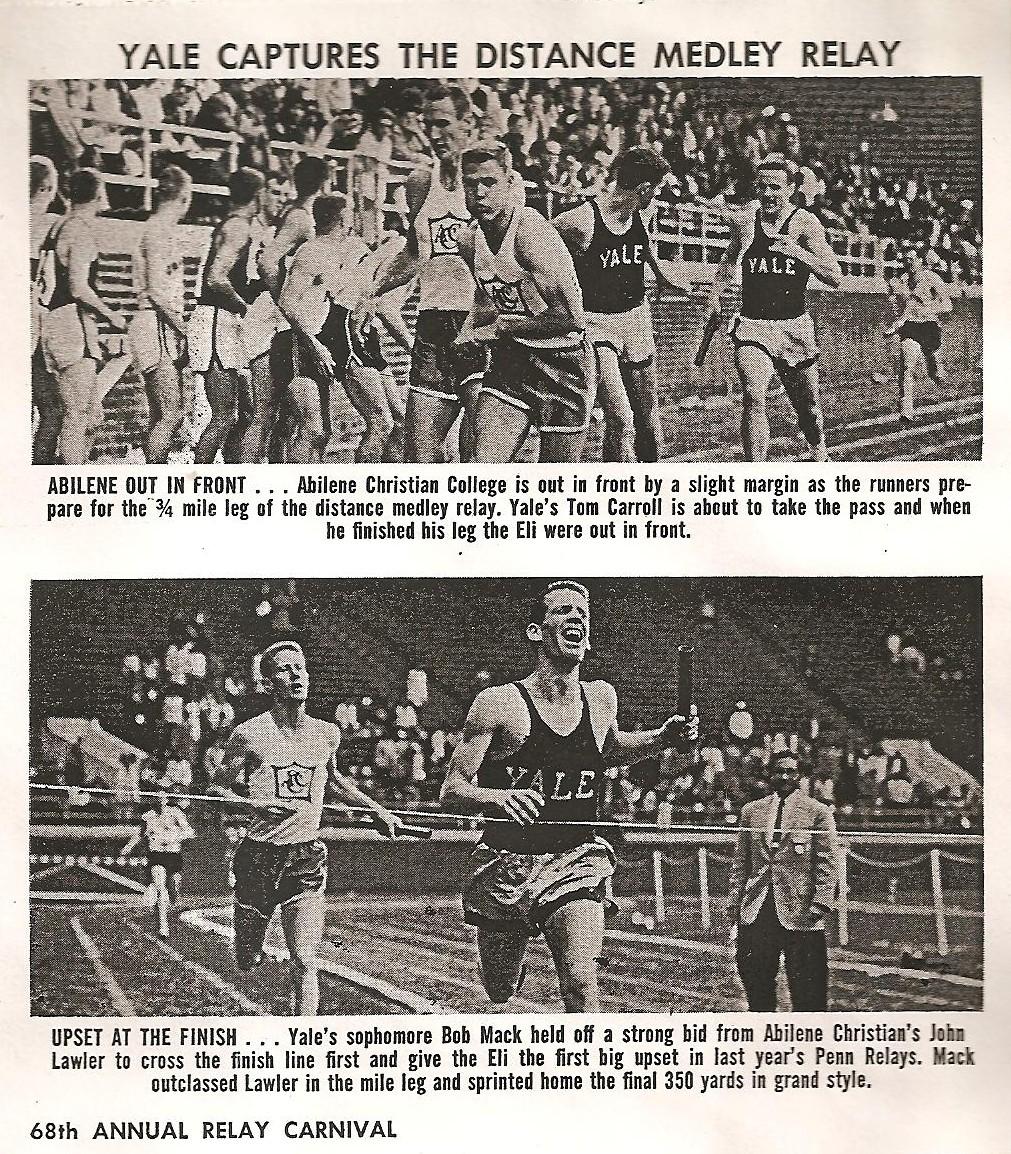
Why is it that I only get my picture in the newspaper when I’m getting beaten or falling into a water hole?
Two weeks after losing the encounter with Yale, five of the ACC team were back at Soldiers Field in Philadelphia for the NCAA championship. Bobby Mack and I were contesting the steeplechase event. I guess he was an even worse hurdler than I, as he fell going over the water jump, and I went on to win the race.
1961
(Philadelphia, June 17)
(23 started and 19 finished)1. John Lawler' (Abilene Christian) So ......9:01.1 (MR)
2. Pat Traynor (Villanova)...... So ......9:01.6 (also under old MR)
3. Dave Martin (Michigan) .... Sr .......9:07.5
4. Steve Moorhead (Penn State) .. Jr.........9:12.0
5. Don Tretheway’(Western Washington) ..Sr ......9:17.9
6. Ron Davis (San José State).. So .......9:17.9
7. Bob Mack (Yale).. So .......9:24.5
8. Bill Peck (Oxy).... Sr .......9:24.7
(defending champ Clark 2nd in 3 mile
What is crucial to my story is that the following week the five members of our team were to compete in the AAU Championships in New York, so, rather than fly back to Texas after the NCAA and then have to fly back to New York, our coach, Oliver Jackson, managed to arrange with the Yale coach, Bob Giegengack, for our small team of runners to join him and his team of runners at Yale’s summer camp in the Catskills in upstate New York. As the photo reveals, it wasn’t exactly a “boot camp” for rigorous training. It was, in fact, a very relaxing five days. Bob Mack, Denis, and I had a few runs together. We also canoed and swam and had an occasional beer… all essential preparation for the last race of the year.
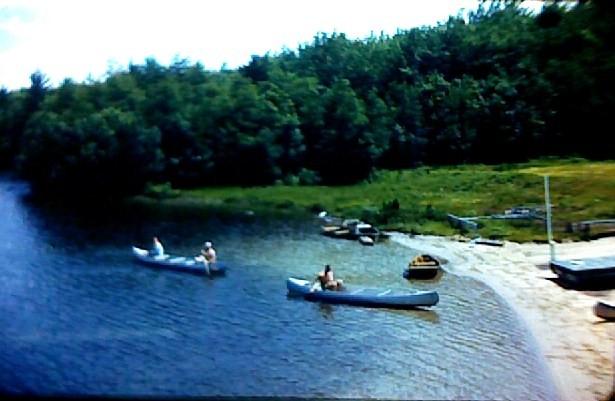
During our time at the camp I got quite well acquainted with Bob Giegengack. He was particularly interested in our training methods, since a number of Australian athletes attending US colleges were performing quite well. Two years later I applied to Yale’s Graduate School of Industrial Administration, a two year MBA type program. I’m fairly sure that Giegengack’s endorsement wouldn’t have hurt my chances of being admitted to the program. And I’ve often wondered if that endorsement would have materialised if I had beaten Bob Mack at the Penn Relays.
The annual enrolment into this particular graduate program at Yale was only fifteen students, one third of whom came from overseas universities such as Oxford and Cambridge. As only ten places remained for US students, the competition for those places was intense. Oh, and I should perhaps mention here that there was one other vitally important bit of assistance I received when I applied for admission. It concerned my application letter, the author and typist of which was Charlotte Ann Droll. When the acceptance letter arrived from Yale March 1963 offering me a full scholarship, what else could I do but change her name from Droll to Lawler and tell Denis that our training days and bed-sharing times were about to end?
The AAU Championships in New York weren’t all that bad for me. For a change, my water jumping went okay as seen in to photos taken during the race. I must have tutored Bobby Mack while we were at the Yale camp on how not to hurdle the water jump as he again took the plunge later in the race.
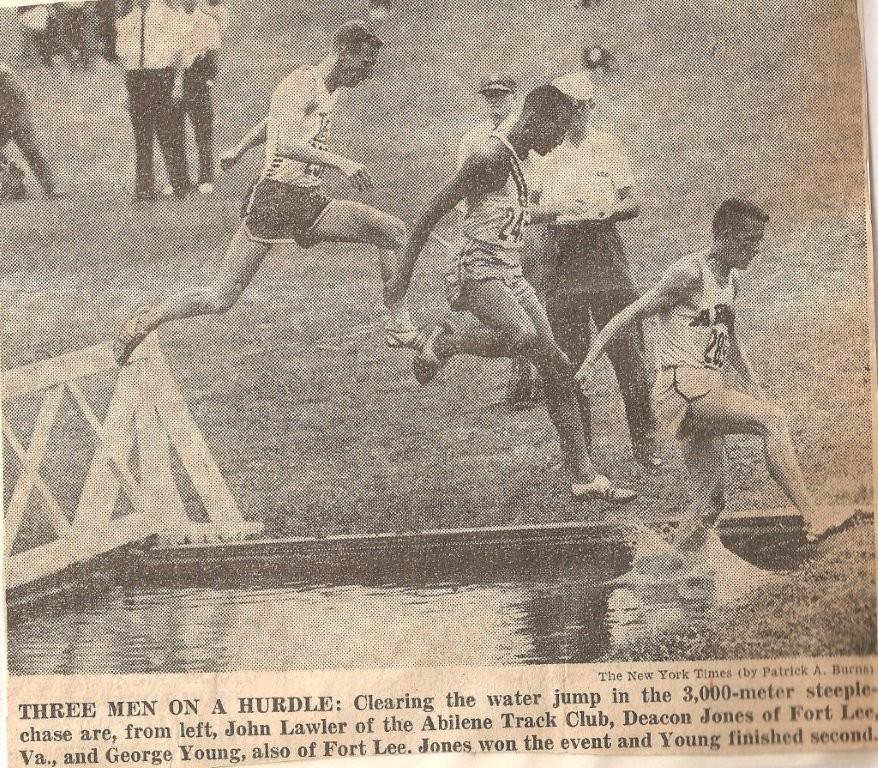
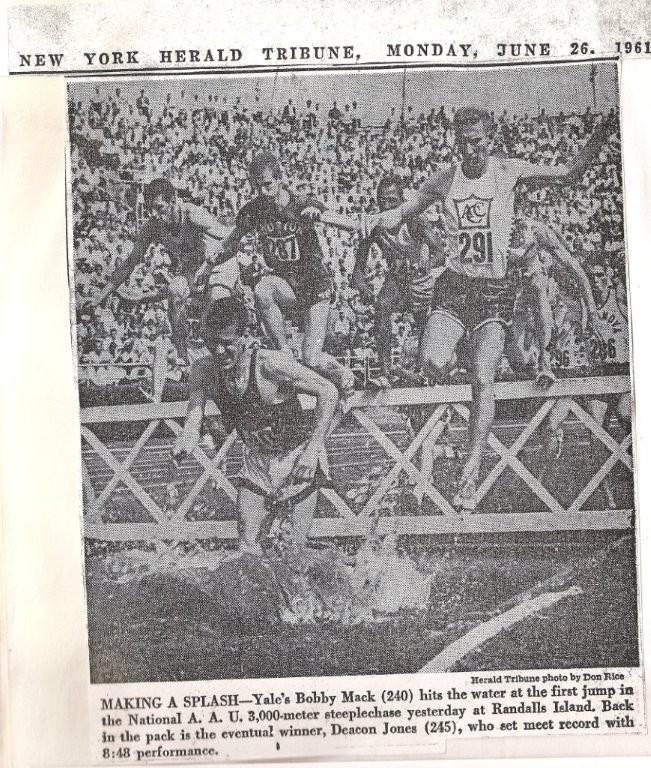
With 300 yards to run I had managed to clear all but the remaining two hurdles and the final water jump and was running about a yard behind the two leaders when disaster struck. Approaching the second last hurdle, I was clipped on the heel by the fourth place runner, stumbled, lost my balance, and slid under the hurdle. Those are the hazards of steeplechasing. It happens. Some supportive observers thought I could have won the race had I stayed on my feet, but the truth is that more often than not, you stumble or lose your balance when exhaustion is taking control. And besides, there was still one more water jump to negotiate. I managed to crawl back the way I came, jump over the hurdle, sail over the water jump and finish fourth. All in all, it wasn’t a bad way to finish the season.
These are the only results we could find for this race. Schul isn't seen in this photo. The Houston runner may be Pat Clohessy. ed.
These are the only results we could find for this race. Schul isn't seen in this photo. The Houston runner may be Pat Clohessy. ed.
| F: 3,000 meters; D: 25 JUN | ||||
| 1 | Deacon Jones | 8:48.0 | MRm | |
| 2 | George Young | 8:50.8 | ||
| 3 | Bob Schul | 8:53.6 | ||
| 4 | John Lawler (AUS) | 9:12.6 | ||
| 5 | Dave Martin | 9:17.8 | ||
| 6 | Hal Higdon | 9:21.8 | ||
In conversation with Bob Schul about this race last October, Bob recalled that he may have tangled with Lawler in this race. But he wasn't sure if the collision was with John or someone else. He did remember that he got knocked off stride, and it may have cost him a place. However the results here indicate that they were probably close together when John went down, so it seems highly likely it was the two of them. When I brought this to John's attention he was not aware that it was Schul. One of those little incidents in a long ago past. I could not find reference to this race in Bob's autobiography, "In the Long Run" ed.
While in New York, Denis and I met Dick Sorkin, the Newsday journalist who wrote the “Banana and a Dime” article. The picture of Dick and me was taken by Denis when Dick took us for a drive on Long Island. “Sorry, Dick,” we said, “No quotable quotes from us this time. The coach has summer work for us this year back in Abilene.”
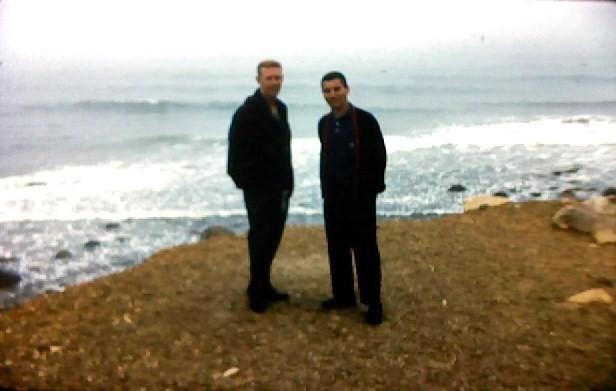
Sorkin would go on to have a somewhat checkered career as a sports agent. You can google his name and find out for yourself. ed.
One of the problems when competing at the national track championships in those days was that these events took place in the first four weeks of the summer break. All the easily procurable jobs had long since disappeared by the time the championships finished. Once again, we were on the bread line. With the permission of the coach, Denis and I cashed in our return airline tickets to Abilene (worth about $180 in those days) because we had discovered a much cheaper way to transport ourselves. It is best described as “Have cab, will travel.” Those of you who watched television in the 1950’s will remember the TV series with a similar name: “Have Gun, Will Travel,” starring Richard Boone. In much the same way as his gun travelled around the Wild West, this particular New York Yellow Cab took us through the not-so-wild west in 1961.
New York Yellow Cabs in the 60’s were big and robust. They had to be running 24 hours a day on those New York roads. But even they had their limits. Their operating life in the ‘Big Apple’ was one year, after which they were sold to cab companies in country towns or smaller cities where the requirements were less arduous. The problem was not finding them a new home; it was finding drivers to get them there.
Ollan Cassell, my old bed mate of the previous summer, was competing at the AAU championships for Houston University. He had discovered an agency that recruited these needed drivers. He and one other member of the track team had signed on to take a cab to Houston. The arrangement was that you were not paid for your service, but the cab gave you a means of free travel if you were prepared to pay for the gas and then be reimbursed when the cab was safely delivered. Sounded like a pretty good deal to Denis and me. We had each pocketed $180 dollars from our airline tickets, and the Greyhound bus tickets, our other alternative to Abilene would have cost us about $50.
We presented ourselves at the agent’s office, which was located in a dingy, rundown neighbourhood, with the vital piece of documentation needed to qualify as a prospective driver: my Californian driver’s license. The agent was an elderly Catholic lady, and the one-room office was adorned with religious icons and pictures. Unfortunately for us, not one taxicab company within 300 miles of Abilene was in the market for a yellow cab, and the best available drive was for a buyer in Clovis, New Mexico, some 325 miles west of Abilene. Still, this was better than paying for two bus tickets, so we, or more accurately, I signed up. Denis was still an unlicensed and untutored driver.
The lady agent obviously had her qualms about us. One driver, recently licensed in California, who was a foreigner, to boot, did not add up to the best possible credentials. But the pool of drivers willing to drive a cab 2500 miles to Clovis consisted of one. Me. She was obviously desperate. As she handed over the keys, she said to us that she would go to the local Catholic Church tomorrow when we started our journey and burn a candle for our safety and the successful completion of the contract. Well, it was nice of her to do that. Ollan, who is a Catholic, obviously did not have a candle burned for him. He and his driving companion failed to complete their journey when their cab broke down on the Pennsylvania Turnpike, just south of New York.
The route we chose was down the Pennsylvania Turnpike, through Ohio, Indiana, Illinois, Missouri, Arkansas, Oklahoma, Texas, and finally, New Mexico. That way, we could use the extensive turnpike and freeway systems for the first half of the journey. I reasoned that it would also make the driving easier for Denis when I needed relief. Our travel plan was to keep driving, stopping only for gas and food. Oh how we missed Don Boshart!
The trip began well. We covered about 400 miles before I relinquished the wheel. I wasn’t feeling all that bad, but it was late; there were freeways for the next 300 miles, and there wasn’t much traffic. I gave Denis a last minute lesson in braking. It only remained for him to get the car into gear and we’d be on our way to Clovis! The dilemma for Denis was that the cab had a column gear shift that was a little bit difficult to engage. It tended to slip out of first gear if you failed to exert just the right amount of pressure on the accelerator when starting. Mistake: I had parked the car some thirty yards in front of the gas pump on a slight uphill slope. Every time Denis attempted to start the car, it would stall and roll back a few feet. By the final attempt, the rear bumper of the cab was only a couple of feet from the pump, and the expression on the gas attendant’s face made it clear that a change of drivers was required.
Why we didn’t try again on a flat piece of ground or on a slope going the right way, I don’t remember. But without a wink of sleep, I drove that taxi for something like twenty hours. Not very smart ─ in fact, it was a reckless and dangerous act. I truly believe that the prayer and candle burning by our agent must have been a factor that night. Somewhere outside of St. Louis, Missouri, I could go no further. Denis was equally exhausted as he had remained awake to make sure I didn’t fall asleep at the wheel. So I just pulled the car over to the side of the road, and we both slept for several hours. Unlike the VW, New York taxis are spacious and not at all uncomfortable for a few hours of napping.
From St. Louis we (I) drove nonstop through Missouri, Arkansas, and Oklahoma. Fatigue was well advanced when we crossed the border into north Texas, but relief was near at hand in the form of a double bed as I steered the cab onto Fuzzy Lunsford’s mosaic car park and came to a complete stop.
It says a lot for a relationship when you can drive a New York Yellow Cab onto someone’s property unannounced and unexpected and be welcomed like long lost prodigal sons. Well, I suppose that is how Dema and Richard thought of Denis and me. No, they didn’t kill the fatted calf or put a dinner jacket on us, but they fed us real food and made up our double bed before we collapsed into it. Dema and Richard are in a special category all their own, but I have to say that the generosity of the Texas people is real. In our four years’ stay as pseudo-Texans, Denis and I were mentored and assisted many times by many different families, something that made those four years among the best of our lives. They were for me, anyway.
After a good night’s sleep and a hearty breakfast, the “have cab, will travel” team was on its way again. This time, we opted for a short drive of two hours to Abilene. There was no point in Denis driving the final 300 miles to Clovis. Much better that he contact the coach, we figured, and get us geared up for the summer job waiting for us. I dropped Denis at the college, and, as it was a working day, headed for Hugh Bowie Jewellers.
Nothing impresses a girl more than to be picked up unexpectedly at work by a semi-delirious driver with an NCAA medal dangling around his neck, and driving a New York Yellow Cab. Charlotte’s boss, Hugh Bowie, gave her an ‘early mark’ for my sake. As Charlotte will attest, a mid-summer storm was raging when she hopped into the front seat. Before we could get reacquainted, though, a bedraggled pedestrian jumped into the back seat, commented on how remarkable it was to find a New York Yellow Cab in Abilene during a thunderstorm, and gave us his address.
What the heck. I was feeling too good to say no, and, anyway, I had other things on my mind, so we drove him to the other side of town and didn’t charge him a cent. Maybe I should have. On the way back to town the taxi stalled on a flooded street. Now I was hoping for an hour or two of parking time, but hadn’t planned that it would be in the middle of an intersection. We just sat there till the flood subsided.
The final chapter of “have cab, will travel” was the drive to New Mexico the following day. It was only three hundred and a bit miles, mostly flat and straight across the West Texas desert, and there were good highways all the way to Clovis. Trouble started with less than 100 miles to go. The gear stick that had given Denis trouble got stuck in high, which meant that I couldn’t use first and second gear. I could manage on the highway, but it was going to be a problem with stop lights when driving through towns. The car was too heavy to restart in top gear…and hills would be a further problem.
I had just enough gas to complete the trip, and the road ahead looked flat enough. But I did have to pass through a couple of towns. I hit two red lights, but, wonder of wonders, both allowed a right hand turn on red, so I slowed down and kangaroo hopped (my specialty) around the corner and then around the block until I got a green light. Must have been a special treat for those west Texas people to watch a New York taxi doing kangaroo hops around the block a few times before it disappeared into the sunset.
By this time it was late afternoon. The last of the towns were behind me, and I was going well until, somewhere near the Texas/New Mexico border, a huge hill came into view on the horizon. It wasn’t so much the height as the extent of the climb that worried me. Only one thing to do: I wound up the cab as fast as it would go on the flat stretch ahead and hoped the candle our agent lit for us still had a flicker in it. The needle on the speedometer tickled 90 miles per hour as the ‘yellow streak’ reached the base of the hill. I don’t imagine it had ever approached that speed in its taxi days on New York City roads. We flew up the hill! Going straight up at 90 mph in a New York Yellow Cab with my head thrust back by the “G” force and the car rattling and shaking uncontrollably made me feel a little like an Aussie astronaut, at least until the deceleration set in about halfway up. Like the engine in the nursery rhyme I started muttering, “I think I can! I think I can!” in a prayer-like chant as the crest came into sight and the speedo headed to its lower limits. The candle must have been burning bright in New York as the greatest cab, yellow, black, blue or white, that ever traversed half the US reached the top of the hill and made a graceful descent into the town of Clovis.
I clearly remember angle parking the taxi nose first into the curb outside the city cab company. The buyer wasn’t too put out that the gears were shot (By this time reverse was gone too.). He paid me for the gas, and I headed for the highway to thumb my way back to Abilene. Hitch hiking in the 1960’s wasn’t a problem. A lot of car-less students travelled around the country by thumb, and it wasn’t the first or even the last time I hitched a ride.
Back in Abilene I was ready to start work. I would have preferred a few days to recover, as I was feeling a mite tired ─ more like exhausted. But no need to worry on that score. The coach, it transpired, had left town to take a team of runners on an overseas tour. And there was no job.
I guess the candle had finally sputtered out.
Next: Working with a two-time murderer and the world’s fastest (wind assisted) 100 yards.
Monday, March 16, 2015
V5 n 22 Part 5 The John Lawler Saga
Episode V
PRELUDE TO THE SUMMER OF 1961:
“…AND THE TRUTH WILL SET YOU FREE”
All of us, I’m sure, have experienced events that have changed the direction of our lives in a dramatic and unexpected way. One such event occurred in my own life in the school year prior to the 1961 summer break.
It occurred shortly after Denis and I returned to college for our second year of studies. Before leaving Australia, we had pretty well determined that after our four years of studying and running for the Abilene Christian College Track Team on scholarship, we would go to England for two or three years to work and compete on the European track circuit. At the tender age of 20 running was our passion, and Europe was the home of track for those who were no longer running at the collegiate level.
Summer in California in 1960 was doubly good for us. First, it restored our finances ─ not that the combined $1000 we earned was a brilliant total, but it is what we started with when we first arrived in Abilene a year earlier. True, it wasn’t the potential $6000 we had salivated over when we enrolled in the Bible selling program, but it was better than the $0 that looked highly possible when we bowed out of Bible selling to try our luck elsewhere. The second benefit was the time we had for training in California. The weather was perfect for distance running, and the Mountain View Golf Course near our house was an ideal cross-country venue. After eight weeks of training, Denis, in particular, was in peak condition. I do believe, too, that the periodic shortage of food during the summer months enabled Denis to reduce his weight, which had become a problem for him in the US. Back in Australia “Skinny” was his nickname, and when his physique matched his nickname, he could gobble up those miles in very short order.
To test his fitness, Denis entered a twenty mile road race that summer. I think it was called “The Sunnyvale Open,” and the prize was a whopping trophy. The night before the race, Denis and I visited our local watering hole for a few beers. The bar was located on the El Camino Real, a major highway, and was called the “Okie” and “Arkie” bar because it was patronized by down and outs from Oklahoma and Arkansas (and of course, down and out Australians). “Cheap” was the best way to describe the place. And periodically, they would have a special Friday night when hamburgers were 10c and a beer was 25c a glass. The night before the race was one such night and, considering our financial circumstances, was not to be missed.
The next day, the first five miles of the race were painful to watch. Denis needed at least two, and possibly three, ‘pit stops’ to relieve himself of the previous night’s indulgence. The only thing not ahead of him at that point was the $45 Studebaker. But just like John Landy in the 1956 Australian Mile Championship, “Skinny” finally got mobile, caught and passed the whole field of runners, and took home the trophy!
Denis and I arrived back in Abilene in the fall of 1960 in excellent shape. The Coach, Ollie Jackson, was extremely impressed with our form and even more so with our innovative training methods, which were at variance with the American technique of training distance runners. Australians generally employed a slower tempo of running and concentrated on increasing the miles. The coach allowed us, mostly, to conduct our own training regime, and he not infrequently required the other distance runners on the team to train with us. On one such occasion in October Denis told the coach he wanted to do a twenty mile road run out past Fort Phantom Lake. I was happy to join Denis on the run, and the coach thought that all distance runners should participate. The 880 yard runners, Blackwood, Essin, and Istre, I have to say, were much less enthusiastic than Denis and I were about the pronouncement. There was no trophy to be won this time, but Denis wanted to make it a hard run. Well, he made it a hard run for me, at least. We finished together in the time of two hours and six minutes, and one yard after the finish line, I came to a complete stop. Denis, I’m sure, could have run another six miles to make the distance a full marathon.
When we got back to the college, it was approaching the time for the evening meal, which was served in the college cafeteria, known as “the Beanery.” The food wasn’t all that bad, but after a twenty mile run, something more sustaining than fried chicken and more refreshing than iced tea was merited, we thought. As we were about to enter the Beanery, Boshart intercepted us with an offer too good to refuse (Yes, the same Boshart who had transported us halfway across the United States in a VW and who had been our Oklahoma bedfellow). A carload of students, six in all, he said, were planning to drive 70 miles to a steak house known as Lowake’s, and did we want to come?
Lowake’s also had an added appeal besides its reputation for big juicy steaks. It was located in a “wet” county that allowed beer to be served with the meal. The town of Abilene, on the other hand, was located in a “dry” county that restricted the sale of alcohol to private clubs and the drinking of alcohol to those clubs and private homes. Abilene Christian College rules, however, did not allow its enrolled students to drink alcohol on its premises… or elsewhere, for that matter.
Eight of us crammed ourselves into one car and headed for Lowake’s. As well as Boshart, Denis, and I, there were some very distinguished members of the student body included in the group. The owner and driver of the car was Al Scott, the son of one of the Trustees of ACC. Wally Adams, the son of the Dean of the school (its senior administrator) was with us, as was Bill Woodhouse, famed sprinter and the owner of the afore-mentioned VW driven to California. I’m sure the remaining two participants will be relieved that I can’t remember their names.
The steak was like pheasant to a bird dog, and the beer was served in pre-frozen mugs. Not the best beer in the world, I’ll grant you, but after a twenty mile run, that was the least of my concerns. The steaks we ate went unobserved, but not the drinking of the beer. Someone connected to ACC saw us drinking beer… and called the school.
Paul Faulkner, ACC Dean of Men and scrutinizer of morals and good behaviour, was waiting for us when we arrived at the dormitory. Denis and I readily admitted that we had each drunk two beers at Lowake’s. No point in pleading the Fifth Amendment or in asking the identity of our accuser or in denying that those tall frosty glasses contained anything but beer. The Dean wished us a good night and ordered us to report to the Dean of Students, Garvin Beauchamp, at 9 o’clock the following morning.
Interesting. All six of our fellow-conspirators denied that they had taken a drink. Particularly interesting because Denis and I, the only non-believers, non-members of the Church of Christ, had admitted our guilt. But considering my previous history in dealing with the truth, who am I to cast the first stone?
The next morning, as we waited outside the entrance to the Administration Building, I noticed that these words were etched into the sandstone above the portal: “And the Truth Will Set You Free.”
They were still there when I returned to Abilene in 1996 ─ this time to be inducted into the university’s Hall of Fame.
But did the truth set Denis and me free? In one sense, no. But all six deniers walked free. The school’s penalty for drinking was unambiguous. Those who broke the no alcohol rule were to be sent home and suspended from ACC for the remainder of the semester. But suspension for that length of time meant a second penalty for athletes, who, because of eligibility agreements, would be automatically disqualified from competing for ACC in intervarsity events for the entire school year.
Sixteen hours prior to our visit to the Dean’s office, the coach was in raptures over our twenty mile run. I’m sure there was little doubt in his mind that we would be a major addition to the varsity track team for the next season. ACC, although a very small college, was recognized nationally as a real track powerhouse. ACC athletes and relay teams held eleven world records, and one ex-member of the track team, Bobby Morrow, won three gold medals at the Melbourne Olympics in 1956. To say the coach was now shattered was an understatement. When we saw him outside the Administration Building before we appeared before ‘Pontius Pilate,’ he said, “I know that beer is less harmful to a runner than coke, but how in the heck did you manage to let yourself be seen in a place like Lowake’s drinking beer?” The photo below was taken in 1996 on a revisit to the scene of the crime.
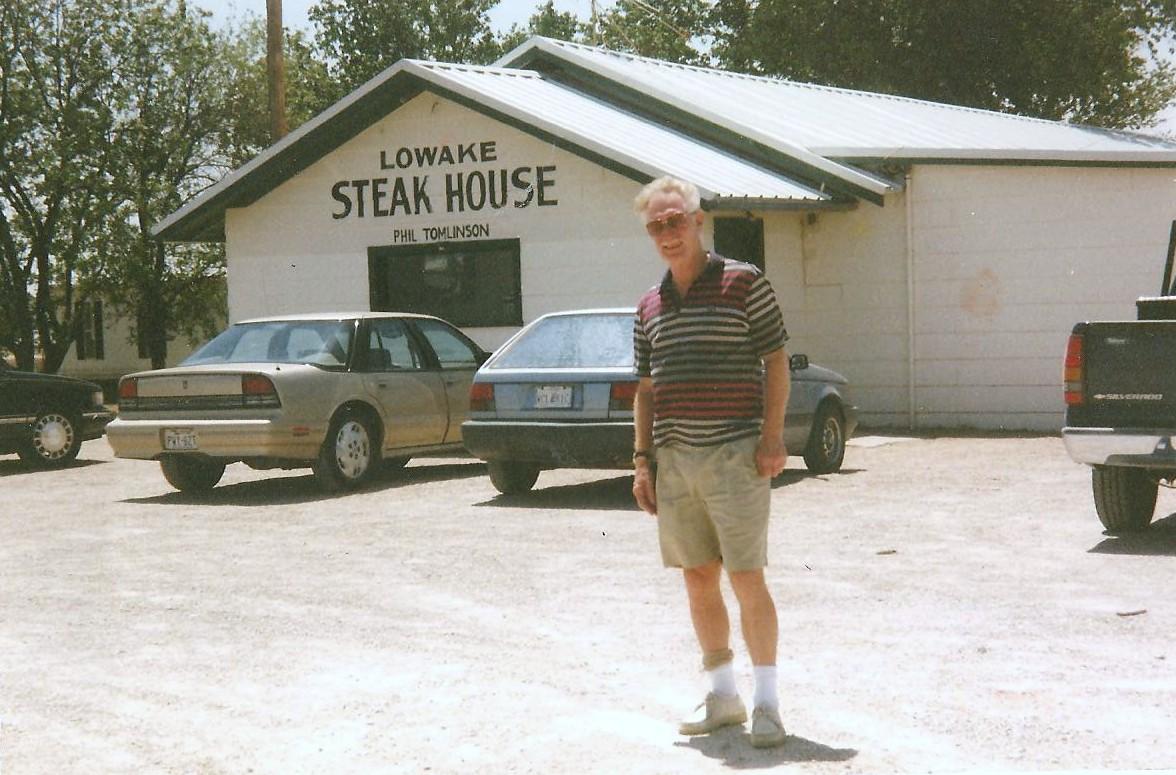
Rules are rules, and the prescribed penalties must be invoked when the regulations have been breached…unless there is a special problem or, perhaps, a kind of loophole? Sometimes, the regulations have to be reregulated. The meeting with the Dean of Students was deferred until the afternoon to give the administrators the time to fully consider the circumstances. I don’t know for certain, but the likelihood that we would not be returning if we were sent home, halfway around the world, must have weighed heavily on their deliberation. They may not have been aware that Denis and I didn’t have the wherewithal to pay for our fares home, but they might have guessed that even if we managed that, a trip back would have been out of the question. And of course, if we did return, there was the eligibility problem.
Late in the afternoon Dean Garvin Beauchamp summoned us to his office. For the second time we passed under the portal with the memorable quote. The school authorities, he said, would suspend us for two full weeks, and we would be required to leave the campus. (Ah, nice. No eligibility problem.) Furthermore, he said, the school recognized that, obviously, we could not go home, so the school had arranged for us to spend the two weeks on a Texas cattle ranch some two hours’ drive north of Abilene. We were to use the time to maintain, as best we could, our scholastic efforts. Oh, and of course, we were to continue our training.
Not too bad at all. Not completely fair, mind you, considering those students who had borne the full weight of the penalty in the past. However, it is interesting to note that subsequent violators of the drinking rule pleaded the “Australian case” as a precedent and were granted a reduced sentence. Our mate Sam Gafford, for one, invoked the precedent and had his sentence reduced to two weeks. In some ways it is nice to leave your mark on the institution you attend, but perhaps not in the way Denis and I did on this occasion. (Though my friend Sam may not agree.)
The cattle ranch was some twelve miles outside the little North Texas town of Throckmorton, population 1,000 or thereabouts. The rancher, Richard Lunsford, known to everyone as “Fuzzy,” was an ex-ACC football player. He and his wife Dema lived in a very small house with their two children Raymond (5) and Lynette (3). As well as ranching, Richard was a lay preacher and conducted services at the local Church of Christ. He was the perfect warden, you would have to think, for two Australian reprobates.
But on our arrival at the ranch, the most remarkable sight met our eyes when we stepped out of the car. The clay surface where the cars parked at the front of the house was a mosaic of Lone Star bottle tops ! Hundreds of them carpeted the entire area.
Well, methinks, the plan must be to wean us gradually from our beer addiction. Here is the ranch house with the cars parked on the mosaic.
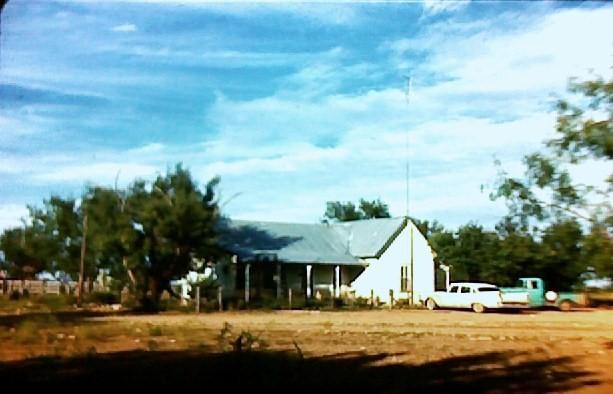
The explanation, as we learned later, was that the ranch was actually owned by Fuzzy’s dad, a tough, hard drinking Texan who carried his Lone Star with him wherever he went, frequently popping a top off when he arrived at the ranch. Fuzzy’s father also owned a small movie theatre in one of the small towns nearby ─ I think it was Olney. Denis and I actually saw a movie there during our visit. The theatre was fairly old, and the seating was canvas seats. Several years later it was the centrepiece in a movie based on Larry McMurtry’s novel, “The Last Picture Show.” It was a great movie, and it was awesome to watch it, knowing that you had sat in those very same canvas seats that appeared in the film.
On our first day at the ranch, Denis and I diligently applied ourselves to the study of our course work. (I should also report that the room Denis and I occupied contained two pieces of furniture: a double bed and a cot. The choice we made was obvious. But I won’t go into that again.) The ranch was primarily cattle, but wheat and alfalfa were also grown there. There were five oil wells too, but in those days the income from them was insignificant. To make the ranch a viable proposition, Richard and Dema worked from dawn till dusk. Richard would be up at four in the morning and work hard all day, and Dema was also on the job before sunup.
After our first day of relative leisure, Denis and I decided that it wasn’t right for us two healthy specimens to be sitting on their front porch, eating the Lunsford food, and thumbing our way through a few books while Dema and Richard slogged their way through the hours. Besides, there was a lot to learn working on a Texas ranch if you are city bred and find yourself with the opportunity try your hand at farming. I did have a cowboy hat and a new pair of jeans, so I volunteered to move the herd of cattle to the “lower 40” ─ provided, of course, that someone could saddle the quarter horse and give me a leg up. Richard obliged and assured me that the horse knew what to do. I only needed to sit on her, he said, and Dorothy would do what was required.
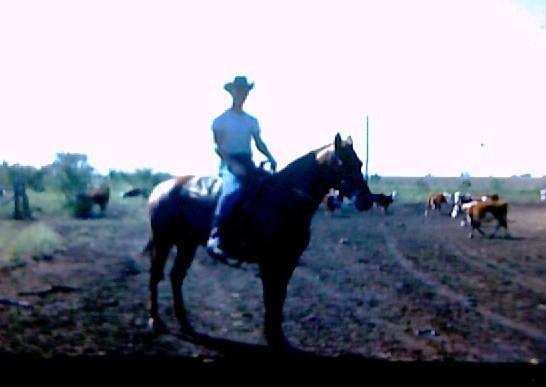
That’s me, resplendent in my cowboy hat astride “Dorothy” and ready to start the roundup. The herd that you can see in the background responded knowingly to our presence and meandered off in the right direction. Nothing to it, I thought, just sit there and say “Mush! Mush!” every so often, and it would all go to plan ─ that is, until one of the calves decided to leave the herd in a gallop. One less calf didn’t seem that important to me, but Dorothy dropped her left shoulder, wheeled 90°, and took after the stray at warp 3 speed. My response was not to tighten my knees and lean into the stride like I’d seen in the cowboy movies; instead, I dropped the reins, my feet flew out of the stirrups, and all I could do was grab the saddle horn. Mistake. Once Dorothy realized she was in control, she abandoned the chase and headed for home base, her barn, and a feed of oats.
For those readers who have little horse sense, a quarter horse is renowned for its acceleration and speed over a quarter mile. That’s its name, after all. Perfect for rounding up cattle, but not necessarily for delivering Aussie greenhorns back to the ranch house unscathed. Dorothy was at full pelt when she passed under the clothesline. It removed my hat, leaving a permanent black line just below the crown. Much like Denis in the VW, I had no conceivable way of applying the brakes as I had no idea where they were. And, unlike Denis, I had no big truck’s rear end to slow Dorothy, so I decided to abandon the horse and take my chances on a soft landing.
As a steeplechaser, I had experienced heavy falls (as the photo at the end of this episode illustrates). So, I reasoned, hopping off a horse at full speed shouldn’t be all that different. Well, nothing broke, but it sure did shake me up, leaving me somewhat dazed and scratched. Having to walk back to the ranch and tell Fuzzy his horse was back in the barn with her saddle on and that my roundup days were over was much more embarrassing than falling off.
Denis, in the meanwhile, was given the task of ploughing a field to prepare it for planting crops. No driving license or driving experience was necessary, according to Fuzzy. He said to point the tractor down the row and keep parallel with the fence. Then, when you came to the end of the row, you hit the left-hand brake, and the tractor would do an automatic 90° left-hand turn. Simple. Especially when you consider that Denis was an absolute master at applying the brakes.
Several months later we paid the Lunsfords a social visit to say hello. It was well into the growing season, and Denis’s field was a sight to behold. What are the words of that song from “Oklahoma”? “… and the waving wheat, it sure smells sweet when the wind comes right behind the rain!” Well, let’s just say that Fuzzy’s wheat didn’t need any wind to make it wave. Every row Denis ploughed had plenty of waves. And the corners ─ they were something special to behold. Here is Denis astride his steely mount with Raymond on his lap.
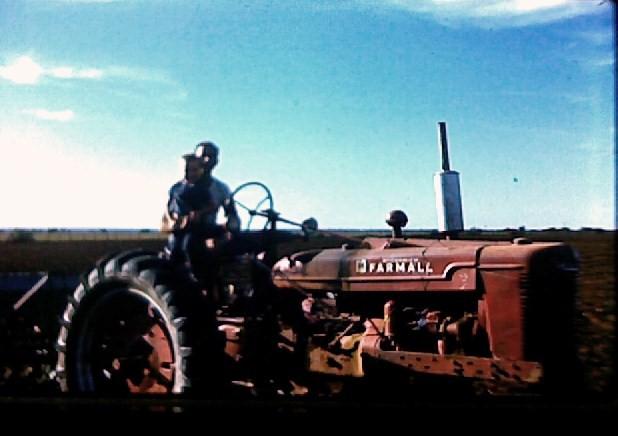
After our one day of leisure we worked every day: mending fences, building a water trough, herding the chickens, helping in the kitchen, and playing with Raymond and Lynette. On one occasion, Dema had us shift all the kitchen and dining room furniture clockwise around both rooms, looking for that perfect designer effect, but, funny thing, everything eventually ended up exactly where it had started. And there was the time that Denis displayed his culinary skills when Dema asked him to break up some ice for iced tea with the aid of an ice pick. Denis deposited a healthy chunk into a delicate water glass and, with one jab of the pick achieved the inevitable. The Lunsfords, I have to say, were truly a great family to be incarcerated with. Richard was totally at ease with the gradual disintegration of his ranch as Denis and I laboured through our assigned chores. And Dema still recalls Denis’s delicate touch with the ice pick in the kitchen.
But it wasn’t all work and no play. As well as going to the movies at the Lunsford movie theatre, we swam in the farm tanks, and, on Saturday, some of the local high school girls took us to a rodeo. Best of all, on Sunday, some of the ACC track team drove down to the ranch with their dates, and, after church, Dema and Richard provided our guests with a Barbecue lunch. When the boys went back to the college, the word spread quickly that the two Aussies were having a marvellous time riding horses, swimming, going to the movies, and having dates with the local girls. Not exactly what the school authorities had envisaged for us as punishment. Here is a picture of our two wardens, Dema and Richard with their two children and dog.
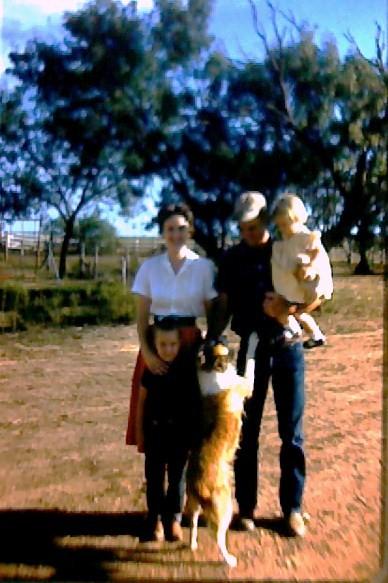
On Tuesday morning, eight days after we had arrived at the ranch, I answered the phone to hear Dean Beauchamp’s voice. He informed me that he was sending a car to bring us back to school and that we were to be ready to leave in two hours’ time.
I could not see the fairness of this. I put it to the Dean that we had broken the school rules and that the penalty was two weeks’ suspension to be served at the Lunsford Correction Centre for wayward Australians. Eight days, I said, was not sufficient to rehabilitate us.
We needed to serve our full term. But the Dean was unmoved by my lament. Two hours later, the car arrived. And who should be driving but Al Scott, sitting in the very same car that had taken us to Lowake’s and back. He was equally as impressed as we had been with the beer bottle top mosaic and suggested that we might stop for a steak meal at a certain restaurant on the way back to ACC. No thanks, we told him. Not this time.
Now, all this verbiage was to lay the groundwork for the momentous event that changed by life and shortened my track career. When we returned to ACC, we had missed a week of lectures, so it was smart to borrow someone’s notes to recover lost ground. I was doing reasonably well in the various courses I was taking. I mostly got “B’s,” which, if not excellent, was considered a solid passing grade. What was wanted, if I was to continue at that level, was certainly NOT the notes of my track buddies, whose grades were generally at the bottom of the alphabet. I needed notes from someone whose grades were “A” level.
Two courses that needed particular attention were English and Bible. It’s worth noting that I had not completed my last two years of high school, having left when I turned 15. Consequently, I was deficient in my knowledge of grammar and literature, and, as I was raised in a non-religious family, my knowledge of the Bible was even more deficient. It was, therefore, most important that the notes I borrowed were of the highest calibre. I carefully considered my options in each of the two classes, going over in my mind the thirty or so fellow classmates.
The essential requirements were “A” level grades, neat, readable notes, and occupation of a front seat in the class. The dullards, I observed, were to be found in the back rows of the class. If the person was female, attractiveness was also desirable, but not an essential. Why was I so confident of help from my classmates? The student body, to a man (or woman), were anxious to help Denis and me maintain our scholastic eligibility for the forthcoming track season, and, I’m certain, were also hoping to help with our rehabilitation. ACC was a Christian school, after all.
The winning candidate met all the requirements for both my English and Bible classes…and was pretty, to boot. Charlotte Ann Droll provided me with her notes, and a few days later I returned them and bought her a coke in the small on campus café we called “the grill” as a thank you.
After a week or so, I telephoned her at her dormitory to ask if she would like to go out on a date. She wasn’t there, so I spoke to her roommate, Colleen, who assured me that Charlotte wouldn’t be interested. Well, so much for my rehabilitation appeal.
Come the track season, Denis and I were competing for the college with considerable success. I’d won practically all my races in the first half of the season and had picked up a number of school and meet records. But all the major championships were scheduled in the second half of the season, after the Easter break. Nearly everybody went home during the break. Not everyone did, though. There were two Australians and a few people with part-time jobs off campus who were still around. As a matter of fact, that good note taker Charlotte Ann was one of these. She worked at Hugh Bowie Jewellers in downtown Abilene. As there was little in the way of male competition, I plucked up the courage to ask Miss Droll if she would go out with me. I suggested we might see a movie, half expecting that she would answer me as her roommate had done. Maybe it was because I had won a few races and had not besmirched my name any further since the Lowake’s episode that helped me out a bit, who knows? But for whatever reason, she said she would like to go. So it was that on April Fool’s Day in 1961, Charlotte and I went to see “101 Dalmatians” at Abilene’s best (and only) theatre, The Paramount.
Two and a half years later, we were married in the chapel at the College Church of Christ, there at the corner of the ACC campus. The minister who performed the ceremony, his first wedding, was Richard Lunsford. Denis had left for the summer, but two close members of the track team, Bud White and James Blackwood, and the notorious Don Boshart, were on hand as Best Man and Groomsmen to see to it that I did not cut and make a run for it at the last moment.
Ten years after our wedding, Charlotte and I and our two children, Donna and Todd, visited the Lunsfords on their ranch near Olney. I couldn’t help asking Fuzzy a question that I had only recently entertained: whether or not he was ever ordained or authorized to perform weddings. After all, he was only a lay preacher when he married us, and it was his first wedding as a celebrant. Of course, I wasn’t really worried, but I thought I should know for sure. Fuzzy’s response was most reassuring. He said, in his broad Texas drawl, “Well, John, if Charlotte and you ‘ain’t,’ there’s hundreds like you now. I wouldn’t worry about it.” That was good enough for me. No need to worry any further.
So there you have it. Two glasses of beer, and my whole life had been changed. What if Denis and I hadn’t been seen at Lowake’s? Or what if we had denied the allegations and had been set free? No visit to the Lunsford ranch…no need to borrow notes…no date to see “101 Dalmatians.” And more than likely Denis and I would have spent a year or two gallivanting around Europe. Except for the need to borrow those notes, the prospect of Charlotte’s getting together with me was remote in the extreme. We moved in different circles and had different interests. I never did know who saw us boys at Lowake’s that fateful night and called the school. At the time, my attitude toward him or her was anything but Christian. But as Charlotte and I approach our 47th wedding anniversary, I can only say, “God bless whoever it was!” I must now confess that telling the truth to the Dean of Men in our room at the dorm did set me free to pursue a more delightful and rewarding life than I could ever have thought possible.
Still have to wonder, though, what it would have been like to compete for two years on the European track circuit with Denis. Well… maybe I wouldn’t have been up to the standard required. That’s a thought!
Have another look at the picture on the next page and judge for yourself.
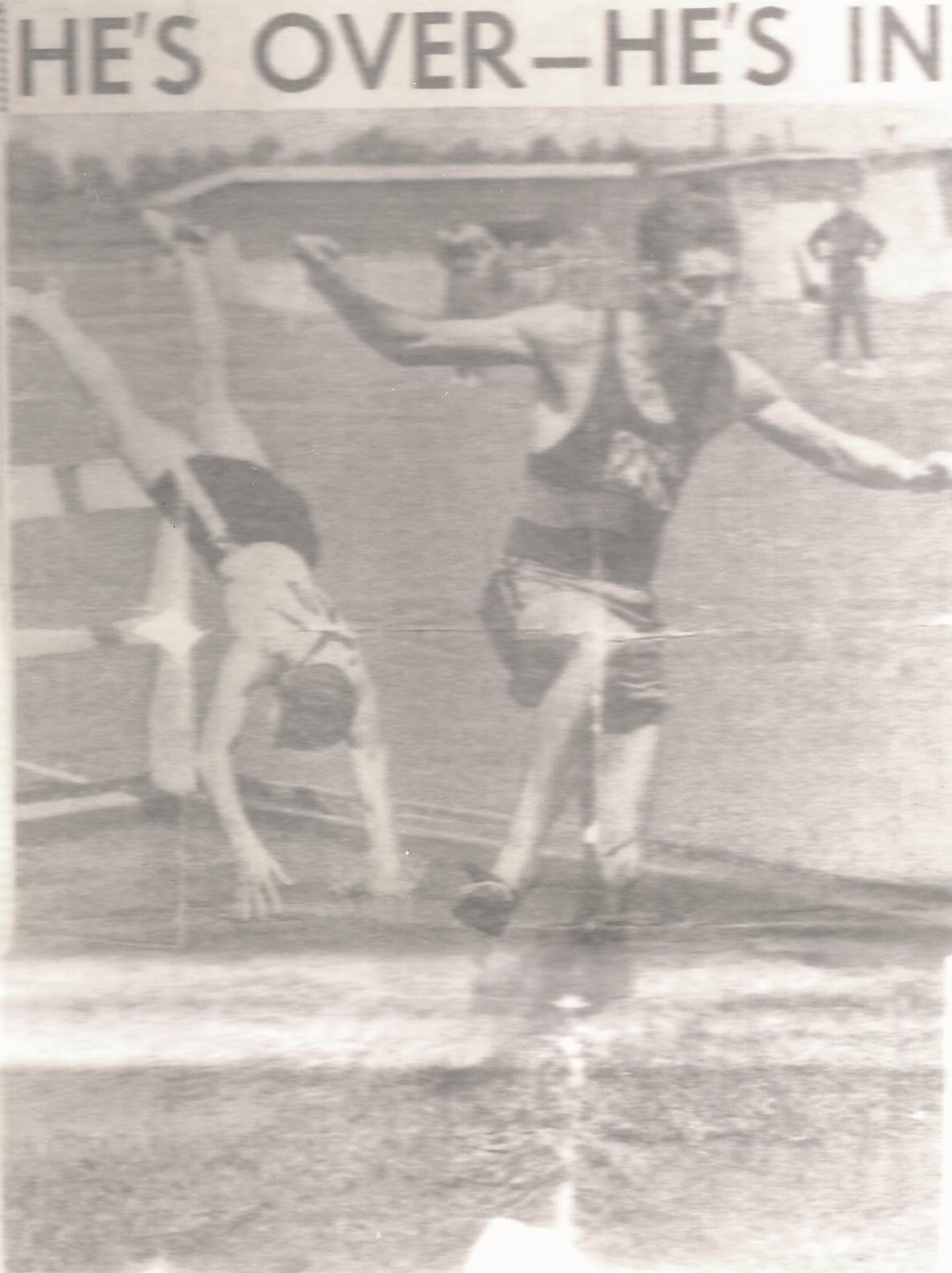
John Lawler neglects to mention he won the NCAA steeplechase championship in 1961. ed.
Thursday, March 12, 2015
v5 n 21 British XC championships from a head cam
Many of us have heard about , seen photos, or even film of the British Cross Country Championships, but few have had the honor of running in them. This film taken with a Go Pro camera on someone's head is about as close as you can get to the real thing. Taken during last months 2015 nationals. It covers the full race for 46 minutes. The runner wearing the cam finished 279 out of over 2000 runners. Watch this from your treadmill or standing in a bathtub of wet sticky mud and get the full effect. Even drone photography cannot match this. As our British friends might muse, " Absolutely bloody brilliant!"
https://www.youtube.com/watch?v=ZdchQYltGF4
Some people say this url doesn't work anymore. If not , then just go to youtube.com
and type in National Cross Country Championships, Feb. , 2015 Parliament Hill. That should get you there.
George
https://www.youtube.com/watch?v=ZdchQYltGF4
Some people say this url doesn't work anymore. If not , then just go to youtube.com
and type in National Cross Country Championships, Feb. , 2015 Parliament Hill. That should get you there.
George
Wednesday, March 11, 2015
v 5 n 20 Coach Bill Schnier Off to the Philippines
One of our regular readers, Bill Schnier, retired in 2013 from over thirty years as the head coach at U. of Cincinnati just accepted a 3 week gig consulting and advising the Philippine national track and field team in its preparations for the Southeast Asian Games. Bill had two medalists at the Beijing Olympics , Mary Wineberg (4x400 gold) and David Payne 110H silver, so that gives him lots of credibility in that part of the world, apart from his all round likability. Have a great trip Bill. You'll hardly have your bags unpacked before you're on the return flight.

Subscribe to:
Posts (Atom)
V 15 N. 10 Gunder 'The Wunder' Haegg Visits Cincinnati
Bob Roncker of Cincinnati, Ohio has sent in this account of one day on the 1943 tour that Gunder Haegg of Sweden made to the US to help rais...
-
 Noting the passing of Brian Oldfield on March 26, 2017. Oldfield came from Elgin, IL and left the world from that same town. He was 71 y...
 -
 JUNE 1963 The top half of the first page of this issue is devoted to a photo of a powerfully striding Adolph Plummer nearing the finish...