Once Upon a Time in the Vest

Wednesday, March 11, 2015

v 5 n 19 A Tribute to Joyce Smith, now retired

This was published in The Guardian  earlier this month.


Joyce Smith: 'I stopped running when I was 74. You don't pick up your feet as much'

One of Britain’s distance running greats on keeping fit at 77, the frustrations of not being allowed to race long distances as a woman and jelly beans, lemon squash and chocolate


Joyce Smith
 Joyce Smith in 1980, winning the second Tokyo women’s marathon at the age of 43 Photograph: Keystone Pictures USA / Alamy

Joyce Smith began running in the 1950s, at which time the longest distance for women in international competitions was 800 metres. She broke the world record for 3,000m in 1971, and ran at the 1972 Olympic Games. In 1979, she retired from track racing and turned to marathons. She won the Toyko Marathon in 1979 and 1980 and won the first London Marathon in 2:29:57, becoming the first British woman and the first woman over 40 to complete the distance in less than two and a half hours. A year later, she won the event in 2:29:43, again setting a new British record, and becoming the oldest woman to win the race at 44 years, 195 days – a record which still stands. She retired in 1986. She and her husband Bryan, who was also her coach, are on the board of trustees of the London Marathon Charitable Trust.
First, do you still run? No.
When did you stop? Three years ago. I was still going out for three mile runs, but as you get older – because I’m old now! – you don’t pick up your feet so much, and I had a fall on an uneven pavement and it came up like that [makes balloon gesture] on my ankle. And I thought, this is silly, because [what would have happened] if I’d been a long way out and had to get home … So I just go to the gym and go on the running cross trainer, and I do static cycling. I think if you have run the whole of your life, you still want to feel fit.
How many miles a week did you run at your peakFor marathons, between 70 and 90. I didn’t go over 100.
When people ask you for a training tip, what do you tell them? I refer them to my husband [laughs]! He still coaches a few women marathoners.
Did you ever wear a watch or running gadget? No.
Did you even listen to music? No, never.

Joyce Smith with her medals
Pinterest
 Joyce Smith (with her husband Bryan) holding her winner’s medals from the 1981 and 1982 London marathons. Photograph: Robert Hallam/Rex Features

How did you distract your mind when you were running? In Tokyo, in the interview after the race in the first year, they said: “Did you enjoy seeing all the sights of Tokyo?” I said: “I didn’t see any of them.” You’re just concentrating so much on what’s happening around you, what you are doing, getting your drink and so on, that you don’t think about anything else.
Advertisement
What’s the greatest thing about running? Obviously achieving something at whatever level, and being happy about it.
And you didn’t do too badly. Not too badly, no. I would have liked to run marathons earlier in my career, but in the whole of my athletic career I just moved up when the new event for women came in.
People forget that it wasn’t long ago that women were not allowed to run beyond 3,000m? Yes, the 3,000m came in in 1974, then it went to the Olympics in 1984. The marathon actually went into the Olympics very quickly. I don’t know if it still is like this to this day, but to get a new event into the Olympics it had to be in all five continents. So that’s why it took longer for some events.
What’s the worst thing about running? When you have had a bad run, or you haven’t done quite what you wanted to do.
How did you motivate yourself on those cold, wet, grim mornings? You look ahead and to what you are hoping to achieve. You know you’ve got to do it. So you do it.
What did you have for breakfast before a race? Honey on toast. Couple of bits of toast.
Did you have anything in the races back then – no gels and so on? No, just water. Well, actually, we were sponsored by Robinsons, so there was squash. I used to put the tiniest bit of lemon squash in the water. But then Bryan used to give me jelly beans; I used to eat them quite a lot before a race.
What was your post-race indulgence? Chocolate, lots of chocolate. We used to get Mars bars too. I still love chocolate.
Who would you watch, Mo Farah or Usain Bolt? Both. Usain has brought something to sprinting – watching him, his style is great. And Mo is just … I’ve known Mo since his younger days. Because he won the mini marathon, and when he went to St Mary’s, London Marathon were involved. So we’ve watched his career develop, and we knew his first coach very well. So it’s just nice to see what he has done.
Who is the greatest runner ever? Oh dear … Well, obviously we all look to Paula Radcliffe and what she has achieved. But when I first did athletics I used to look up to Diane Leather – the first woman to go under five minutes for the mile. I met her when I made the international team as a reserve for England v Scotland. It was a long time before events came in for us, as women. When the 800m went into the Rome Olympics, I was actually the third fastest in the country, but Diane made it for that – and it was wonderful for her to make it to an Olympic Games.

v5 n 18 part 4 Lawler Chronicles

1960 SUMMERTIME
Episode IV: Hi Ho! Hi Ho! It’s off to Work We Go!

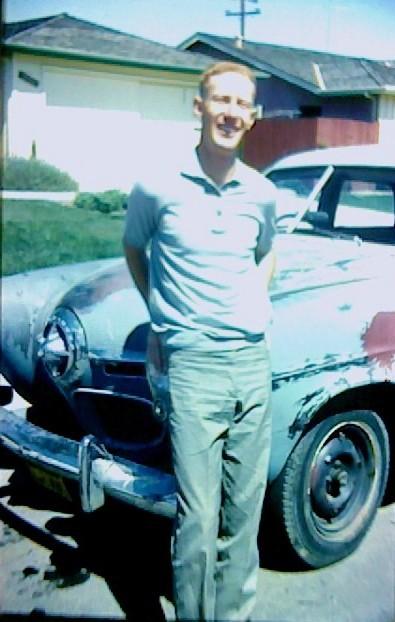
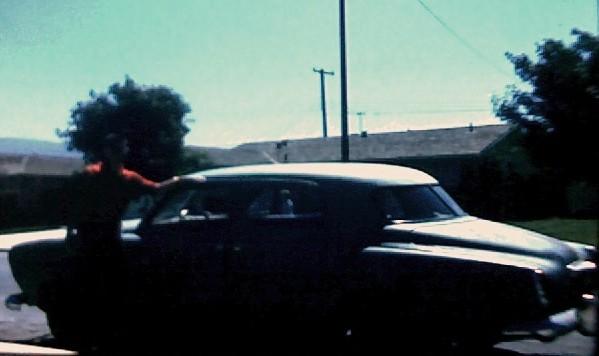
Before we (Barrie, Pat, Denis, and I) left the Mountain View home, we had all been hired for jobs of various kinds, one of which was fruit picking. To be fruit pickers we needed transport, as the orchards were a considerable distance from us, and the public transport system was virtually non-existent. Barrie, the only member of the clan who possessed folding money, was the purchaser of our transport, a magnificent 1951 Studebaker, for the princely sum of $45. One picture is worth a thousand words, and here are two photos of our pride and joy. I’m featured in one, and Barrie, in the other.
Note the oil spilled on the road in the first picture. There was no bargaining when our car was purchased. It was a take it or leave it proposition. The dealer did offer to help us get it off the lot if necessary, but we managed to get it moving without a clutch start. There were, however, two major problems with our newly acquired asset.
  1. It’s consumption of oil exceeded its petrol consumption. What didn’t blow out in a large plume of smoke would drip onto the road (another complaint registered by the Christiansons).
  2. Its top speed was 50mph, and that was on a downhill slope.

Both deficiencies resulted in traffic fines. The first was when I was driving on the Bayshore Freeway. (Yes, by this stage I did have an American drivers’ license.) A police motorcycle came through the smokescreen coughing and spluttering and pulled me over. He issued me a ticket for not reaching the minimum 50mph speed limit on the freeway. I disputed the charge as I explained that it was the car’s fault and not mine. He examined the registration slip and issued the ticket in the name of the owner, Barrie Almond. I hear rumours that Barrie is still being sought by the Californian police. I do know for a fact that they sent follow-up notices to him at the University of Houston. Tsk! Tsk!

The second fine was for polluting the atmosphere and included a notice to repair the car to stop the smoke. This was best attended to, we thought, by not putting oil into the car. Our method did work: the smoke plume was substantially decreased, and the oil spots on the road were largely eliminated. Of course, the inevitable happened. On a bright summer’s day the motor seized up, and the “Studie” came to a complete halt on a suburban road. There it stayed until an enterprising scrap metal merchant offered $10 for it, no questions asked. It was too good an offer to turn down, and that fine piece of automotive engineering was no longer ours ─ or Barrie’s, to be precise. When the seizure occurred, Barrie was already well on his way back to Houston on a Greyhound bus, and, as far as I know, he has never been reimbursed by the one who pocketed the $10.

When we took possession of the Studebaker, about a week after we arrived in Mountain View, the fruit picking season began. Four of us, Denis, Barrie, Pat, and I, drove to one of the apricot orchards seeking work.

The deal, as best I remember it, was that we would be paid 10c for every bucket of apricots we picked. Those picked, we were told, must be fully ripe, not green. As nature would have it, the ripe apricots were at the top of the tree when the season commenced. To access the top we were each given a twenty foot ladder. Having hooked your bucket to the ladder, the technique was to balance on the top rungs and use both hands to pluck the ripe apricots. Speed was all important if you wanted to make any type of money in the fruit picking business.

From the ground level a twenty foot ladder doesn’t look all that high. I think it’s because your head is already six feet off the ground ─ only fourteen feet more to the top. But when your head is four or more feet above the top of the ladder, it can be a fearful sight to glance down some twenty-four feet to the ground while balancing without a handhold. We watched the Mexican workers go at it before we tried picking fruit ourselves. They shinnied up the ladders and, with both hands working like machines, were down again in a breath or two with a bucket of choice apricots ready to be tallied.

Our ascents were far more cautious, and releasing your hold on the ladder to pick with both hands was mind-numbing. After four or five hours and precious few buckets to our credit, Denis and I were fired. Denis was told he was far too slow, and the field manager accused me of eating more than I was picking. He wasn’t wrong there. The apricots were delicious…and free. But in the days that followed I did pay the price of consuming an excessive number of the little beauties. I’ll leave that bit to your imagination.

Towards late afternoon Pat was dismissed. Apparently, he fell off the ladder and broke some limbs (tree limbs, that is) on the way down. Barrie managed to keep his job until he was caught shaking the tree, a method that deposited both ripe and green apricots on the ground. It was a technique that did improve his productivity, but arranging the green fruit on the bottom of the bucket and covering it with the ripe fruit wasn’t considered kosher.

So it was that, come late afternoon, we were all unemployed again. In those days there was no redundancy payment or even worker’s compensation for Pat’s injuries. Even if there had been such a thing, we would probably have decided that in our particular case, suing for wrongful dismissal may not have been worth pursuing.

But the commencement of the fruit picking season also meant that the fruit canneries started hiring casual workers to process the newly picked fruit. So Denis and I joined the mass of humanity outside the gates of the two local canneries: Libby’s and Richmond-Chase. We lined up at separate canneries, hoping to display our talents to a wider market.
Denis was successful. I guess he looked more Mexican than I did. After awhile, I figured out the way into the system. Jimmy Hoffa’s Teamsters’ Union controlled the canning industry in California, and you had to belong to the union before you could be rostered on by the company. Here’s the “catch 22”: you could not belong to the union unless you were employed by the company. Much later I figured out that you had to slip the union delegate $25 to break the nexus. But even if I had known earlier, I didn’t have $25.

With nearly half the summer gone, I was like Orphan Annie. Barrie secured full-time work at Track and Field News; Pat got a job with an insurance company; Al was on his way to the Olympics; lovesick Ollan was getting ready to head east, and the banana and the dime had long since disappeared. My total income for the summer was half a day’s pay for picking fruit and a few hours’ part time work stuffing envelopes at Track and Field News. I was home alone, the only unemployed member of the household and its sole dependant. So what to do? Repairing the table I had demolished wasn’t income producing, and summer casual employment was now non-existent.

I started looking in the employment section of the paper for permanent positions, thinking, “Well, what the heck? I’ve got to get some work.” I was living off my mates, and none of them were exceedingly wealthy. In one of the local papers I came across an advertisement for a paint salesman for a hardware store in Palo Alto. Now that was something I could do. Selling Bibles? No. Picking fruit? No. But selling paint? Yes! For five years I had worked in a paint factory as a sales clerk, and before I had left Australia for the United States, I had been promoted to a position as junior salesman. I knew paint technology extremely well, having completed a course at night school and worked in the paint laboratory.

I called, was interviewed, and got the job, starting immediately. My credentials were impeccable for what they wanted. But my credibility as a fulltime employee was not the best. I have to say that I did not tell the truth about my intentions to remain in California. I flat lied. And I still have pangs of remorse about deceiving the wonderful couple who employed me. My dilemma was that I knew I could not survive the following year at university without at least some money in the bank for personal expenses. At the interview I had said that I was an Australian student who had completed one year of college and had decided that one year was enough study. Instead of continuing with my education I had applied for American citizenship and planned to stay permanently in the United States.

The hardware store was Hubbard’s Paint, located in a small shopping centre north of the Bayshore Freeway. I think the suburb was North Palo Alto. The owners, Mr and Mrs Hubbard, were well into their sixties and looking to limit their time in the store. Paint was the main product sold, but they also stocked a full line of hardware. Mr. Hubbard was less knowledgeable about the paint business than he was about hardware in general, so when I showed up with a head full of paint technology, I was like manna from heaven.

With half the summer gone, the best I could give them was seven weeks, and I have never put in a more earnest or honest seven weeks’ work than there at the hardware store. I mixed paint, advised buyers about the type of paint best suited to their need, explained the correct techniques for preparing the surface, and raced up and down the Bayshore Freeway in the company’s delivery truck. At the end of each day, I could reconcile the takings with the sales dockets and close the shop.

Exemplary work practices have their downside. After five weeks of labour that was way beyond the call of duty, Mr. and Mrs. Hubbard told me that they were hoping to slowly withdraw from the day to day activities of the business in order to begin enjoying the fruits of partial retirement. As they had no children, they wished to know if I would be interested in buying, or more likely, earning my way into the business as a partner.

What to do? Telling them that I was leaving in two weeks to go back to school would be hard enough. Now that they wanted me to go into partnership with them, I couldn’t face the prospect. I don’t mind telling you that I did not feel really good about this. Call it cowardice if you like. I could not come out and say that I had deceived them. I just did not have the courage, and more importantly, I didn’t want to cause any hurt or feelings of betrayal – especially as they had come to trust me implicitly and wanted to share their business with me. Instead, I compounded my earlier deceit with a new fabrication.

With one week to go, I said to them that I could not accept their generous offer of a junior partnership in Hubbard’s Paint as the United States government had drafted me into the Marines. I explained to them that, as I was unemployed when I applied for citizenship, I was a candidate for military service when citizenship was granted. Moreover, I said, the notice required me to report in one week’s time to the Quantico Military Base for basic training, after which I would be attached to the Marines for two years.

One week later I was on the Greyhound bus for “Quantico” (via Abilene, Texas). An earlier epistle revealed my encounter with the Border Patrol, so I won’t recount it here.

As for my one year of military service, I never did quite make it to boot camp. However, I did have a friend from college who, after graduation, signed up with the Marines and was stationed at Quantico. I felt so bad about what I had done that, for a little over a year, I mailed him a few cards and a letter addressed to the Hubbards and asked him to forward them, postmarked Quantico. None of them had a return address, of course, as I did not want letters arriving at Quantico addressed to Private first class John William Lawler.

Towards the end of this one year of my correspondence, the Vietnam War was getting underway, and I considered writing one last letter to the Hubbards informing them that I had paid the ultimate price for my American citizenship but that had an obvious flaw. In the end, I just stopped weaving my “tangled web.”

Two years later I was back in the Palo Alto area for another summertime work stint, and I drove past the paint store. The name “Hubbard’s Paint” was still there, but I did not make my presence known. I was not up to concocting another fantastic tale and could not face telling them the truth.

So, dear reader…what do you think? Were my actions utterly deplorable, and will I be removed from your next years Christmas card list? And consider for a moment what you would have done once your half share of the banana and the dime was gone.
I can only hope that my grandchildren do a better job than I did when they have to face what appears to them to be an insurmountable problem.

The next summer the saga continues:
  • Driving a yellow cab from New York to Roswell, New Mexico…
  • Working on a missile base with a construction crew that included a known murderer…
  • Busboy duties at the University of Houston cafeteria while being pursued by the campus police.

The prospect of making the summertime sagas into a TV series was considered and rejected by the major networks on the grounds that the stories were too unbelievable and would certainly not get a “G” rating. Disappointing, as I was hoping Russell Crowe might want to play the lead.


Sunday, March 8, 2015

v5 n 17 Part 3 John Lawler saga


1960 SUMMERTIME
Episode III: A BANANA AND A DIME

After Bakersfield, Boshart, Denis, and I travelled on to the venue for the US Olympic Trials, Palo Alto, which is just south of San Francisco. We parted company with Don Boshart and the VW when he deposited Denis and me at the front door of an attractive home in the nearby suburb of Mountain View.

Our first act when we arrived was to examine the state of our finances, as the fruit picking season, our primary hope of employment, had not yet commenced. Three and a half weeks had passed since the end of school, at which time our joint account was already thin. Since then we had been on a strict austerity program as our income over the period had been less than minimal ─ nil, to be exact. We emptied our pockets onto the kitchen table of our summer home. Our assets, all that remained to us in total, were a banana and a dime. Yes, one banana and one dime. As I think about that, I wonder what was considered below the official poverty line in the US during the summer of 1960.

At about the time we were calculating our net worth, a young journalist from New York was circulating in the Palo Alto area making contact with the cream of the US track athletes as they gathered for the forthcoming trials. His name was Dick Sorkin, and he was a sports writer for Newsday, Long Island’s local newspaper. Its circulation, I believe, was about two million copies, mostly limited to Long Island. As well as covering the Olympic Trials for his paper, Dick wanted to do a piece about foreign athletes who had university scholarships. In particular, he wanted to delve into what they did, how they managed, during the summer months when universities were not in session. He already knew that in those days very few flew home for the vacation period. I suspect that through his connection with the sporting journal Track and Field News, which was based in Palo Alto, he had come across either Barrie Almond or Pat Clohessy, Aussies who had some part-time work there. Whatever the source, he had heard that Denis and I were in residence and were a prime source for his article.

We were introduced to Dick, who suggested that we jot down some of our experiences, expectations, hopes, and disappointments. As we did not as yet have work, we were happy to oblige, with the help of our housemate
Al Lawrence, who had some journalistic ambitions and was a deft hand with the pen. We put together a treatise about our experience of the summer months to that point (which was later augmented by the tale of our fruit picking, covered later in my next saga). Dick massaged our efforts into an article that was later published with the same title I’ve used for this episode, “A Banana and a Dime.”

We didn’t think much about what we had written. We were enjoying the attempt at composing a newspaper article. The circulation of Newsday, as we’ve said, was in Long Island, New York, a fair distance from our Alma Mater in Abilene, Texas. The impression we left in what we wrote was that the college we attended was largely responsible for our sorry state of affairs. No harm, we thought, and it made a good story. Besides, Newsday was hardly read south of the Hudson River, let alone the Mason Dickson Line -- or so we thought. Of course, we had always known that we had to fend for ourselves when summer arrived, and when the coach left to take part in the Olympic Trials, Denis and I were already securely ensconced in the Bible selling training program with work assured.

What we hadn’t counted on was that Dick’s article was so well received that it was sold to the wire service and syndicated to sixty papers across the country ─ some of them in Texas. You might say that we were not exactly ‘top of the pops’ when we returned to ACC in the fall. And it was some time before our names appeared in any publicity released for the track team. Can’t blame them, I guess. We were way off base saying what we did. Have to say though, after this experience, the phrase ‘power of the press’ took on a very personal meaning for Denis and me, a good lesson to learn early. With time and a few good wins, harmony was gradually restored between us and the administration. By the time I graduated, all was forgiven…including a later brief suspension. But that is another story.

As a final comment to the banana and dime saga, four years after the article was written, Charlotte and I, then married and living in Connecticut, attended Dick and Barbara Sorkin’s splendiferous wedding on Long Island. He and his wife, Barbara, visited us later at our home in Woodmont.

Friendships are a vital component of survival, especially if the family is not around to assist when times get hard. Both my family and Denis’s were working class. The phrase means little now, but then it meant that what little financial assistance they could give went on our fares to the United States. The provision of a ship berth to Hawaii and then a flight to Abilene were not only generous; they were all the help our families could manage. We both steadfastly resisted calling upon them for more. In this light you’ll understand that the three Australian runners from Houston we met at Bakersfield were not just casual running mates we skylarked with when we went to the party there. I mentioned in the previous episode that Barrie Almond, Pat Clohessy, and Al Lawrence were club mates of Denis’s at Botany Harriers in Sydney. Although I ran in a separate club, both Denis and I were trained by Al Lawrence. As well, I trained most evenings after work with the Botany runners. Then on Saturday I’d compete against them. For years we trained, competed, and socialized. When all five of us ended up in the United States on college scholarships, the bonds were drawn even closer. In many ways we were family.

And that family-style friendship was just what we needed, and got, when Boshart deposited us in Mountain View. By good fortune, Pat Clohessy knew the owners of the house I’ve mentioned. I’m guessing they were track fans. And as they were going on summer vacation, they offered the house to him, Barrie Almond, and Al Lawrence to occupy and care for ─ a decision they may regret even today. Somehow, Ollan Cassell also appeared on the scene in need of accommodation, and of course, they couldn’t turn away Denis and me when we appeared on their doorstep like two orphaned children minus their cribs and clutching their banana and their dime.

Accommodation for three was now stretched to cope with six. There were three bedrooms with four single beds and a double. Yes, the dreaded double bed again. I suspect this was the reason Boshart declined the invitation to stay a night or two. As usual, we drew lots for the beds. The two short straws were bedfellows for the summer. This time Ollan and I were the ‘short strawers’. That night, our first night of twenty-eight, Ollan politely inquired whether I wore pyjamas. It was a real comfort to hear Ollan ask that question. I didn’t know him that well. Yet.

Now a bit about our summer companions: Al was the elder statesman. He had already been selected to run for Australia at the Rome Olympics in the 5000 meters and the 10,000 meters. At the previous Olympics in 1956 he had collected a bronze medal when he finished third behind Vladimir Kuts in the 10,000 meters. Alan wasn’t looking for work, as he was focused on rounding out his training for the forthcoming Games.

Pat Clohessy had aspirations to join the priesthood of the Catholic Church as a young man, but his poor vision was looked upon as a hindrance to that profession, so he eventually accepted a scholarship to run for the University of Houston, where impaired vision was not a constraint. Pat’s nickname was “the village idiot.” Now don’t get the wrong impression. Pat did not lack ‘smarts’; in fact, where intellect is concerned, Pat could give all of us half a straight start. But he did have a charming naivety that tended to endear him to his companions and all that knew him. Later in his life Pat was appointed as head distance coach of the Australian Institute of Sport and was also the personal coach of Australia’s renowned marathon runner Rob DeCastella. Here’s a picture of Pat the scholar in our Mountain View retreat, studying even then for the next semester.

Barrie Almond was the practical one of the group. He, more than anyone, ran and organized the household and most of the daily activities. As a half-miler and miler he had the distinction of finishing a close second to Herb Elliot in an Australian 880 yards championship. Very few runners ever made it into the frame at the end of a race against Herb Elliot. The only other one I can think of, off hand, who did is Merv Lincoln, in a mile, when Herb was still a teenager, and even then Merv was second like all the rest.

My bedfella, Ollan Cassell, a part-Cherokee, and a great 440 runner for Houston U., would later, as I have already written, ascend to the highest administrative level in US amateur athletics: Secretary of the AAU. In 1960 though, as a member of the Houston track team, he was an easy-going fellow, quiet and studious. He was also troubled. Ollan and his future wife Kathy were having a romantic disorder, and as Kathy was in Houston, there were frequent late night telephone conversations spoken in hushed tones followed by hours of tossing and turning in our double bed. They eventually got the problems all worked out, I’m happy to say, and, the last I heard, they were still married after fifty years and had six children, an achievement in itself.

How Ollan succeeded in becoming “boss cocky” of the AAU amazes me. He never displayed any obvious administrative skills while a member of the summer household. Nor did he reveal any of the characteristics later ascribed to him during what some have dubbed his “reign of terror” as Secretary of the AAU. Years later, the occasional awestruck person would ask if it was really true that I knew Ollan Cassell personally. “Know him?” I’d say, “I slept with him for four weeks in the summer of 1960!” Not sure what that did for Ollan’s reputation. Those who knew me thought little about it.

The decision to allow three Australians ─ later, five ─ and one love sick Cherokee to take possession of their home for a summer was probably not the best choice for the family who owned our Mountain View residence. It’s not that we weren’t conscious of the need to do the right thing. In fact, we made every effort to be model tenants. There were no parties or lady visitors or excessive drinking bouts. Drinking was heavily constrained by our lack of money. What was lacking was ‘house nouse’.1 We were all dorm dwellers and not fully house trained. As a consequence, accidents happened. Pat, for instance, put a pot of potatoes on the stove and either forgot to put water in it or failed to see that it had all boiled away. (You can see how he got his nickname.) Barrie tried to redeem the situation by plucking the pot from the flame, but by that time, the handle was red hot, so he dropped it onto the laminated kitchen counter, producing a permanent scorched decoration as a reminder of our visit. Pat’s other contribution was allowing his oily hair (Remember, this is 1960.) to rub against the wallpaper of the master bedroom where he slept. We did try to remove the small stain…and managed to expand it into what looked like a substantial slug track. Not a good idea. There were other mishaps too, but the worst was of my making.

I had spent an extended time in the back yard without a shirt one afternoon and was displaying a nice rosy-red glow on the shoulders and back. Here I am in the garden of Mountain View. You can see what a prime candidate I was for a sunburn.


I secured a volunteer to apply some lotion to the affected areas and plonked down semi-naked on what looked like a small ornamental stool that served as a side table. “Delicate” may be a more apt description than “ornamental,” because its edges snapped off and collapsed onto the floor in what seemed to be a jigsaw of a couple of dozen pieces of assorted sizes, grouped around the legs, which were broken but still attached to a small part of the top surface. I spent countless hours reassembling this table, carefully gluing each piece of wood into place. I did my best, but when the restoration work was completed and my masterpiece was placed in position, it had a decided list (so much so, in fact, that the group of shells placed there as decoration occasionally slid off).

After six weeks’ holiday, the owners of the house ─ I think their family name was Christianson ─ returned. “Christian” by name, but when they saw the fruits of their generosity, their response was less than we were hoping “Christians” might display. Who could blame them? Total forgiveness would have been a very big ask.

Prior to their return, Al had departed for the Olympics, Ollan had gone to New Jersey to meet with Kathy and her parents, and Denis, Barrie, Pat, and I had moved to another home in Sunnyvale, where once more we were the recipients of the kindness frequently displayed by generous Americans, and again we were allowed to stay rent free. This time, happily, the home survived our stay intact.

Pat, a brave man of principle, decided that he should remain at the Mountain View home to explain what had happened. He genuinely believed the owners would be very understanding. In retrospect, it was too much to expect of mere mortals. So the morning they arrived, we had an urgent call from Pat for rescue as the Christiansons were about to physically eject him from their home (which they did). We had by this stage purchased a car (more about that in the next episode), so Barrie and I went to pick him up.

There is surely no sight more forlorn than that of a man sitting in the gutter with his bag and a box of cornflakes beside him.

Next episode: “Hi ho, hi ho, it’s off to work we go!”

1 A slang Australian expression meaning ‘know-how.’   

Friday, March 6, 2015

V 5 N 16 Part 2 Lawler Go West Young Man

More of John Lawlor's adventures in the great American west driving Bill Woodhouse's VW from Broken Arrow, Oklahoma to Palo Alto, California with unlicensed and inexperienced driver.  Those Aussie lads were truly resourceful.

Episode II
GO WEST YOUNG MAN

When Don Boshart heard of our abject failure as door-to-door Bible salesmen and of our desire to go West, he drove up to Broken Arrow in the VW, and we commenced preparation for our adventure. It’s a big, big drive from Broken Arrow, which is near Tulsa, Oklahoma, to California. And, as money was in short supply, we decided to drive non-stop to save on accommodation expenses. The odd hamburger along the way would have to suffice. We spent our final night in Broken Arrow in Denis’s bed. Yes. The three of us in a double bed. Not the first time, nor the last, for any of us.

The plan was to head down Route 66, straight across the deserts of Texas, Arizona, and New Mexico, through the great Rocky Mountains into California, and then north to San Francisco. We’d alternate drivers, with the first relief driver sleeping in the back seat of the VW. True, it was tight back there, and you had your knees under your chin, but compared to sharing a third of a double bed, the back seat of a VW, all to yourself, was pure luxury. The second relief driver would catch what sleep he could in the front seat.

That’s, of course, if Denis wasn’t driving. You see, Denis COULDN’T drive, and it was partly my fault. Well… I suppose it was completely my fault. Before we left Australia I suggested that I’d teach Denis to drive in my family’s one and only car: a little Mini Minor. Just as we were beginning the initial lesson, we crashed as I was driving to a quite location, and we both suffered concussion, knocked out cold, when I ran into a parked car in front of us. Remember, it was before seatbelt days. Denis apparently revived first, got out of the car, closed the door, and then passed out, falling into the gutter.

It is quite disconcerting when you return to the living and find that your training partner and friend has seemingly departed. When I opened my eyes, Denis was the proverbial “nowhere man”! Empty seat. Just as I was beginning to question my own mortality, the door opened, and people began to practice their first-aid training on me. I hadn’t noticed, but I had a spectacular cut on my head to go with the headache that I did know about. At the time of impact my head was under the dashboard looking for the “L” plates* as was Denis’s.
I tried to explain to the three amateur “surgeons” who were trying to close my head wound that I had lost something important: my passenger. He hadn’t been ejected though the windscreen, that was obvious, so where was he?? About that time Denis slowly arose from the gutter, like the rising sun, displaying his own impressive head cut. That episode had occurred about six months before we left for the United States and was Denis’s first and last driving lesson.

Boshart drove most of the first day. Sometime in early evening, when we had crossed the state line into New Mexico, I took over the driving. Although not a good driving instructor, I was a reasonably safe and reliable driver. My principal limitation was that I was unlicensed. Not having a car obviated the need for a US license, and my Australian license, which I carried for identification, had expired. I reasoned that this little deficiency should not be a problem if I abided by the local road and traffic laws and kept the car on the right-hand side of the road.

My driving stint went okay, and somewhere about midnight Denis took his turn at the wheel. The road was straight, and there was very little traffic ─ just the odd truck or two. Perfect for an unlicensed, untutored, and uninsured driver.

Getting Denis started in a car with a four-speed floor-mounted gearstick was not going to be easy. His lesson had not progressed much beyond starting the motor. The strategy was for Denis to compress the clutch pedal while Boshart, the co-pilot, moved the gearstick into first gear, and, on signal, Denis would slowly release the clutch and depress the accelerator. Once mobile, the same procedure would be repeated until the VW had reached top gear. Simple, when you think about it.

After a few false starts and several kangaroo hops (appropriate), we were on our way West, heading down the right side of the road. Boshart suggested I take the back seat and get some sleep as, he said, he was feeling fine, and I had just had a long spell at the wheel.

I have no recollection of how far we had travelled with Denis at the wheel when I next woke. In spite of the discomfort of the back seat, I must have slept a couple of hours at least. The first thing I heard was Boshart suggesting politely that Denis apply the brakes: “Denis, brakes.” But Denis’s tutorial had concentrated solely on the clutch pedal and the accelerator. As the road was both flat and straight, with virtually no traffic, we had not considered it necessary to complicate Denis’s driving instructions with a lesson on braking. The idea was to get the car moving, after all. Boshart’s next suggestion was a little more urgent: “Denis! Brakes!” No response. The third appeal was both frantic and emphatic: “Denis! The brakes!” At this point I opened my eyes. Through the window of the passenger seat I found myself staring at the underside of a huge truck. The sloping front of the VW had literally gone beneath the back of the moving truck.

I cannot recall whether Denis finally found the brake or simply took his foot off the accelerator, but, ever so slowly, the distance between the rear of the truck and the front of the VW increased. As the truck and the VW parted company, Denis uttered these memorable, nay, unforgettable words: “Boshart,” he said, “you worry too much!”

Worry we did. That was Denis’s last stint at the wheel. With still over half the distance to go, we were down to two drivers. Boshart suggested that I replace Denis so he could retire from the driving instructor role and get some shut-eye in the back seat. Denis’s sole responsibility was to keep the driver awake.

Sometime during the next night, while crossing the Arizona desert, I passed a police patrol car parked beside the highway. I was well within the speed limit and driving on the correct side of the road, so didn’t worry. But to my surprise, the patrol car pulled out onto the highway and began to follow me. There were no flashing lights or siren; he just sat about 100 yards behind. I slowed to well below the speed limit and watched the car closely in the rear vision mirror. After several miles, the red light came on ─ no siren ─ and I was directed to pull over. Two officers got out of the car. They asked me where I was going and whether I had been drinking (Drugs weren’t a problem in 1960.) So I said, “California” and “No.”
I politely asked one of the officers if something was amiss. Up to that point, they had said nothing about why I had been stopped and had not asked to see my license.

Well, yes,” he said. “You’ve been weaving all over the road.” I answered that the reason for the weaving was probably that I’d been watching the patrol car so intently in the rear vision mirror and that I couldn’t understand why they followed us for so long. It might seem strange to say it these days, but they actually accepted my explanation and suggested that tiredness might also be a problem and that we should change drivers. Just when it looked as though we would be on our way without the need to produce my dicey driver’s license, the dreaded request was made: “Could we see your driver’s license?”

But, not to worry, I had a plausible explanation that went something like this: “Well, you see, sir, I’m an Australian and have been here in the USA as a foreign student.” I had been told, I said, that an Australian license was valid to drive in the United States. I was counting on two circumstances: first, I believed that my statement was probably true, though I wasn’t absolutely certain, and second, as it was now dark, I was hoping they wouldn’t notice that my license had expired. They used a torch to examine it. The one doing the scrutiny seemed happy enough, but the second officer, looking over his shoulder, said, “Hey, I’ve seen a lot of these Aussie driving licenses. I was an M.P. (Military Police) in the Second World War and was stationed in Australia. What a great place!”

Would you believe it? It now appeared that in less than a week, a second American soldier from WWII was about to derail our summer work efforts. Of course, the next thing he said was, “This license expired some time ago.”

In view of what followed, all I can say is that I’m very grateful for the warm welcome Australia gave the Yanks in the dark days of war, when they were stationed Down Under. His advice to me after telling me my license was expired was to suggest that I should plan to have it renewed or, better still, to get an American drivers’ license when I reached California. (I did so a few weeks later.) I have to say that I doubt that would happen anywhere on earth today. Without further drama we continued on our way to Bakersfield, California, with Boshart doing the lion’s share of the driving.

It was Saturday when we arrived, and the place was awash with athletes from all over the country. Each year Bakersfield hosts a major track meet for the top athletes, and in 1960 the meet had a very high profile as it was the final track meet before the Olympic Trials. The University of Houston’s track team, which had included several Australians, was there. But the best news for us was that there were some spare beds in the motel where they were staying. In fact, three of Houston’s runners, Barrie Almond, Al Lawrence, and Pat Clohessy, had been members of Denis’s old Sydney athletic club, the Botany Harriers, and all were close friends of mine.

As well as providing a place to sleep and much needed sustenance in the form of food and liquid refreshment, the Houston track team had organized an end of season party at the motel. There were three other notable attendees at this party: Al Kirkland, Alex Henderson, and Ollan Cassell, and I should probably say a few words about each.
Al Kirkland achieved notoriety by being the first American gridiron football player to play rugby league for a first grade team, Parramatta, in the Sydney Rugby League competition in the mid 1950’s. I do remember seeing him play, and he was quite good. The photo displayed here shows Al Kirkland on the right, sitting next to Denis. Al Lawrence and Don Boshart are on Denis’s left. In the background is Barrie Almond on the left.

Alex Henderson was an Australian athlete attending another American university. He is best remembered as the runner beaten by John Landy in the Australian one mile championship in 1956, when John Landy stopped in the middle of the race to go back to help his team mate, Ron Clarke, get back onto his feet after being knocked down. Unthinkable! Landy then chased down the entire field and passed Henderson with eighty yards to go to win the race in 4:4.2. To stop in the middle of the race, go back fifteen yards, assist your team mate, and recommence the race from a standing start is energy sapping in itself, but taking into account the loss of distance and the disruption to a runner’s rhythm, the question has to be asked. What time might Landy have posted for the mile in this race if he had not stopped?

Ollan Cassell, also a member of the Houston track team, was a part Cherokee Indian and a top class 440 yards runner. Later in life, as Secretary of the Amateur Athletic Union of the United States, better known as the AAU, I’m sad to say that Ollan was at one period possibly the most hated man in track by both athletes and officials.

After the party at the motel…the less said about that, the better, we headed off to our assigned beds. Those of us who were lucky got a rollaway. But two had to share a double bed. The poor blokes who drew the short straws were Boshart and Henderson.
Alex Henderson, aside from being a very fine miler, was quite a shy type of fellow. Boshart was the son of a church minister.

Before they retired, they were each, independently, given a piece of advice that the person they were to share the bed with was of “dubious inclination” but would not pose a problem if they were not encouraged by being accidentally touched. I did not personally witness the consequences of this deceit, but the perpetrators, Almond and Lawrence, gave a graphic description the next morning of the two bedfellows being seen at various stages of the night clinging to their very separate edges of the mattress and facing inwards. The gap between, they said, was sufficient to drive a truck through. I have to say that Boshart deserved a better night’s rest after all the driving he’d done for three days.

The following morning, the three intrepid travellers resumed our journey in the VW to San Francisco, this time a reasonably short and drama-free hop.

Next episode: “The Tale of a Banana and a Dime”.

* Learner plates, which are to be displayed next to the license plate when a learner is at the wheel.

Sunday, March 1, 2015

V.5 N.15 Part 1 A Literary Find, John Lawler's Memoirs


Those of you who were around in the late 1950s and early 1960s and were familiar with USA college track and field will recall the influx of Australian talent into the southwestern college scene.  I'm not sure who was the first one to come up from down south but Al Lawrence the 10,000 meter bronze medalist at the Melbourne Olympics may have been the first.   He appeared at the University of Houston and won the NCAA cross country championship in 1959.   Soon there were others on the scene at Houston including Herb Elliot's little brother  Laurie, Barrie Almond,   Pat Clohessy, and Geoff Walker all solid middle distance and distance runners.  Clohessy and Walker both scored well at the national level in the NCAA and AAU meets.  The Abiliene Christian came up with John Lawler who won the NCAA steeplechase in 1961, and Colin Ridgeway a two time Olympian high jumper who went to Lamar Tech and became Australia's first 7 foot high jumper.  Ridgeway can also claim fame as the first Aussie to play in the NFL as a punter.  He lasted three games with the Dallas Cowboys in 1965, but the NFL was not ready for that type of kicking, although other Aussies have since adapted to American rules, including Ohio State's punter of recent years.  Alex Henderson at Arizona State was another very good Aussie miler , two miler who won the deuce at Drake Relays one year.  When I ran at the U. of Oklahoma,  Jack Daniels was coaching at Oklahoma City University and they had several Aussies including George Scott who looked about 40 years old but really was about 26.   These guys set the college distance world on its ear for a few years, and coaches were all complaining that Johnny Morris the Houston coach was taking advantage of the system by recruiting older runners.  Actually these guys stimulated American runners to step up their game to compete with the lads.   Before the NCAA could make a rule against the Aussies coming to the states,  the Aussie Athletic heirarchy beat them to it by banning the exporting of their athletes to America.  They were told that if they left Australia to run at universities in America, they could forget about running in Australia when they came home.   In reality it may not have been that severe of a sanction, the pipeline dried up after that.   The rule is no longer in place, and if you google the subject you can find sites that give  Australian athletes information on how to get a scholarship to the States again.

Anyway to get to the subject of this posting, a few years ago I was in correspondence with Jerry Dyes about his days at Abiliene Christian as one of the all time great all rounders in American track history.  He won the javelin at Kansas, Texas and Drake all in one year, and on another occasion won the javelin at Penn Relays and also ran on their winning 4x100 team still wearing his javelin boots.   Somehow John Lawler's name came up and Jerry gave me John's email address.   I corresponded with John at least three years ago and asked him about those days and how all those guys fared while here in America.  He sent me several chapters of his memories of those times, and I found them such good reading and funny to boot that I asked if we could print them on this blog.  John was reluctant at the time, but I recently got back in touch with John through Al Lawrence, and John graciously sent me 100 pages of those memories and permission to put them on the blog.  As you will see, life was not a total bed of roses.  These guys were on their own to support themselves over the summer, and that led to many adventures all over America.    John refers to himself as a 72 year old in these, so I assume they were written in 2011.    So this is what you will be seeing over the next month or so, as they would be too much to put on one posting.  Thank you so much John for allowing these stories to be read.       George Brose


SUMMERTIME CHRONICLES
1960 – 1963


The Life and Times of John W. Lawler
As a College Undergraduate
At Abilene Christian College


Abilene, Texas

United States of America


INTRODUCTION

Readers of the Summertime Chronicles may well wonder how a 72 year old man can recall so vividly events that occurred over half a century ago. No, I am not a person with exceptional powers of recall. In fact, I often live the cliché of walking into a room to do something or get something, only to stand there with a puzzled look on my face. (Sound familiar to all you ‘three-score-and-tenners’??)

What enables me to relive and describe events of the distant past is a secret source: a trove of over 200 aerogrammes and letters that I wrote in my youth, largely to my parents, but some to my wife-to-be. I discovered most of them about a decade ago in a shoebox in my mother’s cupboard after she died. I had forgotten that for the years I was in the States I wrote one letter each week describing anything of significance that had happened to me. When you think that I left for Abilene on the 29th of August in 1959 with Denis Moore and returned exactly six years later, on the 29th of August in 1965, minus Denis, but with Charlotte, it means that there were a lot of letters to read. I read every one of them chronologically, one a night. What I found intriguing was that, as I would be reading about some long-forgotten event I had recorded, gradually, all the other surrounding memories were triggered. (Of course, as you would guess, there were events I did not include in the letters, but such events are the ones imprinted indelibly on one’s mind.) I began to recall what, how, and when everything happened. And I decided I’d better write everything down before it vanished altogether.

Some readers may think that our summers in the States, with and without my mate Denis, were too fantastic to be believed. But all the events I’ve written about did occur. I may be looking through a lens that gives the times a bit more flair or colour than some of you oldies remember, but for each episode so far, there has been a response from at least one of you who affirms that he or she remembers it too…sometimes, with bells on.

I’ve written these chronicles primarily for my four granddaughters:
Amy (12), Anna (10), Becky (10), and Amanda (8). Although the tales and stories relate to the four years Denis and I spent at Abilene Christian College in Texas as undergraduates from the autumn of 1959 to the summer of 1963, the focus of the sagas is on the summertime periods, when schools and universities are in recess for three months and the acquisition of money, for us, became an absolute necessity. Unfortunately, our summertime frolics were never overly rewarding in the restoration of our depleted funds, but they were rich in experiences and excitement ─ some of which we would happily have avoided.

It is my sincere wish that what I have written will reveal for the three ‘A’s and the one ‘B’ some important lessons as they experience life, and, very importantly, that they experience the humour of it all. It’s there to be had!

1960 SUMMERTIME
Episode I: SUMMERTIME, AND THE LIVING IS EASY

Well, Porgy and Bess might have thought that “summertime” was the easy life, but my first summer in the US (1960) was best sung to the refrain “it ain’t necessarily so.” How does this resonate with you for a summer experience:

  • Selling Bibles door-to-door in Broken Arrow, Oklahoma,
  • transporting a VW from Texas to California (non-stop)
  • stuffing envelopes for a journal in Palo Alto, California
  • picking fruit with Mexican illegals in San Jose, California
  • selling paint in a hardware store in Palo Alto, California,
  • and a stint in the Marines at the Quantico Training Base.


All these occurred in the space of ten weeks ─ except for my time in the Marines, which lasted for a little over one year.

In September of 1959 Denis, my Australian sidekick and roommate for four years at college, and I arrived in the United States with a grand total of one thousand U.S. dollars, or thereabouts. That’s a thousand dollars combined, not each. We shared most things during our four year pursuit of higher learning. Money was just a part of it. A thousand dollars is not a lot of money, but in 1959 you could get by for a whole year with that much if you were on a full scholarship. Education, accommodation, and food were all provided during the school term, and your only out of pocket expenses were clothing, entertainment, and the occasional ale. Hard to believe, I know, but Abilene Christian College, the school of our choice, did not provide the special kind of liquid refreshment best suited to Australian long distance runners.

Living was easy during the school year, but come summer, we were on our own. The thousand dollars we started with was largely depleted when the school year ended, and we were down to pocket change. To feed ourselves and to pay for accommodation over the summer, we’d need to find a job. And of course, we also needed to build up a reserve of cash to carry us through the next school year ─ preferably, a bit more than the thousand we started with.

But we weren’t worried. We heard that some of our school friends made up to three thousand dollars selling Bibles door-to-door during the summer months. As we considered the prospect of selling Bibles, we were told that a knowledge of your product was helpful, but not essential. Anyway, the marketing company for these Bibles conducted a week long training course that provided their prospective salesmen with the various techniques needed to access the homes and demonstrate the worth of their $40 family Bibles. You have to understand that these Bibles were not of the ‘el cheapo’ variety. In 1960 any Bible selling for that princely sum was considered an upmarket item.

In addition to the sales training the marketing company provided each salesman with a sample bag and assigned an exclusive marketing area for the entire summer to each person or sales team. Denis and I enrolled for the course and completed the one week of training with, well, if not distinction, then with what was considered to be sufficient knowledge to take the Bible (physically, that is) through the length and breadth of our assigned area: Broken Arrow, Oklahoma. One last piece of advice we were given was to make contact with the local church minister in the assigned territory as soon as we arrived as they could often be helpful in opening doors before the selling began. The college we attended was endowed by the Church of Christ, a very conservative, evangelical denomination. As Broken Arrow was considered a strong Church of Christ community, our strategy was pretty well defined: to knock on the rectory door of the largest C of C in town.

For me there was one small complication before I could commence accumulating wealth. The coach of the track team had entered me in the final track meet of the season in Houston, Texas, a meet that took place the week we were to start our selling. 


It was a championship event, and the attached photographic evidence records that I was beaten into second place, but not by much. If there had been a second frame it would show that I came to a complete stop one stride later and turned north to Oklahoma.

Denis wasn’t required to complete, so he, his sample bag, and his high hopes were headed straight for Broken Arrow a full week ahead of me. His first task was to find accommodation for the two of us, get in a stock of food, and then to make contact with the Church of Christ minister. Although our funds were very low, we reasoned that a couple of quick sales would pay for bed and board. We had agreed that our requirements in this regard were minimal, but when I saw what Denis had rented on a daily basis, I had to redefine the word. There was one room, one bed (thankfully, a double), and no additional furniture of any kind.

Denis had decided, as well, that food was a non-essential item, so there wasn’t any.

I asked what I thought of as the relevant questions:
  1. Have you made contact with the C of C minister?
  2. How many doors have you knocked? And
  3. How many Bibles have you sold?

The answers were “Yes.” “None.” and “None.” The problem, Denis explained, was that the local C of C minister happened to be an ex-soldier who had fought in the Second World War and who was stationed for a time in Australia. During that time he had become very fond of Australian beer. The Church of Christ prohibited the drinking of beer (as both Denis and I were to have underlined to us in a very personal way during the following university term.). As a Church of Christ minister, Denis’ new friend had no one with whom to share his enjoyment of an occasional light ale ─ that is, until Denis turned up on his doorstep. Every day, Denis said, the minister had taken him (and a six-pack of Coors) out to the lake to teach him to water ski. Denis assured me that I would really like the minister and asked me if I had brought my swimmers, as the three of us were going water skiing again the next day.

We didn’t knock on many doors during our time there. (None.) And that is also how many family Bibles we sold. I did, on one occasion, manage a shaky one-ski effort on the lake. And Denis was able to stand up on his skis for a few seconds at least twice. The picture below is of our Broken Arrow ski instructor, Mr. Thompson, and Denis.
Within three days of my arrival in Broken Arrow we wrapped up our sample bags, mailed them to the Bible sales company, and started looking for a more promising career. I should acknowledge here that my brief experience as a Bible salesman never appeared on my curriculum vitae.
About the time we conceded defeat…well, succumbed without a fight is, perhaps more apt, we learned that one of our university friends, Don Boshart, was about to embark upon a cross-country drive from Texas to California in a VW. The owner of the Volkswagen, Bill Woodhouse, was competing in the U. S. Olympic trials at Stamford University. Bill wanted his car to be there after the trials but did not relish the thought of the long drive before competing there. Don wanted to see the trials, so he offered to do the transporting. Denis and I had heard independently that there was big money to be made in California picking fruit, and that the season was about to commence. We knew that Mexicans were preferred by orchardists as pickers, but I ask you, was there ever a Mexican who could outpick an Australian?


Next episode: “Go West, Young Man.” The drive to California.


V 15 N. 10 Gunder 'The Wunder' Haegg Visits Cincinnati

Bob Roncker of Cincinnati, Ohio has sent in this account of one day on the 1943 tour that Gunder Haegg of Sweden made to the US to help rais...