Once Upon a Time in the Vest

Monday, October 21, 2013

Vol. 3 No. 62 St. Ignatius College Prep HS Cross Country Gets Ignited by a Past Team Member

Recently Tom Coyne who wrote a previous entry for us about the Chicago running scene in the 1950s and 60s , contacted us about an event worthy to mention in our blog.  It talks about Ray Mayer a 1951graduate of  St. Ignatius College Preparatory High School from where Tom O'Hara graduated before moving on to fame as one of America's great milers at Loyola University.  Mayer came to the support of his school's cross country program in a unique and wonderful way, sponsoring the team's trip to compete in Bethesda,MD.    The following article appears in the St. Ignatius alumni magazine  and correspondence comes from Tom Coyne.  File the name Dan Santino for future reference.  Dan is a sophomore leading this year's varsity team.

Dear George:

Back in February, Ray Mayer, my former teammate and co-captain of the cross country team at St. Ignatius High School in Chicago made it possible for the current St. Ignatius track team to participate in a track meet in Bethesda, Maryland.

Another teammate, Paul O'Shea wrote up the meet for the Cross Country Journal and the St. Ignatius Alumni Magazine.

This is the article.  There is a photo that goes with it.  If you think the article would be of interest, I can try to get the photo sent to you.

Take care,

Tom


   The St. Ignatius College Preparatory High School

 
Is there a future Tom O'Hara in this pack?
 

A Trip From the Past
By Paul O’Shea
When you give back, others go forward.
In the l950s Ray Mayer’51 was a leading miler in the Midwest and student at one of Chicago’s prestigious high schools, St. Ignatius.  Later, he went on to distinguished service in the military, serving as a Green Beret in Vietnam, and to a successful career in real estate.

Mayer never forgot the education he received from St. Ignatius High School and the opportunity it gave him to explore his athletic potential.   To help his school’s current athletes, his generosity recently funded a trip to Washington, D.C. for the St. Ignatius Wolfpack track team. By giving back he’s helping kids three generations behind him create their own legacies. 

The initiative began last fall when Mayer was impressed with the performances of the distance runners at St. Ignatius (now St. Ignatius College Prep High School), particularly Jack Keelan ‘13.  In 2012 Keelan won the Illinois state 3-A division cross country title, was 26th at Nike Cross Nationals and ran a 4:09 mile.  When Mayer competed he was a 4:35 miler, running about 20 miles a week, common then for top distance runners.

Mayer asked St. Ignatius head coach Ed Ernst to find an opportunity to showcase Jack and the rest of the team in a high-profile competition that would also provide an educational experience.  Answer: the Jesuit Invitational Track and Field Meet at Georgetown Prep High School in Bethesda, Maryland. Mayer offered to provide the financial support to St. Ignatius for it to fund the 21 runners, jumpers and throwers competing against other top Jesuit schools in the East.

“My high school years were considerably enriched by participation in the school’s championship cross country and track programs,” Mayer remembers.  “Because today’s Ignatians have many more opportunities to develop their God given talents, I contacted Ed Ernst, the boys’ coach to find out what I could do to help the team.  He responded that he would love to enter the Georgetown Prep meet in D.C., not far from where I live in Fairfax, Virginia.  From that moment it was written in the stars that the team could enter—and win.  For me, this was a partial payback for what I received by going to St. Ignatius.”

Mayer’s St. Ignatius co-captain and running partner, Tom Coyne ‘51, also backed the Washington venture and attended the February meet.  He understood its value after serving as vice president for student services at Western Michigan University in Kalamazoo where he now lives.  Coyne believes the trip helped the students prepare for the pressures of juggling academics and athletics at the university level. 

“By participating in an East Coast meet the St. Ignatius students jump started their potential roles as college athletes,” Coyne said.  “Traveling by air to quality away meets is what the big guys do.  However, in the way they competed with respect for their opponents, their mature, enthusiastic behavior and individual, all-out performances, the lads demonstrated they have the qualities good universities want in their students.”

What did the opportunity mean to Keelan as a student and athlete? 

“Just the act of getting on the plane to compete set the tone for our team
and season, saying, ‘we are serious about what we do and we mean
business.’  So taking home the trophy was more like the cherry on top.”

For Coach Ernst, “the Washington trip was a reward for the hard work of these particular boys.  We hope we will be able to do something like this for other athletes in the future, as an incentive for hard work.  As far as what it means for the team in the future, I believe the older boys set the example and tone for the younger boys.  They teach each other year after year how to work hard—and how to succeed.”

In a storybook ending, St. Ignatius took the Jesuit Invitational team championship by four-and-a-half points, scoring in the final event, the triple jump.  Keelan won both the 1600 and 3200 yard races in record times and in the fall, joins the perennial distance powerhouse at Stanford University.

 
   In the center holding the trophy is Ray Mayer '51.   The older guys across the front row are  Paul O'Shea in grey sweater,   Tom Coyne '51 in brown jacket,  and extreme right  Coach Ed Ernst
                                                        To enlarge photo, click on it

Not long after the announcement that the team had won, one of the St. Ignatius athletes asked a semi-serious question: “Will they let us take the trophy on the plane?”   At the airport, TSA got on board.  And so did the trophy.

-----------

Publisher’s Note:  A former high school cross country coach, Paul O’Shea writes about the sport from his home in northern Virginia.  From l949 to l951 he was a teammate of Ray Mayer and Tom Coyne at St. Ignatius.  O’Shea’s e-mail address is Poshea 17 at aol.com.


From Coach Ed Ernst came these comments and video youtube links

With the help of a generous gift from Ray Mayer of the Class of 1951, the boys and girls cross country teams travelled to Washington, DC, on Saturday, October 12 to compete at the Georgetown Prep Classic.  Mayer was in attendance to watch the varsity boys finish first out of 13 teams in the seeded varsity race.  Sophomore Dan Santino was third overall, first for Ignatius, running 16 minutes and 14 seconds on the 5,0000-meter course on the Georgetown Prep campus.  The Wolfpack placed three more runners in the top ten, and six overall in the top 20:  Senior co-captain Chris Korabik 8th, senior co-captain Taylor Dugas 9th, junior Andy Weber 10th, senior Patrick Manglano 14th, junior Kallin Khan 16th, and junior Brian Santino 44thThe girls varsity team finished second out of 13 teams in the “seeded varsity” race, beaten only by Centennial High School of Ellicott City, MD.  Junior Olivia Meyer was the top Wolfpack finisher in sixth, running 19 minutes and 28 seconds.   Junior Alexis Jakubowski was eighth in 19:30, junior  Jill Poretta tenth in 19:52,  sophomore Anastasia Bouchelion 21st in 20:23, senior Kirstyn Ruiz  25th in 20:33.  Junior Maggie Connolly and senior Cara Zadeik rounded out the Varsity race by finishing 27th and 33rd.  The Wolfpack won medals and trophy plaques in the meets other races, as well:  Twenty of the 24 members of the girls’ team, in fact, won top-20 finisher medals in their races.  The girls junior varsity team won easily over 12 DC-area teams. The freshmen team also won, as all six runners finished in the top-12 of the race. On the boys side, a team of juniors and seniors finished second in one junior varsity race, and a team of sophomores was third in another.   
The meet itself is as much a cross country running festival as it is a race.   Later in the day Ignatius senior  co-captain Dugas won a dance contest in the New Balance cross country store tent.  Two announcers manned a booth near the finish line, where they did some race play by play, as well as post-race interviews with the winners. When they heard that the Ignatius team had come to the race from Chicago–and had won the boys seeded team race–they invited the team on stage.   Sitting in front of the stage during the interview, benefactor Mayer accepted public thank you-s from the announcers, the crowd–and the Ignatius team.
 
There are also race videos available on Youtube:
 
 
Coach Ed Ernst also wrote about the trip on his blog: 


Sunday, October 20, 2013

Vol. 3 No. 61Amelia Wershoven Wood, 1956 Olympian RIP

To be noted ,  the passing of Amelia Wershoven  Javelin Thrower on 1956 US Olympic team.
(Thanks to Ernie Cunliffe for bringing this to our attention)

Amelia Wershoven was a javelin thrower, who won a gold medal in the 1951 Pan American Games and two bronze medals in the Pan American Games, in 1955 and 1959 (as Amelia Wood). In the 1951 Pan American Games she also finished fifth in the shot put. She also represented the US several times in international dual meets. Wershoven was AAU Champion in 1953 with the javelin, and in 1955 in the baseball throw. It is with a baseball that she is probably best known, for setting a women's world record of 252-4½ (76.92) in August 1957, a record that likely still stands as the event is not held anymore. Wershoven competed for the Queen's Mercurettes.
Personal Bests: JT – 154-11 (47.22) (1958); Baseball Throw – 252-4½ (76.92) (1957).

Results

GamesAgeCitySportEventTeamNOCRankMedal
1956 Summer25MelbourneAthleticsWomen's Javelin ThrowUnited StatesUSA14

Women's Javelin Throw

Event History  · Glossary  · SHARE  · Embed  · CSV  · PRE  · LINK  · ?
GamesAgeCitySportCountryPhaseUnitRankDBMD
1956 Summer25MelbourneAthleticsUnited StatesFinal Round1444.29
1956 Summer25MelbourneAthleticsUnited StatesFinal RoundRound One944.29
1956 Summer25MelbourneAthleticsUnited StatesFinal RoundRound Two1240.4544.29
1956 Summer25MelbourneAthleticsUnited StatesFinal RoundRound Three1432.5944.29
1956 Summer25MelbourneAthleticsUnited StatesQualifying Round11QU44.39
1956 Summer25MelbourneAthleticsUnited StatesQualifying RoundRound One944.39
1956 Summer25MelbourneAthleticsUnited StatesQualifying RoundRound Two10pass44.39
1956 Summer25MelbourneAthleticsUnited StatesQualifying RoundRound ThreeNPpass


WOOD - Amelia (nee Wershoven) of Mattituck, NY on June 7, 2013, age 82. Beloved wife of John E. Wood. Mother of Suzanne Barron (Keith), Brendan, Sean andTerence. Member of the 1956 US Olympic Track and Field Team.

Friday, October 18, 2013

Vol. 3 No. 60 Tribute to Billy Mills


This picture shows Billy probably winning the Big 8 cross country meet against Oklahoma State Aggie, Miles Eiseman.  (I'll accept corrections to this as the picture was not captioned.

Hi George, Paul Ebert here, I ran in this big eight and have all the results at Stillwater, Okla
        team finals
          Oklahoma St 40, Kansas  50,Oklahoma 84, Missouri 85, Nebraska 139, Iowa st  161, and Colorado 180
        individuals:
             In 1960 at Stillwater
          1. Bill Mills      Kansas    15:03                    In 1958 Hodgson OU 14:00
          2. John Haraughty  OSU      15:04                In 1959 Eisenman OSU 13:55
          3. Jack Mc Phail    OSU      15:05                 2.Mills Kansas 14:11
          4. Harold Smith    OSU      15:06                  3.Hodgson OU  14:14
          5. Bill Dotson      Kansas    15:07   
          6. Robert Hanneken  Missouri  15:17 
          7. Raymond Schmitz  Missouri  15:23  
          8. Leslie Stevens  Nebraska  15:28   
          9. PAUL EBERT      OKLA.    15:31  
          10. Lee Smith        Okla.    15:33   
          11. Gail Hodgson    Okla.    15:36
          12, Bill Hayward    Kansas    15:38
          13. Pat Mc Neil      K State  15:39
          14. Kirk Hagean      Kansas    15:43
          15. Ray Graham      OSU      15:46
          16. Bill Stone    OSU    15:49    
          17. Robert Linrud  Kansas  15:56
          18. Don Gabbert Missouri  15:58       
          19. Bill Kinney  Nebraska  15:58
          20. Karl Brown Iowa St    16:02
          25. Tim Leonard OU        16:10
          27. bud Stewart OU        16:13
          30. Jerome McFadden Missouri 16:16
          33. Ted Reisinger  Kansas  16:23
          35. Dick Neff      OU      16:28
          36. Neville Soll  OU      16:35


http://www.kuathletics.com/news/2013/9/26/TRACK_0926133117.aspx

This site from the University of Kansas , honoring Billy Mills, was brought to our attention by Mike Solomon, a former Jayhawk , runner.  There is a brief video of the final 300 meters of the 1964 10,000 meters that Billy Mills won in such surprising and spectacular fashion.   There is also a brief biography of Billy. 

This past August , I had the pleasure of chatting briefly with Billy at the induction ceremonies of the Cincinnati area Track and Field Hall of Fame.  He proved to be a superbly gracious individual , willing to share stories and acknowledge the help that others had been in his career and his life before and after the Olympic victory.  I had no idea of all the money he has raised for worthy causes.  When I mentioned to Billy that I had run at the University of Oklahoma shortly after he graduated from Kansas, he instantly remembered the names of some of my teammates including Gail Hodgson and Ernie Kleynhans and that they were from South Africa.  Such a memory that could conjure up names from fifty years in the past.

I do remember reading in one of Nicholas Sparks' books Three Weeks With My Brother about a round the world trip that Sparks took with his brother, that he had once dated Billy's daughter.  Although that relationship didn't work out,  Billy remained close to Sparks and ended up paying for Sparks' honeymoon when he married another woman.   Sparks had had a tough life growing up in a single parent family, was a good half miler and ran for Notre Dame. 

Another example of Billy's persona occurred at that Cincinnati meeting this summer.   A friend Dick Trace had given us of picture of Billy running in a three mile race for Quantico Marines.  In the picture with Billy, who was leading, was Les Hegedus from Central State University (Ohio) and Andy Schram (Miami of Ohio).  Hegedus had gone on to win that race.  Billy was kind enough to autograph the picture to Les , saying, "Les, you beat me bad that day."    Billy later admitted that he had suffered frequently from hypoglaecemia and was still learning to control it.  This was one of the day he had run out of fuel.  He mentioned that he used to eat honey before a race, but when his coach, Bill Easton found him doing it, he told Billy to refrain from that practice for some  reason.   In those days when the coach spoke it was his way or the highway.

GB


Tuesday, October 15, 2013

Vol. 3 No. 59 A Documentary Film in Production about Steve Prefontaine

http://www.youtube.com/watch?v=3o9SPH-GNu8

Here is a 15 minute preview of a documentary in production about Coos Bay, Oregon and the people who grew up with and knew Steve Prefontaine as he was growing up.  There is also a pitch at the end to raise money to complete the project.

Thanks to Mike Solomon for bringing this to our attention.

GB


Friday, October 11, 2013

Vol. 3 No. 58 Valiery Brumel remembered in Moscow

 
George and Roy,
I really enjoy reading your blog.  Mary Ann and I had the opportunity to go to the World Track and Field Championships in Moscow this past August.  One day we were exploring a cemetery not too far from the Olympic Stadium.  We were told that Kruschev was buried there and we were searching for his gravesite.  Well, I came across something better.  How well can you read Cyrllic?

Bob Roncker


Good quote from Geoff Peitsch.


I can't read Cyrillic but I can read high jump form. And Brumel's style was so recognizable.


George,

getting used to tim horton's coffee houses yet? Great photo from russia you just sent.

I remember going to the big indoor meets in L.A. years ago ( sunkist invite and l.a. times meet) and watching the great Russian athletes. When I was a senior in high school competing in an invitational mile run  the sports editor of the now defunct l.a  hearld examiner introduced me to  Gerry Lindgren and Richmond Flowers...pretty cool

but back to Brumel... there was a story that during the ussr vs. usa dual meet taking place in Palo Alto  Brumel walked into the Stanford gym and the Stanford basketball team was working out and they sort of laughed at this guy wearing the CCCP outfit on his sweats....they didn't have a clue who he was....so Brumel runs onto the court and jumps and touches the basket tim with his foot!!! just to shut them up.
 Another h.s. pal saw Brumel work out one day at Orange Coast junior college in Costa Mesa and everyone was in awe watching him work out on the track...things that American jumpers wouldn't even fathom doing!!!.

Mike Solomon


Thanks to Mike Solomon and Phil Scott for reminding us
about this picture.  Phil thought it was in NYC , but the  equipment
looks rather East European.  I recall seeing the photo in
Track and Field News many years ago.  And TF&N has
their name on the pic.

Thursday, October 10, 2013

Vol. 3 No. 57 Handicap races and big business taking over road racing

A slow news week.  Here are a few articles and events that came across the desk recently.  The first is a youtube  video covering a 120 yard handicap race held in Australia.  Admittedly the lads down under have some different takes on sport including Australian rules football.  American colleges are now recruiting some of their kickers  to boot their field goals.  We also include an article from the New York Times on the takeover of some of the big road races by investment companies and their realization that they don't have to pay elite runners to show up, because the mobs of amateurs don't care a bit who is up front in their races.  The $$$ rolling in from entry fees and corporate sponsors has usurped the need to pay the top athletes any money to show up.  So now the career of an elite athlete is moving toward solely support from equipment manufacturers and a few other products.  Maybe they will end up endorsing cigarettes like the pros did back in the 1950's.  Cash earning life of an elite is not very long.  Maybe three or four years.  And the rewards are small compared to a cyclist, NFL player, baseball or basketball player at the top of the heap.  One good year can set up a Kenyan for life back home, and take care of most of his or her extended family.  That's a big reason they train so hard.  

If 15,000 marathon runners show up for Boston or New York or Chicago.  During the year they each may have consumed four pair of shoes at $100 a pop  ($400 x 15,000= $6,000,000), consumed a few dozen Power Bars or the equivalent 15,000x $25=$375,000), bought some socks, windbreaker, tech shirt, pants, gloves, tech winter shirt, sunglasses, headgear, a garmin watch, ($900x15,000=$9,500,000), bought plane ticket and three nights in a hotel in NYC, and a $200 entry fee,( $1,500x15,000=$15,075,000).   Hey we haven't even gotten to the sponsorship money.  No wonder the vultures are descending.  This is just one race.  It used to be fun as a race director to bring in the elites just to be able to hobnob a bit with the them.  I bet these directors who are losing power are really pissed. 

here's the site for the handicap race. 

http://www.youtube.com/watch?v=YqDI-fFpIRM


After looking it over ,  Bill Schnier , former U. of Cincinnati track and field coach had some comments.  We also got going on NFL head injuries.  Sorry to you track affecianados for this drift.
I'm wondering if the sport of rugby has similar problems with long term effects of playing the game.
Our runners probably suffer from a bit of oxygen deprivation from the years of interval training.

Bill,
Knowing just a little bit about the Australian psyche, I would expect that there was a lot of betting in the stands and even with legal bookmakers at the track.    How bout you take the top ranked sprinter performers for the year in any event in a race like this ,  get some sponsorship money and see if people would pay to watch and wager? 
 George


George
This is just fun.  We have strayed too far from having fun.  When I took our T-M (high school) teams to Sauble Beach, Ontario the week always culminated with the Sauble Beach Relays which was a 4 x 2-mile shuttle relay with even teams.  We all discussed who should be 1st, 2nd, 3rd, . . . 18th, etc. the night before.  Then we assigned teams to make them even.  Each time a person who was ranked last or nearly last erupted with a fabulous race, demonstrating a lack of effort all week long.  We also found out that many people ran best from the front whereas others ran best from the back.  A few times it was simply a handicap race much like this 100 M. in Australia.  In any case it is lots of fun to project or predict results, then to actually see if you were right all along.  The handicapping was perfect in Australia.     Bill


Bill,
Did you see Frontline last night on the saga of NFL head injuries and the league's long and ongoing attempt to deny, then agree to payoff some considerable $,    760 million to about 4000 former players?  But they still contend there is no well grounded scientific evidence that long term head injuries are directly related to the game?
George


George
The NFL is absolutely sure there is a relationship between head injuries and repercussions later in life, otherwise they would not pay out these sums now.  They are paying now so they won't have to pay more later.  The bottom line for the NFL and the public in general is the game must be preserved at all costs.  Harry Edwards said in the 1980s that sports are the slavery of the present day with the owners being the slave masters and the athletes being the slaves, even though the modern slaves are handsomly paid.  In Dr. Edward's case he was primarily talking about the black athletes.  At the time I was so energized by sports and would have loved to have been such a slave that it didn't make any sense, but looking at the owners in their luxury boxes, living to an old age while watching players whose life expentency would be 53 years, often ending up with dementia and steroid-related problems makes me realize that he was right.  The NFL of today is the modern counterpart of the Christians versus the Lions of yesteryear.  
   Nevertheless it is still entertaining.  I don't especially watch the games but when the Bengals are doing well I occasionally tune them in.  The emphasis now is on head injuries since that follows the payout money.  However, that leaves the players more vulnerable to lower body injuries since you have to tackle a person somewhere, either high or low.  The players in general would rather have their legs protected than their heads since leg injuries tend to be career ending whereas head injuries don't show major problems until years later.  Jim Brown once had a concussion during the first half, continued to play after a few sets of downs off, then played the entire second half.  He mentioned that he did not remember the first half at all.  This would be a classic example of "suck it up."  None of this is easy to understand because for every point there is a counterpoint, but in the end the money for everyone has backed everyone up against a wall, preserving the game for the owners, the players and the fans.

   With all of that in mind, is your team the Browns, Bengals or Seahawks?  Have a wonderful day in the Great Northwest, or should I say the Great Southwest?       Bill
 

From another reader

First, I have been advocating the outlawing of football in high school and College for a while now.  I think that the brain problems are a lot more prevalent than we know.  Two of my friends just were diagnosed with football induced brain damage.  One was a runner who only played in high school as a youth.  The other is only in his mid 40s and never played as a pro.  The NFL owners should be jailed and better still should have to pay all medical expenses.  Like everything today, it is all about money and the richest 1% of us seem to have it.

Now the fun news.    I have spent the morning reading about Alice Munro,of Huron County, who is in a class by herself as the first Canadian and, the first writer of mainly short fiction to win the Nobel Prize.
Now I must get back to the running message boards.  Boy, is our sport messed up.  Dumbing down is only one of our problems.  A medal means nothing now.  Again It is all money and drugs.   We were so lucky to run when we did although there were problems then too.  When I started there were no women in road races or on the roads,  Now, I see more women than men running and jogging on my walk most mornings.
Please, keep writing,


Doing a websearch I found this discussion on a Track and Field forum page.  GB

scratch and handicap races

 
Id like to get some information on the history of the handicapped race. I can imagine that it was useful for country/county fair races where there was a need to have a competitive race with few participants. But we find even high level competitive races organized with handicaps right into the 20th century and persisting even to this day in Australia. First question was the handicap always given as an advantage (shortening of) distance to the weaker runner, or would the handicap be against the stronger runner with the weaker running the named distance.


As far as I am aware, the longest distance run was always the nominal race distance with slower runners running less than the full distance. In many races no runner ran the full distance (ie from scratch) because none were considered fast enough. This is not to say overdistance handicaps never happened but I have not read anything about this alternate approach.

There were certainly instances where the handicapping was on time and all athletes ran the full distance, however, this is much more difficult to administer, especially with shorter distances.


In Scotland handicap races have been popular in both amateur and professional versions of the sport before 1992 and have remained popular in the open era since 1992. In all cases the maximum distance run has been that of the published distance, e.g. in a 100m race no-one runs more than 100m. The 'scratch' athlete always runs the full distance and everybody else runs the same or less.


In some Australian results I've seen from the turn of the century, the usual handicaps are given eg:

* Smith (3y) = running 97y in a 100y race

but I've also seen in the same races

* Jones (owes 2y) where Jones would be the notional favourite.

So I've assumed this meant Jones might have been running 102y.

In Australian races, a false start means a penalty of additional distance so the scratch runner can potentially go back behind the scratch mark.

Be interested if anyone else has further clarification of how these rules changed through the years.

So,  Ernie,  would you rather in a mile race against Burleson,  run the full mile with a 4 second head start, or start the race 30 yards ahead, or make him start 30 yards behind and run the mile plus 30 yards? Oh yes, and let's add a $5,000.00 first prize and a set of steak knives for 2nd prize.

 
Here is the article on elite runners being squeezed out of their appearance money.
 Admittedly some of this is too much finance gibberish for me to comprehend.  I'm from an era when you could get in a race for a couple of dollars and get a mimeographed result a week or two later in the mail.    If you put your mind to it you could personally know every marathoner in America, because there were only three marathons,  Boston , Yonkers, and Culver City, and they didn't have big fields.   GB

http://www.nytimes.com/2013/10/03/sports/a-race-organizer-goes-in-a-different-direction-ending-appearance-fees.html?hp


Sunday, September 29, 2013

Vol. 3 No. 56 Ben Johnson, 25 years and a new World Best Marathon

 I refer you to three  articles concerning ped's and genetics.  Last week was the twenty-fifth anniversary of Canadian Ben Johnson's disqualification at the Seoul Olympics. The first article concerns that 100 meters in 1988.    The second article is an interview in The New Yorker written by Malcolm Gladwell  with Ben Epstein who has recently published a book The Sports Gene on sport, genetics, and drugging.  I must admit it has caused me to think some more about this era in sport and what it means to partake in fair competition vs.  the drive for fame and riches.  The third article is from the Vancouver Sun recalling that 1988 100 meters and how it affected Canada.  We could editorialize on these subjects, but we leave it to you to peruse and digest.  Most of us old timers wish that track and field could be like the old days ie. 1950's and 60's.  But we cannot turn back to an era that no longer exists.  One of the hard facts of "growning old".


                  ON THE BRIGHTER SIDE


Another Kenyan,  broke the marathon world best in Berlin today (Sept. 29, 2013)  Wilson Kipsang,  2hr. 3 min. 23 sec.  That is 4:42.35 per mile or a 47:03 ten mile pace.    GB


Vol. 3 NO. 55 April , 1964

APRIL 1964


In our last report we promised you two world records and the return to competition of one of the icons in the sport. That is coming up. But first let's go to Santa Barbara for the Easter Relays on March 28 where there are many fine early season marks and almost a collegiate record. Remember the sloppy officiating in the indoor meets reported in the March issue? Well the outdoor season isn't starting any better.


Fresno State's Charles Craig is the victim. He triple jumps 52-1½ to better the 51-9¼ collegiate record set by Luther Hayes of USC in 1962 but there is no wind gauge.


hoping this is the Charles Craig of the story
 
 
Whoever was in charge of the gauge had taken it home. While it was in use it had recorded only one race in excess of the limit and witnesses say the wind was minimal at the time of Craig's jump but without a wind reading, record recognition is doubtful.


The mile relay is won by the Camp Pendleton Marines in 3:08.9, the fastest time of the season. One second back are the Striders who are handicapped by a 49.2 lead off leg from Mike Larabee.
Mike will be a tad faster in Tokyo
The Striders beat the LATC in an unremarkable distance medley, unremarkable except that the lead off man for the Striders is comebacking Olympic 400 champ, Otis Davis, who eases into his season with a 48.6 split.

Otis Davis
 
The best race of the day is the 880 relay where Adolph Plummer of the Striders takes the baton five yards down to Darryl Newman of Fresno State and blows by to win by three with a 20.4 split.

Things heat up the next week with three solid meets. The Texas Relays are held on April 3 and 4. In what is the only open division race, Ollan Cassell clocks the fastest 440 this year, 46.6. Perhaps more significant is the second place 47.0 of high schooler Blendon Johnson who beats established stars Earl Young, Ted Nelson and Ray Saddler. LSU's Billy Hardin, son of 1936 Olympic champion Slats Hardin, shows genetics weren't wasted on him as he blisters the 400IH in 50.8 to top the world list.
 
 In the frosh-junior college division Texas A&M freshman Randy Matson opens eyes with an amazing PR of 62-11½.

As good as those marks are, the star of the day is Missouri's Robin Lingle. Lingle, a transfer from the US Military Academy, anchors the Tigers to wins in the two mile relay and the distance medley with splits of 1:48.3 and 4:02.3 in posting the year's fastest times, 7:22.3 and 9:45.2. He is voted athlete of the meet.

In 1964 when an athlete wanted to continue competing after his college career had ended there were three choices: join the service and compete for the Marines, Navy or Army, join a club or compete unattached. The first required a serious commitment. The last required the expense of getting to meets. Club teams flourished. The Grand Street Boys Club, the Pasadena AA, the Striders, the Santa Clara Valley Youth Village, the Pacific Coast Club, the San Francisco Olympic Club, the LA Track Club provided coaching and travel and thus were the choice of many post collegiate stars.

On April 4 two club teams had dual meets with colleges. The Pasadena AA took on nearby Occidental and the Striders traveled to Tempe to run against college powerhouse Arizona State.

Whereas the PAA-Oxy meet was the lesser of the two, no one went home disappointed after witnessing the performance of shot put record holder Dallas Long. As you may remember, Long is in dental school at USC, a commitment that kept him from competing until the last two weeks of the season last year. Although he produced the best mark in the world, 63-9, it was only by and inch and one had to wonder whether his cloak of invincibility is gone. That doubt is erased this afternoon. In his first meet of the year Long throws over 65 feet three times and his 65-11½ breaks his world record by an inch. Long is surprised, “I felt like I was in the twilight zone, it came so easy”.

Now we are in Tempe where ASU's 220 world record holder, Henry Carr, takes the baton in the 440 relay well down to the Strider's Adolph Plummer. Though he doesn't catch the 440 record holder, he gives an indication of what is to come by gaining five yards. Minutes later he is in the blocks for the 100. Gerry Ashworth of the Striders leads for 80 yards but Carr comes on strong at the end to win in 9.5 for both. This victory is not without cost. The Arizona State star suffers a “muscle injury” during the race. Henry Carr is the odds on favorite for the Olympic gold at 200 meters in six months. Indeed he is the only man to run faster than 20.5 with two 20.4s and his WR of 20.3. Obviously the wise thing to do is watch the rest of the meet from a spot on the infield. No, not Henry. He is a spit on it, rub a little dirt on it, get back in the game kind of guy. The 220 is coming up and he will take another shot at Adolph Plummer.

For some reason they are in the lanes with the tightest curve, Plummer in one, Carr in two. This is no problem for the ASU star. He leads by four yards off the curve and increases the margin to six at the tape. The watches read 20.2. Once again the Detroit native has broken the record. Plummer's 20.8 is hardly noticed.

And now for the return of the former world record holder and Olympic champion who hasn't competed since the 1960 Olympics. This would be Charlie Dumas, the first man to jump seven feet, but only a figure in history for the last four years. Where has Charlie's road taken him? After the Games he tried out for the San Diego Chargers but was cut early on. As he was never paid, his AAU eligibility was reinstated just last month. An effort to join the Marines had come to naught because of a bad knee. In the time that he was out of the track spotlight he returned to USC and earned his teaching credential. Now Charlie is employed by the Inglewood, CA school district. As satisfying as making lesson plans and grading papers may be, he has decided to give track one more shot.

          Charles Dumas
And what a shot it is. Not certain of his fitness, he opens at 6-0. As that goes well, he skips 6-2 before clearing 6-4, then 6-6, then 6-8. He misses at 6-10 but at this point he has to be happy with 6-8 in his first meet back. Not bad for an old timer. But Charlie is buying none of this old guy stuff. He clears 6-10. Now he is back in the Olympic team picture. With the bar set at 7-0½, all eyes are on him as he readies himself on the apron. Over he goes and the crowd erupts. Charlie D hisownself is back. He decides to end the evening on a high note and retires with a seven foot clearance in the books. Time to work on Monday's lesson plans. Good to have you back, Charlie.

Richard Romo leading a stellar field of milers
Oddly, there is no report of a meet on the weekend of April 11. We move ahead two weeks to the Kansas Relays held on the 17th and 18th. Robin Lingle proves his performance in the Texas Relays wasn't an aberration. He anchors the Missouri four mile relay team to victory with a 4:01.0 split on Friday and returns the next day to take the Tigers to the victory stand in the two mile relay in 7:26.6 with a 1:49.9 split. The college distance medley is won by Emporia State on the strength of a 4:02.3 anchor by John Camien. Richard Romo nearly matches that with his 4:02.5 anchor to bring Texas in second in the four mile relay.

Richard Romo, president U. of Texas San Antonio
where Jerry Dyes is now cross country coach
 
Jerry Dyes displays his significant decathlon potential by scoring 7059 to defeat veteran Phil Mulkey who scores 6961. Mulkey's 15.2 to 17.0 advantage in the hurdles is more than made up by Dyes' 249-1 javelin effort which puts him 63 feet ahead of Mulkey.

Olan Cassell of Houston betters his yearly world best at 440 yards. His 46.4 gives him a full second advantage over Ted Nelson of Texas A&M.

Apparently no meet would be complete without the mention of poor officiating. The 10,000 winner is John Macy in 29:49.0 with the parenthetical note that the race might be a lap short and that no other times are available.

Under the heading of Profiles of a Champion we have two in hammer thrower Ed Burke and triple jumper Charlie Craig. Unfortunately their photos are transposed making Craig the thickest necked triple jumper ever.

A check of the US Report listing the top marks in each event finds that Bob Hayes has equaled his own WR at 100 yards in 9.1....Jerry Siebert hasn't raced since the USSR meet in 1962. Jerry's work for a doctorate in physics has taken priority over training. Yet on March 28, while at the track “to trot around”, he was talked into competing by coach Brutus Hamilton just 20 minutes before the start of the half mile. The former Cal star clipped off a 1:50.2 for the second fastest time in the country this year. Still he says that the doctorate comes first and that he isn't considering a return to serious running and a shot at the Olympic Games......The national leader in both the mile and two mile is Bob Schul of Miami (OH) with times of 4:00.9 and 8:47.3.

Coming up in the next issue are the major relay meets: Drake, Penn, Mt. SAC. West Coast (Fresno), Coliseum and California (Modesto).


Wednesday, September 4, 2013

Vol. 3 No. 53 Another Shoe Report (Smelly Feet Part 2)

September 4,2013
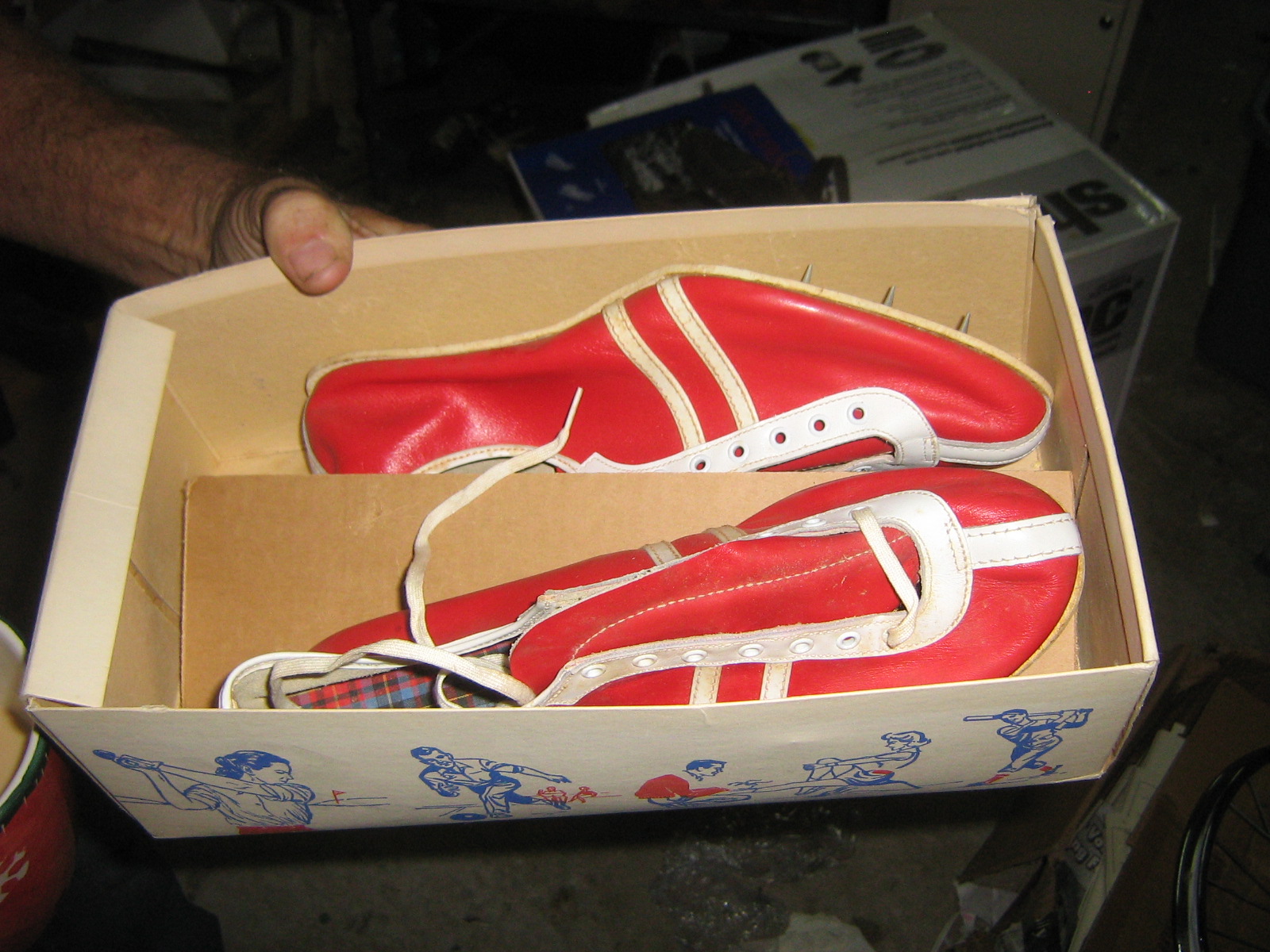
I spent the morning and part of the afternoon with my friends Steve Price and Phil Scott.  Steve was for years the women's coach at Bowling Green State University, and Phil  coached many years in the Midwest and most recently at Cedarville University.  His son Jason is pushing 18 feet as a pole vaulter.   Phil restores antique bicycles, was a national JC decathlon champ in the early 70's at Santa Barbara JC, and now lives in the Dayton, Ohio area.  He  is the collector of track shoes who was featured in the blog last year.  He is a fount of track stories, humour, wisdom, absurdity, and an unabashed raconteur.    His mother once told him,  "Phil, I only asked you what time it was, not how to make the watch."   Below are some of the shoes Phil has collected over the years on eBay, by calling people up and charming them with his interest in them and his ability to demonstrate his profound track and field knowledge.  In one instance Phil was talking to Ron Morris the bronze or silver polevault medalist in 1960.  He learned that Ron had never seen any film of himself vaulting in the Olympics.  Phil contacted the IAAF in Switzerland and borrowed video from them and got it copied and sent to Ron.   He's always doing things like that and sometimes the favors are returned.

He tells a story of working in a shoe department in Dayton and a lady, completely irate, came in to return a pair of Nikes.   Her comment,  "Don't even get me started.  I'm so angry.  There was no note in the box saying you could not put these in the washer and dry them in the dryer.  Now look at them."   Phil opened the box and found a pair of track shoes all dried up burnt, and twisted.   He didn't know what to do.
Finally the owner of the store came down to see what all the commotion was about, heard her story and replied,   "Maman,  there wasn't any note on your stove saying not to stick your head in the oven was there?"

Phil in his basement, he's recovering from serious back surgery. That explains the brace.
1920's indoor shoe
Pin Head Spikes in those 1920 indoor shoes

Phil with Bill  Ashenfelter's  shoe worn in 1952 Olympic Steeplechase.  Bill's brother Horace won at Helsinki,  Bill DNF'd.


1958 knockoffs to look like Adidas, made by Brooks
1920's or 30's marathon shoe

John Walker model Brooks

John Walker signature model, not his actual signature


A shoe called Magnus

1950's Aussie Shoe


Lilly Whites  Piccadilly Circus    -   England 1960

Sportcraft  England late 1960's

Gola


Gotham Athletic Footwear

Gotham's 

One of Phil's Shrines
These in center are all of the shoes son Jason ever wore.  Jason is
still vaulting and coaching at Cedarville University in Ohio, his alma mater.

A brand called Lowe & Campbell, cities listed on label
Cincinnati, Kansas City, Minneapolis,

Lowe and Campbell

One of the early jazzed up Nikes

These shoes worn by Joe Deloach at 1988 Olympics kept Carl Lewis to 3 golds instead of 4 with Deloach winning the
200 meters at Seoul.  Phil picked these up at a sports memorabilia auction.  He was the only bidder.  They
are signed by Deloach

Deloach winning the 200 over Lewis

Phil is still trying to figure out what these shoes were used for.
The have an inscription 'Wimbeldon' on the sole.

Sole on the 'Wimbeldon'  Tennis anyone?

Restoration projects in another wing of the basement.
The orange frame belonged to a world champ from Dayton, Karl Kiser from the
1920's.  Found in a garage in Old North Dayton.  Slowly being rebuilt.  Black bike
in the back has wooden wheel rims.  Phil won a national championship for
antique bikes on this model.


Spotbilts
An early Lydiard.  Phil thinks this is the lightest shoe ever made.


V 15 N. 10 Gunder 'The Wunder' Haegg Visits Cincinnati

Bob Roncker of Cincinnati, Ohio has sent in this account of one day on the 1943 tour that Gunder Haegg of Sweden made to the US to help rais...