Once Upon a Time in the Vest

Wednesday, April 10, 2024

V 14 N. 21 World Athletics Will Present $50,000 to Each Track and Field Gold Medal Winner in Paris

 Sean Ingle in today's The Guardian  noted that World Athletics will give $50,000 to each gold medal winner in Track and Field this summer at the Paris Games.  The article implied that the award was almost a unilateral idea and decision made by Sebastien Coe the head of World Athletics.  No mention was made whether Silver and Bronze would receive a monetary prize. Track and Field at this writing is the only sport to present monetary prizes at the O's.    Noted too was the fact that approximately sixty percent of the world athletics federations also give monetary prizes to their country's winners.  When you consider that the average salary of an NBA player in an 82 game season is $10 million, this comes to an average of $121,951.22 per game,  The NBA minimum salary is $1.2 million or $14,634.15 per game for the lowest paid player in the league.  So bench warming 4 games will put the lowest paid NBA player into the Olympic gold medal class of monetary rewards.  In those terms,   $50,000 seems a bit of a pittance.   In the period between 2017 and 2021 World Athletics took in $7.6 billion dollars in TV revenues and other sources and is said to have distributed about 90% of it back into the sport.  What ways that distribution went was not noted.  That averaged out to about $4.2 million per day.  The cost of the monetary refund to the Paris gold medalists will be $2.4 million.  At least there is something being thrown down from the Luxury Box by the V.I.P.'s.

When asked about the money, Norway's Karsten Wahrholm the 400IH record holder said that the 'glory is more important than the money.'   The truth rings in that statement, when you consider that Karsten might make more money in a season pulling codfish into a trawler in a good year on the North Sea.  And working to prepare for either running sub 46 in the IH or hauling 50,000 pounds of codfish out of the water in rough seas is equally hard.  Although running the 400IH might be considerably less dangerous.  There is no glory in codfish.  And don't ask me if there are codfish in the North Sea. There are.  I just looked it up on Google.

Money, Money, Money by ABBA   link

In another vein, I am considering starting another blog not related to track and field but life in general based on my experiences the past 81 years.  What I need is a catchy title to attract readers.  I'm looking for suggestions from all of you.  If your suggestion is chosen you will get a free lifetime subscription to the new blog just like you do to this blog.    Thank you for your consideration.  You may send your suggestion to me at irathermediate@gmail.com   All suggestions will be considered, no matter how bad they may be for my health and longevity.

George Brose

Sunday, April 7, 2024

V 14 N. 20 A New Book About England's First Black Olympic Medallist Harry Edward


I received an email this week from Neil Duncanson telling me about the new book he has put out as editor of the memoir of Harry Morton, England's first black Olympic Medallist.  The story rang a bell in my aging mind, I recalled that I had made mention of that story  almost three years ago.  I had found an earlier article in The Observer by Mr. Duncanson and posted it in this blog.  See link just below.  If you do open the link, you may find the two articles following it interesting as well about two other all but forgotten British athletes.

Once Upon a Time in the Vest

Mr. Duncanson found Harry Edward's memoir in the archives of the Amistad Research Center in New Orleans and prepared it for publication.  

Harry Edward won two Olympic medals in the sprints for his country in 1920, the immediate post WWI Olympics held in Antwerp. 

What is unique in his story is that Harry Edwards as a British subject had been interned in Germany during the war and lived in very harsh conditions for four years.  He came to England immediately after and started competing in athletics as he had as a schoolboy in Germany.  At one point in his career in 1922 he won three major sprint championships in England in the space of an hour.  Then he moved on to the US where he spent most of his life in a variety of pursuits.     See below some commentaries about this book.  

When I asked Neil how he came across the memoir in New Orleans, here was his reply:

Long story, George.

During Covid I was assembling a 4th edition of my book on the men’s Olympic 100 metre champions, The Fastest Men on Earth. 
The publishers wanted some short sketches included on the silver and bronze medalists, as well as the world record holders.
When I got to 1920 I knew the name Harry Edward from the record books, but very little else. The standard records started in 1919 and ended in 1923. That was odd. 
I had his UK athletics records, but there was nothing else in the UK press or sports magazines about him. Not even an obituary.
After some intense digging I came up with some references to the Amistad Center, in New Orleans. It turned out his widow had donated all Harry’s papers to them when he died in 1973. They had sat there largely untouched for 50 years.
When I went out to go through them (9 large boxes) the collection included a variety of versions of a memoir - some handwritten and some typed. I read them all and his story was fantastic, and while his track career was astonishing, the rest of his life was even more so.
He had tried unsuccessfully to get it published before he died, so I decided to finish the job he started.
I hope you enjoy it.best
Neil D

Below are comments from the press release by the publisher Yale University Press, London

“A fascinating historical document, Harry Edward had a sharp eye and an ever-busy pen. Unfailingly frank, humorous, always dignified and empathetic, Edward describes a world in flux, as seen by a Black hero no-one really knows about – and everyone should.” Hugh Muir, Writer and Editor at the Guardian

“The celebration of Britain’s first Black Olympic medallist would merit its own narrative, but that was just the beginning of Harry Edward’s race through life. His story deserves to be told and his experiences should remind us all that we are all equal both in and out of the sporting arena.” Steve Cram, British Track and Field Athlete

“Harry was empowered by his Olympic experience and truly lived the Olympic values. He fought injustice and for inclusion wherever he went. His story is an inspiration to us all and is as relevant today as it was fifty years ago.” Joël Bouzou OLY, World Olympic Association President

“Such a beautiful, engaging, fascinating book – and to think we had it here at the Amistad Research Center all this time. When I Passed the Statue of Liberty I Became Black is a wonderful contribution to the fields of sports and history. Kudos to Neil Duncanson for getting this memoir out into the world where it belongs.” Lisa Moore, Amistad Research Center

“An engrossing account of the life of a remarkable man wrestling with a variety of racial and professional issues in the early twentieth century. It's as if his commitment to athleticism was reflected in the way he dealt with life's more important challenges.” James Walvin, author of The People’s Game

“Captivating. Edward's singular voice and extraordinary achievements should reach a wide audience.”

Simon Hall, author of Ten Days in Harlem

“America's original twentieth century everyman turns out to have been a Black Brit from Berlin by the name of Harry Edward. In the fairer world he fought for, his incredible life story would have been heard long ago. This book is his final, posthumous victory.” Tom Peck, Writer at The Times

“This is a fascinating discovery, a real jewel which yields so many invaluable insights into the life of the truly remarkable Harry Edward, an Olympian in the sporting arena and beyond.” Philip Barker, Editor, Journal of Olympic History

“This is an incredibly important and beautifully constructed tribute to a proper hero. We are incredibly proud of Edward at the University of Westminster (home to the Polytechnic Harriers) and indebted to Neil Duncanson for his extraordinary labour of love in seeing this book finally realised.” Guy Osborn, University of Westminster


 I haven't read this book but it reminds me of another book on a similar topic:  Living on the Color Line by Greg Williams who later became the president at UC (U. of Cincinnati).  I believe you read it because his family moved from Virginia, where they were considered Italian, to Muncie, IN, where they were considered black.

Saturday, March 16, 2024

V 14 N. 19 Query on Dave and Don Styron

 Asking any of you who read this blog if you know if Dave and Don Styron who ran at  NE Louisiana and Southern Illinois in the early 1960's  are still alive.  Their 84th birthday is coming up this coming Monday.  And a Happy St. Paddy's to all our readers of Irish descent.  And to the pretenders as well.


  from                    Albequerque Journal  June 18, 1961

Thursday, February 29, 2024

V 14 N. 18 "Enhanced Games" ? What Next ?


February 29, 2024

Coe Suggests Long Ban on Enhanced Games Participation  link  The Guardian by Sean Ingle


If you want to read the latest coming from the mouth of Seb Coe, click on the above article from today's The Guardian.

It's hardly worth the effort, not because of Sean's writing, but because of Seb Coe's statements.  It really sounds like someone pushed in a corner and suggesting they are going to tell their Mama if their tormenter doesn't stop.  World Athletics seems to be threatening a long ban if someone participates in a competition where you can be as doped as you want.  Isn't that already what W.A. has been doing for years to athletes caught doping in clean competitions?  If they  got caught doping, they got banned for three or four years which is basically career ending for most athletes.  Oh, and they had to return their medals.    They had to actually go out and find a job then or sleep in their parents' garage.  Yes, a few have come back after 'rehab', but they are few and hardly worth mentioning.  There will always be doubt when we see their name in lights.


And what if an athlete who is clean wants to compete in the Enhanced Games and show those juice heads they can still compete with them?  Would Coe want to ban a clean athlete who goes that route?  If so, would that even be legal?   Something about ..."unfair restraint of trade?"  I'll ask my lawyer about that.  There obviously is going to be some money to be made, so why make life difficult for an honest, hard working athlete who needs to send his or her kids to school or get them to the orthodontist?  Even Noah Lyles needs to maintain his wardrobe.   

The Enhanced Games will not be limited to track and field but may also include ballroom dancing, gold fish swallowing,  Nathan's Hot Dog eating, oh and most likely the Donald Trump hair growing relay.  Wait, do I smell a conspiracy to raise funds for the former president.?   Okay, to remain politically neutral we'll also suggest the Joe Biden vs. Mitch McConnell shuffle relay.    Possibly the draw to this sort of competition really would be to see if some super drugged whack job tries to squat 3,000 pounds and his brain explodes or his guts shoot out of his nether regions.  

This kind of stuff comes out when you are given an extra day every four years to do as you wish.

George,

We could avoid all that crazy stuff like The Enhanced Games.
A simple solution: Substitute March 0 for Leap Day.

Gary Andrus


I like that idea.  It gives me an extra day to ignore paying my taxes.   George


Monday, February 26, 2024

V 14 N. 17 Now They Wanna Remove the Take Off Board, Daddy ? World Champ Calls Idea 'Dog Shit'

 Long Jump May Become Like Wimbeldon   (Or Worse)   Link


The above article by Sean Ingle appeared today in The Guardian.  If you can bear to read it, Sean is relating that World Athletics and Lord Coe in a move to attract viewership is proposing that long jumpers can jump from virtually anywhere and the jump will be measured from where they leave the earth to where they land back on it assuming they land in the pit. And unlike the latest moon lander, it won't matter if they fall one way or the other.   This will attract more viewers?  Sean thinks not, and I concur.  But Sean offers an option.    Turn the event into a knockout, such as playing in a tennis tournament and each jumper is paired with another  after a normal qualifying round to select the final eight or maybe sixteen jumpers.   That would mean a sort of jump off with the eighth best jumping against the  best and the winner moving forward  against the other pairings.  So theoretically a person could set a WR in an early round and not even medal.   I dunno.  This might well increase the betting revenues which seem to be making headway in all TV sport.  Maybe we could also modify the flight area with hot coals or fill it with water and crocodiles  and turn it into one of those game shows that seem to attract a lot of idiots.    Anyway, it all seems to be too much of a radical move for my old bones.  And how are we to compare Bob Beamon with today's heroes?

But wait,  there may be an option with the technology available at most of our fingertips.   Think about going to a live track meet when you are sitting in the stands watching four or five field events scattered around the stadium and racing going on the track.  How much do you catch live?  Unless your grandkids are performing in an event or there is a potential record throw or jump about to take place and a great announcer brings it to your attention, you are going to miss a lot of action.  With all the technology available at our fingertips, a broadcast could give the viewer the option to focus on the event of their choice.  Some techie could put one of those little thingees at the bottom of your screen that you could click on or just touch and it would go to the long jump only or the hammer throw only.   A small  team of 'experts' would be assigned to cover each event separately and you could just dial in live and see what is going on in detail. I don't know where we might assign some of the current announcers, possibly handing out towels in the washroom?   You might have a split screen option where you would also see a running event simultaneously.   Track is a three ring circus, so you are going to miss somethings live.  Playbacks can put you into the whole picture.   And to avoid those  Euro 990 tickets to the Olympics, the Paris heat, and French snobbery if you don't pronounce things properly, you can get the best seat in the house without leaving home.  Door Dash can bring you a nice Beaujolais and croissants and cafe creme to your door.   See you this summer, one way or the other.   George

This comment came from the editors of the blog:   Track is Not Dead, It's Only Sleeping  

 It seems that the attempts by  higher ups in the sport of track and field (Athletics to the uninitiated) are hoping to increase interest  by simplifying the long jump.  They think by removing the take off board  the jumpers would not be charged with an unmeasured jump if they went beyond the board on the take off, because there would not be a board.  Absolutely freaking brilliant.  Thank God for British public schools.    Wouldn't this modification of the rules get you to turn on your set to watch what you have been missing for the last twenty years?  American Idol and The Voice are already considering lodging protests at the Supreme Court.   Sir Billy Bob Hume-Churchill  (S.P.C.  E.X.T.  M.P.A. albeit)

And from Jay Birmingham:

Removing the take off board in LJ and TJ means zero fouls. All the throws would follow: a computer would declare starting and end point. Then crossbar eliminated in HJ and PV.  Hurdlers would soon just pretend to hurdle objects and the computer would judge. 


Read the lyrics to Yoshimi Battles the Pink Robots. 
“Those evil-natured robots;
They’re programmed to destroy us.”


from Mike Waters,  Corvallis, OR:  I could see this happening    I worked the horizontal jumps at the 16 trials    The lazor overruled the person that was watching the takeoff board.     But as we well know this technical stuff costs money.  Not even some colleges can afford this .


Dr. John Telford

to me
the long jump was my favorite event in high school
8:51 AM (1 hour ago)

  From: Bill Schnier    

 For every benefit, there is a corresponding liability.  By jumping from wherever you want one would determine the best jump, but by watching those jumps from the stands, one would think the jumper landing farthest into the pit would be the winner, but not necessarily so.  I suggest we leave it as it is and not require every LJ runway in the world to be fitted with high-tech lasers.


In the March 3, 2024  The Guardian:  Quote from new world long jump champion....

" men’s long jump winner Miltiadis Tentoglou attacked World Athletics’ proposals to scrap the wooden take-off board as “dogshit”. “If the rules are applied, I will stop doing long jump,” he added. “Changing it would remove all the skill.”


Thursday, February 22, 2024

V14 N. 16 Bob Mathias from an Old Life Magazine

 Found an old Life Magazine   (July 11, 1949) last week.  The cover with Bob Mathias got to me right away.  Inside a spread about his return home to Tulare, CA to compete in US National decathlon the year after his 1948 Olympic decathlon victory in London as a 17 year old high school phenom.   Two Life photographers Bill Wasson and Michael Rougier were there to cover the event.  No credit given to the writer. (ed.)


A lifetime pass to high school sporting events?  What about the senior prom?  What about the $40,000 spent on the parade?  Her sights seem to be set.  (ed.)


Pole Vault added 696 points to Mathias' score as he cleared a height of 11 feet 6 inches- amazingly good for a 195 pounder.  His all-round excellence in the field events clinched his victory.   

22 feet 4  1/2 inches Broad Jump  3rd place, 2nd in his heat in 100 m

15.0  110HH 2nd place


Between events Mathias grins at closest rival Moon Mondschein, three times U.S. Champion.  Said the 25-year-old Mondschein, "When this kid matures, I retire."  


Bob's mom and then gov of California Earl Warren study the form.
I bet he knows all of mom's favorite recipes now.  (ed.)


Congrats from the Gov. later to be Chief Justice of Supreme Court (ed.)

                                  Momma has some words of advice about that 1500 meters.  Out fast, don't                                                     look back,  I've got blueberry pie in the oven. (ed.)


                                 Bob's brother (left) helps him walk it off and talks over their

                                         options for the rest of the evening in downtown Tulare. (ed.)


Very complete T&F coverage of Bob Mathias before the days when 20-30 "sports" clamored for attention each week and pro sports dominated the cable wires.  It was also a time when the decathlon winner was considered the greatest all-around athlete.  I believe Bob Mathias later became a US Representative for California.  A life well lived!  Bill Schnier

Thursday, February 15, 2024

V14 N. 15 Not Another One, First Kelvin Kiptum and Now Henry Rono R.I.P.


                                                    February 12, 1952 - February 15, 2024


 Henry Rono was one of the most devastating runners ever to lace them up, and now he is gone at age 72, the same week as the young Kelvin Kiptum, age 24 the world record holder in the marathon.   Rono came on the scene shortly after Kipchoge Keino stepped off the world stage.  Had he been a bit younger or a bit older he might have been better known, because in his best years Kenya boycotted the Olympics in 1976 and 1980 to protest New Zealand's sending a rugby team to South Africa.  He ran faster hung over than most men ran sober or juiced with PED's.  Or so legend has it.  He didn't deny this in his autobiography.   His mom ran a shabeen or illegal alcohol speakeasy in Kenya, so he grew up in that milieu.     

Eventually Henry found his way to the US and got hooked up in John Chapin's program at Washington State where he won numerous NCAA championships and also happened to break four world records in 81 days in 1978.  10,000 meters (27:22),  5000 meters (13:08), 3000 meters steeplechase (8:05.4), and 3000 meters (7:32.1.   Those records have long since been broken.  But no one has ever shown such versatility in such a short period of time.   

The current records are   10,000 (26.11)   Joshua Cheptegai,   5000 (12:35) Cheptegai,                                                 3000 Steeplechase (7:52.11)  Lamecha Girma,  3000 (7:20.67) Daniel Komen

Yes, today's times are significantly faster, but it's been 44 years since Henry Rono set those times.  I think Rono belongs in a small group of all time great Kenyan runners along with David Rudisha, Eliud Kipchoge,  Daniel Komen, Kip Keino, and arguably fifty others.

I was fortunate to see him run one time, but he had a terrible day at the NCAA national cross country meet in 1978 in  Madison, Wisconsin.  It was horrible weather and he apparently took a wrong turn in the race and never made even into the top hundred runners.  Possibly finished 237th.    I did get a picture of him in that race and he autographed it when I met him  in Cincinnati in the 1990's.  He laughed about how bad he was that day.   Bob Roncker held a book signing for Henry at his running store.  Only two people showed up.  He was already a forgotten man.  He once got accused of participating in a bank robbery in the Eastern US and spent some time in jail, but he was fortunately acquitted.   The last I heard of him he was coaching First Nations runners in a community college somewhere in the Southwest US.  


The following is a description of Henry's book on the Amazon page.


In a span of 81 days in 1978, Henry Rono broke four world records, committing the most ferocious assault on the track-and-field record books by a middle-distance runner in the history of the sport. This is what Henry Rono is known for. However, it is not who Henry Rono is. Henry Rono was born a poor Nandi in Kenya's Rift Valley. After an accident when he was two, doctors believed he would never again walk. This would be the first of countless obstacles Rono would have to overcome in order to pursue his two life goals: to first become the greatest runner in the world and then to become the best teacher he could be. Rono's first goal was accomplished in 1978, when he was considered not only the greatest track-and-field athlete in the world, but also by many to be the world's greatest athlete period. His second and greater goal, to become a teacher, was more difficult in coming. Once Rono became a star, coaches, agents, meet directors, and corrupt Kenyan athletic officials (whose boycotts of the 1976 and 1980 Olympics turned Rono's dreams of Olympic gold into Olympic smoke rings), wanted him to serve as their personal moneymaker, and so they did everything they could to discourage Rono's pursuit of an education and dream of teaching. The corruption and discouragement Rono encountered, as well as his alienation and exile from his homeland and family, pushed him to 20 years of alcoholism and even occasional homelessness. This is the life story of Henry Rono, whose descent from triumph to abyss, and whose subsequent ascent from abyss to triumph, are perhaps steeper than those of any track-and field athlete in history.


                                                                       Photo from New York Times

V 14 N. 14 And You Thought You'd Heard the Last of Horatio Fitch?

      As if yesterday's piece by Mike Tymn were not enough to spoil you, we just received another story relating to Horatio Fitch.  It is awe inspiring how these stories can stir the nether regions of one's brain to draw out things long forgotten from the past.   This one comes to us from Russ Ebbetts.


                                                                  Into My Office…

                                              by Russ Ebbets


A long jumper, a javelin thrower and a coach walk into my office…there should be a joke there, but all I’ve got is my own little version of Ripley’s Believe it or Not!

The door to my office at Union was a funnel for a parade of alumni, prospects and suspects that all came with a story to tell in exchange for a moment of my time.

The “Marathoner from Miami” was a kid who wanted to come to college to run the marathon. He already had two under his belt with a PR of 3:06. Frank Shorter was his idol and he made it clear he was going to run the marathon. I told him the marathon wasn’t a college event and that there was strong evidence that running a marathon before physical maturity could hinder athletic development.

“But,” his mother added, “my son is a marathoner.” It sounded more like a learning disability than a mark of distinction. I was getting nowhere with this pair. I thanked them for making the visit, they left and I dropped the athletic questionnaire in the waste basket.

In the early 80’s track on TV was a more regular event. One indoor season produced a series of great mile races between Eamonn Coughlan and Steve Scott. Coughlan’s clever tactics produced three great wins that highlighted the indoor season and inspired countless people. “I saw the milers on TV Saturday,” began the Pit, “it looks pretty easy, it looks like fun,” then he dropped the clincher, “I think I can beat them.”

The Pit had black hair, stood about 5’10” and was a fat 170 pounds. The Pit couldn’t beat an egg. But what I remember most about the Pit was his eyes. There was a complete vacancy to his stare. He spoke like a drone. There was an uneasy feeling in my stomach. I had heard enough. I wrote down directions for his physical, practice times and told him to show up when he’s been cleared to run. I never saw him again but for the longest time I found myself checking the rooftops for snipers.

It seems “The Miler” was making a career out of college. He would surface every few years take a few courses and then disappear. All the while he’d tell anyone who would listen that he’d run a sub-four minute mile. The problem was no one ever saw him run a step. His previous incarnation was during NCAA Champ Kevin Scheuer’s era. Mention this guy to Kevin and he’ll spit.

But there was a flip side too. Stan Gasorowski coached at Albany High. One day he gave me a call. “I gotta guy you gotta see…” he began. Periodically I’d sneak one of the top local kids into the Field House to train. “He’s a long jumper.” I’m thinking Stan’s got a kid doing 21’-22’. “Russ, I know this is going to sound strange but,” I’d known Stan for over a decade. He is a solid, no BS guy. “Russ, the guy jumped 26’4” in our pit the other day.”

Downhill? Wind aided? Twenty-six feet is still twenty-six feet. I paused a moment. What could I say? Then Stan added, very sheepishly, “Russ, he really jumped 27’4” but if I tell you that I’m afraid that you’ll think I’m crazy.”

I was trying to process this. “Stan, do you realize what you are saying?” And before he could answer I added, “That is what Carl Lewis is jumping.” All Stan could say was, “I know.” And then he added that 27’4” would be the fourth longest jump in the world last year. He had looked it up in Track and Field News. I told Stan I’d like to meet the guy. The guy was named Mike Fields. He looked like Willie Banks. He came to the Field House, warmed up and jumped. He ran down the runway with an arm action that was too high, steps that were too long and he jumped 25’6” with a 10-step approach. He said his foot hurt. He didn’t want to jump again. I saw what I needed to see.

This guy was more than a diamond in the rough. This guy was history, as in “make history.” I looked at Stan and said, “We gotta talk.” Fields was interested in college. He’d jumped 21’ in high school, grew six inches since graduation three years ago and wanted to know if I could help him.

I wondered where he would fit in. Fields had his own concerns. He wore a gold neck chain that was thicker than a finger. I wondered more. Fields was a professional gambler. In his own brilliance he’d learned how to write a tip sheet for the California horse tracks which he sent daily over the wire to racetracks in California. Gambling and the NCAA don’t mix.

Nonetheless word got out. Florida State called, then Texas and UCLA. The questions were always the same, “Did you see…?” or “Is this guy for real?” All I could say was what I saw. The guy jumped 25’ and change on a 10-step approach. Even on a bad day that is an NCAA Division 1 All-American. Fields never pursued his talent. I still wonder.

And there were always the calls out of the blue regarding using the track, getting into a meet or finding a competition. Gary Cudmore of Amsterdam HS called, said he had a foreign exchange student and could this student see me? The javelin is not a regularly contested event in New York State high schools. The kid showed up with his host mother. The mother did the talking, the kid only spoke broken English. It was quickly apparent that all the mother knew about the javelin was that it was thrown. I explained the NYSHS situation, mentioned some clinics Tommi might attend and told her I would make a call on their behalf to Kevin McGill, one of the top throws experts in America, then at Columbia University.

“By the way, how far does Tommi throw?” The mother didn’t know. She asked Tommi. He pulled a thin, glossy covered magazine from his duffle bag. His picture was on the cover, he stood at the center of a podium, arms raised and a gold medal around his neck. The caption was in a foreign language I couldn’t read but I did notice the “73m” in the title. Seventy-three meters. It took a minute for me to translate the metric into English. My hammer thrower was throwing 60 meters which was about 190’, a meter is 10% longer than a yard…I ran  the numbers through my head and figured this kid was throwing close to 240’. That was close to the US national high school record.

I called McGill. I said, “Kevin, you are not going to believe this…” Every fall Iona College held clinics and competitions for the throwers. We arranged for Tommi to make the trip down. He set the clinic on its ear. McGill still talks about Tommi Viskari. The perfect form, the powerful arm, the blast off the right foot. The kid was videotaped like a movie star. Later that fall Tommi set the US National High School record for the international weight javelin that still stands. You can look it up. His name is on the same list with Jim Ryun, Rudy Chapa, Gerry Lindgren and Renaldo Nehemiah.

Tommi Viskari, Amsterdam, NY, 241’11”. (Editor’s note – Viskari’s record was broken in 2010 by Sam Crouser from Gresham, Oregon)

But the man I remember most was Paul Sweet. Tall and almost gaunt Paul entered my office with a regal carriage that belied his 85+ years of age. I had no idea who he was. I had never heard of him. Paul introduced himself and asked if I had the time to talk a few minutes. We talked. He was the track coach for the University of New Hampshire for over 60 years. He’d recently retired and was now living in Scotia, NY. Towards the end of the conversation he invited me to his house for dinner. A free meal is a free meal. I accepted. That three-hour visit has become one of the most fascinating evenings of my life. Initially we spoke about how training has changed. The useful “old methods” were reviewed and the new innovations that have revolutionized the sport were discussed at length. Then he got out the scrapbooks.

Paul had scrapbooks dating from the 1920’s. His UNH teams had upwards of 120 members. He pointed with his finger and named runner after runner as if he’d coached them yesterday. Of particular note was an athlete named Morcom. Boo Morcom and another teammate once won the IC4A Trach Championships by themselves. I remembered reading about this two man  "team” in Ripley’s Believe it or Not. Paul provided the details.

Paul also coached Jeff Bannister, one of the top US decathletes in the late 60’s. For some reason a picture from Track and Field News of Bannister (about 6’6”) towering over Bennett (about 5’8”) has always stuck in my mind. I asked Paul what he did when he was an athlete. He had a scrapbook for that too.

Paul ran for the University of Illinois. He had a picture of a relay team, all smiles, standing with a coach, all hands on a baton. He told me his coach’s name was Harry Gill. It didn’t register for a second, then it did.

“Harry Gill of Gill Hurdles?”  He smiled and said yes. The Gill Equipment Company had been one of the major suppliers of track and field equipment in America since the 1920’s. He turned the page.  He told me, “This was my best day,” and pointed to a yellowed slip of newsprint with the title, ‘Illinois Quartet Sets World Record in Relay.’ I read on with great interest.

At the Drake Relays Paul had anchored the University of Illinois 4x110 relay to a world record. I couldn’t believe it. “Notre Dame was there,” he said, “guess who was their coach?” I had no idea. I thought a moment and still had no idea. I threw out the only name I could think of, Knute Rockne.  “You’re right.” This was getting weird. He asked if I’d finished reading the article. I read on. After setting the world record in the 4x110 Paul and his teammates came back and set the collegiate and American record in the 4x220, missing the world record by 1/10 th second. Paul anchored.

Paul was scheduled to run the anchor leg on the 4x440 but strained his Achilles tendon and was replaced by a runner named Fitch. “Do you know who he was?” I had no idea, not even a guess. “Did you see Chariots of Fire?”  I had, but I still made no connections. Paul told me that Horatio Fitch had gotten second to Eric Liddell, the Scotsman in the 400m at the 1924 Paris Olympics.

Paul told me that in the “old days” one couldn’t coach and compete at the same time. That was considered professional. He had gotten married; a family was on the way and he’d been offered the coaching position at New Hampshire. A decision was made.  He never said what I thought, but the hint that things would have been different in Paris hung heavily in the next moment’s silence. Paul stood straight against the indignities of old age with 60 years of scrapbooks and the memories they generated. I stood there thinking about Frost’s “The Road Not Taken” and marveled at how strange history can be.


Russ Ebbets has taught in the USATF Coaching Education for over 35 years, speaking at Level 1, 2 and 3 schools and the High Performance Summits on distance running. He has served as the US National Team chiropractor to three IAAF World Championships. His documentation and standards of care for on-site sports chiropractic have been adopted nationally. He has directed complimentary chiropractic care at over 250 events, 25 national championships and overseen thetreatment of some 15,000 athletes at events ranging from local 5k's to Friehofer's Run for Women, Utica's Boilermaker and the Millrose Games at Madison Square Garden. Since 1999 he has been editor of Track Coach, the technical journal of USATF. Track Coach enjoys a worldwide circulation and is seen as one of the leading training journals of the sport. Ebbets has lectured throughout the USA, in Canada, Scandinavia and the Caribbean. Since the fall of 1983 he has contributed regularly to Pace Setter Magazine with his Off The Road column.


Wonderful story by Russ Ebbets.  All of us have had such kids come in, some imposters, some talented.  My best two gifts were Lewis Johnson (1:47.00) who stopped by one day and said he wanted to be on the team.  Another was Rodney Johnson (7' 3") my first year whose HS did not offer T&F but was very talented and is now an actor in Hollywood.  A third was James White (6' 10-3.4" and 25' 7-1/2") who was also a basketball player who wanted to be the first NBA player to win the 3-point and slam dunk contest.  That never happened but he did win the Drake Relays LJ one year.   Bill Schnier

Wednesday, February 14, 2024

V 14 N. 13 Horatio Fitch and the 100th Anniversary of "Chariots of Fire"


    Sometimes the story behind the story, behind the story is as interesting as the story.

  In yesterday's post, one of the respondents Mike Tymn mentioned that he had written an article in the Honolulu Advertiser about the American 400 meter runner Horatio Fitch who finished second to Eric Liddell in that race in the Paris Olympics of 1924.  Most of you will remember Liddell as one of the two heroes in the film  "Chariots of Fire", the other being Harold Abrahams who won the 100 meters. Fitch actually broke the 400 world record in the prelims.   It was only then that I realized that this year's Olympic Games to be held in Paris for the second time will also be the 100th anniversary of that first Games so depicted in the movie.  

     Mike's note set me off on a search to find his article.  With a weapon on my computer like Newspapers.com, that kind of search was not too difficult.  I tracked down Mike's story with a few strokes on my keyboard.  It appeared on February 23, 1984, forty years ago and then already sixty years after the race.  Mike was fortunate to find Fitch still alive and conscious in Colorado and get an interview.  He writes about some interesting aspects in those games, including the atmosphere and compares it to the how they were depicted somewhat differently in the film.  Ah, poetic license of directors and screen writers.   Fitch  describes some things in the film that just were not there in real life.   He also mentions how he was a bit befuddled by the  cords or lane separators strung along each lane line to keep the runners from drifting out of their lanes.  And he makes note of the reception of the athletes.  There was some confusion in the film giving the impression of 'docking' in Paris.  The ocean liners can't come up the Seine River.  So there was a train ride to finally arrive in Paris. Mike also mentioned that a member of the women's swimming team, a diver named Aileen  Riggin connected with Mike after reading the article and  noted  an  error in the film not in Mike's report,  and how he got to know her from that connection.  I will put that bit at the end of this post.  So here is that wonderful article by Mike Tymn written forty years ago this month.


tThis is a continuation of the article on another page and unfortunately cannot be maintained at same type size.


Finish of the 400 meters 1924  from The Guardian

George,
 
I got to know Aileen Riggin fairly well during the last 20 years of her life.  We often lunched together.   Aileen won the gold medal in diving in 1920 and took silver (diving) and bronze (backstroke) in 1924.   After the Paris Olympics, she turned professional, which involved giving swimming and diving exhibitions around the country.  The stigma of turning professional was such that she could no longer enter the front doors of various sporting clubs.  She had to go in the back door. Much shame involved..
 
I got to know Aileen after the movie 'Chariots of Fire" was released.  I interviewed Horatio Fitch, who took second in that historic 400 at Paris, for the morning paper.  Aileen called me to correct something I wrote about those Olympics, but I don't recall what it was. See my photo of her attached.
 
Aloha!
 
Mike
         Aileen Riggins

I sent the article to Mike.  This was his reply.

George
I had not read my article for many years and I forgot about several things, including his (Fitch's)  fear of running into the lane separators.  I was trying to visualize running with those stakes and flags separating lanes and I can appreciate his concern about running into them.  Then, again, it may have helped them better pace themselves, i.e., not go out too fast. 
 
I was thinking Aileen's initial call had to do with the ship docking in Paris, but I don't know what she might have added to what Horatio already said. 
 
Aloha!
 
Mike

(My son recently watched the film with this "Paris docking" error in mind.  He notes that the scene clearly depicted it was Le Havre not Paris. So it must have been something else that got Aileen's attention)  ed.


George

Aileen's correction had something to do with the movie, not with my article, but I don't recall what it is was.  She was only 14 in 1920 and 18 for the Paris Olympics.  I recall that she told me she was  I infatuated with Charlie Paddock, but It was in 1920.  I don't recall if he made the team in 1924.    Attached photo is of her on victory stand in 1920.
 
Mike


An anonymous contributor added the following:

Looked Aileen Riggin up in the Wallechinsky Olympic book.  Both she and the silver medalist in diving in 1920 were 14 years old.   Aileen was all of 4'  7 inches and 65 lbs.  They had a chaperone but no coach go to the Olympics with them.  No hot showers also.  Competition was outdoor in a moat filled with cold muddy water.  Riggin's said the stress of competing was not her main concern.  She was worried about sticking in the mud at the bottom and not coming up due to getting stuck and no one would miss her and she would die a horrible drowning death.   The book has a picture of the two girls and the silver medalist, Helen Wainwright was heftier and quite a bit taller.
Riggin was 5th in the 1920 platform  diving too.


From John Telford in Detroit, MI  former All American 440 runner for Wayne State University.
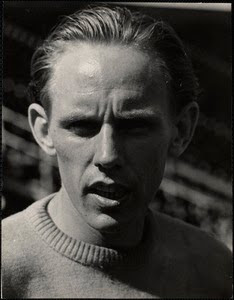
How the DNA must overlap in these two men, Telford and Liddell.  ed. 

What a wonderful article about the 1924 OLympic 400.   It brings back memories, because .  Eric Liddell was my father's cousin on his mother's side.    Liddell and my father--John "Scotty" Telford --were both born in Scotland in 1902.  Liddell stayed in Scotland, and my father came to America through Ellis Island with his parents Francis "Frank" Telford, Margaret Telford,  sisters Margaret and Letty, and brother Dan--and they became naturalized citizens.   A second brother--my uncle Frank--was born in this country.  I learned about Liddell's 1924 Olympic 400-meter victory from my grandmother in the early 1940s--long before the movie 'Chariots of Fire.' 

 THE BEST NON-RELAY TIME I EVER RECORDED WAS 45.9 AT THE 440-YARD DISTANCE RUNNING FROM SCRATCH IN THE WNY SCOTTISH GAMES IN WILLIAMSBURGH, NEW YORK IN THE SUMMER OF 1959--BUT I RAN UNDER ERIC'S 1924 FAMILY RECORD OF 47.6 FOR THE SLIGHTLY SHORTER METRIC DISTANCE SEVERAL OTHER TIMES AS WELL.   John Telford

George,

A special thanks for this post. My love of this movie and the inspiration it gives is only increased. May 2024 treat you well.   EARL YOUNG

V 15 N. 10 Gunder 'The Wunder' Haegg Visits Cincinnati

Bob Roncker of Cincinnati, Ohio has sent in this account of one day on the 1943 tour that Gunder Haegg of Sweden made to the US to help rais...