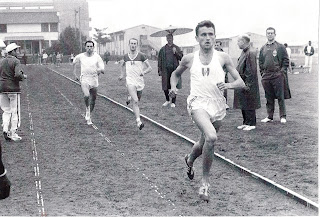
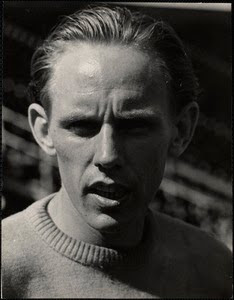
Once Upon a Time in the Vest

Sunday, February 11, 2024

V 14 N. 11 Kelvin Kiptum Marathon World Record Holder R.I.P.


It is with much regret that we have to announce the death of Kelvin Kiptum, world record holder in the marathon at the age of 24.  He died in an auto accident along with his coach Rwandan Gervais Hakizimana in Western Kenya.  His time of 2 hours  35  sec. was set last fall in the Chicago Marathon.


This more updated report from BBC is now available.

Kelvin Kiptum's Untimely Passing  


The following is an early report from BBCBy Celestine KaroneyBBC Sport Africa, Nairobi
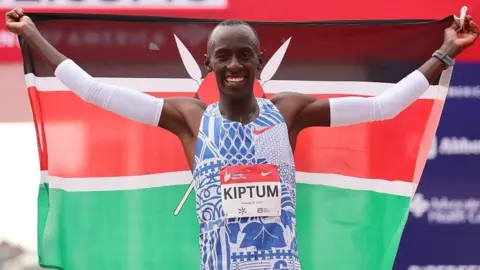
Getty Images Runner Kelvin Kiptum after breaking Eliud Kipchoge's marathon world record in ChicagoGetty Images
Kelvin Kiptum broke Eliud Kipchoge's world record in Chicago last October

The men's marathon world record holder, Kenya's Kelvin Kiptum, 24, has died in a road accident in his home country.

He was killed alongside his coach, Rwanda's Gervais Hakizimana, in a car on a road in western Kenya on Sunday.

Kiptum made a breakthrough in 2023 as a rival to compatriot Eliud Kipchoge - one of the greatest marathon runners.

And it was in Chicago last October that Kiptum bettered Kipchoge's achievement, clocking the 26.1 miles (42km) in two hours and 35 seconds.

The two athletes had been named in Kenya's provisional marathon team for the Paris Olympics later this year.

Paying tribute to Kiptum, Kenyan Sports Minister Ababu Namwamba wrote on X: "Devastatingly sickening!! Kenya has lost a special gem. Lost for words."

Kenya's opposition leader and former prime minister, Raila Odinga, said the country had lost "a true hero" and was mourning "a remarkable individual... and Kenyan athletics icon".

Sebastian Coe, the president of World Athletics, said Kiptum was "an incredible athlete leaving an incredible legacy, we will miss him dearly".

The road accident happened at about 23:00 local time (20:00 GMT) on Sunday, police were quoted as saying by the AFP news agency.

Giving further details of the crash, police said Kiptum was the driver, and the vehicle "lost control and rolled, killing the two on the spot".

A spokesman quoted by AFP added that the third passenger - who was female - had been injured and "rushed to hospital".

Just last week, his team announced that he would attempt to run the distance in under two hours at the Rotterdam marathon - a feat that has never been achieved in open competition.

The rise to fame for the father-of-two had been rapid - he only ran his first full marathon in 2022.

He competed in his first major competition four years earlier running in borrowed shoes as he could not afford a pair of his own.

He was among a new crop of Kenyan athletes who began their careers on the road, breaking away from the past tradition of athletes starting on the track before switching to longer distances.


At a gathering to watch the superbowl this evening a gal that ran track at Penn st ( many years ago )  reported 
this      There's a picture of him with the owner of the Eugene running company, running store in the store. 
He was there promoting the Nike flyknit running shoe   
very sad the way this happened  
Mike Waters  

When I read the first line, my thought was "who now?" envisioning a veteran of the '64 Olympics.  Wow, 24!  Remember who you were at 24?  I sure remember 24.  What an idiot I was.  Like to think I've made progress since then as the bar was set pretty low.
Roy Mason

 Sad to hear this.  Runners like Kiptum were not just athletes who weren't good at team sports and consequently switched to running, but instead were runners who everybody knew they could not beat in a million years and whose athleticism was astounding to all who watched them perform.  Bill Schnier

Thursday, February 1, 2024

V 14 N. 10 Al Buehler Duke Track Coach for 40 Years R.I.P.

 Al Buehler passed away on January 5, 2023.  The following article is from the The Chronicle.

Apologies,  missed this date by one year.

Former Duke track and field, cross country head coach Al Buehler dies at 92

Longtime Duke track and field head and cross country coach Al Buehler died Jan. 5 at 92 years old at The Forest at Duke Retirement Community, his family announced Tuesday. A member of the Duke Athletics Hall of Fame and a larger-than-life figure in Blue Devil history, Buehler spent 45 years at the school from 1955-2000.

After graduating from the University of Maryland, where he enjoyed a successful career as a track runner, Buehler began as head coach of Duke's cross country team in 1955 and became its track and field head coach in 1964. Duke hosted the NCAA Track and Field Championships at Wallace Wade Stadium in 2000, and Buehler retired shortly after, bringing to an end an illustrious career. He was inducted into the Duke Athletics Hall of Fame in 2001 and continued teaching as Duke's faculty chair of the department of physical education until 2015.

Buehler's legacy extends beyond Duke. His career on the international stage featured three appearances as a member of the U.S. Olympic track and field coaching staff in 1972, 1984 and 1988. He is a member of the North Carolina Sports Hall of Fame and the U.S. Track & Field and Cross Country Coaches Association Hall of Fame.

In addition to serving as chairman of the NCAA Track & Field Committee, Buehler was the meet director at the U.S.A.-Pan Africa-Federal Republic of Germany Meet in 1975, the USA vs. USSR meet in 1974 and the Martin Luther King Jr. Games in 1973.

Among the many ways in which Buehler's legacy is honored at Duke today is the Al Buehler Cross Country Trail, a three-mile loop circling the Washington Duke Inn & Golf Club. He is also the subject of a book and documentary by Amy Unell, both titled "Starting at the Finish Line."

At Commencement in May 2022, President Vincent Price spoke of Buehler, his philosophies and his lasting impact on the Duke community. Standing in Wallace Wade, where Buehler coached before the removal of the track in 2015, Price likened life to a footrace, imploring the school's newest graduates to approach that race with Buehler's teachings in mind.

"You may recognize his name from the cross-country trail on the other side of the road," Price said, "but it was right here that Coach Buehler brought out the best in All-Americans, ACC Champions, and Olympians—a hall-of-fame career that led none other than Mike Krzyzewski to say that Al 'defines the word Coach, and sets an example for all of us.'"

"Throughout his career, Coach Buehler has been a bold and courageous voice for what is right—a champion of integrating college sports during the height of segregation and a vocal advocate for equal scholarships for women. But what the runners he’s coached over the years most appreciate is his quiet wisdom, and a guiding philosophy built around three core principles," Price continued.

Those principles, Price explained, are to set up your own race, stay conscious and teamwork.

Buehler is survived by his wife, Delaina, their children and their grandchildren. A memorial service for Buehler will be held Jan. 28 at 2 p.m. at Duke Memorial United Methodist Church. The online service can be viewed here.

Memorial donations in honor of Buehler may be made to the Al Buehler Athletic Endowment Fund at Duke Athletics, The Salvation Army of Durham or a charity to be decided by the donor.


From Bill Schnier:      Al Buehler was a wonderful coach at Duke for many years.  Despite the upper crust university he coached at, he was instrumental in a number of very significant cross-racial endeavors.  He collaborated with LeRoy Walker, coach at North Carolina Central in Durham, on several notable occasions.  As a distance-oriented coach at Duke, he wanted his sprinters to receive more attention so he suggested to his coaching peer across town that both schools' sprinters train at NCCU and both schools' distance runners train at Duke.  This was still during Jim Crow days but the two pulled it off successfully.  Later they joined together to host three major summer track meets at Duke's Wallace Wade Stadium involving the US team against the Pan-Africans, the USSR, and West Germany.  All were extremely well attended with about 40,000-60,000 each time.  Finally, Coach Buehler served as an assistant track coach for the US Olympic Team in 1972 in Munich.  In 1968 in Mexico City following the men's 200 and the subsequent demonstration by Tommie Smith and John Carlos, the two were dismissed from the team and sent home.  Al Buehler took the very shaken pair to the airport and on the way told them he was supportive of their demonstration and that in time their actions would receive general praise from the American public, which proved to be true.  He was a friend when those sprinters found few other friends.  For the last 20 years of his life he climbed up the stairs and then a ladder to the steeple of his Methodist church and rang the bell to announce the service each Sunday.


V 14 N. 9 Michel Jazy Olympic Silver 1500, 9 World Records R.I.P.


(FILES) France's Michel Jazy, cheered on by the crowd, crosses the finish line at a meeting in Melun on June 24, 1965, where he set two new world records, the 2-mile record in 8'22"6/10 and the 3000m record in 7'49". Former French athlete Michel Jazy died at 87 years-old announced the French Athletics Federation on February 1, 2024. (Photo by STAFF / AFP)

February 1, 2024

Michel Jazy died today.

If you were a child of the 1950's and 60's in the track and field world then you were aware of a lean Frenchman named Michel Jazy.  He ran in some of the great races of those times, namely the 1960 Olympic 1500 meters final where he finished second to Herb Elliott who broke the World Record in that race and four years later in the Tokyo finals of the 5,000 meters where he finished to him a very disappointing fourth to Bob Schul, Harold Norpoth, and Bill Dellinger, with a young Kip Keino close behind.  

Michel Jazy was 87 years old when he died.  He was the son of Polish immigrants to France.  His father worked in coal mines.  He only became a French citizen at age 18.  He worked as a typesetter or linotype operator.    After the 1960 defeat at the hands of Elliott, he went on to break Elliott's World Record running 3:53.6.    


He was born in France in 1936 a Polish citizen and only got French citizenship in 1955.  His early life was not an easy one, and in those days we often thought that great middle distance and distance runners did not come from rich families.     His story backs that theory.  Wikipedia describes it thus:  

 Jazy was born into a poor coal-mining family from Poland. His grandfather, together with his wife and their daughter, emigrated from Poland to France after World War I. They settled in Oignies. Michel's grandfather worked as a coal miner in nearby Ostricourt. Michel's father was also a coal miner, whereas Michel's mother worked in a brewery in Lille. Michel was raised by his grandmother during much of his childhood. He was 12 years old when his father died of silicosis. When Michel was 14 years old, he, his mother (Marianne Jazy) and his older sister (Alfreda) settled in Paris. Marianne worked as a waitress in a café in Montmartre. Marianne remarried; her new husband, a truck driver, moved the family into a 10-by-12-foot (3 × 4 m), one-room apartment on Rue Rodier in Montmartre. Michel was passionate about football when he was a schoolboy. As a schoolboy, he would spend hours daily playing football. Michel left school at the age of 14 and became a uniformed doorman and elevator operator at a bridge club near the Arc de Triomphe. At 16 he became an apprentice in a neighborhood printshop.[5][6]

                                                    Michel Jazy lead Harold Norpoth


World records[edit]

Jazy shows his book Mes victoires, mes défaites, ma vie to wife Irène in 1967

Between 1961 and 1966, Jazy set nine world records over the following distances:

Personal bests[edit]

  • 800 metres: 1:47.1 minutes (1962)
  • 1500 metres: 3:36.3 minutes (1966)
  • mile: 3:53.6 minutes in Rennes in 1965 (This was a world record that was broken in July 1966 by Jim Ryun. It remained the European mile record until it was broken by Eamon Coghlan in 1975)[11]
  • 2000 metres: 4:56.2 minutes in Saint-Maur-des-Fossés in 1966 (This was a world record that was broken only in June 1976 by John Walker.)
  • 3000 metres: 7:49.0 minutes in Melun in 1965 (This was a world record that was broken only six weeks later by Siegfried Herrmann.)
  • 2 miles: 8:22.6 minutes in Melun in 1965 (This was a world record that was broken in July 1967 by Ron Clarke.)
  • 5000 metres: 13:27.6 minutes (1965)
  • 4×1500 metres relay (Michel Jazy, Claude NicolasGérard Vervoort and Jean Wadoux): 14:49.0 minutes in Saint-Maur-des-Fossés in 1965 (This was a world record and Jazy ran the third leg of the relay race.)

                                  Jazy prepping with a 2:53  1200 meters in Tokyo 1964
                                      Behind him are Michel Bernard and Jean Waddoux.


Schul about to overtake Jazy at Tokyo
                                  Painting of above photo owned by Bob Schul


The finish of 5000 at Tokyo a difficult 4th
L to R  Norpoth, Keino, Jazy, Schul, Baillie, Dellinger


                                  Schul consoling Jazy after the race


According to reports I've read today, the French fans did not deride Michel Jazy for this defeat at the Olympics.  I don't think he was the favorite going in.  He was the best miler in the field, but he was moving up against more experienced 5,000 men in this race.  


 The great Michel Jazy,  was a contemporary of Bob Schul as well as a world record holder.  He was almost Kenyanese in size yet still was the premier miler for at least one year.  Strangely, he was known to be a smoker to some extent.  Bill Schnier

Most of the French team smoked:   That may be hyperbole, but a number of European athletes had the habit.  George

    Monday, January 29, 2024

    V 14 N. 8 Doping Then, Doping Now

     Last October Preston Davis (U. of Texas)  sent me this first news piece (below) from India. Took me a long time to get it on the blog, Preston, but I hope it was worth the wait.   Wow, India has arrived in the doping market of track and field.  Once it was mainly East Germany and American throwers who garnered all the attention.  I'm also reminded personally of an encounter in 1970 with members of a Special Forces A Team in England and their mentioning that they used 'stimulants' when going into the field.  The British equivalent lads Special Air Services (SAS) were a bit taken aback when they heard this from our guys.  To confirm the Green Beanies' statement, I found this article online from The Lancet  Use of Amphetamines in the Military  (Note:  It looks like Chrome or Google wants to block this.  Just type Use of Stimulants in the Military by Eric A. Bower into your URL and the article may come up.  It reports that stimulants were used by US military as far back as WWII and still are used.   I also decided to look back into old newspapers 1890 to 1914 to see what was being mentioned on the subject as regards sport.    There were numerous articles from 1900 on talking about administering strychnine, cocaine, and oxygen as stimulants to performance in running as well as swimming.  The idea seems to have come from horseracing where a bit of money could be made from not very sophisticated drug abuse on the horses, not the jockeys. Maybe even Phidippides was getting hits of ouzo from grateful peasants while on his way to declare the Greek victory at Marathon.  One article on performance enhancement regarding the design of the swimming suit sounds like the description of the advantage of the latest running shoes.  Today's shoe marketing stammer  could easily have been lifted from this particular article.     I've posted a number of those stories from places as remote as New Zealand and as close to home as Omaha.  There were rules listed formally banning stimulants at the 1912 Olympics in Stockholm, this being one of the first official bans on chemical assistance in sport.  It really worked, didn't it?  Makes for some interesting reading if you have the  time.    George


    From Preston Davis:    Wild story out of India, where most athletes disappeared from a state track meet after doping officials showed up.  November,  2023

    From The Indian Express:

    "The final day of the Delhi State Athletics Championship … at the warm-up track of the Jawaharlal Nehru Stadium in the national capital, turned into a cat-and-mouse game between athletes and doping control officers on Tuesday."

    "The number of participants fell by half as news spread that National Anti Doping Agency (NADA) officials had dropped in, a day after a purported video clip of the washroom at the stadium showed piles of used syringes."

    This is nuts: Only one person ran the men's 100m final after seven others withdrew, citing cramps or muscle strains. In the steeplechase, one athlete kept running after crossing the finish line to evade testing.

    The big picture: Doping is a serious problem in India, which ranked second behind Russia in violations per a recent World Anti-Doping Agency (WADA) 

    Here are those news stories from the distant past

     This one first got my attention.  It is from our youth when the world was still an innocent place.  At least I thought it was.  I love the term  "Pep Up Pills",  it just sounds so naive in today's lingo.  Something out of James Dean's  "Rebel Without a Cause" or Brando's "The Wild One".

                                                               From L. A. Mirror June 6, 1957


    Roger Bannister's Advisor , Franz Stampfl's Reaction to Above Article


    Skip Back to Turn of the 19th Century

                                                   The Omaha Daily Bee  May 30, 1909


                                                       Washington Post August 16, 1914


                                                The Montreal Star  December 7, 1907


             Possibly the World's First Doping Poem in The L.A. Herald  August 29, 1909


                                  from The Evening Star (New Zealand) April 3, 1901

                The article appeared in numerous journals around the British Empire


                                             The Alameda Times   September 7, 1908

                         Doping with Oxygen,  Gambling, Heaven Forbid, and Fast Gear


                                We're Gonna Fix This Thing For Good in Stockholm

                                    Also several interesting Track and Field Rule Changes

                                                          Running Against The Sun?


    Salt Lake Tribune Dec. 26, 1913
    And Lawyers Get Into the Act (second story)

     Doping is overwhelming but I did not realize its beginnings as far back as 1909.  I will simply trust the anti-doping organizations to weed out the abusers who are always ahead of the enforcers.  Sometimes the question is which drugs are legal and which are not since they all get the athlete to a better place.  I can honestly say none of my marks were aided by drugs, even Coca Cola.  Bill Schnier

    V 15 N. 10 Gunder 'The Wunder' Haegg Visits Cincinnati

    Bob Roncker of Cincinnati, Ohio has sent in this account of one day on the 1943 tour that Gunder Haegg of Sweden made to the US to help rais...