This post is based on readings from Science of Running blog article by Steve Magness
http://www.scienceofrunning.com/2014/12/everything-you-need-to-know-about.html
and this BBC article: http://www.bbc.com/sport/0/athletics/30324812
Generally speaking this type of stuff explains why we at Once Upon a Time in the Vest delve more into the distant past (pre-1970) on this blog than the recent past , the present or the future.
Track and Field has always had some corruption and bad behavior linked to it, but not at the levels we saw beginning in the early 80's onward. Today a burgeoning scandal is in the news, and it runs from the top down to the middle levels of the sport. It centers around doping as usual, but it also deals with bribery at high levels of the world governing body, the International Amateur Athletics Federation. Several members of that august bunch of wankers have stepped down recently including its treasurer as well as the son of the president who has been connected to a $5 million dollar bribe to get the 2017 World Championships scheduled in Qatar. In any organization, when the treasurer is forced to step down, there is some serious shit in the fan. Lord Sebastian Coe is lobbying to become the next leader of the IAAF, and of course this recent revelation by the Germans may be something that spurs him on or perhaps has the opposite effect, to say 'the hell with it'. I suspect his ego is one that will keep him in the race for leadership.
The latest doping piece has been outed by a recent documentary from the German "Das Erste" tv station suggesting that the Russians are pretty well drugged up across the board and surprise surprise, the Kenyans as well. One former member of the Russian testing body who blew the whistle has had to flee the country along with his wife who herself was a 'banned' athlete. The implications are that if a Russian athlete tested positive in Russia, they could get things fixed with a $100,000.00 bribe. And since everybody is doping this means a lot of money can be made if you work for the Russky testing agency. The majority of the 228 international athletes implicated (names not given) are endurance athletes. The only name connected at the moment to this is Sally Jeptoo, the Kenyan distance runner whose virtue was called into question this year with an abnormally high hematocrit reading indicating use of EPO to increase red blood cells and thus her ability to transport more oxygen to her muscle cells.
The data that came to the surface of the 228 athletes (unamed) was the result of statistical analysis of a blood testing 'passport' established in 2009 that is maintained for athletes over a series of years, showing fluctuations in blood chemistry that might indicate a periodic use of performance enhancing drugs. It does not measure for illicit drugs themselves but looks at some basic blood profiles. Thus if certain blood component levels rise and fall over a period of time, an athlete might be put on the sideline or subjected to more stringent testing , by an antidoping body, WADA, or by a coach , or by an agent. The latter two would do this to avoid subsequent detection and risk of an international ban. The key is getting to the athlete on a regular basis to draw blood and then analyze it and logging in the results where they can be compared over time. At this time the collection is supposed to be done by each country's own forces, and the testing around big competitions may be done only in close proximity to the venue of the competition. It has been assumed that Kenyan initiated testing is all but non-existent, and if it is, it is highly corrupt. I'm not sure where the fingers are pointing in Russia. Jamaica has also been chided recently for its lax anti doping program.
And we know why this is occurring. It's about the rewards of success in the sport. A lot of money stands to be made by the athlete, her or his coach, agent and equipment supplier and even the administrators who are supposed to be the watchdogs. Indeed some of the foxes appear to be guarding the hen house.
We in no way care to go into this too deeply, because it is not the mission of this blog to be in this arena. Actually I'm not sure we have a mission. However, some days you just cannot keep your head in the sand about these things. There is plenty of material to be read on the subject. Just go the the Track and Field News website and start clicking from there.
"Mission? We don' got to show dem no stinking mission...." R. Mason with apology to
B. Traven author of "Treasure of the Sierra Madre".
http://www.thisdayinquotes.com/2010/01/we-don-need-no-stinking-badges-misquote.html
"The fact that most of the offenders have been distance runners is a somewhat recent trend, but not unexpected. The emergence of Chineese distance runners and distance swimmers about 10 years ago foretold of that problem. Kenya has so much to lose if they no longer dominate distance running, so they might be at risk. They are so gifted, but the fear of losing that monopoly might cause them to flee to the dark side. This is especially true with Ethiopia coming on strong. To have equal testing done all over the world would be an amazing feat, far beyond what is being done now." Bill Schnier

Beginning our 14th year and 1,200+ postings. A blog for athletes and fans of 20th century Track and Field culled from articles in sports journals of the day, original articles, book reviews, and commentaries from readers who lived and ran and coached in that era. We're equivalent to an Amer. Legion post of Track and Field but without cheap beer. You may contact us directly at irathermediate@gmail.com or write a comment below. George Brose, Courtenay, BC ed.
Sunday, December 14, 2014


Friday, December 12, 2014
v. 4 N. 94 A Tale of Two Miles
First I wish to acknowledge the work of Keith Sharon (George Fullerton article) and Dave Johnson (Rudy Simms article) and their respective organizations The Oregonian and Track and Field News for their initial stories that combined have enabled this piece to be written.
This is the story of two divergent paths from both coasts of this big country, yet bound by the universality of Track and Field and the one mile run. It germinated with a note from Rick Lower of Beaverton, OR, always an inquisitive guy especially when it comes to distance runners. Rick sent me a copy of a recent article about George Fullerton formerly of Ashland, OR who ran a pretty fast mile in 1946 when he was a senior in high school in that town. Two weeks prior to that race, George had destroyed what had been the Oregon state high school record by running 4:28 in the meet running up to the State meet. Unfortunately state meet records in Oregon only counted if set in the actual state meet. Too bad if it is raining and snowing at your state meet. This was still the case in 1961 in Ohio when I was never credited with a state meet record having made the time in the district meet. Leaving nothing to chance Fullerton ran 4:24 the following week to officially put his name in the Oregon state high school record books. It should be remembered that the national high school mile record of the day was listed as 4:21.2 set in 1934 by one Louis Zamperini.
The following week on June 3, 1946 in the State AAU meet in Portland, Fullerton hooked up with Oregon State runner Dick Petterson. Fullerton set the pace and led the race right down to the last straight when Petterson blew by him to win in 4:19 in a PR time, but when the second place timers checked their watches, they read 4:20.5 for the kid. That was 0.7 seconds under Zamperini's record. Fullerton was greeted by a brass band when he got home to Ashland. And though his high school coach filed with the National Federation of State High School Athletic Associations (NFSHSAA) for ratification, it was never granted because of the meet being run in "open" competition. Even though Fullerton did all the pace setting work, he did not get credit for the record. The complete story can be read in The Oregonian, Dec. 9, 2014, written by Keith Sharon. Fullerton still lives in the Northwest, in Vancouver, Washington.
Those three weeks of miling got George Fullerton all the attention in the world from college recruiters, and he chose Oregon State to seek his fortune on the cinders. Unfortunately a foot injury early in his Freshman year at OSU ended his running career. He got his degree , served time in the army and came home to teach physical education and coach track and field, eventually retiring from Clark Community College.
Having read this piece about Fullerton, and wondering if others may have lost national records to the stilted rulings of a national organization of old boy administrators, I started googling for more info and was amazed to learn about the way national scholastic records are rejected or accepted. This is nothing new to serious track and field statisticians, but to the guy less possessed of that mindset, it is a very different world to discover. I won't go too deep into this because it is a bit confusing as there are several bodies who look at records and treat them in different ways for instance Track and Field News and NFSHSAA or whatever monnicker they are using today. I will give you a link to a discussion on the Track and Field website that is much more definitive than where I'm prepared to go with this report.
But you are probably wondering about the title of this piece, A Tale of Two Miles. What is the second mile? This one's a real whodunnit that was uncovered by Dave Johnson in 2007 reporting for Track and Field News on their digital website.
Rudi Simms and the First Sub 4:20 High School Mile
In 1943, Rudi Simms ran 4:18.2 to break Chesley Unruh's 4:20.2 mile record set in 1925. Unruh was also in an 'open' race. The record would not be broken again until Deacon Jones ran 4:17.8 in 1954. Wow, this takes Zamperini out of the picture in the list of high school mile record holders. Or does it? It all depends on whose definition of high school record holders you care to acknowledge. Simms and Unruh would fall under the banner of: as long as you are under 20 years old at the time, and you have run the race no later than August 31 of the year of your graduation, we don't care who was in the race, whether it was only high schoolers or whether there were at least 4 schools in the event and, on and on. By the more conservative definition, Jim Ryun and Lukas Verzbicas would be the only two high schoolers to meet those rules for sub 4 minute miles in high school. Alan Webb, Tim Danielson, and Marty Liquori would not be on the list because their miles did not meet the conservative definition. Readers please correct me if I'm wrong on this last statement. A great and detailed discussion of these rules and the progression lists of best high school milers can be found at
http://trackandfieldnews.com/discussion/showthread.php?113390-High-School-Mile-Record-Holders-since-1930/page2
Keep in mind this is a 3 page discussion that you must flip through to get all the details. And it was done in 2005 before Dave Johnson's discovery of the Rudy Simms story. Also note that Glenn Cunningham does not get on to some peoples' list , because he was 20 years old his senior year in high school although he was within the rules of the state of Kansas high schools on age allowed to compete.
But back to Rudi Simms. He had just graduated from DeWitt Clinton High School in the Bronx where twenty years later world class shot putter Gary Gubner would compete. Simms' 4:18.2 was run in the Metropolitan AAU meet at Triborough Stadium on Randall's Island, an " open" race where he finished third to Bill Hulse former NYU runner (4:15.9) and Fred Wilt (NT). Simms and Hulse carried the New York Pioneer Cub colors that day. Dave Johnson's impeccable research would confirm Simms' birth date as Feb. 9, 1925 making him 18 years old on that day. Also of note at that meet was a 174' 10 1/8" discus throw by Hugh Cannon former BYU athlete competing for the US Navy. This bettered the listed WR held by Willi Schroder of Germany (1935) but slightly less than the pending WR of Adolpho Consolini at 175' set in 1941.
Earlier in his career Simms was credited with a 1:59.8 half mile his junior year. His credentials also included an anchor leg on the DeWitt Clinton winning distance medley relay (1 7/8 miles) at the Penn Relays. In May 1943 he had a 4:31.1 mile in the PSAL meet and on June 2, 1943 ran a 4:25.8 putting him 3rd on the annual national list behind Roland Sink (South Pasadena, CA) 4:21.4 and Jack Corridan from (Wiley HS, Terre Haute, IN) 4:24.4. (see brief bios of Corridan and Sink at end of this piece)
But there is more. The rest of Simms' life is one of mystery and perhaps American tragedy. First, Simms 4:18.2 proved to be no fluke as he ran a 4:01.4 1500 meters finishing second in the AAU junior meet in 1943. Simms is listed as Rudolph Gordon Simms in NYU's records , competing for the Violets in 1944-45 (a sixth place finish in 28:55 in the IC4A cross country meet in 1944 in Van Cortland Park) and winning the IC4A mile in 1945. But after that Rudy Simms fell almost completely off the radar. There is only a brief mention of a comeback attempt after the war in the Amsterdam News.
In 1971 there is a story of the death of a Rudy Simms at the hands of a white policeman's bullet during a racial incident in the Bedford Stuyvesant district of New York. The deceased was listed as 45-50 years of age. But it has not been confirmed this person is the same Rudolph Gordon Simms of our story.
So Dave Johnson's research confirmed the 4:18.2 to be legit, as Simms was not over age and for Simms to have become a "new if unknown-at-the-time national high school record holder in the mile".
Johnson continues, " The remainder of the story is unknown, and filled with question marks. Apart from the postwar comeback attempt little is known of Simms after he left NYU following a win in the '45 IC4A mile. Did he leave to join the war effort? Was he just not a good student? Had he fallen onto hard times? And is he the same person who died in a '71 racial incident?" And what is the definition of a 'racial incident' in 1971?
Jack Corridan was recently inducted into the Indiana High School Track and Cross Country Hall of Fame, Jan. 2014.

This is the story of two divergent paths from both coasts of this big country, yet bound by the universality of Track and Field and the one mile run. It germinated with a note from Rick Lower of Beaverton, OR, always an inquisitive guy especially when it comes to distance runners. Rick sent me a copy of a recent article about George Fullerton formerly of Ashland, OR who ran a pretty fast mile in 1946 when he was a senior in high school in that town. Two weeks prior to that race, George had destroyed what had been the Oregon state high school record by running 4:28 in the meet running up to the State meet. Unfortunately state meet records in Oregon only counted if set in the actual state meet. Too bad if it is raining and snowing at your state meet. This was still the case in 1961 in Ohio when I was never credited with a state meet record having made the time in the district meet. Leaving nothing to chance Fullerton ran 4:24 the following week to officially put his name in the Oregon state high school record books. It should be remembered that the national high school mile record of the day was listed as 4:21.2 set in 1934 by one Louis Zamperini.
 |
| George Fullerton 1946 |
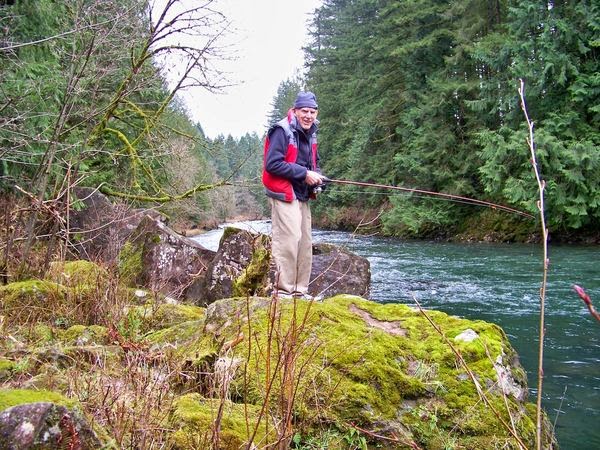 |
| George Fullerton today catching Steelheads pictures were provided to the Oregonian by Fullerton's daughter Candace Spiro |
The following week on June 3, 1946 in the State AAU meet in Portland, Fullerton hooked up with Oregon State runner Dick Petterson. Fullerton set the pace and led the race right down to the last straight when Petterson blew by him to win in 4:19 in a PR time, but when the second place timers checked their watches, they read 4:20.5 for the kid. That was 0.7 seconds under Zamperini's record. Fullerton was greeted by a brass band when he got home to Ashland. And though his high school coach filed with the National Federation of State High School Athletic Associations (NFSHSAA) for ratification, it was never granted because of the meet being run in "open" competition. Even though Fullerton did all the pace setting work, he did not get credit for the record. The complete story can be read in The Oregonian, Dec. 9, 2014, written by Keith Sharon. Fullerton still lives in the Northwest, in Vancouver, Washington.
Those three weeks of miling got George Fullerton all the attention in the world from college recruiters, and he chose Oregon State to seek his fortune on the cinders. Unfortunately a foot injury early in his Freshman year at OSU ended his running career. He got his degree , served time in the army and came home to teach physical education and coach track and field, eventually retiring from Clark Community College.
Having read this piece about Fullerton, and wondering if others may have lost national records to the stilted rulings of a national organization of old boy administrators, I started googling for more info and was amazed to learn about the way national scholastic records are rejected or accepted. This is nothing new to serious track and field statisticians, but to the guy less possessed of that mindset, it is a very different world to discover. I won't go too deep into this because it is a bit confusing as there are several bodies who look at records and treat them in different ways for instance Track and Field News and NFSHSAA or whatever monnicker they are using today. I will give you a link to a discussion on the Track and Field website that is much more definitive than where I'm prepared to go with this report.
But you are probably wondering about the title of this piece, A Tale of Two Miles. What is the second mile? This one's a real whodunnit that was uncovered by Dave Johnson in 2007 reporting for Track and Field News on their digital website.
Rudi Simms and the First Sub 4:20 High School Mile
In 1943, Rudi Simms ran 4:18.2 to break Chesley Unruh's 4:20.2 mile record set in 1925. Unruh was also in an 'open' race. The record would not be broken again until Deacon Jones ran 4:17.8 in 1954. Wow, this takes Zamperini out of the picture in the list of high school mile record holders. Or does it? It all depends on whose definition of high school record holders you care to acknowledge. Simms and Unruh would fall under the banner of: as long as you are under 20 years old at the time, and you have run the race no later than August 31 of the year of your graduation, we don't care who was in the race, whether it was only high schoolers or whether there were at least 4 schools in the event and, on and on. By the more conservative definition, Jim Ryun and Lukas Verzbicas would be the only two high schoolers to meet those rules for sub 4 minute miles in high school. Alan Webb, Tim Danielson, and Marty Liquori would not be on the list because their miles did not meet the conservative definition. Readers please correct me if I'm wrong on this last statement. A great and detailed discussion of these rules and the progression lists of best high school milers can be found at
http://trackandfieldnews.com/discussion/showthread.php?113390-High-School-Mile-Record-Holders-since-1930/page2
Keep in mind this is a 3 page discussion that you must flip through to get all the details. And it was done in 2005 before Dave Johnson's discovery of the Rudy Simms story. Also note that Glenn Cunningham does not get on to some peoples' list , because he was 20 years old his senior year in high school although he was within the rules of the state of Kansas high schools on age allowed to compete.
But back to Rudi Simms. He had just graduated from DeWitt Clinton High School in the Bronx where twenty years later world class shot putter Gary Gubner would compete. Simms' 4:18.2 was run in the Metropolitan AAU meet at Triborough Stadium on Randall's Island, an " open" race where he finished third to Bill Hulse former NYU runner (4:15.9) and Fred Wilt (NT). Simms and Hulse carried the New York Pioneer Cub colors that day. Dave Johnson's impeccable research would confirm Simms' birth date as Feb. 9, 1925 making him 18 years old on that day. Also of note at that meet was a 174' 10 1/8" discus throw by Hugh Cannon former BYU athlete competing for the US Navy. This bettered the listed WR held by Willi Schroder of Germany (1935) but slightly less than the pending WR of Adolpho Consolini at 175' set in 1941.
Earlier in his career Simms was credited with a 1:59.8 half mile his junior year. His credentials also included an anchor leg on the DeWitt Clinton winning distance medley relay (1 7/8 miles) at the Penn Relays. In May 1943 he had a 4:31.1 mile in the PSAL meet and on June 2, 1943 ran a 4:25.8 putting him 3rd on the annual national list behind Roland Sink (South Pasadena, CA) 4:21.4 and Jack Corridan from (Wiley HS, Terre Haute, IN) 4:24.4. (see brief bios of Corridan and Sink at end of this piece)
But there is more. The rest of Simms' life is one of mystery and perhaps American tragedy. First, Simms 4:18.2 proved to be no fluke as he ran a 4:01.4 1500 meters finishing second in the AAU junior meet in 1943. Simms is listed as Rudolph Gordon Simms in NYU's records , competing for the Violets in 1944-45 (a sixth place finish in 28:55 in the IC4A cross country meet in 1944 in Van Cortland Park) and winning the IC4A mile in 1945. But after that Rudy Simms fell almost completely off the radar. There is only a brief mention of a comeback attempt after the war in the Amsterdam News.
In 1971 there is a story of the death of a Rudy Simms at the hands of a white policeman's bullet during a racial incident in the Bedford Stuyvesant district of New York. The deceased was listed as 45-50 years of age. But it has not been confirmed this person is the same Rudolph Gordon Simms of our story.
So Dave Johnson's research confirmed the 4:18.2 to be legit, as Simms was not over age and for Simms to have become a "new if unknown-at-the-time national high school record holder in the mile".
Johnson continues, " The remainder of the story is unknown, and filled with question marks. Apart from the postwar comeback attempt little is known of Simms after he left NYU following a win in the '45 IC4A mile. Did he leave to join the war effort? Was he just not a good student? Had he fallen onto hard times? And is he the same person who died in a '71 racial incident?" And what is the definition of a 'racial incident' in 1971?
Roland Sink was AAU mile champion in 1945 and placed third in the 1,500 at the 1948 NCAAs. He competed for USC and the Los Angeles AC.
Personal Bests: 1500 – 3:52.7 (1948); Mile – 4:12.6 (1948). He competed in the 1948 Olympics in London and was eliminated in the opening heat of the 1500 meters.
Mr. Sink also was a middle school teacher of one of our most loyal readers, Pete Brown.
Mr. Sink also was a middle school teacher of one of our most loyal readers, Pete Brown.
 |
The site of "red-headed" Jack Corridan running daily to and from his home on Crawford Street in Terre Haute, to St Patrick’s Elementary School was common. When he entered Wiley High School, he traveled the same route only more than a half mile farther. Corridan put that experience to work in high school, finishing second in the mile run in 1942 and winning the Indiana state meet in the event with a record time of 4:24.4 in 1943. That time bettered the existing mark by nearly two full seconds. Corridan’s record stood for 6 years.
Corridan earned a track scholarship to Georgia Tech but his collegiate career was interrupted by service in World War II. When he returned to school he ran the 400-meter hurdles in addition to the distance events.
Corridan was so modest and unassuming that he did not share his many athletic successes with his children. Jack Corridan died in Blairsville, Ga., age 80, in February of 2005.
|
Sunday, December 7, 2014
v.4 N. 93 Marilyn Monroe Set an Early Pace for Women's Running
The following piece came from the Penn State Alumni Track Blog written by David Baskwill.
A few days ago I sent him the address of a blog from England with a picture of Marilyn Monroe doing a morning run which apparently was a regular thing with her when she was young. Since most of our readers know who Marilyn was, I won't go into detail about her life and career. Many of you probably kept that one issue of her in Playboy between the mattress and the bed frame where your mother would never find it. It was the first issue of Playboy in 1953. Mint condition copies are going for $1000.00 on ebay. Of course if you still have your personal copy, I doubt it is in mint condition. Somehow David turns the initial idea into a short treatise on two a days and overcoming a genetically challenged high school coach. I've added a few more pics of Marilyn working out. I think most of you will find some value. By the way the Penn State track alum blog should be on all of your reading lists.
http://psutafalumnigolf.blogspot.ca/
Really great reading by a lot of their alums. Don't be fooled by the reference to 'golf', it's a cover for their annual track alum golf tournament.


A few days ago I sent him the address of a blog from England with a picture of Marilyn Monroe doing a morning run which apparently was a regular thing with her when she was young. Since most of our readers know who Marilyn was, I won't go into detail about her life and career. Many of you probably kept that one issue of her in Playboy between the mattress and the bed frame where your mother would never find it. It was the first issue of Playboy in 1953. Mint condition copies are going for $1000.00 on ebay. Of course if you still have your personal copy, I doubt it is in mint condition. Somehow David turns the initial idea into a short treatise on two a days and overcoming a genetically challenged high school coach. I've added a few more pics of Marilyn working out. I think most of you will find some value. By the way the Penn State track alum blog should be on all of your reading lists.
http://psutafalumnigolf.blogspot.ca/
Really great reading by a lot of their alums. Don't be fooled by the reference to 'golf', it's a cover for their annual track alum golf tournament.
Norma Jean Always Did Her Morning Run
The only reason I ever was allowed to walk on to the Nittany Lion team back in 1977 (Again, "Thanks Coach!") was a decision I made half way through 1975. I'm not sure where it came from really, as there was little in the way of literature then. Running World and its authors may have actually stimulated my "unique" idea to get better at running following the collapse of my basketball career.
I'm talking about the decision to do "2-a-days", of course. I had a somewhat rigid schedule during the school year of 3 miles at 6:00am on Monday, Wednesday and Friday, and 5 miles at 5:45am on Tuesday and Thursday. That counted even days with cross country or track races in the afternoon. Saturdays were usually just one run, but often 2 anyway. Sundays were long run day in homage to whoever first dreamed that up. While this only added 19 miles to my weekly totals (60-70 miles being my norm with the mornings, with several 100's thrown in sporadically), it added an edge to my psyche. I honestly figured this should mean I should beat everyone I came up against, as I knew no one else was doing it. At least in my limited little world.
And it was true. I did lose a few XC races that Senior year, even to a teammate at first. But half-way into the season, I made an error by ignoring my coach's orders and setting a course record in winning my first XC race ever. We had been asked to run as a group, in order to help the slower runners run faster and theoretically score better as a result. The team had a vote and unanimously voted to suspend me for the next meet, where I had to run as a JV runner, starting a minute after the real race.
I was quite pissed, but realized there was no changing things on a team I alienated during the summer by not smoking marijuana at the Shrine of St. Mary with everyone else at Summer Camp at Mount Saint Mary's. (Still haven't, by the way. Thank Goodness, I have no need for that kind of stuff.)
The day of the JV race came, and I ran with an abandon I had never had before starting the "2-a-days" and I won the whole race despite starting a minute behind everyone else. I figured I was running more than anyone, therefore I should be beating those who were running less. I still say twice a day runs are the most important thing anyone can do to improve at running. And the "easiest". Science backs me up.
As did Coach Groves! (Harry Groves, long time Penn State iconic coach ed.)
Morning runs were a big part of the adjustment to college distance running for everyone at PSU. Even though I was doing it regularly before I arrived, it was still a big adjustment. Looking back, it is obvious that those with the best resumes took this seriously. I refer to the morning routines of my Freshman Captains Bruce Baden andJohn Zeigler especially.
I was still pretty religious about morning runs the first 2 years, and only shirked a little Junior year too. My "career" happened to mirror my morning ritual. Take note, youngsters!
So when I was tipped off to a very unique photo by our best Canadian friend and Drone Fuhrer, all of this morning run stuff came pouring back into my consciousness.
Yes, everyone in the PSU Track Alumni Golfing Universe, Norma Jean once had a morning run ritual to compliment her other health and fitness routine. The more I learn about her early life, the more I like her. The lousy bastards that ruined her (including Joe DiMaggio) robbed us of so much more.
This picture is from the blog Go Feet.
I'm talking about the decision to do "2-a-days", of course. I had a somewhat rigid schedule during the school year of 3 miles at 6:00am on Monday, Wednesday and Friday, and 5 miles at 5:45am on Tuesday and Thursday. That counted even days with cross country or track races in the afternoon. Saturdays were usually just one run, but often 2 anyway. Sundays were long run day in homage to whoever first dreamed that up. While this only added 19 miles to my weekly totals (60-70 miles being my norm with the mornings, with several 100's thrown in sporadically), it added an edge to my psyche. I honestly figured this should mean I should beat everyone I came up against, as I knew no one else was doing it. At least in my limited little world.
And it was true. I did lose a few XC races that Senior year, even to a teammate at first. But half-way into the season, I made an error by ignoring my coach's orders and setting a course record in winning my first XC race ever. We had been asked to run as a group, in order to help the slower runners run faster and theoretically score better as a result. The team had a vote and unanimously voted to suspend me for the next meet, where I had to run as a JV runner, starting a minute after the real race.
I was quite pissed, but realized there was no changing things on a team I alienated during the summer by not smoking marijuana at the Shrine of St. Mary with everyone else at Summer Camp at Mount Saint Mary's. (Still haven't, by the way. Thank Goodness, I have no need for that kind of stuff.)
The day of the JV race came, and I ran with an abandon I had never had before starting the "2-a-days" and I won the whole race despite starting a minute behind everyone else. I figured I was running more than anyone, therefore I should be beating those who were running less. I still say twice a day runs are the most important thing anyone can do to improve at running. And the "easiest". Science backs me up.
As did Coach Groves! (Harry Groves, long time Penn State iconic coach ed.)
Morning runs were a big part of the adjustment to college distance running for everyone at PSU. Even though I was doing it regularly before I arrived, it was still a big adjustment. Looking back, it is obvious that those with the best resumes took this seriously. I refer to the morning routines of my Freshman Captains Bruce Baden andJohn Zeigler especially.
I was still pretty religious about morning runs the first 2 years, and only shirked a little Junior year too. My "career" happened to mirror my morning ritual. Take note, youngsters!
So when I was tipped off to a very unique photo by our best Canadian friend and Drone Fuhrer, all of this morning run stuff came pouring back into my consciousness.
Yes, everyone in the PSU Track Alumni Golfing Universe, Norma Jean once had a morning run ritual to compliment her other health and fitness routine. The more I learn about her early life, the more I like her. The lousy bastards that ruined her (including Joe DiMaggio) robbed us of so much more.
 |
| Marilyn Monroe on a morning run in 1951. |
'
This of course may remind you of Ernst Van Aaken's timeless question.
"Do they run because they are beautiful, or are they beautiful, because they run?"
George: Only thing I have left is MORNING RUNS. after a midnight midnight snack of trail mix black liquorice and cranberry juice. Phil Scott
Today I learned that Elvis played the piano then I learned that Marilyn Monroe was a runner. It's only 3:00 PM 3:00PM , so I feel I have learned enough and could now go to bed. Bill Schnier
Thursday, December 4, 2014
V.4 N. 92 Walk On Nominations
What Is A Walk
On?
Def. Someone who gives a track coach a lot of satisfaction without costing a dime. Taken from the
Once Upon a Time in the Vest Dictionary of Concise Thought, Irrational and Irreverent Opinion.
Once Upon a Time in the Vest Dictionary of Concise Thought, Irrational and Irreverent Opinion.
Without having fully defined the meaning of Walk On we've received mentions of
several varieties all of which might fit into someone's definition. In
my mind I was thinking a Walk On at an American university athletic team would
be someone who presents herself or himself to the coach and by past
history or present initiative is allowed onto the team without
costing the coach any funds from the track budget other than taking a physical, filling in NCAA paperwork, and consuming a few
bits and pieces of equipment , and maybe having a locker. But I also realize there may be other opinions as to what constitutes a walk on. If an athlete quits a team and joins another at the same school , is that a walk on, or if a football player wishes to dodge Spring football by coming out for track is that a walk on? Some have completed Spring football , then come over to the track team for the last few meets of the track season. Anyway , this is just an exercise not a definitive decision about walk ons. However it has brought out more responses from readers than any previous request for your input.
In the British Commonwealth , every athlete might be considered a Walk On , because athletic scholarships aren't given to anyone, in fact readers from other countries probably have no idea what we are talking about. Then too our own Ivy League schools (Dartmouth, Harvard, Brown, Princeton, Cornell, Yale, Penn) supposedly do not offer athletic scholarships, but they certainly do some recruiting to get good athletes into their programs. Some of you might disqualify a person from being a walk on if a coach sent a letter of encouragement or made a phone call , or an electronic communication. I tend to discount that aspect, but if someone wants to come up here to Vancouver Island and get into a shouting match with me, they are most welcome, and by the way when you cross the border would you please bring a couple of bottles of duty free wine, a box of Ritz Crackers and some Cheez Whiz? Actually several examples came to us that were completely out of this framework, such as Delano Meriwether, M.D. and Michelline Ostermeyer, but we have chosen to accept them into this exclusive club, because their stories are just so darned interesting. And now, on with the show.
In the British Commonwealth , every athlete might be considered a Walk On , because athletic scholarships aren't given to anyone, in fact readers from other countries probably have no idea what we are talking about. Then too our own Ivy League schools (Dartmouth, Harvard, Brown, Princeton, Cornell, Yale, Penn) supposedly do not offer athletic scholarships, but they certainly do some recruiting to get good athletes into their programs. Some of you might disqualify a person from being a walk on if a coach sent a letter of encouragement or made a phone call , or an electronic communication. I tend to discount that aspect, but if someone wants to come up here to Vancouver Island and get into a shouting match with me, they are most welcome, and by the way when you cross the border would you please bring a couple of bottles of duty free wine, a box of Ritz Crackers and some Cheez Whiz? Actually several examples came to us that were completely out of this framework, such as Delano Meriwether, M.D. and Michelline Ostermeyer, but we have chosen to accept them into this exclusive club, because their stories are just so darned interesting. And now, on with the show.
Our
first nomination came from Gary Wilson University of Minnesota Coach, (ret'd.)
Gabrielle
Anderson of Minnesota. Came in as a 5:05 miler and
ran 4:13 for 1500 as a 6th year senior after two bouts of
cancer.
 |
| Gabrielle Anderson (one l or two l's?) |
 |
| Gabrielle Anderson |
Also
Eileen Donaghy of Minnesota who ran 5:25 for 1600 in
HS. Won the Big Ten CC title as a Junior. Note: Suzy Favor was second
that day.
In
fact she was a walk in. I never recruited her since it was my first
day on the job back in 1985 when she entered my office.
I
am sure there are better stories but those are two of my best.
Hope
you had a great Thanksgiving George.
Wils
Gary's
nomination of Gabrielle Anderson and Eileen Donaghy meet the
'classical' definition of a walk on (in). And by the way, that was a helluva coaching job with both of these athletes, Gary.
Kristin Gaddis
Steve Price, former Bowling Green St. U. Women's Cross Country and Track coach sent this:
For what it's worth : Kristen (nee Gaddis) was third/fourth girl on her Worthington, Ohio cross-country team in the late eighties/early nineties. She was a walk on at BGSU and in 1995 was All-Ohio collegiate champion and part of the team that qualified for the NCAA Championships....making it the first team from the MAC Conference to do so.
Steve Price, former Bowling Green St. U. Women's Cross Country and Track coach sent this:
For what it's worth : Kristen (nee Gaddis) was third/fourth girl on her Worthington, Ohio cross-country team in the late eighties/early nineties. She was a walk on at BGSU and in 1995 was All-Ohio collegiate champion and part of the team that qualified for the NCAA Championships....making it the first team from the MAC Conference to do so.
Dixon
Farmer sent this one in:
A
nomination for Chuck
Smith,
Occidental '70.......Won College Division 100/200 in 9.4/20.7 in 1st
year of running. Was a swimmer at LACC (Los Angeles Community College). Made 1972 Olympic team after
winning FOT 200. 5th in Munich 200 final.
Chuck
Smith
Definitely
a winner and member of our all walk on team.
Here's what Sports-Reference has on Chuck Smith
Here's what Sports-Reference has on Chuck Smith
Charles Kenneth "Chuck" Smith
Height: 6-1 (186 cm)
Weight: 176 lbs (80 kg)
Born: March 12, 1949 (Age 65.261) in Chicago, Illinois, United States
Affiliations: Southern California Striders, Anaheim (USA)
Height: 6-1 (186 cm)
Weight: 176 lbs (80 kg)
Born: March 12, 1949 (Age 65.261) in Chicago, Illinois, United States
Affiliations: Southern California Striders, Anaheim (USA)
Chuck Smith won the AAU 200 in 1972. He also placed sixth in the 1971
AAU and the 1970 NCAA.
Personal Bests: 100y – 9.3 (1971); 100 – 10.2 (1972); 200 – 20.55 (1972).
Munich 200 5th. |

See the Munich 200 at about minute 6 mark in this youtube clip about Valeriy Borzov.
https://www.youtube.com/watch?v=qNdvwbbws6o
https://www.youtube.com/watch?v=qNdvwbbws6o
DELANO MERIWETHER, M.D.
Bob
Roncker Cincinnati Running Store proprietor (ret'd.), U. of Cincinnati athlete, Xavier U..coach, and state runner up in Ohio High School cross country, Elder HS (1960) just
wrote:
"Here's
my response. However, he was not a walk on to an educational
institution. I am referring to Dr. Delano Meriwether. He did
not participate in track in either high school or college. As I
recall the report in Track and Field News or another
source, he was watching a track meet on TV and said that he
could do that.
that.
that.
He
started sprinting and was an immediate success. He was national
outdoor 100 champion in 1971 and the indoor sprint champion in 1972.
He received additional recognition for his unusual attire –
hospital scrubs, suspenders, and swimsuit."
Wikipedia posts the following about his career:
Wikipedia posts the following about his career:
Here is a refresher on Dr. Meriwether's running career, although his professional career is even more extraordinary, including graduating from pre-,med at Michigan State in three years, being the first African American accepted into Duke Medical School, serving as a physician in South Africa under the apartheid regime, and his achievements in medicine just continue on and on.
Meriwether began competitive running in 1970 while working at the Baltimore Cancer Research Center. In order to train Meriwether would scale a fence at the nearby Johns Hopkins University athletics track and would run at night in the dark.[13] Due to his relative inexperience and unique attire, Meriwether drew the attention of the news media; appearing on the cover of Sports Illustrated magazine posing in his running gear,[2] and also featured in Time magazine.[9]
Meriwether made his mark as a runner at the Amateur Athletic Union USA Outdoor Track and Field Championships in Eugene, Oregon in June 1971 when he won the 100 yard dash.[2] His appearance at the event was unusual for a number of reasons. He was unattached to any educational institution and he was wearing a hospital shirt, gold and white suspenders and swimming trunks. The most remarkable element of the day was the time he recorded for the 100 yard dash. In recording a nine second 100 yard he became the second runner to run the distance in nine seconds flat, the other being John Carlos, however Meriwether's time did not count as a record as the run was wind assisted.[6][9][10][21]
In 1972 Meriwether was the United States Indoor Track and Field Champion,[22] but due to a knee injury he was unable to compete for selection for the United States 1972 Olympic Games team. After another injury prevented his chances of being selected for the 1976 Olympics, he retired from regular competition to concentrate on medicine.[18]
For a number of years he ran in masters events and his 200 meter run of 20.8 seconds in 1978 is still a current national record in the 35-39 age group. Wikipedia
JANE RAMIG BROOKER
George,
Jane Brooker was a cheerleader at Cedarville College. She decided to go out for track and became rather good at the 800. Jane was a NAIA All-American and the first female (from Cedarville?) inducted into the NAIA Hall of Fame. In 1994 she ran 2:01.13 at the National Championships in Knoxville.
Bob Roncker
G.P.
Williams just sent this from Victoria, British Columbia
Hi George.
Interesting topic. As I have no background or much knowledge of
US college track my example is probably not what you are looking for
but might form a basis for another area of research.
I go back to
the years following the Second World War to a French lady called
Micheline Ostermeyer. There is good coverage of her in
Wikipedia and it seems that she was a type of "walk-on" in
the way she got into track after being a concert pianist as a child
and young adult. I saw her in about 1950 at the White City and
recall being impressed by her dual life. Hope you can use this
in some way.
Regards.
Hey, this demoisselle has quite a story according to Wikipedia
Michelline Ostermeyer
A great-niece of the French author Victor Hugo, and a niece of the composer Lucien Paroche, Ostermeyer was born in Rang-du-Fliers, Pas-de-Calais. At the insistence of her mother, she began learning piano at the age of 4, and at 14 she left her family's home in Tunisia to attend the Conservatoire de Paris. After the outbreak of World War II, she moved back to Tunisia where she performed a weekly half-hour piano recital on Radio Tunis.
It was during her return stay in Tunisia that Ostermeyer began participating in sports, competing in basketball and track and field events. After the war, she continued her participation in athletics while resuming her education at the Conservatoire. She competed in a range of contests, eventually winning 13 French titles in running, throwing and jumping events. In 1946, she placed second in the shot put at the European Athletics Championship in Oslo, as well as winning the Prix Premier at the Conservatoire.[2]


The 1948 Summer Olympics were Ostermeyer's finest hour as an athlete. She won gold medals in the shot put and discus throw (despite having picked up a discus for the first time just a few weeks before the event), and a bronze medal in the high jump.[1] She thus became the first Frenchwoman to win three medals in a single summer or winter Olympic Games. Her performance was only overshadowed by that of Fanny Blankers-Koen, who won four gold medals at the same Olympics.[2] After winning the shot put, she concluded the day with an impromptu performance of a Beethoven concert at her team's headquarters.
She retired from sports in 1950 after having won two bronze medals at that year's European Championships, and continued to pursue a career in music. Her athletic prowess damaged her reputation as a concert pianist, however, and she even avoided playing anything composed by Franz Liszt for six years because she considered him too "sportif".[2] She toured for fifteen years before personal commitments, including the death of her husband, led her to take a teaching job, a post she held until her retirement in the early 1980s. In her final years she emerged from retirement to give a series of concerts in both France and Switzerland before her death in Bois-Guillaume.
https://www.youtube.com/watch?v=Q5ZiGuImp-4
LOWELL PAUL
John
Lawson U. of Kansas 1966 and former NCAA XC champion sent us
this:
Lowell
Paul ran
as a walk-on for Kansas University from 1963 to 1966. Lowell ran on
every relay from the 440 to the 4 mile relay. He was primarily an 880
runner but had speed as well as distance abilities. Lowell was a
straight A student and went on to run for the Chicago Track Club
after graduation. He was from Colby, Kansas.
 |
| Lowell Paul and Dave Wottle laying some hurt on each other. This photo appeared in the New York Times a few years ago misidentifying Lowell as Rick Wohlhutter. Lowell's daughter set them straight very quickly. |
John,
Thanks
for responding. Lowell definitely makes the team.
I remember running in several relays at Texas and Kansas against him.
Talked to him several years ago by phone. Really nice guy and
doing good work serving the poor in Legal Aid in Lawerence and Topeka area. He ran for the U. of Chicago Track Club in the Rick Wohlhutter era and had a 1:46+ 880 PR. Also his son turned in some very good times a few years ago.
George,
glad you remember Lowell and have had contact with him in more recent
years. I remember he was one of the first runners to grow a long
beard while running for Chicago Track Club. Pretty sure he was in
Grad school at U of Chicago. Yeah, he was a very nice, quiet guy.
John
DON HOELTING
Hello. My friend and team mate at Mizzou, Don Hoelting, was a 4:32 high school miler, (Duchense H.S., St. Charles, MO) and walk on. By his senior year he was 4th/5th man on our Big 8 XC championship team, 6th place team NCAA XC championships, and in the spring of 1971, as a senior, ran 13:38-39 three mile on the track. Were you within about 15 yards of him in the last 300 you were doomed; he had a vicious, vicious kick! Kerry
As
I recall in our phone conversation, Lowell said that when he was at
U. of Chicago Law School, they had an exchange program in Germany
that he attended and got a nice stipend from the U. of Chicago and
spent a lot of time running in meets in Europe. That might throw
him into the track scholarship category, but what the heck, he had
already used up his NCAA eligibility. George
DAVID PAYNE
Bill
Schnier U. of Cincinnati Track Coach (ret'd.) wrote:
I
don't know the best walk-ons or who was even a walk-on, but I
nominate David
Payne.
He goofed up his senior year in HS and was academically ineligible,
so he attended UC his first year but could not practice or compete.
The next year he joined our team, but only as a walk-on. He was
on scholarship his third year in college and after that he was a
two-time All-American before winning the silver medal at Beijing for
the 110 Hurdles following graduation, 13.02.


LEWIS JOHNSON
My second-best walk on was Lewis Johnson (now announcing the big track and field meets for television) who dropped out of track for two years after running 51.5 in HS. He then ran the 400 for two years, about 48.8 before switching to the 800 M. where he ran 1:47.00 and placed 8th in the NCAA Div. I meet at LSU in 1987.
 |
| Lewis Johnson on the Job |
Bill
CHRIS WINEBERG
Filbert Bayi
Here's a Walk In story from J.D. Martin who coached over 35 years at U. of Oklahoma.
JULY 2005
Last year after picking up the current OU Track and Field media guide, I was browsing through the list of former letterwinners. Up came the name of Filbert Bayi in the late 70's. Filbert Bayi was one of the premier milers in the world and had once held the world record in that event. Then I see that he earned a letter at OU years after setting the record. This had to be an interesting story and certainly J.D. was the man to provide background. How did he get to OU, how many Mercedes did J.D. have to buy him, how's come he didn't retake the mile record with J.D.'s coaching? Like any newsman, you go to the source. So here's J.D.'s reply.

 George, here's the poop on Filbert.
It starts with me hiring a distance coach from Eastern New Mexico named Bill Silverberg.
He had a reputation of getting Kenyans and other foreign runners.
Anyway, after he was with me for awhile he asked what travel agency we used to fly kids to school. I told him none, as that is a NCAA violation. He wanted to know how I expected him to bring athletes here from Kenya or Tanzania. That was my first clue that he had his own ways of playing the game and he scared me to death.
Later that year Kenyan's began showing up on campus. Most could not get into school
and were sent along to JR. Colleges. One young 18 year old ran for a couple of years but didn't make much of an impact.
But one day out of the blue and a surprise to Silverberg, Filbert walked into our office.
He knew Silverberg and had heard that he was recruiting for us. He just decided to
come over and see if he could go to school and run for us. All legit.
He ran cross country for us but had some injury problems and was never able to perform
up to his abilities. After one semester he decided to transfer to UTEP where most of his
buddies were and the climate was more like home.
One day later I get a call from a local travel agency wanting to know when we were going to pay the bill for the flights from Africa......(not Filbert)
After getting up off the floor Silverberg and I had a little discussion about him working somewhere else and told him he had a large bill at the travel agency.
He moved on and I don't know if the bill was ever paid.
Filbert was as great person. It is a shame he didn't stay longer and get healthy.
That is the Filbert Bayi story.
Some of you distance runners may remember Bill Silverberg as a pretty good steeplechaser when he ran at Kansas.
JOHN GUTKNECHT AND QUENTIN BRELSFORD
CHRIS WINEBERG
 |
| Chris Wineberg |
George,
I would like to add another quaity walk-on, Chris Wineberg of the University of Cincinnati. As a 51.3, 13' 6" athlete from Springfield Northeastern HS, Chris came to UC as a walk-on, later earning a scholarship. His best event was the decathlon where he scored 7584 (2004), still our school record. He was an All-American, 8th in the NCAA decathlon in 2004 and helped UC to a C-USA championship that same year as well as an undefeated season in all team-scored meets. In the C-USA meet he did the following: decathlon (1st, 7296), pole vault (3rd, 16' 4-3/4").
Chris's college top marks are: 7584 (Dec), 5616 (Heo), 10.94, 22.14, 48.87, 46.9 (R), 4:38.67, 15.54, 23' 10-1/4", 6' 4", 17' 3/4", 44' 3-1/4" (SP), 185' 1" (Jav), 128' 5" (D).
Bill
Filbert Bayi
Here's a Walk In story from J.D. Martin who coached over 35 years at U. of Oklahoma.
JULY 2005
Last year after picking up the current OU Track and Field media guide, I was browsing through the list of former letterwinners. Up came the name of Filbert Bayi in the late 70's. Filbert Bayi was one of the premier milers in the world and had once held the world record in that event. Then I see that he earned a letter at OU years after setting the record. This had to be an interesting story and certainly J.D. was the man to provide background. How did he get to OU, how many Mercedes did J.D. have to buy him, how's come he didn't retake the mile record with J.D.'s coaching? Like any newsman, you go to the source. So here's J.D.'s reply.
It starts with me hiring a distance coach from Eastern New Mexico named Bill Silverberg.
He had a reputation of getting Kenyans and other foreign runners.
Anyway, after he was with me for awhile he asked what travel agency we used to fly kids to school. I told him none, as that is a NCAA violation. He wanted to know how I expected him to bring athletes here from Kenya or Tanzania. That was my first clue that he had his own ways of playing the game and he scared me to death.
Later that year Kenyan's began showing up on campus. Most could not get into school
and were sent along to JR. Colleges. One young 18 year old ran for a couple of years but didn't make much of an impact.
But one day out of the blue and a surprise to Silverberg, Filbert walked into our office.
He knew Silverberg and had heard that he was recruiting for us. He just decided to
come over and see if he could go to school and run for us. All legit.
He ran cross country for us but had some injury problems and was never able to perform
up to his abilities. After one semester he decided to transfer to UTEP where most of his
buddies were and the climate was more like home.
One day later I get a call from a local travel agency wanting to know when we were going to pay the bill for the flights from Africa......(not Filbert)
After getting up off the floor Silverberg and I had a little discussion about him working somewhere else and told him he had a large bill at the travel agency.
He moved on and I don't know if the bill was ever paid.
Filbert was as great person. It is a shame he didn't stay longer and get healthy.
That is the Filbert Bayi story.
JOHN GUTKNECHT AND QUENTIN BRELSFORD
 |
| Quentin Brelsford Ohio Wesleyan U.. winning the 1946 NCAA Cross Country Meet against the big boys |
JIM ALLEN AND JEFF ALLEN
We've recently been in contact with Jim Allen (Washington State) and from this email it seems that he more than deserves to be on the all walk on team. Here's his credentials:
Interesting project. I suspect some of the best "track walk-ons" could have been football players on scholarship seeking to avoid Spring Ball by turning out for track. In the early to mid 60's, Mel Renfro at Oregon and Henry Carr at Arizona State come to mind.
I was a walk-on at Washington State University in 1960. Thought it was a good way to satisfy my semester PE class requirement. Three years later (1963) I was Bronze Medalist in the 440 yard intermediate hurdles at the NCAA Championships at Albuquerque and awarded All-American status by the NCAA. A week later I was Silver Medalist in the same event at the AAU National Championships in St. Louis and selected to the USA Team as one of the two intermediate hurdlers that travelled to Europe to compete against the National Teams of Russia, Poland, Germany and Great Britain/Northern Ireland.
I was also Conference Champion (what is now the Pac 12 Conference) in the Intermediate Hurdles in 1964.
Might be worth an honorable mention.
Regards,
Jim Allen
Jim: This is much better than honorable mention. Furthermore I think that your son Jeff Allen deserves a place on the team. He played football at Stanford but had been 300IH state champ in Washington.. He told me he came out for track under Vin Lannana about his junior or senior year and filled in on relays for a season or two, and when one of their 4x400 guys was unable to run in the finals at the NCAA championships he moved in and ran a sub 47 leg, the team scored points and he made All American, so you guys are the only father-son combo on our list. Can anyone confirm Mel Renfro and Henry Carr's walk on status? George
OTIS DAVIS

Rick Lower suggested that Otis Davis should be considered a walk on.
Otis Davis transferred over from basketball at U. of Oregon to the track program and went on to win the Olympic 400 meters in Rome in World Record time in only the tenth 400m of his career.
the following from wikipedia
at the age of 28, Davis made the U.S. Olympic team. He ran his fastest time to date one week before participating in the 1960 Summer Olympics in Rome as one of the oldest members of the track team, where he was nicknamed "Pops" by his teammates. According to Davis, "I was still learning how to turn with the staggered starts and all. I was still learning the strategy involved. I was still learning how to run in the lanes." Wiki also relates that on his first day on the track he high jumped 6'0' and long jumped over 23'. Won the PCC meet that year in the 220 and 440. No info whether he was on an athletic scholarship coming from basketball to track, but it is likely his being a four year Air Force veteran, he was probably getting G.I. Bill money and it cost neither the basketball program nor the track program very much if anything.
JOHN BORK
George:
I'd have to say that I consider my self a walk on.
My high school Coach, Bob Epskamp introduced me to the idea of going to Western Michigan.
My. teammate, Art Eversole, was also from Monroe and enrolled at WMU a year before me.
(Art was 3rd. in the NCAA XC in 1959 at Mich. State.)
I never received a phone call or letter from George Dales, but, when I arrived at WMU, he knew that I was coming
and arranged for a room Job and a State Board Scholarship for Teachers- to cover tuition.
(I got a form letter in the mail from U of M but nothing else.
The picture of the track team on the flyer looked like it was out of the 1940's or something.
I didn't have the foggiest about college recruiting, etc. so, I was an easy "recruit" for Coach Dales.
John, it doesn't look like anything came out of the track budget. John went on to win the NCAA Amazing how things worked back in the day before there were recruiting rules. When I was recruited at Oklahoma, Coach Bill Carroll came to Dayton and took my family to dinner and said there was a scholarship for me. No papers signed, no nothing. I showed up at the campus a year later and went to school. Offer and acceptance were totally verbal. Ed.
BILL BLEWETT
 |
| Bill Blewett on the pole with some fairly illustrious company |
Just as I was ready to do this posting, Bill Blewett's name came to mind. Bill is not exactly a household name in track and field, but his story certainly is a good example of a classic walk on. Bill was from Lawton OK and never broke 5:00 minutes for a mile in high school yet his shop teacher Dee Givens frequently talked about his years of running at OU. He was a 9.3 100 yard sprinter and made the Olympic Trials finals in 1960. Bill came out for cross country his freshman year at OU and broke 5:00 minutes three times in his first workout there. He went on to run a sub 4:10 mile while at OU and sub 14:00 three mile after graduation.
BOB SCHUL
And now for our last but by no means least , member nominee for great walk ons in university sports or otherwise. Bob Schul, Olympic Champion , 5000 meters, 1964.

In Bob's autobiography, "In the Long Run" he recounts that he did not go to college straight out of high school. He instead worked for a year in a factory in Dayton, Ohio. The following season he enrolled at Miami University and showed up at cross country practice. Coach George Rider recognized him as having been a decent high school runner (4:34 mile) and welcomed him to the team. Whether he got any assistance that Fall for cross county is not mentioned in the book, but until that is disputed, Bob will be on the list.
So his is our first list of extraordinary individuals who might be called 'walk ons' to track and field
Gabrielle Anderson Minnesota
Eileen Donaghy Minnesota
Kristin Gaddis Bowling Green
Lowell Paul Kansas
Bob Schul Miami of Ohio
Lewis Johnson Cincinnati
David Payne Cincinnati
Chris Wineberg Cincinnati
John Gutknecht Ohio Wesleyan
Quentin Brelsford Ohio Wesleyan
John Bork Western Michigan
Don Hoelting Missouri
Henry Carr* Arizona State
Mel Renfro* Oregon
*under consideration
Special Category "I didn't recruit him but he came anyway and I gave him a scholarship"
Filbert Bayi U. of Oklahoma
Special Category "father and son"
Jim Allen Washington State
Jeff Allen Stanford
Special Category "I never did this before"
Michelline Ostermeyer Conservatoire de Paris (concert pianist)
Chuck Smith Occidental (swimmer)
Dr. Delano Meriwether Michigan State, Duke Medical School (academic/medical doctor)
Jane Ramig Brooker Cedarville University (cheerleader)
Otis Davis U. of Oregon (basketball)
Don't let this list remain static; send your additions and anecdotes in to irathermediate@gmail.com or add in to the comments at the end of this article.
Gabrielle Anderson Minnesota
Eileen Donaghy Minnesota
Kristin Gaddis Bowling Green
Lowell Paul Kansas
Bob Schul Miami of Ohio
Lewis Johnson Cincinnati
David Payne Cincinnati
Chris Wineberg Cincinnati
John Gutknecht Ohio Wesleyan
Quentin Brelsford Ohio Wesleyan
John Bork Western Michigan
Don Hoelting Missouri
Henry Carr* Arizona State
Mel Renfro* Oregon
*under consideration
Special Category "I didn't recruit him but he came anyway and I gave him a scholarship"
Filbert Bayi U. of Oklahoma
Special Category "father and son"
Jim Allen Washington State
Jeff Allen Stanford
Special Category "I never did this before"
Michelline Ostermeyer Conservatoire de Paris (concert pianist)
Chuck Smith Occidental (swimmer)
Dr. Delano Meriwether Michigan State, Duke Medical School (academic/medical doctor)
Jane Ramig Brooker Cedarville University (cheerleader)
Otis Davis U. of Oregon (basketball)
Don't let this list remain static; send your additions and anecdotes in to irathermediate@gmail.com or add in to the comments at the end of this article.
Subscribe to:
Posts (Atom)
V 15 N. 10 Gunder 'The Wunder' Haegg Visits Cincinnati
Bob Roncker of Cincinnati, Ohio has sent in this account of one day on the 1943 tour that Gunder Haegg of Sweden made to the US to help rais...
-
 Noting the passing of Brian Oldfield on March 26, 2017. Oldfield came from Elgin, IL and left the world from that same town. He was 71 y...
 -
 JUNE 1963 The top half of the first page of this issue is devoted to a photo of a powerfully striding Adolph Plummer nearing the finish...