FEBRUARY 1967
How time flies. It is February 1967 already. Let us turn the pages as we go back in time half a century. To show you how complete we are, let's start with January, specifically Wednesday the 26th when the venerable Millrose Games is celebrating its 60th running. Australian steeplechaser Kerry O'Brien has been here only two days but already has created overweight baggage problems for his flight home. The 20 year old O'Brien, already fifth fastest steeplechaser ever, destroys the two mile field in the last quarter mile to win in a meet record 8:39.6, leaving Pat Traynor (8:43.0) and Tony Benson (8:43.8) in his wake. For his efforts he is faced with stuffing his duffle bag with three large trophies, one for winning, another for being selected the meet's outstanding athlete and permanent possession of a “big silver cup for the best time over a three year period”. No, we are not quite sure what that means nor do we see the difference between winning a trophy and being granted permanent possession of one, but we have our best people working on both these issues and will undoubtedly have a clear explanation for you later in this report.
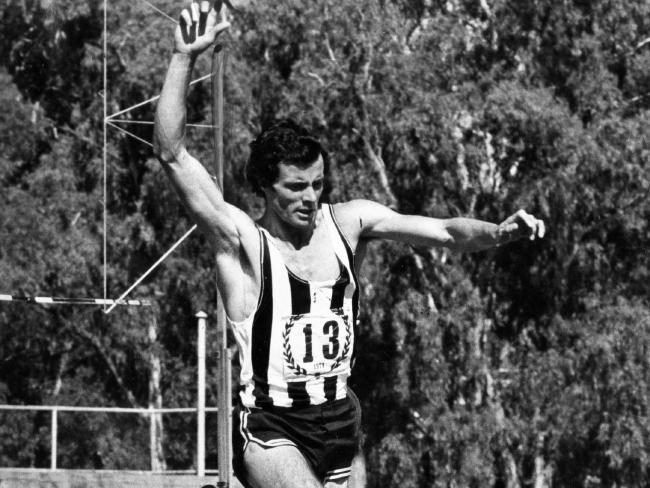 |
| Kerry O'Brien |
Two nights later O'Brien and luggage arrive in Boston for the Boston AA meet. The potential problems on his flight home are exacerbated by winning the two mile, setting a meet record and being awarded another of those cumbersome most outstanding athlete trophies. His 8:38.4 is the fastest in the world this year, but doesn't come easily, as he has to run 58.1 on the final quarter to hold off Tom Laris (8:38.8) by three yards.
O'Brien was not the only one leaving with a seasonal world best. Ricky Urbina blazes 1000 yards in 2:08.1 for that distinction.
The 600 provides a preview of a things to come as Martin McGrady is credited with a “mild upset” for holding off Dave Hemery and Bill Crothers in 1:09.9. Let's keep an eye on this McGrady kid. He may have found his race.
 |
| Judge Ricardo Urbina (ret'd.) Georgetown Track Legend Photo: Washington Post |
The 600 provides a preview of a things to come as Martin McGrady is credited with a “mild upset” for holding off Dave Hemery and Bill Crothers in 1:09.9. Let's keep an eye on this McGrady kid. He may have found his race.
 |
| McGrady appearing on TF&N cover in 1968 beating Lee Evans and Jim Kemp |
On the same night, 3088 miles away in Portland, world indoor shot put record holder Neil Steinhauer puts more distance between him and the accepted gold standard of the event, Randy Matson, when he puts the iron ball 67-10, a spectacular improvement of 15 ¼ inches. Indeed he nearly averages his old record as his six tosses average 66-6 1/8, topping Matson's best average of 65-10 ¼. Apparently there's a new sheriff in town.
 |
| Neil Steinhauer |
Ralph Boston notches his fourth hurdle – long jump double of the season, 7.1 and 25-8 ¼ . Charlie Greene outsprints Harry Jerome and San Jose State teammates Bob Griffin and Tommie Smith, all timed in 6.1.
 |
| Ralph Boston |
Wait, there's more this evening. Travel with us 1362 miles (yes, we love Google maps) Southeast to Albuquerque for the appropriately named Albuquerque JC meet where three world records are set, only one of which is benefitted by the ten lap to the mile track. That would be Theron Lewis' 47.1 440. Wendell Motley's old record of 47.3 is tied by Jim Kemp who is second this evening. Jim Hines of Texas Southern ties the 60 record of 5.9 in a heat before winning the final in 6.0. This is just business as usual, for Hines ran that time twice last week in the NAIA meet.
 |
| Jim Hines |
Bob Seagren pulled a muscle in his back two nights ago in the Millrose Games. Trooper that he is, Seagren not only competes, but takes a shot at his 17-1 world record. Efficiency is his watchword as he takes but three attempts, 16-0, 16-6 and 17-2 for the WR. Thanks for coming, Bob.
 |
| Bob Seagren |
Three world records make for an I-was-there night for any fan, yet the crowd favorite this evening is 17 year old high school kid Jerry Proctor who wins the long jump at 26-2. How good is this? Let us count the ways. He breaks his own high school record of 25-10 ½. His worst jump is 25-5 ¼, equal to the previous best ever HS jump indoors or out (Doyle Steele last year). No aberration this, not only did he jump this distance twice, he had another effort at 26-1¼. Oh, he also beat a pretty good field, Bill Miller, Gayle Hopkins and Bob Beamon. The kid may have a future. Stay tuned.
We would be amiss were we not to mention that the 49er Track Club records the third fastest two mile relay ever, 7:25.6, more significantly the fastest ever on a ten-lap-or-smaller -to-the-mile track. Harry McCalla opens with 1:52.9. Darryl Taylor picks up the pace with a 1:51.4 carry, handing to Tom Von Ruden who sizzles a 1:49.2. Preston Davis finishes with a 1:52.1. Job well done, guys.
 |
| Lindgren and Baillie (photo listed for sale on E Bay) |
The big news the next weekend comes from the west coast. On Feb. 4the Seattle Invitational sees New Zealand's Bill Baillie hanging with state favorite Gerry Lindgren for 20 of the 22 laps of the two mile. At this point Lindgren goes to the afterburners to open a gap of 40 yards at the tape. His 8:31.6 is history's third fastest (Ron Clarke 8:28.8 and Jim Beatty 8:30.8) and heightens track fans' anticipation of his match with Clarke in San Francisco in two weeks. Baillie finishes in 8:37.8. Darryl Horn sets meet records of 25-8 and 51-0 in the horizontal jumps.
The initial San Diego Invitational the same evening plays to a capacity house of 11, 781 with over 2000 turned away. The primary attraction is the matchup between the two big guys in the shot put, indoor world record holder Neil Steinhauer and the holder of the outdoor record, Randy Matson. A month earlier Steinhouer broke the world record in handing Matson his first defeat since the 1964 Olympics. Since then he had increased that mark as reported earlier in this report.


 |
| Matson putting another kind of ball. A little one on one before an indoor meet with Steinhauer and Matson might have sold a few more tickets. |
The magic isn't there for either. Steinhauer pops 66-2¼ on his second toss but Matson is stuck in the 63s until getting 65-4 on his fourth attempt. Steinhauer can't improve, but with Matson throwing only 60-1 on his penultimate effort, he may not have to. With Matson throwing first, the pressure is on the big Texan. He responds with a 66-10½, placing the burden on the Oregon senior. History does not record the length of Suoerduck's response, as he fouls, giving Matson the win and tying the year's indoor series at 1-1.
When he toes the line for the start of the 1000, Tom Von Ruden's best is 2:10.2. Two minutes six and eight tenths of a second later he breasts the tape with the third fastest clocking in indoor history. Only Peter Snell and Bill Crothers had run faster and then just barely at 2:06.0 and 2:06.4.
The USTFF is held on the following Friday, Feb. 10 in New York. As well as San Diegoans supported their meet the previous week, the New Yorkers don't. Only 4409 spectators see Villanova's Dave Patrick blaze a 55.6 final quarter to finish the season's fastest mile, 4:00.6.
The big news on this weekend is produced in consecutive evenings in Texas. On Friday in Fort Worth, Randy Matson destroys, crushes, smashes, demolishes (your turn, you pick a word) Neil Steinhauer's 67-10 shot put record. Not only does he throw an amazing 69-2, his average for six puts is 67-11.
What can he do for an encore the next night in Dallas? Hopefully you are seated. He blasts a 70-7½, a quarter inch beyond his outdoor record. Track and field officials are notorious for nit-picking. They find the throwing area exceeds the maximum slope allowable by, well, it isn't stated, but we bet it isn't much, so it doesn't count as a record. Doesn't matter to Randy who says, “I'm just happy I could do so well, so soon.”
That very night a sell out crowd at the Times Indoor Games sees Ron Clarke run away from Bill Baillie in the last half mile of the two mile to win 8:41.8 to 8:48.2 and Bob Seagren set the pole vault world record....sort of. Yes, the USC sophomore clears 17-3 to break his own record by an inch, only to have the pole go under the crossbar, which no longer is a sin, but back in the day this was sufficient to negate a clearance. Maybe next week, Bob.
This is a memorable evening for track fans as the Mason-Dixon Games are being held on Freedom Hall's spacious 8 lap to the mile track. As the turns on a 220 yard track are less tight that those of the traditional 160 yard 11 laps to the mile tracks, the M-D meet has produced at least one world record every year since 1962. This night is no exception as four WRs fall.
Three weeks ago Theron Lewis broke Wendell Motley's 440 WR with a 47.1 effort in Albuquerque. Tonight Tommie Smith puts that on the ash pile of history with a 46.2 clocking which also displaces Mike Larrabee's 46.8 400 meter record. Tom Von Ruden runs negative splits, 56.5 and 52.5, to shave eight tenths off Tom Farrell's 1:49.8 WR. Inexplicably 8 lap to the mile times are lumped together with 11 lap to the mile times, but apparently a time run on a larger track is not valid for record purposes as the fastest ever indoor time is 1:47.7 by John Woodruff in 1940 on a 263 yard banked track.
Further evidence of the difference between 8 and 11 lap tracks is offered by Southern University's mile relay team. The previous night in New York the Jaguars ran 3:16.7. Tonight they lop 9 tenths off the record they share with Texas Southern at 3:10.2. Neil Steinhauer wins the shot at 65-8, but we may want to keep an eye on the second place finisher who nets a lifetime best of 63-4½, 24 year old George Woods.
On Friday, Feb. 17 15,382 spectators view the 99th running of the New York Athletic Club Games, nostalgic because it is the last to be held in the original Madison Square Garden which is soon to be torn down. Villanova's Dave Patrick, who missed breaking the four minute mile barrier by six tenths of a second last week, dominates a good field, pulling away for a 3:59.3 victory and moving to fourth on the all time US list.
Finishing in a bunch between 4:01.9 and 4:02.6 are Richard Romo, Dave Bailey, Tim Danielson, John Camien and Tom Von Ruden.
 |
| Dave Patrick |
If Von Ruden's 49erTC teammates miss him in the two mile relay, you couldn't prove it by the Oregon team. The Ducks had the lead at the last handoff, but 49er anchor Preston Davis is up for the challenge. His 1:50.1 carry gives the Long Beach squad a four tenths of a second win in 7:29.8.
On the same evening Stanford senior Jim Eshelman is the star of the fifth annual Golden Gate Invitational in San Francisco, vaulting 16-10½. His six inch improvement moves him past John Pennell, into second on the all time indoor list. In a change of strategy, Ron Clarke allows Jerry Lindgren set the pace in the two mile. With four laps to go, the great Aussie makes his move and appears to have the race in hand. Lindgren bides his time before responding with two laps left to pull away for his first win over Clarke in six tries, 8:32.6 to 8:35.8.
 |
| Lindgren and Clarke in years prior |
San Jose State has chosen this meet in their backyard to take a shot at the 11 lap to mile WR in the mile relay. After two 49.7 legs, Lee Evans zips a 48.2 quarter and hands to Tommie Smith who counters any thought than a long legged athlete can't run such tight curves, with a stunning 46.5 split. The Spartans' 3:14.1 easily tops the record of 3:15.6 set two years earlier by Morgan State.
Cecil Turner of Cal Poly nips USC's newly enrolled football prospect, OJ Simpson, in the 60 with both clocking 6.1 PRs.
Now it is the next evening and we are back to mundane 160 yard tracks. Track size doesn't concern Bob Seagren as he increases his three week old pole vault WR to 17-3 in the Cleveland K of C meet. It appears that USC has another sprint prospect in Lennox Miller who takes the 50 in 5.3.
On this same evening in Vancouver, a mile match up among Ron Clarke, Dyrol Burleson and Kip Keino doesn't come off as one might expect. Burleson turns on the gas to win in 4:03.4. Surprisingly, Ray Haswell and Dave Roberts take the next two spots in 4:03.7 and 4:06.1 with Clarke a well beaten fourth in 4:09.9. What about Keino?, you may ask. Being boxed on the last lap, he is discouraged and drops out. What? How about that “A winner never quits and a quitter never wins” adage? Don't fret. Twenty-four minutes later there is the enigmatic Kenyan lining up for the start of the two mile. Long story short, he wins in 8:37.6, his fastest indoor time.
Before we tell you about Jim Ryun's exploits Feb. 23, we have to give you some background. On Wednesday, the 15th, he finishes fifth in a dual meet with Oklahoma. How can this be? There must be an explanation. Yes, there is. He had run two hard workouts the previous day and another the morning of this meet. Compounding his competitive handicap, is the fact that this is a 600 yard race, no more than a workout. Three days later he wins the Kansas Federation two mile in an unpressed 8:44.2.
 |
| Ryun about to pass Glen Ogden |
Now it is the dual meet with Oklahoma State on his 220 yard home track on the 23rd. He has lessened his training and is ready to run fast. And he does. His 1:48.3 eclipses Tom Von Ruden's recent 1:49.0, but doesn't qualify for the world record because it is run on a clay track. Indoor records must be run on boards. Go figure.
 |
| Keino on a better day |
We used the word enigmatic earlier to describe Kip Keino. Though history will remember him as one of the greatest distance runners of all time, he is at a hit or miss period in his career.
In Toronto's Maple Leaf Games on the 24th, he is leading with half a mile left in the three mile. Money in the bank, right? No, for an unexplained reason, he falls off the pace and finished ninth. Dave Ellis holds off Van Nelson 13:35.2 to 13:36.0. Sixth place is 13:51. No time is given for Keino.
Ryun will be running the 880 in the NCAA meet in two weeks, but even with his recent 1:48.3 to verify his status as favorite, he may have a serious challenge on his hands. On the 25th, Villanova's Dave Patrick clocks 1:49.1 on a 160 yard track in Baltimore, the fastest ever on a track of that size. Your reporter can't wait until the action goes outside where all tracks are the way God made them, the same size.
Oh, speaking of outside, Texans already are. On the 24th, in a meet with Baylor, Randy Matson tosses the rock 68-8¾. It is 50 and windy the next day in Houston, but that doesn't prevent Texas Southern's 440 relay team from running 39.9. Anchor Jim Hines returns to hold off East Texas State freshman John Carlos in the 220 by a tenth in 20.9.
Now tidbits culled from the On Your Marks column: Ralph Boston is contemplating another athletic endeavor when his track career is finished. He has plans to play for the Kansas City Chiefs of the AFL. A wide receiver or defensive back, you may be thinking. No, a punter....…
Clyde Glosson is one of the fastest men in the world based on his times last year, 9.2w and 20.6w, yet his Trinity University coach not only won't use him on the anchor leg of the 440 relay, he won't put him on the relay team at all. Here is the question for the more astute of Clyde Glosson? Clik here Clyde G
Not heeding the directional advice of Horace Greeley, Western Michigan assistant, Bob Parks. is going east, specifically to his alma mater, Eastern Michigan where he will assist this season before becoming head coach at the end of the season.
We'll keep an eye on the young man.......Back in the day, Mel Pender raced the best sprinters in the world. Difficult as that was, it didn't prepare him for the tension of his current occupation.
He is an Army platoon leader in Viet Nam, “hacking my way through the jungles of the Mekong River Delta”..........We all remember the image of 8000 pigeons being released at the recent Tokyo Olympics. The MPFA (Mexican Pigeon Fancier Association, but then you knew that) is preparing a challenge. They have promised that in next years' Mexico City Olympics the sky will be filled with 10,000 pigeons, a spectacle we will cover in detail...
 ..And now the reason why Clyde Glosson will not carry the baton for the Trinity Tigers: there are only two guys on the team, Clyde and some guy named Fred. The team bus is the coach's VW bug......As proof that this was a simpler time, we'll close with this notice, “Results of the postal competition sponsored by T&FN are now ready, and are available by sending a self addressed envelope with ten cents postage for first class service.”
 |
| Clyde Glosson |
Clyde Glosson is one of the fastest men in the world based on his times last year, 9.2w and 20.6w, yet his Trinity University coach not only won't use him on the anchor leg of the 440 relay, he won't put him on the relay team at all. Here is the question for the more astute of Clyde Glosson? Clik here Clyde G
Not heeding the directional advice of Horace Greeley, Western Michigan assistant, Bob Parks. is going east, specifically to his alma mater, Eastern Michigan where he will assist this season before becoming head coach at the end of the season.
 |
| Bob Parks |
 |
| Mel Pender |
Where did you find all those recent GREAT pics.....especially the one of Boston going over a lumber yard of hurdles. I will tell you that moving those monster barriers was not a job for the timid.......or the weak. That is one part of "back in the good ole'days" I do not miss one bit.
(along with having to line the track before every meet). Steve
that Ralph Boston photo, hit that hurdle you were done for the week....I remember those NCAA guides. They covered the results of even the little bitty conferences like the Prairie College Conference (I think that was the name) that Principia was in. I remember going through those leagues, looking for those in which I had a faster time than what won their championship. Weren't many, maybe one. Think it was an amalgamation of agricultural colleges in western South Dakota, appropriately named the WSD 4 conference...
.....Do you realize that somewhere there is someone who knows someone who accidentally sees our site and tells those people of the Glen Ogden photo. Eventually this leads to the comment, "Grandpa, you are on the internet. Boy, were you skinny."..Roy
Such incredible memories, guys. Never to be repeated for me. Went to the "Old Guys" gathering right down the road in Seal Beach a couple of week-ends ago. Great group of "old" guys. I'll just mention some names:
Ron Allice
Laszlo Tabori
Bob Soth
Les Berman
John Rambo
Ed Caruthers
Reynaldo Brown
Bob Larson
Don Ruh
Kevin Hogan
Martha Watson
***many others
76 guys/gals in attendance. Gathering will be moved to Mt. SAC as a permanent venue once the renovation is complete.
Thanks for keeping the fires burning!
Darryl Taylor