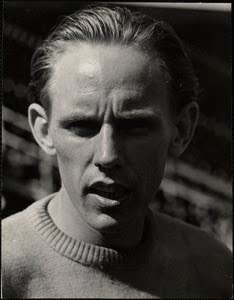
Once Upon a Time in the Vest

Sunday, November 6, 2016

V 6 N. 81 Track Guy in the Newsroom and Walter Cronkite

This week when there were some newflashes reminding us of the 100th anniversary of Walter Cronkite's birth, I remembered this picture of Walter I put on my first blog  U. of Oklahoma Track and Field Blog
When I was visiting my alma mater The University of Oklahoma, I saw this picture of Walter interviewing an OU Sooner prior to the Oklahoma Texas football battle in 1937.  Cronkite must have recently graduated from the U. of Texas and was on assignment up in Norman, as that appears to be the old Owen Field west grandstand.  In those good ole days the track was still in the stadium.  Of course in a few years Walter would be covering much more important battles in the European Theater of WWII and many gruelling presidential campaigns, and it was his announcement  of President Kennedy's death that is most remembered.  But since this is a track and field blog, and there is no record of Walter running track, I thought it would be inappropriate to mention this picture without also remembering an earlier post about a newsman who did run track.  That was Howard K. Smith, not as well known as Walter Cronkite but still a fixture in the American press at the same time as Cronkite.  We did have an earlier recognition of Smith and it can be found at.


Walter Cronkite in Owen Field , Norman Oklahoma, 1937


Howard K. Smith  on Once Upon a Time in the Vest
Click on Howard K Smith and the piece will open.  However you must scroll well down into the article to see the section about Smith.

Howard K. Smith, a 14.5 hurdler at Tulane in 1936


Thanks to Sheppard Miers my former teammate at Oklahoma I was made aware of the following story about Cronkhite which recounts that Cronkhite was the first play by play announer for OU football.  Please forgive us for straying so far off the track and cross country course for this one, but it is just an interesting story that some of you might like.

newsok.com/article/3386402
Walter Cronkite was a 'Five Ws' man
JOHN ROHDE Published: July 19, 2009 12:00 AM CDT
3 shares
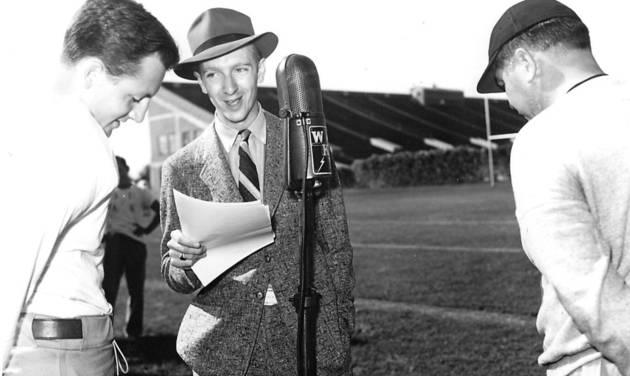
Working for WKY radio in 1937, a 20-year-old Walter Cronkite, center, interviews Oklahoma football player Beryl Clark, left. Cronkite died Friday at age 92. (Photo courtesy University of Oklahoma)Working for WKY radio in 1937, a 20-year-old Walter Cronkite, center, interviews Oklahoma football player Beryl Clark, left. Cronkite died Friday at age 92. (Photo courtesy University of Oklahoma)

Editor’s note: This story originally appeared in The Oklahoman on Aug. 29, 2002
In the eyes of Walter Cronkite, journalism has slowly decayed into a featurized state.
Cronkite is a "Five Ws” man. He wants the who, what, when, where and why — and he wants them pronto.
"I’m so tired of stories starting, ‘Maud Jones was walking her dog down Broadway.’ You’ve got to go over to the back page somewhere to finally find out the damn dog was run over by a truck,” Cronkite said. "Get the thing told, for heaven’s sake. Everybody doesn’t have to be an O Henry.”
So, here it goes:
Hall of fame broadcaster Walter Leland Cronkite Jr. was the first play-by-play radio announcer for Oklahoma football, making his debut Sept. 25, 1937, when the Sooners lost to Tulsa 19-7 at Skelly Stadium.
Cronkite described his debut as a disaster, but said the experience taught him a valuable lesson in preparation.
He left WKY radio within a year and eventually became "The most trusted man in America” as anchor for the CBS Evening News.
And that’s the way it was...
That voice

It’s been 21 years since Cronkite signed off from the anchor desk, but that familiar voice on the other end of the telephone immediately rekindled memories of the CBS Evening News.
Cronkite is 85 years old and still carries a quick wit.


Speaking from inside his home at Martha’s Vineyard, Cronkite struggled to hear questions over the yard work being done to his lawn.
"Do you hear that?” Cronkite shouted into his phone. "With the equipment this guy’s using, he could have saved those nine Pennsylvania miners in about 10 minutes.”
Cronkite continued to joke as if he were covering breaking news.
After another intrusive stretch of noise, Cronkite deadpanned: "It’s a miracle. They’re bringing the first miner out now.”
Cronkite then pondered how to alleviate the problem. "I could change telephones,” he said, "but that would mean getting up.”
After a loud bang, Cronkite said, "My God, he’s coming through the door.”
Finally, as the mower left the grounds, there was one final roar. "Well, I think that was one of ours that just flew overhead,” Cronkite said. "Now, where were we?”
Cronkite was addressing the state of journalism. With the onslaught of cable television, is there an oversaturation of news?
"I think there’s an oversaturation of scandal and feature stories today on television,” Cronkite said. "I think newspapers are doing a better job, but television has slipped terribly in the importance of the broadcast. Most of the people, according to polls, are still getting their news from television, which means most of them are inadequately informed.”
Cronkite said he misses his days at CBS.
"Oh, yes. Sure,” he said. "I miss particularly the managing editor role on the Evening News. Appearing (as anchor) was not that important. Helping set the day’s agenda and deciding what we used and editing it, that was a journalistic high point. I liked reporting as well. Just doing the news — the live performance — wasn’t important. Working on the desk was.”
Voice of the Sooners
Cronkite was a measly 20 years old when WKY manager Gayle Grubb hired him to do the first live broadcast of an OU football game.
Cronkite had been a campus reporter for Scripps-Howard News Service and did sports scores on radio while attending the University of Texas in 1933-1935.
He gradually dropped out of school to pursue journalism.
After a stint as a cub reporter with The Houston Press, Cronkite was hired as an announcer for KCMO in Kansas City, Mo., where he did simulated play-by-play off Western Union sports bulletins.
But at WKY, Cronkite was hired to do live play-by-play.
"I had never done live football,” Cronkite said. "I had done wire reports on football and, of course, that’s a vastly different thing. It takes a lot of imagination doing that. I didn’t need many facts and just used my imagination.”
Upon his arrival at WKY, and in an effort to better describe the action, Cronkite invented an electronic board that would provide information directly in front of him. Cronkite hired a couple of spotters to identify players.
"The spotters would punch up who was carrying the ball and who made the tackle, and the light would flash,” Cronkite said. "The spotters turned out to be impossible, and I was looking at the board and not the game. My design of the board was far too fancy. It got out of whack. So it was a disaster.”
Grubb was on hand for Cronkite’s debacle.
"He was standing behind me in the radio booth and muttering defecations — several fits of profanity — and getting louder and louder as the game went on,” Cronkite said. "When the game was over he said, ’Stay here. I want to talk to you.’ ”
Grubb and Cronkite sat on the last row of the bleacher seats next to the radio booth and stayed until the stadium was nearly empty.
Grubb: "Well, what did you think of that?”
Cronkite: "It was terrible.”
Grubb: "What are you going to do about it?”
Cronkite: "First, I’m throwing out this automatic board...”
Grubb: "You mean if you’re going to be going on with this.”
WKY radio was owned by The Daily Oklahoman and Times. Grubb and Cronkite were called in for a 6:30 Monday morning meeting with The Oklahoman’s Edward K. Gaylord. "Grubb was certain we both were going to be fired,” Cronkite said. "Then Mr. Gaylord said, ‘Well, I thought that was pretty darn good.’
"I thought Grubb was going to faint, and I thought I must have misheard Mr. Gaylord. He said: ‘Yeah, I got some good comments. Just keep on doing the good work.’ ”
Before the next game, Cronkite and color commentator Perry Ward ("A great gentlemen,” Cronkite said) memorized names, numbers and hometowns of players on both teams.
"I was going to have it all in my head. I was not going to have to look at any board,” Cronkite said.
In preparation, Cronkite and Ward tested each other throughout the week.
"We’d shout out numbers,” Cronkite said. "I’d shout, ‘Oklahoma, No. 22,’ and he’d tell me who that was. He’d shout, ‘Nebraska, No. 15,’ and I’d tell him who that was. We really drilled and rehearsed this thing.”
The overall improvement was immediate.
"The rest of the season went marvelously — very well,” Cronkite said.
After the season, Cronkite was assigned to the WKY news staff. Within months, he accepted a job as public relations manager for Braniff Airways. A year later, he joined United Press International to cover the war.
After informing Americans through three wars, the assassination of John F. Kennedy, numerous political conventions and the space race, Cronkite stepped aside when CBS imposed a mandatory retirement age of 65 for its employees. Cronkite’s final broadcast was March 5, 1981, and Dan Rather replaced him.
Since then, no news anchor has come close to Cronkite’s popularity. During the Richard Nixon years, the Ladies’ Home Journal polled its readers on which newsman they most trusted.
Cronkite won with 40 percent. "None” was second with 30 percent. Rather finished at 4 percent.
Although Cronkite attended UT only briefly, he was there long enough to learn he was required to hate OU.
"Oh, yeah,” he said with a chuckle.

This one last bit of Cronkite history coming from another born and bred Oklahoman, Stephen Fisher now permanent resident of Dar Es Salaam , Tanzania. A bit of worldly wisdom he heard attributed to Cronkite.

Never trust a fart 
Never pass up a drink 

Never ignore an erection 

Tuesday, November 1, 2016

V 6 N. 80 "Today We Die A Little" a Book Review by Paul O'Shea


Before The Bullet Train, The Czech Locomotive

A Book Review

By Paul O’Shea

My Czechoslovakian mother objected when I joined the high school cross country team. You’ll wear yourself out, it’s bad for your health.  Look how tired you are when you get home from practice.  

The year was l949. I was thirteen and had just entered St. Ignatius High School, confident I could earn a place on the freshman football team. Two days later my gridiron hopes fizzled, but a different future beckoned across the way from the practice field. Around the perimeter, a dozen shirtless boys were relentlessly running laps. They were the school’s cross country team, one of Chicago’s finest.

While the runners didn’t look happy in their pursuits, there was an aura of dedication and camaraderie. And I didn’t need a coach’s approval to join this resolute band. Catching the back of the peloton, I jumped in, and rather than embracing a winning Hail Mary (I was, after all, attending a Jesuit institution), I discovered the sport of a lifetime, competitive running.

As I evaded Betty O’Shea’s oversight that September, thousands of kilometers to the east another athlete with Czech blood was also wearing himself out, but with more success. He was Emil Zatopek. By the time he retired from athletics in the late 1950s, he had won four Olympic gold medals, set 18 world and four Olympic records, and collected three European titles.  He broke Czechoslovakian records, most his own, fifty times.

When we hear his name today, many of us recall a week in the summer of l952 when Emil Zatopek bequeathed the sport a priceless heirloom.  In eight days at the Helsinki Games he achieved what no other Olympic distance runner had ever accomplished: three Olympic victories, each an Olympic record. It was Zatopek’s Golden Week, still an unequaled hat trick.

Widely respected as one of history’s greatest distance runners (in 2013 Runner’s World named him the Greatest Runner of All Time), the name Zatopek takes its place with the incomparable Nurmi, Viren, Gebrselassie, Bekele. But Zatopek’s record isn’t widely known since it took place generations ago. American high school athletes have long since eclipsed his personal bests of 13:57.2 and 28:54.2.

On rare occasions biographies of the same individual surface at the same time. Recently, three books about Zatopek were published. They are: Endurance: The Extraordinary Life and Times of Emil Zatopek, by Rick Broadbent (Bloomsbury Publishing, 2016).  The second: Quicksilver: The Mercurial Emil Zatopek, by Pat Butcher (Globerunner Productions, 2016). Today We Die A Little! The Inimitable Emil Zatopek, The Greatest Olympic Runner of All Time (Nations Books, 2016), is the subject of this review.  

Richard Askwith, executive editor of The Independent, recounts the story of the man who, by his inexhaustible pursuit of competitors, titles and records, came to be known as the Czech Locomotive. The author set himself a formidable challenge. Earlier this year he told Kate Carter of The Guardian: “I assumed that everyone knew his story—and I was shocked to find that most people, or most people under 40, had never heard of him.

“I think of Zatopek as the patron saint of runners,” Askwith said. “He didn’t just revolutionize the sport—he reinvented it.  He rewrote the record books and redrew the boundaries of endurance, redefining the whole idea of what was humanly possible.  No one else before or since dominated distance running in the way that he did in the late l940s and early l950s.”

With Czechoslovakia emerging slowly from World War II’s devastation, Emil Zatopek almost was a Did Not Start.

Born in Koprivince in l922, the carpenter’s son from a poor Moravian family left home at fourteen to improve his career prospects.  He arrived eighty kilometers away in Zlin and found work at the Bata shoe factory (placing shoe lasts on the conveyor belt, he’s the original Shoe Dog).

In l941 the nineteen-year-old was conscripted to run in a company race but rebels. “My knee hurts.”  A company doctor checks him and declares Emil a malingerer. To avoid running (an amusing irony), he hides in a reading room, but is dragged out to the starting line. His biographer declares: “The next five minutes would set the path of his adult life.”  One hundred men and boys start the 1,400-meter race.  Without any training Zatopek beats all but one.

And so began a period of running for the Bata club team while working in its factory.  He runs a promising 4:20 for 1,500 meters, then 4:01.4. Four years later he had set national records at 2,000, 3,000 and 5,000 meters, and placed fifth in the European five thousand.

In a career that lasted 17 years, Zatopek ran hundreds of races, according to Bob Phillips in his Za-to-pek! Za-to-pek! Za-to-pek!, not a full biography but a useful overview. It was an era when the leading runners of the day (Mimoun, Reiff, Chataway, Kuts, Pirie) went head to head frequently, so different from today’s reluctance by shoe companies, national governing bodies, agents and coaches to risk their athletes’ reputations and economic bargaining power.

Looking at his body of work, principally the three-, five- and ten-thousand-meters (257 races), he won three of every four outings, ranking first in the world twelve times at these distances. He lost only eight of 62 ten-thousand-meter races. At five thousand meters, he won 120 of 141 events. Competing at three thousand meters he was defeated just eight times in 54 races.

One May to September, he raced twenty-two times in eight countries, winning all but once. In the seldom-staged one-hour run he covered a world record 20,052 meters.

Askwith tells us, “The young man who just eleven years earlier had feigned injury to avoid running less than a mile through the streets of Zlin had, in the words of The New York Times, forced ‘the once –peerless Nurmi…to yield his pedestal as the greatest distance runner in history.’” In Lausanne, Switzerland, a bronze statue of Emil Zatopek sits outside the Olympic Museum in its lovely sculpture garden.

If any runner could be labeled “tireless” it was Zatopek.  By his training, competitive strategies and will, he showed the sporting world how countless sessions of intense preparation translated into faster times and victories.

For its time his preparations were extraordinary. Fred Wilt wrote in his How They Train, “Before Zatopek, nobody had realized it was humanly possible to train this hard.” In one ten-day period, he daily ran sixty 400-meter sixty-second intervals.  In one build up to a major fixture he ran one hundred 400-meter intervals in the morning, another one hundred in the afternoon.  Twenty-five miles of quarters.  He believed, and his record proves it, that multiple fast repetitions with minimal rest periods were the key.  “Why should I practice running slow.  I already know how to run slow.  I want to learn to run fast.”

What were the qualities that made Zatopek such a fearsome opponent? The competition changer was his ability to endure pain.  When he faced exhaustion, he went harder. Then harder still. In training and in races.  
The Czech trained in all types of weather.  When Eastern European snows piled high, he ran in place, inside his officer quarters (he had joined the army), or at home.  Before Onitsuka Tigers were a gleam in an Asian eye, his trainers were military combat boots.

One much discussed characteristic was his unusual running style, earning him the Czech Locomotive sobriquet. Head tipped to the side, he thrashed about, looking like a man trapped inside a beehive, but below the waist he was Sebastian Coe smooth. Well aware of what others were saying about his agonized expression and flailing arms, he countered: “I shall learn to have a better style once they start judging races according to their beauty.  So long as it’s a question of speed my attention will be directed to seeing how fast I can cover the ground.  It is not gymnastics or ice skating, you know.”  

Another task Askwith set for himself was to challenge some of the myths that grew around the legendary runner.  Did Zatopek really run intervals with his wife, Dana, sitting on top of his shoulders?  Once, but probably not more.  

Days before the 1952 Olympics, which would feature his unique performances, did he threaten to sit out the Games if the Czech authorities didn’t allow teammate Stanislav Jungwirth, a political apostate, to compete?
The first flight to Helsinki left with about one hundred athletes, but Jungwirth and Zatopek were absent.  A week later, following tense negotiations the government relented and both were on the second flight.  

Another much-told story involves the marathon and a mid-race discussion between world record holder Jim Peters and first timer Zatopek.  There have been many versions of the exchange, but the most authentic is that about half way through the 26.2 miles, the Czech is supposed to have asked, “Jim, the pace, is it too fast?”  Peters is said to have responded, “No, it has to be like this.”  Again Zatopek questions the tempo.  Peters, now a bit irritated: “Actually, it’s too slow.”  The Czech responded by increasing the pace, and his competitor fell back by ten seconds at twenty kilometers.  Zatopek went on to win by more than two minutes.  Peters was DNF.

More than a half-century later Askwith is persistent in pursuing the truth or getting as close to it as possible. One of his primary sources is Zatopek’s widow, Dana, in her nineties, who provided answers for the British journalist.

Emil and Dana Ingrova met briefly at an international meet in Belgrade, only to discover that they were born on precisely the same day, month and year, a delightfully romantic coincidence.  She was a national class javelin thrower, while he was building his international reputation on the cinders. They won gold medals minutes apart in l952 at Helsinki.   

The book’s title stems from the start of the l956 Olympic marathon on a stifling hot Melbourne day, at least 86 degrees, with Zatopek the defending champion.  Askwith recounts: “Emil was past his best by then and, to make things worse, was not fully fit and still recovering from injury.  He looked around with a grim smile. ‘Men, today we die a little.’” Zatopek finished sixth.

The years after competition were difficult and sad. Zatopek initially was a national hero and used by the Communist Party while serving in the military for many years. He lived in a country that would be invaded by the Soviet Union after the nation had sought political liberalization.

Before the Prague Spring in 1968 he sided with the more democratic elements of the Party, and the national hero was rewarded for his disobedience with brutal work in Czech uranium mines, collecting refuse and digging wells. “In the end, they broke him,” Askwith concludes. Later, as the reformer Vaclav Havel assumed the presidency once the Soviet Union imploded, Zatopek was rehabilitated and lived quietly in Prague with Dana to the end of his life in 2000 at age 78.

Askwith’s To Die A Little! is a well-written treasure for the distance running buff who wants to return to a largely forgotten era. Seventy pages of notes attest to the diligent research that went into the 377 pages of text. This biography is not the author’s first entry into the running genre. Feet in the Clouds, his book about fell running, was named one of the three best running books of all time by Runner’s World.  He also wrote Running Free, a personal take on running in the English countryside.

My Czechoslovakian mother never knew of her countryman’s triumphs. Sport was not part of her daily life. Betty Achilles (yes, her maiden name) came to the United States with her parents in 1930, settled in a Chicago suburb, started working at Western Electric Company, met my Irish father, and they married.  I was born in Brooklyn, and our family moved back to the Midwest when my father took a job with a Chicago printing company.  
From a western suburb I commuted into the city and discovered the sport where I survived, often enough, dying more than a little.

Like the Bullet Train, today’s distance runner elites are sleeker and faster, typified by the exploits of Mo Farah, surely destined to join the Nurmi to Bekele pantheon.  The Czech Locomotive’s timetables were comparatively slower, but they remind us that it is not just the journey, but also the destination.

Paul O’Shea is a lifelong participant in the track and field world, as competitor, coach and journalist.  After retirement from a career in corporate communications, he coached a girls’ cross country team and was a long-time contributor to Cross Country Journal. He now writes for Once Upon a Time in the Vest from his home in northern Virginia, and can be reached at Poshea17@aol.com.


We didn't want to mix the photos in with Paul O'Shea's wonderful review, so now here are a few pictures from another book Zatopek in Fotographien a German publication. Thanks to John Cobley (racingpast.ca) for letting me borrow his copy. Credits for pictures are below. A number of them are by Eastern bloc photographers in those days and were probably part of the progaganda machine that was extolling the joys of the socialist state. Another interesting part of the Zatopek story is the history of the Bata Shoe factory, a Czech enterprise that survived the Communist takeover and thrives today as a multinational corporation. Plenty can be found about it on Wikipedia. GB
High School/ Trade School yearbook photo.
The caption reads  "Later he worked in the factory in Zlin and visited the vocational school 

One of his early races

Always looking for an opportunity to find a training site, he is working out in a riding school stable.

"As he progressed he was gaining knowledge of the importance of tactics and changing gears duing his races."

Close up of what appear to be his training shoes.  Tennis anyone?

Racing the Hollander Slikhuis

Dana and Emil boarding the plane for Helsinki

Wedding Day

Helsinki 10,000?

Hitching a Ride on a Fast Freight

The night before a race in Ostrava, Emil calculated his splits to the tenth of a second.

Followed by Schade, Chataway, Mimoun, Pirie in the 5000 at Helsinki

Running with the Swede Gustav Jansson.  Emil would win in 2:23.03, Jansson third in 2:26.07.  

The Olympic Gold Medal Couple

With his Parents

Post Race or Training Maintenance.    Goon squad in the back?

Looking somewhat Kerouacian

The famous winter training.  Snow doesn't look quite so deep this day.
Photos above are made by the above photographers and appear in the book below
"Zatopek in Fotografien"


Two more of my favorite photos of Zatopek  are by Gerald Bloncourt a French photographer, poet, artist who has photographed  some interesting sports figures on his website earlier but which no longer appear there.  I got these from the Suddeutshc Zeitung Photo site.  They were taken at the cross country meet sponsored by the leftist newspaper in France  L'Humanite  known as  Le Cross de l'Humanite.


Obviously some party officials behind Zatopek, or maybe secret police keeping an eye on him.


Our good friend Geoff Williams in Victoria, BC added this to our posting.
Truly a wonderful piece.  I will be getting a copy of the book as soon as it is available.  ( one small addition)-the book “Zatopek in Fotografien” is actually mine and I lent it to John Cobley.  I received it in my twenties in London ( probably around 1957-8) as a gift  from a pen pal ( manager of a Czech soccer team ) that I corresponded with in Czechoslovakia for a few years .  That correspondence originated from a letter I wrote to World Sports after the 1952 Olympics when I objected to the fact that they commented on Pirie’s “failure” in 4th place in the 5K as compared with Bannister’s “success” in 4th place in the 1500m.  Some years ago I checked online to find that the book could be had for about $300!  As you know I also am the proud possessor of F. Kozik’s book “Zatopek the Marathon Victor” which Emil autographed for me at a London book signing.  ( also signed by Jim Peters who was sitting behind me).  Kozik also produced the above mentioned book.  I had earlier been to see Zatopek get beaten by Pirie and one other ( Norris?) over 5K at White City at the twilight of his incredible career.
 
As another sidebar I have been an email correspondent with Bob Phillips for a few years and mentioned my letter to World Sports and he says he likely saw it as he worked for them during that period.
 
No wonder we all love Athetics ( that’s English for Track and Field). 
 
Hope you are doing well.
 
Regards.  Geoff

V 15 N. 10 Gunder 'The Wunder' Haegg Visits Cincinnati

Bob Roncker of Cincinnati, Ohio has sent in this account of one day on the 1943 tour that Gunder Haegg of Sweden made to the US to help rais...