Once Upon a Time in the Vest

Friday, October 16, 2015

V 5 N. 93 October, 1965


OCTOBER 1965
If you are old enough to have opened the sports section Saturdaymorning October 12, you read of the heroics of the Dodgers' Sandy Koufax who shut out the Twins on four hits in the fifth game of the World Series.

Seventh Game 1965 World Series
You can see the complete seventh game all 2hours and 33 minutes of it narrated by Vin Scully.  Koufax was pitching his third game in the seven game series with only two days rest and and ailing shoulder.  This especially for those Dodger fans now in mourning due to last night's elimination of their team from the playoffs. ed.


But likely you did not read about Ludvik Danek breaking his own discus world record. The giant Czech took advantage of mild weather and an aiding wind in Sokolovo, Czechoslovakia to throw 213-11½, surpassing the mark he set last year by 2'2”. 
Danek Throwing


It is the 32nd and final world record set in this year of amazing achievements.
While Danek clearly dominates his event, the high jump has undergone a dramatic change. Valeriy Brumel's rule in the high jump has ended, at least for the near future, as reported in this issue of Track and Field News .

 China's Ni Chih Chin jumped 7-3¾ on September 29 and followed that with either a 7-4 or 7-4¼ in an unspecified meet. Brumel will be unable to respond to this challenge because on October 7 he fractured his ankle in a motorcycle accident. It will be at least a year until he is able compete. The king is dead (at least temporarily). Long live the king.

Brumel nearly had his lower right leg amputated just above the foot.  He never fully recovered, tried a long painful comeback as seen in the above video.  The injury was to his lead leg not the take off leg, and it is clear that he has a lot of pain while doing his approach.

A bit more on his life which ended at age 60 a few years ago.  Found on Wikipedia.
Brumel was born in a far eastern Siberian village to a family of geologists exploring the region.[3] They later moved to Lugansk and taught at a local university. Brumel took up the high jump at 12 in Lugansk, coached by P. S. Shtein. Aged 16 he cleared 2 metres (6 ft 7 in) using the then dominant straight-leg straddle technique. He improved his skills under the coaching of V. M. Dyachkov in Moscow. In 1960 he broke the USSR record, 2.17 metres (7 ft 1 in), and was selected to the Olympic team. At the 1960 Summer Olympics, he cleared the same height as the winner Robert Shavlakadze, but made more attempts and thus was awarded a silver medal.[2] In 1961–1963 he broke the world record in the high jump six times, improving it from 2.23 metres (7 ft 4 in) to 2.28 metres (7 ft 6 in).[4] He also won the high jump at the 1961 and 1963 Universiade, 1962 European Championships, the 1964 Summer Olympics and the USSR Championships of 1961–1963.[1][5]
After going undefeated during the 1965 season, Brumel suffered a multiple fracture in his right foot in a motorcycle accident, and faced an amputation. He was operated on successfully by professor Gavriil Ilizarov with a new leg-lengthening procedure using his external fixator. Yet even after 29 surgeries he could not fully recover. He retired in 1970 after jumping 2.06 metres (6 ft 9 in) at local competitions.[1][5]
In retirement Brumel turned to acting and writing. He starred in the films Sport, Sport, Sport (1970) and The Right to Jump (1971) and wrote numerous novels and plays, including the novel Don't Change Yourself (1979), which was translated into seven languages, and the libretto to Rauf Hajiyev's operetta Golden Caravel (Золотая каравелла).[1][5]

Personal life[edit]

Brumel had two brothers, Oleg (1944–2005) and Igor, a Russian politician born in 1952 in Rostov.[6] Brumel was married three times. His first wife, rhythmic gymnast Svetlana Lazareva, left him with a son in 1965, when Brumel was recovering from his motorcycle accident. In 1973 Brumel married Yelena Petushkova, an equestrian and 1972 Olympic champion in dressage. The couple divorced 18 months later citing irreconcilable differences. They had a daughter, Vlada Petushkova, born in 1974, who was raised by her mother.[7] In 1992 Brumel married Svetlana Belousova, who later founded and managed the Valeriy Brumel Fund. They had a son Viktor.[5][8]

An injury to Poland's triple jump record holder, Jozef Schmidt, is responsible for the Soviet Union besting West Germany in the European Cup, 86-85. Schmidt took the lead in the first round with a leap of 53-10 but on his second attempt pulled up lame, unable to compete further. Aleksandr Zolotaryev of the Soviet Union then matched Schmidt's mark. East Germany's Hans-Joachim Ruckborn topped them both in the third round with a PR of 54-2. Second place went to Zolotaryev on the basis of a better second jump as Schmidt had only the one jump. Thus the Russians gained the point they needed for the championship.

Little reported on cross county in this issue. Be looking for the November report.

Were you to turn to the final page of this issue, you would see a full page ad for “The Wonder Shoe of Tokyo”.
Tokyo 64
135 grams
 That would be Adidas, of course, the shoe that won 33 gold, 34 silver and 32 bronze medals in the recent Olympics. Adidas may be purchased through Carlsen Import Shoe on Franklin in New York City, Van Dervoort's Hardware on Washington in East Lansing or......wait for it.....Clifford Severn Sporting Goods on Magnolia in North Hollywood. Some things never change.

Wednesday, October 7, 2015

V 5 N. 92 Miki Gorman, Bill Skinner, Beaufort Brown, and Ralph Fessenden, R.I.P.


with Jerome Drayton after 1974 Boston victory


We recently received notice that Miki Gorman passed away at age 80  in September after being diagnosed with cancer about five years ago.   Many of you will remember her as one of the first really good women marathoners.   When only a few women were starting to run marathons, Miki was regularly running sub 2hrs. 50 minutes at that distance and ultimately ran a world best 2 hr. 39 min. 11seconds.  Her first marathon was in 1974 at the Western Hemisphere Marathon in Culver City, CA.  She ran 2hr 46min 36 sec.    An Australian lady Adrienne Beames had run slightly better 2 hr. 46min. 30  over an accurately measured course, but it was as time trial, not an actual race.    Miki Gorman ran in the days before the marathoning and other distance races were added to the list of Olympic events, so her name does not appear in that list of records, but she certainly would have been a major player had there been a women's marathon in 1976.

Miki was born in China to Japanese parents in 1938.  Her father was in the Japanese army of occupation in northeast China.  After WWII she came to the states in 1963 to Carlisle, PA to work and study.  She married Michael Gorman and they came to California.  She joined a gym to workout to put on some weight as she was so small,  5 ft. 87 pounds, but got into running and entered an indoor, 100 miler, but dropped out at 86 miles.  The next year she completed that race.   Eventually she got into training under the eye of Lazlo Tabori, and she was soon burning up the roads.  In 1974, four months after that first marathon, she entered Boston and won in 2hr. 47min. 11 sec.  The following year she was second at Boston, then began a three race winning streak in 1976-77 with victories at NYC, Boston, and again at NYC at age 42.  In 1978 she set a world best time in the half marathon at 1hr. 15min. 58 sec.   Shortly afterward injuries ended her career.

She was honored in several running halls of fame, including Road Runners Club of America, National Distance Running HOF, and New York Road Runners HOF.


Others who have left us


Bill Skinner,   Tennessee All American

Skinner was an NCAA Champion javelin thrower in 1970

Oct. 6, 2015

Bill Skinner Obituary
KNOXVILLE, Tenn. -- Two-time All-American and VFL Bill Skinner passed away on Monday after a fierce battle with pancreatic cancer.
Skinner was an elite javelin thrower and lettered at Tennessee from 1968-70. He took second at the NCAA Championships in 1969 with a distance of 83.28m (273 feet, 3 inches) and won the NCAA title in 1970 with distance of 82.49m (270 feet, 8 inches). In 1970, he swept the NCAA, AAU and USTFF titles. Skinner set the Tennessee javelin record of 88.96m (291 feet, 10 inches) 1970, which predates IAAF javelin specifications in 1980

Born in Wilmington, Delaware, Skinner (as he was known to all) left home at 17 to join the U.S. Navy and toured the world aboard the U.S.S. Canberra. He played semi-pro football with the Delaware Clippers, was an amateur boxer, and worked as a sheet-metal worker. On a bet, he picked up the javelin and days later won the Middle Atlantic AAU title. He went on to earn a scholarship to the University of Tennessee, sweeping the NCAA, AAU, and USTFF titles in 1970. He was a member of the New York Athletic Club, earned four All-American designations, won five National Championships, and was captain of the United States Track & Field Team. He also captained the men's track and field team at the 1971 Pan-American games in Cali, Columbia. He earned notoriety for being removed from the UT track team for refusing to shave his mustache, a feature article in Sports Illustrated, and status as one of the best javelin throwers in the world. His image appears (uncredited) on the side of the original U.S. Track & Field arcade game.

Beaufort Brown    University of Florida
Beaufort Brown passed away earlier this Fall.   Below is his short autobiography that appeared on the U. of Florida track site.


BEAUFORT BROWN
B. 1953 - D. 2015

Beaufort Brown

(born: Tampa, Florida USA 1953)
University of Florida 1971 – 1975 “The Genesis of Champions Era”
Coaches: Jimmy Carnes, Head; Roy Benson, Asst; Dave Atkins,
440 and Relays

2011
I was recruited to the University of Florida's Track Program in 1971, by Head Coach Jimmy Carnes. While in Tampa Florida’s Middleton High School, I played football; was track team captain; and had won Championship titles at the Conference, District, Regional, and State levels.  When I was competing in the State of Florida’s Championship meet, Coach Carnes came to watch me run the 440 and the sprint medley relay—both of which I was favored to win. I anchored and won the relay; but when I made the mistake of looking back near the finish line, I lost the 440! As a result, Coach put me on the Gators’ team—but he wouldn’t give me a scholarship until I proved myself. From that point on, I never looked back—either literally or figuratively. My time as a Trackman at the University of Florida was The Best Time of My Life! I made some life-long friends with some great guys. Together, we put UF on the National Track and Field “map”, and we were among UF Track’s pioneers in “The Genesis of Champions” era. Florida’s jumpers, vaulters, and fielders were already soaring, so we runners began the tradition of the “Flat Out Flyin’ Florida Gators!” I loved impressing the fans with my trademark ‘flying’ leap across the finish line. The UF Track Team, several individuals and I became SEC Champions; my mile-relay teammates and I became National Champions; and I enjoyed earning a long list of honors and awards—including being elected team captain for an unprecedented three years! Coach Carnes encouraged me to be a versatile runner by challenging me to run everything from sprints to middle distances (100 – 880 yds)! I clocked some of the fastest times in the world for several events; ran in prestigious invitational meets; qualified for the Olympic Trials; and beat the Russians in the Jr. Olympics, while setting and shattering UF records all along the way! I even managed to make the Dean’s List! One newspaper article proclaimed, “Brown Is Beautiful!” and another nicknamed me, “Bodacious!”


Ralph Fessenden  University of Illinois

from the Oct. 7, 2015 Missoulian


October 1932-October 2015
MISSOULA – Ralph James Fessenden passed away Sunday, Oct. 4, 2015. He was the son of Douglas Fessenden (former University of Montana Grizzly football coach) and Juliette (Armstrong) Fessenden.
He was educated in Missoula and Brownsville, Texas. He earned a track scholarship to the University of Illinois, where he excelled in running the 440-yard distance. In 1954 he placed fourth at the USA Track and Field Championships.  (editor's note:  I have not been able to verify this placing.  He did not appear in  the NCAA results.  This was probably the National AAU meet.)
He continued his chemistry studies at the University of Illinois, earning his bachelor’s and master’s degrees. He moved to California with his wife, Joan, and earned his Ph.D. in organic chemistry at UC-Berkeley.
After teaching at San Jose State University, Ralph and his family moved to Missoula, where he taught in the Department of Chemistry at the University of Montana until retirement.
Ralph and Joan were internationally known organic chemistry authors, publishing their first book in 1971. Their books have been translated into six languages

Pete Brown sent us this confirmation:
Fessenden got 4th in the 1954 AAU 440 in 47.42 according to T&F News. Lea won, Mashburn second and Jones third.
Source: Track and Field News


Friday, October 2, 2015

V 5 N. 91 Fred Abington, Georgetown, USAF, Vanderbilt, SEC, Igloi, South Africa

Almost a year ago I received an email from Fred Abington through an intermediary, as Fred was not yet using email.  I negligently forgot to follow up on that letter, but Fred, now with email, contacted me again recently and sent  me  the article below about his very interesting career as a runner and through life as a world traveler.  I plan to learn more about Fred and continue the saga.  Here is a taste and a story about the South East Conference before it became a track and field power.

In addition here is a great track trivia question forwarded from John Cobley who writes, in my opinion, the best track blog out there, covering distance runners through the ages.  See:
racingpast.ca.
George

What child of a British track and field gold medalist became a world class actress?
See next post for the answer.


Former SEC champ traded running shoes for boots
May 6, 2015

Commodore History Corner Archive

Fred Abington was an elite distance runner on the Vanderbilt track teams in 1958-59. He broke Vanderbilt records in the one-mile and two-mile runs and was the SEC individual champion in both events in both years. Abington now lives in Cape Town, South Africa in a suburb named Gardens. That location is near the foot of Table Mountain.


This interview was obtained through the Internet by email with help from his friend Jean Bramley. This is a summary of Abington's life told in his own words: 
"I was born on August 11, 1933 in Mineola, Long Island, NY and grew up in Chatham, N.J. where I went to high school. I graduated in 1952 where in my senior year I ran the mile in 4:23.3, which I was told was the second fastest schoolboy time in the nation. I also played on the soccer, baseball and basketball teams in my sophomore, junior and senior years.

"I had to develop my own training methods in conjunction with Fred Wilt who a few years earlier had been one of the premier America mile runners and an FBI agent that ran for the New York Athletic Club.

"From high school I went to Georgetown University on a track scholarship. In my sophomore year, the track coach found out I was playing on the baseball team and he pulled my scholarship thus ending my stay at Georgetown.

This reminds one of the Bruce Dern's being removed from the team at U. Penn about the same year when he grew his hair too long.  See V 4 N. 15 of this blog.  ed. 

I spent two years in the Air Force where I ran a few races, but without any training. I was honorably discharged in 1957 and drove to Nashville where my family had moved during my military service. I was on the G.I. Bill and accepted into Vanderbilt with no intention to ever run again. I just wanted to get my degree, which was Experimental Psychology.

"I did my thesis on my track training, but I couldn't resist and started running again. In the next two years, I won seven SEC championships, two of which were conference records in cross-country (Atlanta, Nov. 24, 1958) and the mile in Baton Rouge in 4:12.2 in April 1959. However, in the Meet of Champions in Houston on June 7, 1958, I ran the mile in 4:07.3, which I'm sure, is still a Vanderbilt record.

"Upon graduation I moved to San Jose, California with my new wife from Nashville and began training under the great Hungarian coach Mihaly Igloi. I was also beginning a career as a probation officer and soon had two children that were 11 months apart. I continued to train daily, but with a new career and children it became increasingly difficult.

"Then the track club moved south to form the Los Angeles Track Club. Since I had a new career and children, I had to stay behind. I never ran again although I did get my time down to 4:04:3 under Igloo. In the decades to follow my life went through some trying times including divorce, bankruptcy, job change among others. In December 1971, I took a job with the city of San Jose as relocation specialist and retired in November 1992 at age 60.

"By this time my daughter and son were married and had children of their own. Prior to my retirement, I had done a three-week Outland Bound survival course in the Oregon wilderness at the age of 55. The following year, I did an Outward Bound three-week expedition to 17, 000 feet in the Himalayas. The next year, I helped put together a whitewater rafting expedition in the Yukon Territory in Canada and Alaska.

"With these behind me, and full of energy and enthusiasm, I decided to strike out on my own. After years of preparation and having informed all of my family, I donned my backpack and purchased a one-way ticket to Katmandu, Nepal with the intention of backpacking the world with no plans and no date of return. I was terrified! And I was scared. It was October 1995 when I backpacked in Nepal, India, Thailand and Sumatra. I was forced to curtail my travels in December and returned to the States to have a hip replacement.

"At the end of my recuperation period I received a call from a friend I had made in the Himalayas and Alaska. We had many conversations about someday going to Africa. She was calling from a place called Cloudbreak Backpackers Lodge in Cape Town, South Africa. Within a week I joined her. I loved living at the Cloudbreak where I met many very interesting people; almost all were college students or graduates from around the world.

"I hit it off with all of them as they used Cloudbreak as their jumping-off place. I became one of them. I stayed at the Backpackers Lodge for six years making new friends and traveling the world. I've been through 43 countries and have had experiences you would not believe especially here in South Africa. I literally lived out of my backpack for 10 years from the age of 62 to 72. The six years I lived at the Cloudbreak were without a doubt the best continuous six years of my life and Cape Town became my home."

Igloi was a Hungarian distance running coach. He was a multiple champion in Hungary in the 1930s. He participated in the 1936 Summer Olympics in Berlin in the 1500 meters. Igloi became a coach in Budapest and the Hungarian Army Club. He coached many of his students in the 1956 Melbourne Summer Olympics.

Igloi moved to the United States and formed the Los Angeles Track Club then the Santa Monica Track Club. One of his runners was Jim Beatty that became the first man to run a four-minute mile indoors. Beatty set many American indoor and outdoor distance records. Another one of his runners, Bob Schul, ran a world record (8:26.4) in the two-mile and won the 5,000 meters the 1964 Tokyo Olympics.

Fred AbingtonIn Abington's first race representing Vanderbilt as a junior, he broke a school record in the mile (4:29.3) that had lasted 43 years set by Robert Garner. Abington then erased the two-mile record that was held by Evan Howell in 1921 with a time of 9:49.4.

This article written by John Bibb of theTennessean appeared in the sports section in the May 21, 1958 edition:

"Vanderbilt's Fred Abington plans to forgo the two-mile after Saturday's Southeastern AAU meet in Atlanta.

"Abington, the finest distance runner in Vandy history and among the best in the Southeastern Conference annals said yesterday he will concentrate on the mile only in the Meet of Champions in Houston and the NCAA in Berkeley, Calif., next month.

"`I'm going to run the mile and two-mile in Atlanta,' Abington said, `but after that I am going to forget the two-mile and concentrate on improving my speed in the mile.'

"Right now Abington is bothered with a blister on his little toe. But, blister or not, Fred is top a heavy favorite to win the SEAAU.

"`I don't know how I got this blister,' Abington said while receiving treatment from Vandy's trainer Joe Worden. `I supposed my sock bunched up or something. It is a little late in the season to be getting blisters.'

"Abington who set two Vandy records in winning the SEC mile and two-mile in Birmingham Saturday now has lowered the Commodore standard to 4:15.2 in the mile and 9:30.3 in the two-mile.

"When Abington started competition this spring for Vanderbilt, the Commodore record in the mile was 4:29.2 and the two-mile was 9:49.4."

Abington finished in fourth in the mile at the Meet of Champions in Houston with a time of 4:07.3. At the NCAA Championships in June, Abington placed seventh in the mile at 4:08.4. Abington also ran a race in the famed Madison Square Garden.

Longtime Vanderbilt track coach Herc Alley led the Commodores in this era. In 1959, Abington repeated as the individual SEC Champion in the one-mile (4:12.2) and the two-mile (9:32.6).

Abington said in a Nashville Banner article in May 1959:

"Admittedly I am a poor loser. When I lose, I know there must be something wrong somewhere, and I've got to find out where. It is not impossible for me to just rub it out of my memory."

This will be the final Commodore History Corner story for this school year.

If you have any comments or suggestions contact Bill Traughber via email WLTraughber@aol.com


What a great article about Fred Abington.  He has done so many things which make the rest of us look like slackers.  The SEC was really primitive in those days, as was the stadium at Vanderbilt.  The Igloi portion of his training did not surprise me, especially with his significant improvement.  Igloi did not only have a sound physiological plan but he was very motivational to nearly all of his athletes.      Bill Schnier

Thursday, October 1, 2015

V 5 N. 90 A Poem and an Old Picture

In about three days we will  get our 200,000th hit on this blog.  Thanks to all of you who read it regularly.  Your comments and  added references make the effort worthwhile.  To celebrate in advance I'm putting a nostalgic picture and a poem for the first time ever on the blog.

Recently I stumbled across this photo from 1936.  It is of University of Texas Coach Clyde Littlefield, third from left and five of his Longhorn runners taken for publicity before the Texas Relays.  I forwarded it to several of our readers who ran at UT in the mid 60s when Clyde was retired but still active with the team.   Preston Davis sent  two messages about it seen below.

George…

Thanks for the photo.  I have seen this photo before in Coach Littlefield’s home back in the mid-60’s. 
 Looks like they had some fun running track at UT with Coach Littlefield.


Note the remarkable resemblance of Clyde to Gene Autrey
Only thing missing is a guitar and the Wonder Horse, Champion

Preston Davis

George, and guys…

The “cowboy” standing next to Coach Littlefield (second from left) is Harvey Wallender, who is in the 
Longhorn Hall of Honor.  He won the SWC 100 and 220 three years in a row and finished second to 
Jesse Owens in the NCAA 220 in 1936.  He also finished fifth in the 100, again to Owens who also won the long jump.  The Texas team won the SWC championship’s all three years Harvey was at Texas…he was captain his senior year.


Also received today is the following poem...   forwarded to us by Joseph A. Swanson, visiting scholar at Kellogg School of Management,  Northwestern University.   I think it was in response to the earlier post from Paul O'Shea's book review of Jeff Hollobaugh's book on tactics in running the mile.   Jim Metcalf had also sent in a comment on Herb Elliott's tremendous race in Rome.  I think this poem outlines some of the thoughts of those who shared the track that day with Elliott.  And maybe some of ours too.

GB


Always Something More Beautiful

This time I came to the starting place
with my best running shoes, and pure speed
held back for the finish, came with only love
of the clock and the underfooting
and the other runners. Each of us would
be testing excellence and endurance

in the other, though in the past I’d often
veer off to follow some feral distraction
down a side path, allowing myself
to pursue something odd or beautiful,
becoming acquainted with a few of the ways
not to blame myself for failing to succeed.

I had come to believe what’s beautiful
had more to do with daring
to take yourself seriously, to stay
the course, whatever the course might be.
The person in front seemed ready to fade,
his long, graceful stride shortening

as I came up along his side. I was sure now
I’d at least exceed my best time.
But the man with the famous final kick
already had begun his move. Beautiful, I heard
a spectator say, as if something inevitable
about to come from nowhere was again on its way.
Source: Poetry (June 2015).

To know more about Stephen Dunn

Click on his name below.  The poem will appear again.

Then click on his name again under the title of the 
poem.

Stephen Dunn


Wednesday, September 30, 2015

V 5 N. 89 Book Review: from Cross Country Journal "How to Run the Mile: Learning Effective Tactics from Great Runners and Races"

Coach: Don't Let Your Miler Leave Home Without a Tactical Plan

Book Review from: Cross Country Journal by Paul O'Shea

How To Race The Mile:  Learning Effective Tactics From Great Runners and Races by Jeff Hollobaugh, Mercury-Chronicle Books, 2015, 327 pages, $19.99.

Walk briskly up to the start with your sister competitors.  Stop.  Look down to make certain your forward toe does not touch the line.  Crouch.  Listen for the starting signal.   Proceed.

What to do next when one of yours is racing one mile or its sibling, 1500 meters, is the subject of one of the most useful and entertaining contributions to the track and field  bookshelf.  Jeff Hollobaugh's  How to Race the Mile takes a comprehensive look at strategy and tactics for coaches and athletes preparing to compete at the highest level, whether the high school conference meet, NCAA competition, World Championships or Olympic Games.

Hollobaugh interviews some of today's elite runners (see under Leo Manzano, Grant Fisher) and a few from days past (Dave Wottle, Steve Scott).  He brings to life more than 60 races that show how tactics worked--or didn't--in competition.   "By focusing on key races and hearing what they had to say about them, I aimed to give readers the effects of listening in on great racers as they shared their thoughts."

Hollobaugh's thesis is that planning and in-race decision making often produce the best results.  He offers chapters on running at the front of the pack, dangers in setting the pace, the mid-race move, and the long- and the short-kick.  He tells how to beat a kicker, how to handle championship rounds, indoor racing, even what to do when following rabbits.

Much more than a primer on game plans, Hollobaugh's book examines the middle-distance history of the sport, its heroes, memorable performances, and tells us how competitors like Snell, Coe and Ovett executed.

Discussing trends in racing today, acclaimed Italian coach Renato Canova tells Hollobaugh, "I don't think it's possible, at the moment, to find somebody successfully leading a top race from the start." One who memorably did was Filbert Bayi who took off from the gun and built an insurmountable lead in the 1974 Commonwealth Games 1500.  Bayi opened up a 15-meter margin at 800, finishing in a world record 3:32.16.

Illustrating the fate of one who made a dramatic mid-race move, Hollobaugh remembers the 2005 World Championship 1500 final.  After a 2:03 first 800, Alan Webb surged to the front and ran the next one hundred meters in 12.3 seconds, probably near his PR for just that distance.  Within the next two hundred he was zwieback, finishing ninth.

Finally, today's most common strategy is undertaken by the sit-and-kickers who come off the last turn and sprint to the finish.  Jenny Simpson, Matt Centrowitz and Sheila Reid are distinguished members of this fraternity/sorority, as was Bernard Lagat just a few years ago.

One of Hollobaugh's interview strengths is his ability to find chestnuts that resonate.

Don Paige, the Villanova Olympian who won 1979 NCAA 800- and 1500-meter titles in a 35 minute span, says that were he recruiting a high school runner today, he would ask, do you like to win or do you hate to lose?  If the runner says she'd rather win, Paige would lose interest.  "Because really, you want those kids who hate to lose.  That is a much stronger feeling than loving to win."

Nine-time All American and World Indoor competitor Heather Kampf advises against making too many moves.  The Minnesota runner warns: "You've only got so much cash to spend while you're out there, and if you use it up too early, you're working on change in the last 100 meters."

Jeff Hollobaugh is one of our sport's accomplished journalists.  For more than 35 years he's watched and written about events across the world, including six Olympics and eleven World Championships. A Western Michigan University graduate with a master's in professional writing, early in his career he was a Track and Field News statistician.  Later he became its managing editor and still contributes articles as a correspondent.

Working as a freelance writer in the 1990s he drew assignments from USA Track and Field and ESPN, and created the MichTrack.org website to promote high school track and cross country in the state.  In 2000 he began teaching creative writing and Shakespeare at a Michigan high school, and for the past eleven years has directed the Pinckney, Michigan middle school cross country program.  How to is his second book.  He also wrote The 100 Greatest Track & Field Battles of the 20th Century.

Why focus on a single event?  "I've always been fascinated by tactics in the 1500/mile.  I think it's the ideal meeting ground of speed and endurance, and the event that is most heavily influenced  by tactical choices.  Plus, I've found that there's a dearth of writing out there for athletes on what to do after the gun goes off."

Are runners racing more strategically today than in the past?   "No, I really don't think so.  I believe every generation has to learn its own lessons.  Most high school runners are horrible tactically, but by the time they're veterans (if they've stuck around that long), they're pretty savvy.  Hopefully, my book will help."

What's ahead for the Michigan native?  "I have two books in the works.  The first is an oral history of the first generation of  American sub-four minute milers, the beasts who did it on dirt tracks in terrible shoes.  There are 29 living Americans who did it prior to 1970, and I've interviewed 19 of them so far.  The other book is the story of how America's top high school miler and his coach put together an amazing high school career."

In the end, Hollobaugh has written a significant work, both practical and pleasurable.


Comment: from Phil Scott

"The beast that did it on bad tracks(had no choice) and horrible shoes(maybe not as horrible as we think). I have shoes in my collection just as light as modern spikes. I think the training shoes helped more than spikes and tracks better much better. If you took a world class runner today and had them run in Adidas Melbournes or Tokyos. times may not be that different. "


Comment from Jim Metcalf

"The greatest mid race move in the 1500 was Herb Elliot at the Rome Olympics in 1960.
They came thru the 800 in 1:57+.  Elliot took the lead and stated a long kick that  gave him 56.0 for the  3rd 400 and he broke the field wide open. he had 2:54 for the 1200.  As you recall the talk was, "could  Elliot have continued on to a 3:50 mile.  I don't think so.  He got very tired the last 100 m.
Sports Illustrated wrote a story about the race.  I remember they said that Witold Boran who led thru the 800 was no doubt horrified that any runner alive would find a 1:57 first 880 so pedestrian that he felt obliged to take the lead and step up the pace.
you can see the entire race on U TUBE.
Steve Scott tried just that tactic at LA against Coe and Ovett and died and faded back into the pack.
Herb Elliot was the finest conditioned Miler of his era. It takes a very strong will and mind and the conditioning to back it up to use that tactic."
Jim Metcalf


From: George
"Elliot makes some very poignant comments about his inner voices during that race and how he overcame some of his own doubts about that third lap.  Click on this link.  It's only two minutes long, but well worth hearing. Small correction to Jim's comment.  I think the leader at two laps was Michel Bernard from France.   I don't think Baran was in the race although he made the 1964 final."
Herb Elliott comments on the Rome 1500


Monday, September 28, 2015

V 5 N. 88 September, 1965


September, 1965
     Now is the time that Americans are pondering the match up of the Minnesota Twins and either the San Francisco Giants or the Los Angeles Dodgers in the World Series. On September 26, the day this issue of Track and Field News arrives in our mailboxes, the Twins hold a 7 ½ game lead over the Orioles in the American League. Don Drysdale has beaten the Cardinals 1-0 to move the Dodgers into a National League tie with the Giants who just dropped a 3-2 game to the Milwaukee Braves. Americans are passionate about baseball. Very few care what is happening in track and field. But we do. Likely you do as well. So let us put aside thoughts of Mudcat Grant, Maury Wills, Willie McCovey, Tony Oliva, Sandy Koufax, Gaylord Perry and Willie Mays and cast our eyes to the tracks of Europe where the season is coming to a dramatic close.

     As you remember from our last report, 1965 has been a landmark year in distance running. Every major record from one mile to 10,000 meters has been broken, a few smashed beyond recognition. The primary doers of these deeds have packed it up. Michel Jazy is vacationing with his family. Ron Clarke has returned to a hero's welcome in Australia. Of the big three who excited European fans with their racing in early August, only Kip Keino remains, but his name is enough to sell tickets. He had returned to Kenya for the African Games but is now back on the European circuit. 

     On the night of August 25th in Stockholm he faces steeplechase world record holder Gaston Roelants at 5000 meters. Roelants is ready, as measured by his 28:10.6 10,000, the fastest by anyone not named Ron Clarke. Rain has softened the track to the point that experienced observers give Keino no chance of breaking Clarke's 13:25.8 WR. But Keino is going to take a shot anyway. He and Roelants run together through 3000 meters, reached in 8:05.0, before the Belgian drops off the pace. Running by himself on a soggy track, Keino soldiers on to a 13:29.8 victory with Roelants 16 seconds back. Speculation abounds about how fast Keino might have run on a dry, fast track.

     Two days later, on a cool pleasant night in the southern Swedish town of Halsingborg, Keino takes aim at Seigfried Herrmann's recently established 3000 meter record of 7:46.0. After a first lap of 59.5, it is the Kenyan against the clock. Fifteen hundred meters is passed in 3:49.5, giving indication of what is about to happen. Three minutes fifty and one tenth of a second later the record is Keino's. His 7:39.6 gives him a 6.4 second margin over the old record.

     Once again the Portuguese Tables are consulted with the conclusion that this is the sport's fourth greatest performance, topped only by Randy Matson's 70-7 shot put, Clarke's 26:39.4 10,000 and Bob Hayes' collection of 9.1 100 yard dashes.
The very next night, Keino's tour of Sweden has its last stop, the town of Fagersta, 300 miles north. Once again running by himself, he breaks his own Kenyan and African 1500 meter record by a tenth of a second in 3:39.5. , No opponent seems to be able to stop Keino, but the IAAF, the controlling body of international track and field, can. Keino has used up the 28 day allowance of international competition permitted under IAAF rules. He requests special permission to compete two days later, August 30, in the Morley Mile held in London's iconic White City Stadium. Fortunately for all concerned, except his competitors, permission is granted.

     The promoters have invited the top milers on the continent. They are all there except for vacationing world record holder Michel Jazy. European 1500 record holder Jurgen May is there as are Alan Simpson, the British mile record holder, and Olympic 1500 meter silver medalist Josef Odlozil.
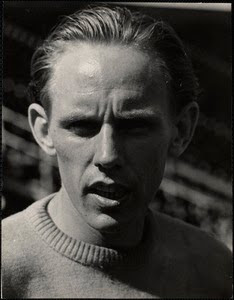
Josef Odlozil

    Derek Ibbotson and Wilson Kiprugut, the designated pace setters, take the field though laps of 56.4 and 1:58.3. Whether it is the slowing of the pace on the second lap or Keino's pre-race strategy is unknown, but the gallant Kenyan throws down the challenge at the start of the third lap. He runs 59.9 then finishes in 56.0 to win handily in 3:54.2, the third fastest time (Jazy 3:53.6, Snell 3:54.1) ever. Odlozil is second in 3:55.6, ahead of Simpson, 3:55.7, and May, 3:56.0.
Ibbotson and Keino

     On September 8 in Houstka, East Germany, Odlozil gets his own record, running 2000 meters in 5:01.2, shaving four tenths off Jazy's mark set three years earlier.


Gyula Zsivotzky


Ah, but what about the field part of track and field? Well, we do have a record for you, an absolutely amazing mark set September 4. The next day the world's newspapers report the death of Albert Schweitzer. But that wasn't the big news in Hungary. The headline in the Budapest Bugle on that Sunday morning announced that Hungary's Gyula Zsivotzky had smashed the oldest record in a standard track event when he used a revolutionary four turn style to throw the hammer 242-11 (73.74 meters in European talk), besting Hal Connolly's pending 233-9 ½ by an astounding 8 feet 1 ½ inches. This mark is 3.6% better than the previous record, ranking it close to Matson's 3.9% improvement in the shot put. Oddly, there is no mention of its value in the Portuguese Tables. 
See video below.  Especially if you speak Hungarian.  
Zsivotzky video

     What follows are bits and pieces found from columns in this issue.

Although Richmond Flowers won both hurdles and the 100 at the Jaycee Junior Championship, the fans went away talking about a high jumper from Oregon. “He used a standard approach but went over the bar head first and landed on his back.” He cleared 6-7 to win. His name is Dick Fosbury.....The favorite sport of Americans according to a Louis Harris survey: baseball 38%, football 25%, basketball 9%, bowling 7%, golf 4%, skiing 2%, tennis 1%, none 1%, all others (including track and field) 12%. That's it folks, track is less popular than “none”......The careers of Peter Snell and Herb Elliot overlapped briefly, pitting them against each other three times in 1960. None of the races was close. On March 14 (before the Rome Olympics) Snell won an 800 in Melbourne in 1:51.3 with Elliot sixth in 1:53.5. They met on successive days, September 22 & 23 in Dublin when both were Olympic champions. Fittingly, Snell won the 880 in 1:47.9 with Elliot fourth in 1:48.4. Elliot won the mile the following day in 3:57.0 with Snell fifth in 4:01.5......The times they are a-changin'. The NCAA just announced that the cross country national championship will be held at the University of Kansas on November 22. Why is this significant? Because ever since the first national championship in 1938, all of the meets have been held on the Michigan State course. The other significant change is the lengthening of the distance from four to six miles......Our last gleaned tidbit might earn you a free pitcher of beer at the Dew Drop Inn next Fridaynight if you play your cards right. Jesse Owens didn't have a first name, just initials. He was christened J.C. As the story goes, a teacher misunderstood his pronunciation of Jesse and he was too shy to correct her.


Jesse Owens Birthplace  Road Side Plaque
in Lawrence Co. Alabama


Jesse Owens birthplace in far northern Alabama, near the town of Oakville. 


Brief Bio on Josef Odlozil from from  Odlozil Memorial Track Meet page


Born on November 11th, 1938 in Zlin, Czechoslovakia, He attended the Military Academy of Jan Žižka in Bratislava. And there he started to really devote himself to athletics in earnest.
After graduating he was posted to the town of Olomouc, where he started to run in the local athletics club Slovan. Further studies brought him to Košice in eastern Slovakia where he spent three years under the guidance of his coach Jan Liška. Josef‘s rising prowess secured him a place on the national team, and since from he firmly belonged to the Army Athletic Club Dukla.
His dream was a bold one: to make it to the Olympics. Thanks to his hard work, unrelenting dedication, and above all a gigantically strong will, he managed in 1964 to secure a spot on the Tokio Olympics team. He brought home a silver medal in the 1500m run, having been beaten only by the phenomenal Peter Snell of New Zealand.
In 1965 Josef broke the 2000m world record with his time 5:01.2, which remains to this day the Czech (and Czechoslovak) national record. During a 1966 international match with France he set a new Czechoslovak 1500m record at 3:37.6. (Today the record is held by Josef‘s later protégée Jan Kubista.) On the next Olympics in Mexico, Josef made it once more to the final of the 1500m run, finishing 8th.
Over the period of his running career he was 7 times the Czechoslovak champion. In addition to his Olympic successes he also brought silver from the 1967 Indoor European championships. He held (or co-held) 11 Czechoslovak records and 5 best times on Czechoslovak soil.
Josef Odlozil graduated summa cum laude from the Faculty of Physical Education and Sports of Charles University (double major Czech literature – Physical education). In 1977 he successfully defended his doctoral thesis „Training top 800m runners“. Despite these academic successes, for political reasons he was forced to leave the Army after the end of his active running career.

John Davies , Josef Odlozil, Peter Snell

Later he worked as a coach in Sparta Prague, 1979 – 1981 saw him coaching at the Institutio National del Deporte in Mexico.
After 1989 he was exonerated and Josef thus returned to the Army where he worked until his death. In 1992 – 1993 he was a UN Peace Corps commander in Iraq.
He tragically died after his return home on September 10, 1993. His life journey was captured by the director Vit Olmer in a documentary feature called Josef Odlozil – An Athlete of Olympic Ideals.

V 15 N. 10 Gunder 'The Wunder' Haegg Visits Cincinnati

Bob Roncker of Cincinnati, Ohio has sent in this account of one day on the 1943 tour that Gunder Haegg of Sweden made to the US to help rais...