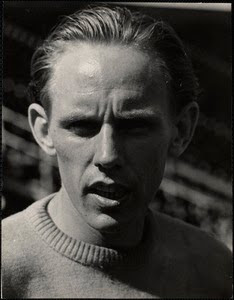
1965 AAU Championships
The war between the AAU and the NCAA has diluted the quality of competition in the AAU championships in San Diego. The NCAA has threatened to take scholarships from college athletes who compete in this meet and so, with the notable exception of Gerry Lindgren, those with remaining eligibility are staying away. For the US this is cutting off one's nose to spite one's face as this is the meet which will decide the team to compete against the Russians in another month.
In a case of sticking the knife in and twisting it, after the meet NCAA president Everett Barnes says that the NCAA rules do not permit this sanction. Just kidding guys. But the damage has been done. This is not to say that US team is mortally wounded. Indeed the winning marks in every event exceed those in last week's NCAA championship. Two world records and three national records are tossed into the dust bin tonight.
 |
| Ed Burke |
Ed Burke is improving rapidly in the hammer throw. He has been closing in on Hal Connolly's world record and today throws 224-5, good, excellent in fact, but not enough to top the unretired Connolly who beats his own listed WR of 231-10 by three inches, but doesn't match the yet to be ratified 233-9 he threw last week.
 |
| Hal Connolly |
Ed Burke profile Click Here He threw for many years as a Master.
The other world record excites the crowd more, as it may be the greatest distance race ever run. Billy Mills is the Olympic 10,000 meter champion, a hero of the highest order. His competition tonight is the squeaky voiced 19 year old whom Cordner Nelson calls “probably the most popular track athlete in the United States”, Gerry Lindgren. The fact that he is defying the NCAA to run in this meet and qualify for the meet with the Soviet Union only adds to his popularity.
Mills is confident that he can break Ron Clarke's six miles record of 27:17.6. Indeed he would like to run a bit longer and break Clarke's 10,000 meter record of 28:14.0 while he is at it. Would that be possible? No, there isn't enough time to measure the additional 376 yards. When Mill's made his request is unclear, but if it were any time other than when the runners are at the starting line, this is just one of the many egregious errors and omissions made by the officials this weekend.
The race is simple. Mills leads, Lindgren hangs on and everyone else gets lapped. Through the miles they go: 4:29, 9:04 (4:35), 13:40 (4:36). Occasionally Lindgren tries to lead but Mills is on a mission and quickly takes over again. His primary goal is the record, not the win. He has to take the chance of a fast pace taking its toll. The track is a hard all weather substance and Mill's feet are blistering.
Another 4:36 mile puts them at 18:16. To break Clarke's record they will have to run 9:00 for the last two miles. On the backstretch Lindgren once again moves to the front only to have Mills take the lead back on the next straight. The next two laps go off in 2:15.5, near the necessary pace to get the record.
Now the crowd is sensing that the record is within grasp. But who do you root for? If you want Mills to win, that means you want Lindgren to lose. If you pull for Lindgren, then you want Mills to lose. The crowd doesn't want either of them to lose.
After the race Mills says, “I thought Gerry was going to drop out after four and a half miles. I hadn't run against him for a long time and I had forgotten that his wheezy breathing is his natural way. “
Indeed, wheezing and all, Lindgren does not drop out. The following two laps go off in 69, leaving them at 22:50. Now a 4:27 mile is needed. The pace doesn't quicken on the next two go arounds. Are they gathering for the final drive or is this nature taking its course? Now the last half mile will have to go off in 2:10. Mills is the Olympic champion. The force of will he exhibited in Tokyo is still in his repertoire. The pace increases to 66 on the penultimate lap but the kid is still there. Cordner Nelson writes, “The crowd is near hysteria”.
On the backstretch Lindgren tries to go around but Mills holds him off and they race, shoulder to shoulder around the final curve and into the straight. Inch by inch Mills pulls ahead. With 40 yards to go he leads by a foot and there he stays. They hit the tape virtually joined at the hip. The last lap has been run in 58.0 for Mills, 57.9 for Lindgren.

On the Bulova timer Mills has won by .06 of a second, but the official time is recorded in tenths so both are credited with 27:11.6. Clarke's record has been broken by six seconds and both Mills and Lindgren are in the new record holders. Mills' margin of victory is less than that of the winner of any other race in this meet. From the photo, it almost looks that if Lindgren had a sprinter's lean in his bag of tricks, he might have won. The crowd has its wish. There is no loser. The 15,320 in attendance this evening have seen one of the great moments in the history of track and field.
We alluded to inefficient officiating. The 440 provides a couple of good examples. In their heats Don Owens and Lynn Saunders both finish in lanes inside those in which they started. Apparently officials were too busy doing something else to notice. This act also begs the question, how do you get confused as to which lane you are in?
To compound things, the officials screw up the starting time of the final as well. The race is scheduled for 6:45 but for some unexplained reason has been moved up to 6:00 causing Theron Lewis, the favorite off his 45.8 in the semis, to miss his usual rub down and rush his warm up. Even so, Lewis is off fast and leading into the final curve before the bear jumps on his back. Don Owens sweeps by and appears on his way to victory before being collared by Ollan Cassell who beats him to the tape by a tenth in 46.1. Saunders and Lewis finish third and fourth in 46.4. This is Cassell's second AAU championship. He won the 220 eight years ago.

The official gaffes mentioned so far are only the warm ups for the big one in the steeplechase. Apparently the official calling out lap times is using a watch with a 30 second face because the times he gives are 30 seconds off. This is but a bump in the road compared to the error that follows. As the leader, George Young, nears the finish line with a lap to go, the official holding the lap cards holds up “2”. Then, after Young is 20 yards past, the gun signaling the start of the last lap is fired. Young, already confused by the nonsensical lap times, suffers a 'what the hell?' moment. What lap am I on? He crosses the finish line in 8:50.6 but keeps going. The rest of the field, seeing the best steeplechaser in the country continuing to run, follows along. No one, officials, spectators nor the announcer, knows what is happening. Fred Best, who places third in 8:52.4, says, ”That final lap was the most grueling thing I have had to do in track”. For those keeping track, Young runs 66.4 on his last lap to establish a world record of 9:59.0 for the newly established approximately 3400 meter steeplechase.
To explain the mile race this evening we have to go back nearly two weeks to June 15 when, in Vancouver, Peter Snell is on the first stop of his retirement tour. The crowd is expecting big things. They get them, but not from the three time Olympic champion. Snell has been sick with gastritis, an inflammation of the intestinal tract. The crowd doesn't know this so it is shocked when Snell finishes last in 4:15.4. Forgetting this 'aside from that, Mrs. Lincoln, how did you enjoy the play?' feeling, the 13,891 spectators are treated to an American record. Jim Grelle goes through the 1320 in 3:00.2 and lights up the last lap to finish in 3:55.4, breaking Jim Beatty's US standard by a tenth. After the race Grelle says, “I honestly believe that I could have run 3:53 if the east turn hadn't been so soggy. It was like running through a mud flat”. Less upbeat is Snell who says, “It will take a long time for me to get over the shame of running last. Believe me, I was doing my best.”
Both Snell and Grelle are here tonight. So are the precocious high school record holder, Jim Ryun, and Czechoslovakia's Olympic 1500 silver medalist, Josef Odlozil. Cary Weisiger and Harry McCalla set the pace for 2½ laps but then the veteran Odlozil makes a break and opens up five yards. But when the gun sounds at 3:00.2, the field has closed. Traditionally in Snell's races, the field respects the king and waits until he kicks before doing so themselves. This has never been an effective strategy. Tonight the group's least experienced member throws down the gauntlet early. Jim Ryun breaks past Grelle and Odlozil at the start of the backstretch. He is not flat out but he is in position to respond when the challenge comes. It comes soon enough. New national record holder Grelle comes up on the impertinent youngster's shoulder at the end of the straight and around the turn they come, shoulder to shoulder, with Snell in close contact. Grelle can't get by as the extra distance caused by running outside takes its toll and he drops back ever so slightly. Ryun enters the straight with a two yard lead but he has to be looking for Snell out of the corner of his eye. Sure enough, the Olympic champion is on the move. He is on Grelle's shoulder and slowly the two gain on the tiring Ryun. Thirty yards from the tape Grelle loses momentum. Not Snell, he keeps gaining but not fast enough. The 18 year old Ryun wins his first national championship and takes Grelle's 12 day old record by a tenth in 3:55.3. Snell finishes in 3:55.4, a tenth ahead of Grelle. Odlozil is a well beaten fourth in 3:57.7. Last laps: Ryun 53.9, Snell 54.2, Grelle 54.8.
See the race start to finish Click here
As soon as they finish Snell puts his arm around Ryun's shoulders, maybe a passing of the crown gesture. He says, “Ryun's got it – the quality that goes to make a champion. He ran a perfect tactical race. I gambled on the sprint. I was not able to explode like I used to.” Ryun, never very talkative, says, “I wasn't surprised at the time. I thought 3:55 was within my capabilities.”
It would be unreasonable to expect another race this evening to provide the excitement and historic significance of the mile and six mile. But in the words of Cordner Nelson, the three mile qualifies. He says, “This was one of the three or four best distance races ever run in this country.”
Ron Larrieu leads a pack of five though the mile in 4:23.0. He is followed closely by 5000 Olympic champion Bob Schul, lanky Neville Scott of New Zealand, four minute miler Bill Dotson and unheralded Lloyd Burson of Western New Mexico. On the next lap Burson has to let go. Dotson drops off the pace a lap later. Larrieu continues to force the tempo. Two miles is reached in 8:50.6. The next two laps slow to 68 and 69. With a half mile left Scott takes over and runs 64.8.
In this situation a year ago Schul's devastating kick would give him the advantage but he has been fighting injuries and is admittedly not in top shape. No one, not even Schul himself, knows what he has left. Larrieu isn't waiting to find out. A long drive is his best shot. Around Scott he goes. Down the backstretch he is pulling away. At the start of the curve he has a four yard lead and appears to be on his way to victory. It is time for Schul to find out what kind of kick he has, definitely a “feets don't fail me now” moment. He tries to go by Scott on the inside, a move which requires some shoving, but he is successful. With Larrieu in his sights, he goes to the afterburners. The Olympic champ still has the lethal kick. He moves easily past the courageous Larrieu and wins in 13:10.4, taking Larrieu's American record in the process. Scott also nips Larrieu, taking second in 13:10.8, a personal best by 5.6 seconds. Larrieu equals his former AR in third in 13:11.4.
 |
| Larrieu, Schul, and Bolotnikov later in the summer |
Only Ron Clarke, Michel Jazy and Murray Halberg have run faster than tonight's trio who are now 4-5-6 on the all time list. Even though Larrieu equals his previous best, he falls from fourth to sixth on the list. Schul says, “I am pleased with my time, but not surprised. I am beginning to get in shape.”
George Anderson edges Darel Newman in the 100, 9.3 to 9.4, as both make the US team. Recently unretired Adolph Plummer demonstrates his old man strength to young Jim Hines, coming from a yard down at the top of the straight to win the 220, 20.6 to 20.7
On Friday Ralph Boston and Darrell Horn go 1-2 in the long jump, 26-3 ½ and 25-5 ½, to make the team against the Russians. Horn is back the next day and appears on his way to victory in the triple jump when Art Walker puts it together on his fifth jump, bounding 53-1 to win by nearly two feet. Horn holds on for second and has the distinction of being the only member of the US team to qualify for the Russian dual in two events.
art walker
Click here for some silent video of Walker and his "all over the runway" technique along with some other more stylish jumpers.
With no Al Oerter in the discus competition, Czech world record holder, Ludvik Danek dukes it out with the rapidly improving Jay Silvester, throwing 205-7 to win by three feet. Dave Weill is third at 191-0 but, as the second American, he is on the team.
 |
| Ludvig Danek |
Morgan Groth opted for the mile in the NCAA meet, but today he is back in his specialty, the half mile. He wins his heat. So do Seton Hall's George Germann and San Diego area JC frosh, Bob Hose. More likely his competition will come from NCAA champion and Olympian Tom Farrell plus veterans Ted Nelson, Darnell Mitchell, Dave Perry and Frank Tomeo.
Tomeo leads through the quarter with Hose and Groth close. Groth pulls alongside on the backstretch. On the curve Tomeo falls back. Now Groth is in control. Farrell is ready to make his move. He pulls up on Groth's shoulder, ready to unleash his trademark kick. Groth turns and looks Farrell in the eye then demonstrates that he has one more gear left, pulling away for a clear win in 1:47.7. Farrell can't answer and indeed runs out of gas ten yards from the tape where his friend, Germann edges by to take second and a place on the team in 1:48.0. Though Germann had finished fourth in the NCAA meet in 1:49.2, his best two weeks ago had been 1:51.2. Germann is torn. He is delighted with his performance, but he is disappointed that his buddy hasn't made the team.
 |
| Tom Farrell back then |
 |
Tom Farrell toay working with St. Johns runners. Note the runner with cell phone
paying close attention. |
High jump veterans Otis Burrell and Ed Carruthers take the two spots on the American team with 7-0 clearances. Bill McClellon also clears seven feet but is third on misses. He can't be too disappointed. This is his first 7-0 jump and he is 17 years old. Time is on his side.
Willie Davenport and Blaine Lindgren hurdle 13.6 and 13.7 each adding another US uniform to his collection. Olympic champ Rex Cawley holds off rapidly improving Jeff Vanderstock in the intermediates 50.3 to 50.7. Both will be on the plane to Russia.
John Pennel joins Hal Connolly and Adoph Plummer in a successful return from retirement. After seven months of “doing nothing”, he dominates the pole vault with a clearance of 17-0 in just the seventh time he as vaulted since returning to the event.
 |
John McGrath
|
 |
| Dave Maggard |
John McGrath wins the shot put at 63-0. Dave Maggard is second at 62-3 but it is unlikely he will be on the US team. That spot will go to Randy Matson who only has to prove he is healthy to make the team. There is no reason given for his absence, but since he also missed the NCAA meet, we are guessing he has been injured.
Next up: the doings of Jazy, Keino and Clarke in Europe. Stay tuned.