Once Upon a Time in the Vest

Friday, April 18, 2014

Vol. 4 No. 27 USA vs. Soviet Union 1964 Day 2

                            USA  vs USSR     1964                      Day Two
                           
                                                      Day One Totals

                             Men     USA  54                    USSR   39

                       Women     USA  27                   USSR   22

400 IH  
Fortunately Sunday, the 26th, is cloudy and cooler. The intermediate hurdles are up first and Billy Hardin and Rex Cawley are setting their blocks. The Russians don't figure to stop a US sweep and indeed they don't. There is no description of the race, but there is a photo of what appears to be the eighth hurdle with Hardin holding a three yard lead. Judging from this, we must assume that Cawley owns the rest of the race as he wins in 49.5 with Hardin running 50.2. The Russians run 51.1 and 52.3. Cawley is concerned that he may be peaking too soon. “That 49.5 scares me a little. Maybe I'm too sharp when you consider that I have to keep that sharpness all the way through October. I have done very little work on the hurdles since I ran 49.8 at the Olympic semis. So I must credit those 500 yard workouts I've been having with Ulis Williams for my strong finish.”

                                  USA     8                USSR   3
                    Total    USA    62              USSR   42


200 Meters


While the high jump, discus and triple jump have started, the next event on the track is the 200, perhaps the most assured sweep of the meet. Henry Carr is the world record holder. Yesterday he won the 100 by four tenths. Today he runs 20.5 to beat teammate Paul Drayton by five tenths. The Russians both run 21.3. Chalk up another 8-3 result for the US.

                                             USA    8            USSR   3
                               Total    USA   70          USSR   45

Discus
As so often mentioned in our reports, in the discus there is Al Oerter and then there is everybody else. Wind Big Al up and he automatically throws 200+. Today is no exception. He fires one out 200-5½ to top Jay Silvester's 193-3 and the 189-9 and 186-1½ of the Russians. Another sweep for the good guys. Isn't this fun?

                                       USA  8          USSR   3
                 Total            USA  78        USSR   48

800 Meters

One always hears about momentum in other sports, but is there momentum in track where there are separate events? Well, apparently there is, at least today. Our 800 guys keep the hits coming. Jerry Siebert runs away from the field in 1:47.5 while Darnell Mitchell easily holds second place in 1:48.8. The Russians go 1:49.9 and 1:52.4. Sweep number four this afternoon.

                                      USA   8         USSR  3
                      Total      USA  86       USSR  51


Triple Jump

Now it's the triple jump, an event in which we appear to be severely outclassed. The Russians have PR's of 54-10 and 54-7½. Ira Davis is the American record holder at 53-10, but that was four years ago and he has competed infrequently since then. Bill Sharpe has a PR of 52-4. Our sweep streak of the afternoon will end here.
There is no sweep, but that is good news as the predicted sweep would be by the Russians. To the amazement of the experts, Ira Davis wins and increases his American record to 53-11. The Russians jump 53-1 ½ and 52-0. Bill Sharpe manages 50-5½. This is the first American triple jump victory in the series. Davis' mark ranks him number three on the world list this year. 

                                                         USA   6           USSR   5
                      Total        USA  92          USSR   56

Steeplechase
 
The steeplechase shapes up as one of the best races of the meet. The Russians are favored but our guys, George Young and Jeff Fishback, have a slugger's chance. They are 1-2 on the all time US list. Young has the US record at 8:38.0 but Fishback beat him by over five seconds three weeks ago in winning the Olympic semifinal meet in 8:40.4. Eduard Osipov, off his 8:34.4, seventh on the all time world list, is the favorite. Lazar Naroditskiy has a best of 8:38.2. Russian hopes of winning the meet died yesterday, but this is a chance to right the ship somewhat.
The four run together for six laps. Young makes his move and pulls away just as Naroditskiy drops back. Now the battle is for second. The five foot four inch Osipov and the lanky Fishback run together on the final lap. Fishback gains two yards on the last water jump only to have Osipov regain the advantage in the straight. But Fishback isn't done. With the crowd urging him on, he passes the diminutive Russian on the final hurdle and beats him to the tape by two yards, 8:43.6 to 8:44.0. Young is the winner at 8:42.1. Once again it is an American sweep.

                                         USA   8        USSR   3
                            Total   USA  100    USSR   59

High Jump
Ed Carruthers and John Rambo are up against world record holder Valeriy Brumel in the high jump. The Russian's best is more than four inches better than what either American has jumped. One by one they drop by the wayside. The second Russian, Andrey Khmarskiy, a seven foot jumper, goes out after clearing 6-8½. Carruthers is eliminated after a 6-10½ clearance. Rambo jumps 7-0½ before his day is done. Brumel clears 7-3½ to cement the win. He then takes three jumps at 7-6, a quarter inch over his world record. None are close. Though the visitors can take comfort in winning the event 6-5, it is obviously too little too late.

                                        USA  5       USSR  6
                            Total  USA 105   USSR  65


USA   3   USSR   8
Total  USA  108            USSR  73  
The great javelin thrower Janis Lusis is just beginning what will be an astounding career. His 270-11¼, combined with Vladimir Kutznetsov's 265-2½, gives the Russians their third sweep of the meet. Frank Covelli and Jan Sikorsky throw 262-6 and 253-6½. 

Decathlon

 
Lusis' career may be on the upswing, but that of the great Russian decathlete, Vasiliy Kusnyetsov, after ten years of top flight international performance, is on the decline. Today he has enough in the tank to leave his competitors well behind with a score of 7842 (no marks given). Don Jeisy increases his PR by two points to 7670. The battle for third requires some explanation. Mikhail Storozhenko and Russ Hodge tie at 7444. The Russian takes third on the basis of having bettered Hodge in six of the ten events. There will be better days, much better days for young Russ.
USA   5     USSR    6
Total   USA   113     USSR    79

1500 Meters
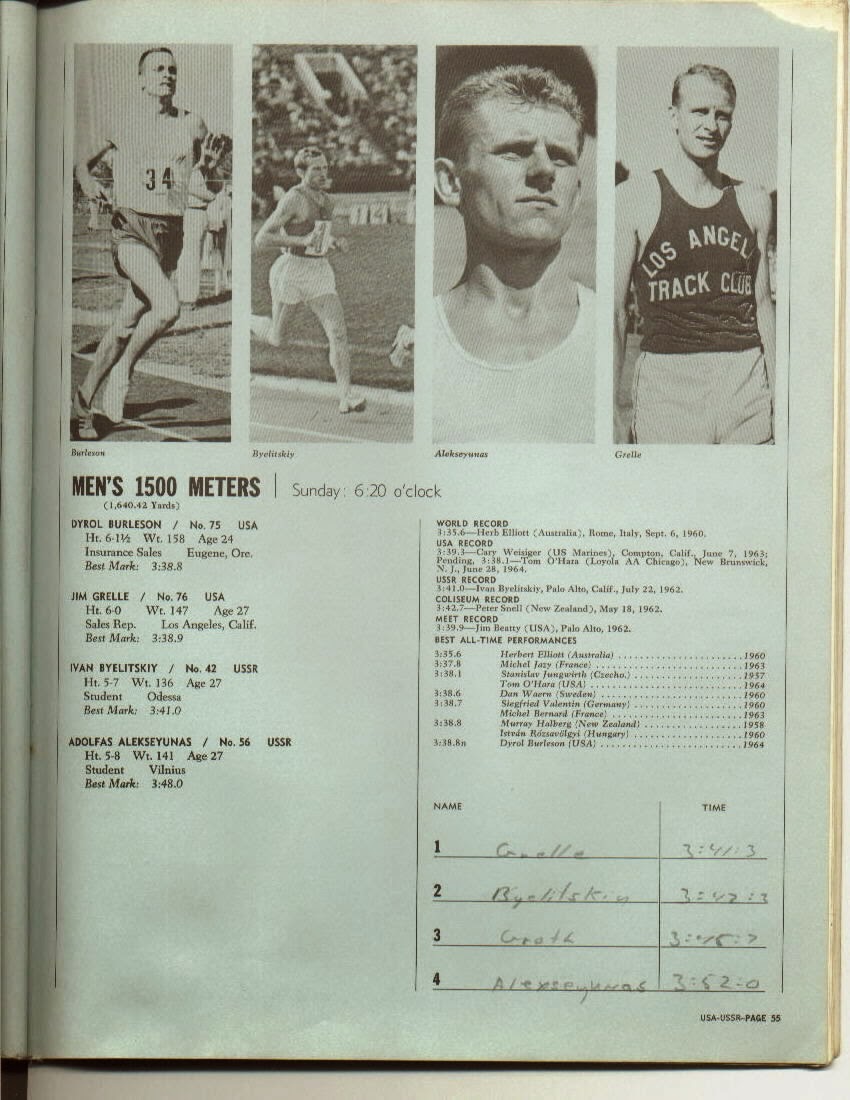
The program lists the US entrants in the 1500 as Dyrol Burleson and Jim Grelle, yet this is Morgan Groth lining up next to Grelle. No explanation is given. No description of the race is given. Grelle, a tried and true international veteran, coasts to a one second victory over Ivan Belitskiy in 3:41.3. Groth has a hard time of it, but tops badly outclassed Aldofas Aleksiejunas 3:45.7 to 3:52.0 for third.

                                            USA  7        USSR    4
                                Total  USA  120   USSR    83

5000 Meters
How many of you recognize that Bob Schul is wearing his Dayton Athletic Club singlet in this picture?
As competitive as the steeplechase chase was, the 5000 has the prospect of being even better. Bob Schul's 13:38.0 tops the world list. But the Russians counter with 1960 Olympic 10,000 meter champion Pytor Bolotnikov who has run 13:38.6 this year. The second Russian, Kestutis Orentas, has a formidable 13:45.0 to his credit. Bill Dellinger, with a PR of only 14:04.8, seems over matched. The race has an educational tinge to it. The program lists Bolotnikov and Dellinger as teachers and Schul and Orentas as students.
As Schul has a wicked kick, the obvious strategy for the visitors is take the race out at a stiff pace. Obvious to all except the Russians apparently. The pace dawdles. At ten laps it is only two and a half seconds faster than the pace Ivanov set in the 10,000. Yet the pace doesn't pick up and pack is together at the bell. The Americans can't believe their luck. The Russians have allowed the race to become a 400 meter sprint. On the backstretch Dellinger is the first to take off. Schul responds and pulls away decisively. It is over that quickly. Schul's last 400, in which he wasn't flat out until the backstretch, goes off in 54.4. Dellinger can't match that, but he leaves Orentas 25 yards in his wake. Bolotnikov is a well beaten last. Schul 14:12.4, Dellinger 14;14.2, Orentas 14:18.0, Bolotnikov 14:20.0.
                                             USA  8       USSR   3
                                 Total  USA  128  USSR  86


 The final race, the 1600 meter relay, is the very definition of anticlimactic. It is as if our guys are running a time trial. Ollan Cassell (46.8), Henry Carr (45.3), Mike Larrabee (45.5) and Ulis Williams (45.8) coast home with a 60 yard margin in 3:03.4.


USA  5    USSR  0
Total  USA   133     USSR    86

Game Set and Match


With ten sweeps and both relay wins, it has been a pretty good couple days for the US. Add to that the world records of Long and Hansen and toss in Jerry Lindgren's stunning upset in the 10,000 and you can understand why everyone is smiling as they leave the Coliseum. We can only hope the good mood will last long enough for them to get home before they revert to the ill-humored miscreants Cordner Nelson describes and start beating their wives.


The Women


USA  8     USSR   3
Total   USA  35    USSR  25


80 Meter Hurdles


USA  3    USSR   8
Total   38    USSR   33

800 Meters


USA 3    USSR  8
Total  41   USSR  41

Shot Put


USA 3      USSR  8
Total   USA    44  USSR  49*
*Track and Field News and our chronicler Steve Lincoln did not record the outcome of the women's shot put.  Until we find that result from some other source, in an effort to improve international relations between our countries, we at Once Upon a Time in the Vest are going to concede a sweep to the heroic Soviet Women's team.   We are asking in return that Vladamir Putin order an immediate withdrawl of Russian forces back 5Km from the Eastern Ukranian border.    We will also throw in 40 cases of Budweiser and some coupons for a 10 percent discount at Subway good until the end of the month but  ask that our Russian friends send over 2 cases of Stolynicha  vodka.  Spasiba.


Long  Jump


USA   4    USSR   7

Total   USA Women    48   USSR Women  56

USA Men 133   USSR Men  86

Combined Scores

USA  181     USSR  142
American prospects for the Olympics look rosy, but there are still two months before the Games, a long time to hold a peak. It is important to understand that much of the rest of the world is just starting its track season and will be heard from.
Ludwig Danek
(B. Jan. 6, 1937   D.  Nov. 15, 1998)

Just a week after the US – USSR meet, in the little Bavarian town of Turnov, Ludvik Danek steps into the discus ring for his first throw. When he steps out, he is the new world record holder. The giant Czech throws the platter 211-9½, a jaw dropping five feet three inches beyond the mark of Al Oerter. Big Al has two Olympic gold medals in his sock drawer. There may not be a third.

The French 400 meter relay team sets a European record of 39.2, just a tenth off the American world record. This may be the result of the new rule permitting relay runners to start ten meters before the passing zone, but our guys had the same advantage in the Russian meet and only ran 39.4. Yes, our team was without Bob Hayes, yet the French have put themselves in position for an upset.

Peter Snell , Murray Halberg, Barry Magee, and Alan McKight
Little has been heard from down under. Australian Ron Clarke has been running well in Europe, recently defeating the formidable Michel Jazy at 5000 meters, but New Zealand's Olympic champions, Murray Halberg and Peter Snell, have been laying low, although the word is out that Snell will attempt an 800 – 1500 double.
Witold Baran

Witold Baran of Poland has positioned himself squarely in the 1500 picture off his recent European record 3:56.0 mile. Steeplechase WR holder Gaston Roelants of Belgium has already run 8:31.8 and is a strong favorite in this event. Venezuela's Horatio Esteves has just run 10.0 to tie the world record. US trained Trinidadians, Kent Bernard and Wendell Mottley, have run 45.7 and 45.8 and are definite threats in the 400.

It is a long time until the Tokyo Games begin and a lot can happen. When it does, we will be there to tell you about it. Our next report will cover the second US Olympic Trials in which the remainder of our team will be selected. Stay tuned.


   And now for that bit of trivia which we throw out every so often so that you will have an advantage when the track crowd gathers Friday night at the Dew Drop Inn. Bob Timmons, Jim Ryun's coach at Wichita East, has taken a job as assistant coach at the University of Kansas. He speaks of his protege's workout program. “Jim is on a two a day program at his home in Wichita. He will continue on the program we worked out until the middle of August. Then he will come to Lawrence and workout with me until the Olympic trials. The emphasis will be on quality, with more speed work. Meanwhile.......(wait for it)......he will continue to service his paper route.”  If Jim Ryun was your paperboy and you didn't get your paper, would you call in with a complaint? Really?


     (Note: A special thanks to Steve Lincoln of Ukiah, California, who, as a rosy cheeked youngster, saw both days of the US – USSR meet. Steve was kind enough to furnish our reporting crew with his meet program. It was a great help. Thank you, Link.)




Monday, April 14, 2014

Vol. 4 No. 26 The USA Soviet Union Dual Meet 1964

DAY ONE
Official Program Cover   $1.00


The following pictures appeared in the program, though some of the athletes did not necessarily appear in the 1964 meeting, notably Glenn Davis, Wilma Rudolph, and Rafer Johnson.


1964 was arguably the greatest year in US track and field history and one of the reasons was the US – USSR dual meet held July 25-26 in Los Angeles. The series began in 1958 and has been held every year since except 1960 when the Olympics took precedence. The US men had won the first four meets by double digit margins but last year in Moscow the balance of power shifted and our guys were fortunate to escape with a 119-114 victory. Will that trend continue? Come along with us to the venerable LA Coliseum and we'll find out.
Unfortunately the August issue of Track and Field News, from which our crack reporting team is working, contains only one page of coverage and another of photos. Armed only with minimal information, we soldier on.
July's issue of TFN wrote off last year's close call in predicting a lopsided US win this year. Given the marks produced thus far, our guys certainly seem to have the edge on paper. But our season starts earlier than that of the Russians so the US athletes have had more meets in better weather, thus more opportunities to produce better marks.
The last time the USSR and United States met on US soil was 1962 at Stanford Stadium where a warm, enthusiastic two day crowd of 153,000 cheered for Russians and Americans alike. Not so this year says TFN co-editor Cordner Nelson. Even though the LA Times gave the meet great publicity and the Los Angeles area has a larger population than that of the Bay Area, only two thirds as many spectators fill the stands. Not only that, but they are not very nice people either, as demonstrated by their lack of vocal support for the visitors. Cordner writes, “The difference between those people (Los Angeles types) and nicer people (anyone else) can be seen at such a track meet as well as on their freeways – there seems to be a strong lack of love for their fellow man”. (Ed. note: Your reporter who moved from Los Angeles County to Northern California 35 years ago can attest to this. Northern Californians are much more pleasant, honest, trustworthy and better looking.)
Now it is 4:00 Saturday afternoon, July 25, a smoggy 90 degree day. The 100 meter dash is the first event of the men's competition. The Americans are strong favorites to go 1-2, but it is not that easy. Henry Carr wins handily in a slow (for him) 10.3 but John Moon barely nips Edvin Ozolin for second, both running an incredibly pedestrian 10.7.

 USA   8        USSR  3
 
The high hurdles produces another 1-2 US finish, but not in the order most experts predicted. Hayes Jones, who ran 13.4 at the first Olympic trials, hits the last two hurdles but it doesn't matter as Blaine Lindgren has the lead from the midway point and holds on to win 13.6 to 13.7. 
USA  8   USSR  3
 Total  USA  16     USSR 6
 
The 20,000 kilometer walk begins at 4:35. It is your reporter's educated guess that the race is contested on a road course. Can you imagine the reaction of those Southern Californians if the price of a ticket included the privilege of seeing four guys in shorts swivel hipping it around the Coliseum track fifty times in an hour and a half? These are LA people, the ones who arrive at Dodger games in the third inning and leave in the seventh.
That said, our guys, Ron Laird and Ron Zinn, get thumped as the Ruskies score their first sweep.

USA 3   USSR   8
Total   USA 19   USSR  14

AAU 400 champion Ollan Cassell has an off day but it doesn't matter. Mike Larrabee picks up the slack, winning in 46.0. Cassell's 46.8 completes the third US sweep of the afternoon.


USA  8   USSR   3

Total USA 27   USSR   17
Next up is the 10,000, a race certain to produce a smile on the face of any track fan of a certain age. The Russians, Nikolay Dutov and Leonid Ivanov, are heavy favorites. Their personal bests are 39 and 33 seconds better than the best American, that skinny high school kid from Spokane, Jerry Lindgren. Our other guy, John Gutnechet, has even less hope. Picture LA fans going to the bathroom or getting a beer and a hot dog. Nothing to see here, folks. Move along.
This is Lindgren's first international competition and he doesn't seem to understand that an 18 year old from the back country of Washington can't run with 25 and 26 year old international veterans in a high pressure competition. The miles go by in 4:37, 9:22 and 14:07, much too fast for the oppressive heat and smoggy conditions, yet the kid is right there with the Russians. Then on the 15th lap, Ivanov makes his move and opens up 20 yards. Lindgren stays with Dutov for 100 yards. Then coach Sam Bell yells, “If you feel alright, go on around”. Obviously Jerry is feeling just fine. He not only goes around Dutov, but closes extremely quickly on Ivanov, not only catching him but moving into a seven yard lead at the end of the lap. Yes, he has the crowd's attention.


This is not a tactical move. It is how the race will go from here on out. The kid adds about five seconds to his lead each lap. Looks of consternation cloud many Russian faces. How can this be happening? Lindgren is not a devastating kicker, but he doesn't need to be. By the time he starts his final lap he has a lead of 100 yards. A 63.6 finish brings him home 22 seconds to the good. His 29:17.6 knocks ten seconds off his PR, but is worth so much more considering the heat and smog. Ivanov finishes in 29:39.8. Dutov and Gutnecht are well over 30 minutes.

The kid who looks like your paperboy owns Los Angeles. Milkshakes and burgers are on the house, young man.
 
USA 6   USSR  5
Total  USA  33   USSR  22
 
There are suggestions that Frank Shorter's  marathon win in the 1972 Olympics was the beginning of the running boom in America.  Some feel that Bob Schul's and Billy Mill's victories later in 1964 in Tokyo were the beginning, but we believe that this race may well have been the prelude to all of those theories.  By 1964, Horace Ashenfelter's 1952 steeplechase win was all but forgotten by the American public.  It could be argued that all but a few even knew about it.  Here was national television coverage showing an American running on a level playing field with international class distance runners in the middle of the cold war against the Soviet menace.  What more could have brought such a focus to the American public?   Two months later in Tokyo, Americans were ready to see Lindgren and Schul take it to the world.  Schul fulfilled those hopes and Mills came out from under the radar and made us believers. 


The hits just keep coming. The pole vault, which started at 4:00, has finished with world record holder Fred Hansen adding two inches to his record with a clearance of 17-4. Dave Tork's 15-11 completes the fourth US sweep of the afternoon.
USA 8  USSR 3
Total  USA 41  USSR 25

An amazing upset by Lindgren and a world record by Hansen within a few minutes of each other, what could match that? 

 How about a stunning world record in the shot put? Dallas Long, holder of the current record of 65-10½ with a pending 66-7½ waiting approval, makes child's play of those marks with a throw of 67-10½. This is an astounding 14½ inch improvement and two feet further than any other man has thrown. Oddly, these two world records within an hour of each other, are produced by dental school students.
 
USA 7  USSR 4
 
Total USA 48   USSR 29


Longfellow wrote, “Into each life some rain must fall” and, indeed, it does, at least figuratively, in the long jump. Olympic champion Ralph Boston comes up a quarter inch short of Leonid Barkovskiy's 26-4¼. Ralph, who had fouls estimated at 27-4 and 26-10, writes it off as “just one of those days”. Charlie Mays' 25-6½ is good for third. With the 5-3-2-1 scoring system, our guys lose at least a point as the Russians take the event 6-5.


Total  USA 5   USSR  6

Total USA 46   USSR  31
Not to worry. We'll make it up in the hammer where world record holder Hal Connolly is ready for a big one. The figurative drizzle from the long jump becomes a downpour as Connolly can't pop the big one. He has roughened the soles of his throwing shoes to provide traction on the slippery cement circle. But the circle has been sand blasted and now the shoes don't slip enough. His 221-2 leaves him third behind Russians Romuald Klim's 225-9 and Gennadiy Konrashov's 223-11. Although popping a foul in excess of 220', Ed Burke is fourth at 207-7. Russia 8, US 3.

USA 3    USSR 8
 
Total USA 49   USSR  39

Fortunately our 400 meter relay team stops the bleeding. Paul Drayton, Bernie Rivers, Richard Stebbins and John Moon combine to run 39.4 and leave the Russians four tenths back.
 
USA  5   USSR  0
 
Total USA 54   USSR  39
As the fans file out of the Coliseum and ready themselves for the battle of LA freeway driving of which Cordner Nelson warned, we will take a moment to discuss the lack of consistency in reference to broad jumping....or is it long jumping? A year ago the IAAF officially changed the name of the event to the long jump. The event featured on page 37 of the program is entitled in capital letters MEN'S LONG JUMP. Can't be more clear than that. Yet, Track and Field News has not accepted the change in terminology. The event is repeatedly referred to as the broad jump, not only in this article and results, but in every report for the last year. TFN eagerly acknowledged the change from hop, step, jump to triple jump, so why not the long jump? Come on, guys, stop living in the past. This is the 60's. Get with it.


On the women's side our commentary is admittedly limited.  The pages from the program and the times and finish places written in by Steve Lincoln who loaned us this document provide the basics.  As most of us who were around in 1964 remember,  women's track was still an after thought.  A full program of events did not include half of today's women's schedule.   No 400 meters, 400IH,  1500 meters, 5,000 meters, 10,000 meters, steeplechase, race walk,  pole vault, triple jump, hammer,  4x 400 and a reduced short hurdles event 80 meters.     The Russians preferred to score the meet as combined, because it gave them some advantage with their strong women's team.  Americans did the opposite preferring to see an overwhelming men's win the measure of success.  We dismissed the women's meet on many fronts, mainly because we didn't think we could win the meet with a combined score.  It was portrayed as innocent American coeds vs. the stoic Russian peasant women , survivors of the deprivations of WWII.   The pictures of the Russians affirm as well as put that thought to rest.

100 METERS    WOMEN        USA 8     USSR 3


DISCUS    WOMEN   USA  3     USSR  8     
Total    USA 11   USSR 11


 JAVELIN   WOMEN   USA  3   USSR  8
Total    USA 14   USSR  19


HIGH JUMP    WOMEN     USA   8    USSR 3
CUMULATIVE  USA 22    USSR 22


                                      4 X 100 METERS   WOMEN    USA  5    USSR    0
                                           

 Total   USA   27    USSR  22


This is one of the write ups in the program recognizing Gerry Lindgren before he became a national hero in this meet.


Thursday, April 10, 2014

Vol. 4 No. 25 How Hungarians Launched America's Greatest Track Era- Rich Elliott

In preparing to read something that has been long awaited,  the 1964 USA  USSR dual meet,  sometimes it is good to do a little advance study.   We're giving you the link to a very good article by Rich Elliott, formerly U. of Kansas distance runner and Big 8 three mile champion in 1971.   Rich has two good distance running books out, to be mentioned shortly, but more recently in Running Times he has a story about the history of the Hungarian influence on American distance running in the 1960's.    Rich's article appeared in the January 27, 2014 issue of the magazine and can be seen in its entirety at the following link

http://www.runnersworld.com/elite-runners/how-hungarians-launched-americas-greatest-track-era

I'm sure many of you will enjoy this along with another link within that article to a Sports Illustrated about the Hungarians.  

Late last year we also published an original piece about Leslie Hegedus, an American Hungarian who was also a part of this era and was a very good runner under the influence of another good Hungarian coach  Julius Penzes. 

http://onceuponatimeinthevest.blogspot.ca/search?q=Les+Hegedus


Now on to Rich Elliot's two books.  
I recently purchased Runners on Running, the Best Nonfiction of Distance Running with contributions by Kenny Moore, Don Kardong, Kathrine Switzer, Hal Higdon, Amby Burfoot, Marc Bloom and others.  I can strongly recommend this work.  And Rich has done a great job putting all this work together in a meaningful order.  

Rich's other book which I have not yet seen is The Competitive Edge  about psychological preparation to compete.
http://onceuponatimeinthevest.blogspot.ca/search?q=Runners+on+Running

He  sells The Competitive Edge for $15 and Runners on Running for $20. That includes shipping.
His  contact info:
575 Grandview Ave.
Valparaiso, IN   46383
 
Just send him a check for the above amounts, and he will send the books to you.  Shipping outside the US will necessitate additional postage. 

Tuesday, April 8, 2014

Vol. 4 No. 24 Stanford Track and Field History

While waiting for reception (via US Postal Service and Canada Post combined, don't hold your breath)    of the US  USSR  1964 meet program promised by my colleague Roy Mason for insertion into our report of said meet, I've decided to move forward with the posting of a rare piece of track and field literature.   Recently I found a book on Stanford athletic history in a second hand store.  The book was published in 1952, and Dink Templeton, a former Stanford track coach turned journalist contributed a chapter on Stanford track and field and "The Big Meet" ie. the Stanford -Cal  dual meet.  Remember he was writing this in 1951 and was talking about the 'old days' relative to that time frame.  The accounts go back to before WWI and focus on the importance of the dual meet and how a less than top rung  team member could turn the tide in a dual.   Remarkably the athletes also seemed to have some negotiating skills with the meet officials, in one particular case getting a last chance to go for a long jump after the mile relay was finished, and winning the meet with a superhuman effort.   Of note too is that some of the California schools were in the IC4A and schools travelled east and west for their annual competition.

I haven't been able to find any pictures of the really old days at Cal or Stanford showing some of those competition, but I'm sure they exist in some archive in one of those venerable schools' libraries.     If anyone can come up with  pictures, please send them to us for inclusion in this article.  

Following the account by Templeton,  Bill Flint, a former polevaulter at Stanford has sent us an account of his experience jumping under Templeton's mentorship at the San Francisco Olympic Club.   Bill also has some comments on the the turnover of coaches and the advent of Payton Jordan.  Thanks, Bill for your comments.


George,

   First of all,  many thanks for all you do with the blog  --- I always look forward to reading it even though you runners dominate the coverage!

  The Dink Templeton articles really brought back memories ---in 1957 and 58 I was still at Stanford but 1956 was my thislast college eligibility year. So in 57 and 58 I competed for the San Francisco Olympic Club and Dink was my coach.  I can still hear his raspy voice yelling  "PULL" at me in the middle of my vault.

 Back to 1956--Jack Weiershauser's last year as Stanford's track coach.  Payton Jordan was to replace Jack in 1957 ---this would be the first time a "non Stanford man" would be coaching track and Jack was concerned future tracksters would loose the Stanford track past.  So Jack put together a dinner for us and had Dink be our guest speaker. I still remember that occasion as a very special evening --- many of the stories in the above article were told that evening and delivered in a way only Dink could  ---thanks, George, for allowing me to relive that time.

  A sidelight  ---Jack was fired (we all hated the treatment he got) but he never shared his feeling about that with any of us as far as I know.  Many years later Payton Jordan told me that when was approached about the Stanford job, he called Jack  ( his longtime friend) and said he wouldn't be party to this shabby treatment and would not accept the job.  Jack's reply was in effect, no, don't turn down this opportunity  --- I'm history here and nothing can chsnge that. To me, this incident shows the great qualities of both of these men.

   Bill

V 15 N. 10 Gunder 'The Wunder' Haegg Visits Cincinnati

Bob Roncker of Cincinnati, Ohio has sent in this account of one day on the 1943 tour that Gunder Haegg of Sweden made to the US to help rais...