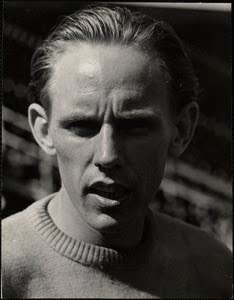
Once Upon a Time in the Vest

Tuesday, June 26, 2012

Vol. 2 No. 55 Meeting John Bork


Below is a series of emails exchanged between John Bork, George Brose, and Jerry McFadden.


Dear George:

Ernie Cunliffe, who I had the pleasure of rooming with during our January 1962 trip to New Zealand, turned me on to your web site!


That picture of me on your web site at Franklin Field-Philadelphia which the caption underneath saying " Penn Relays" is actually the finish of the 1961 NCAA 880Yd. Championship. My time was 1:48.3. At that time was a  new stadium record.

                                                                        CORRECTION
             John Bork Winning 1961  NCAA Meet in Franklin Field Philadelphia
My mistake calling it Penn Relays earlier


John,
Wow, what a surprise to get an email from one of my boyhood heros.   We never shared a starting line but growing up in southwest Ohio I did get to see you run in the MAC championships in 60  when they were at Bowling Green.  Western Michigan was really a powerhouse in those days with you and Jared Ashmore, Dick  Pond, and a few others I can't remember.  I occasionally see a guy named Barry Binkley who ran at Bowling Green and pr'd in that meet in the mile.  He may have gotten second.  But to whom I don't recall.  I'm pretty sure you took the 880 that day.  I graduated from HS in 1961, so I was a bit behind you.  I went to Oklahoma and ran 4:09 and 1:51 but never went to any big meets other than the relays.   Did you ever run that AAU meet that was held annually in Ft. Wayne, Indiana?  That meet used to draw a lot of the big names in the Midwest, and I think a number of your teammates and perhaps you may have been there.
 My good friend Steve Price (coached the Kettering Striders and then the women's coach at Bowling Green) I think knew you .
George Brose

 Dear George:

Boy do we have some paths crossing along the way.

I grew up in Monroe, Michigan.    Monroe is just 17 miles from Toledo and about 40 miles from Detroit.
What town did you grow up in?

I met Steve Price at Miami of Ohio in 1962 when I started my graduate work there.
I was Steve's freshman cross country and track coach as assistant to Bob Epskamp
Steve interested me to Blues music. We went to a local college hangout together that featured 
a great rythym and blues band "Maurice and the Rockets. (CORRECTION from Steve,  It was Maurice and the Mystics)   Bob Epskamp had first been myHigh school Coach at Monroe H.S. and then our assistant coach at Western Michigan to George Dales.  So, I followed him down to Miami of Ohio. I had the honor of coaching Jack Bacheler, Andy Schramm, Dave Bartell when they were freshman at Miami. in 1963.
I ran cross country for four years at WMU so I was in races with Barry Binkley. At that time we had tremendous depth at WMU and Bowling Green did not so, I think we kind of overwhelmed Barry. He was quite talented

At the1961  MAC Meet which you witnessed  at Bowling Green we swept the 880 Rich Mach 3rd. Dick Greene 2nd. My winning time of 1:50.8 was a MAC and Track record at the time. A couple of weeks later at the Central Collegiate Conference meet I ran under 1:50 for the first time with a1:49.0. Bob Teague had graduated from Kansas but, his teammate Kirk Hagan was 2nd in the race. Charlie Durant of Drake was 3rd.

Yes, I ran in the Ft. Wayne Invitational/AAU Meet in 1961. I won the 880 in about 1:50.0, nipping George Kerr of Jamaica/U of Ill. and Jim Dupree.. I was third to Jim Dupree later that  year at the Nat. AAU Championships,  1:48.5 to 1:48.8 Jerry Siebert nipped me at the tape to keep me off the USA Team.  Coming down the home straight, Geroge Kerr ran me out into the 3rd. lane and hammered me with three big elbows which really  took the sting out of my kick. After I finally got around him I set out after Dupree and was rgaining ground but about 10 yards from the tape, Jerry Siebert blew by me and I had no time to respond. Kerr was fourth and our friend Ernie Cunliffe was fifth. Good Company.

But, I must tell you how Mt. SAC JC Champion and 880 record holder, Ray VanAsten, helped me make the finals. I was tired at the AAU meet on Randalls Island NY after running 3  races at the NCAA Meet. But, luckily the heats were slower at the AAU than at the NCAA's.

In the semi's as we neared the 440 mark I was in the middle of the pack with Wayne Farlow of USC on my inside and Ray Van Asten outside me. Suddenly Farlow decided to make a move, cutting directly in front
on both me and VanAsten. In order to keep from tripping over Farlow, I pushed him forward with both hands
which also pushed me backwards, tired and disheartened I was about to step off the track. But, as Farlow cut in front of Ray VanAsten, Ray, yelled "Farlow, you Fucker!". This caused a ripple of laughter in the crowd and cracked me up too, so, I gained back my desire and finished about fourth to make the final.

2 nights ago, I made contact with Ray Van Asten and told him the story and, thanked him for helping me make the final. Ray was a little taken back by my telling of the words he blurted out. He remembered the incident but not his actual words. That was the only time that Ray and I were in a race together. He went on to U of Oregon after Mt. SAC but, told me his career ended in 1964 with a back injury sustained the season before.

So, finding Ray Van Asten after these 51 years to thank him; gave me courage to try and locate
my New Zealand teammate, Ernie Cunliffe and....... then Ernie introduced me to your web site.

Cool!

More later.

John Bork


John,
That's a great story about Wayne Farlow.  I'll include it in the blog maybe as an 'expletive deleted' if Van Asten doesn't mind.   (Like hell, I will.)
  
George  


George:
PS, I see that I goofed... Wayne and Warrren Farlow were twins. I slipped
It was in the semi final race with Warren Farlow, not Wayne., oops.
I don't think I ever ran against Wayne. I'm not sure if he was there at NY but, in another heat.
My. brother Dave coached Track and Cross Country at Monroe High School for many years 
70's thru 90's and was Mid West XC National Coach of the year back when.
His most notable runner was Olympian Todd Williams. Dave had about 9 state champions
and one of his team set a state record for the lowest score ever in the Class A XC Championships
of about 19 points, with Todd the winner, Tim Pitcher (Later of U. Tenn.) and Dave's Son Derek
in the top 10. Derek went on to Stanford and now is a corporate Attorney in Cleveland, Ohio.

It is interesting that you ask if I've written a book. which is funny because last week, my friend Tom Trumpler here in Camarillo commented in an em-mail; that I should write my "obituary" or a book. I told Tom yesterday that I'm not sure, I will because only 4 people would probably read it.  I may do it for my kids. Tom is an ardent track nut, who was meet director for the Camarillo H.S. Relay Meet which featured Jordan Hasay as a high schooler.
Back in the day when Max Truex, Bob Schul; and Ernie Cunliffe were stationed at the Oxnard AFB
they used to come over to Camarillo and use the  old. track.

I had a son and twin daughters who ran on the Camarilo H.S. track teams. Kevin was County 100M and 200M Champion one year. 10.88, 22.1 and 48.5 

Got to go.

John Bork


George,
This is the photo of John Bork I was talking about. The front runner is Dale Story of Oregon State, followed by Bork, then myself, during the 4x1 mile relay at Drake in April, 1961.

Western Michigan came into the event totally unheralded, with Oregon State, Missouri, and Iowa considered the favorites. Jerry Bashaw led off for WMU with a 4:19.8, followed by Jerry Ashmore in 4:10, then Bork blew us all away with a 4:07, with Dick Pond anchoring in 4:13.6 - for an American record of 16:50.4. The previous American record was set in 16:52.4 by an American "All Star' team in London in 1952.

Oregon State took 2nd in 17:04.4 with Missouri in 3rd at 17:08.0.  Sorry the photo is a bit overexposed.

Jerry McFadden


John,   just got this from Jerry McFadden,  the third guy in the picture.
George Brose
                                                        Drake Relays April , 1961
                                                          3rd Leg  4x 1 mile  relay
                    Dale Story (Oregon St.), John Bork (Western Michigan)  Jerry McFadden (Missouri)

Dear Jerry and George:

What a wonderful birthday gift you guys have sent me. And, on my actual birthday.  I had no idea that this photo existed..... for over 51 years.   Did a teammate take this photo, Jerry? Or, is it a press photo?

Thanks so much!

John Bork


John,
It was taken by a teammate. We were hoping that that we were going to have a good day as we had ran 17:05 the previous week at the Kansas Relays and thought we could handle the other teams (only Houston had ran faster at that point) but you guys ruined our party! But it has been fun to say we were there when you guys took the American record.    Glad you enjoyed the photo and that it arrived on your birthday. Nicely done, George.
Jerry  McFadden


Thanks Jerry,   that gives it a unique flavor.   Didn't you tell me Rawson (your roommate) got killed in Viet Nam.  I remember Pelster had a had a strange toes out stride but it didn't seem to slow him down at all.  There's a good picture of Rawson in the Drake Relays archive.  I'll see if I can locate it.

Bill Rawson
George


George,
You have a great memory. Bill was killed in Vietnam as a Marine 2nd Lt. a few months after he graduated from MU. His name is on the Wall in D.C. 

Jerry


It's nice to be remembered some 51 years later.
Just when I was groveling in the realization that I had become an  * askerisk to track and field lore just as
the " Paavo Nurmi's of another day" were to us back in the 1950's and 1960's. - 
So, thanks for making me feel "remembered"..

John Bork


Vol. 2 No. 54 Reggie Pearman R.I.P.

Reggie Pearman (1923-2012)


Reggie Pearman, one of the US’s premier middle distance runners in the post WWII era, passed away June 15, 2012 in New York City at the age of 89. 

Born of Ethiopian immigrant parents in New York City, Mr. Pearman attended NYU and was a prominent member of the Violets track team.  He ran in the 1948 and 1952 Olympics, suffering a severe spike wound tohis Achilles tendon in 1948, and it was thought he would only walk with difficulty after that injury.  He was back running at a high level within the year.  He  finished 7th in the 800 meter final saying, “I ran a lousy race.  Those guys didn’t sit around and wait for me.  They had their own races and raced them. 

In 1957 he won the national AAU 440 championship  at Dayton, Ohio.  In 1976 he was inducted into NYU’s hall of fame.

Mr. Pearman was a close friend of Charlie Jenkins, the 400 meter champ at Melbourne.  Jenkins recruited Reggie into the US Peace Corps where he worked as an administrator in Venezuela.    Prior to that he had been teaching social studies and health education in a junior high school in Queens.  He continued his education at U. Mass receiving a doctorate in education, then taught graduate and doctoral students in education at Cornell, California State (PA) and other schools.

His first race was in a school intramural meet in 1941.  "I think I ran the 440", but the following year he won the New York City high school cross country championship as a freshman.  He also ran for the New York Pioneer Club, one of the first racially integrated track and field organizations.

Having no guidance on seeking scholarships, he was a walk on at NYU.  “My parents came from Ethiopia.  They didn’t understand what a scholarship was.”  As a member of NYU’s team, he helped the school win a number of national relay titles which included a WR 3:22.7 sprint medley in 1950.  His name was put on the Penn Relays Wall of Fame in 1994.

Mr. Pearman served in the army in the Philippines in WWII and re-entered to serve in Korea as well. 

Monday, June 25, 2012

Vol. 2 No. 53 A Scientist's Comments on Lolo Jones

From Bill Blewett

George,


On the subject of Lolo Jones: I saw the piece about her on the NBC Nightly News, and was awed by the magnitude of high-tech support she has received to prevent a repeat of 2008, i.e., hitting the ninth hurdle.  To me it seems simple, fatigue takes hold even in a race of only 100 meters, causing the stride to shorten late in the race.  The 10 cameras and real-time computer modeling is merely technology in search of an application, with the only real benefit being to market her sponsors' products.  She's on the team because of her talent, resolve, and assiduous training, not  because of high-tech gadgets.

Vol. 2 No. 52 Brits' Interesting Concept for Their Olympic Trials

I just noticed in the London Telegraph online site that the British are currently having their Olympic trials, as are the Americans.  However, the Brits allow international runners such as the Ethiopians participate in their trials.  This must spice up the races and give the selectors a chance to observe their athletes in high level competition.  It was stated that the first two British placers at these trials, who also had achieved the famous or infamous  'A Standard' , would get a uniform and a place on the team.  I suppose that leaves the selectors some leeway in choosing number 3 individual in each event from performances in the trials or elsewhere.

Vol. 2 No. 51 You Wanted Those Kenyan OT Results?


Saturday, June 23, 2012

Rudisha runs 1:42.12 at altitude – Kenyan Olympic Trials

David Rudisha at the Kenyan Olympics Trials
David Rudisha at the Kenyan Olympics Trials (Muthoni Njuki (Capital FM))
Nairobi, Kenya - The might of the World 800m record holder, David Rudisha, fittingly crowned the final Kenyan Trials for London 2012 in Nairobi as three reigning Olympic champions survived furious onslaughts to earn Olympic selection on Saturday (23).

In front of an adoring public of about 15,000 in Nairobi’s National Stadium, Rudisha’s powerful strides opened up on the homestretch to stop the clock at an astonishing high altitude record of 1:42.12 to seal his place in his first Olympic Games after a tendon injury buried his hopes four years ago.

The breathtaking performance on the last event of programme appropriately wrapped up an enthralling day of track action as the final pieces of the Kenyan London 2012 jigsaw fell into place.

Nancy Jebet Langat, the women 1500m titleholder from Beijing, will not defend her title after a knee injury ruled her out of the start. However, fellow Olympic gold winners, Pamela Jelimo, Asbel Kiprop and Brimin Kipruto as well as Athens 2004 champion Ezekiel Kemboi booked their places for the London showpiece in contrasting fashion.

World 5000m and 10,000m champion, Vivian Cheruiyot, successfully kept her two-pronged London assault on track by winning the 5000m Trial having taken the 10,000m race a week earlier.

Isaiah Kiplangat Koech, blessed the Nyayo tartan with a new 5000m soil record of 13:09.80 in the other signature performance of the meet to lead a crop of upcoming runners who upset the established order during the selection meet.

'King David’ reigns

Organisers slotted in the men's 800m Trial as the last race of the programme with the main act David Rudisha sending supporters into orbit with another devastating display of front running masterly that will surely send shockwaves across the world.

The anticipation was palpable since the World champion and record holder had laid down the gauntlet when he cruised to a 1:44.0 victory during Thursday’s heats and from the gun Rudisha had an unobstructed view as he pounded the track to smash his own 1:42.84 record at altitude when winning his second African title in 2010 in the same stadium.

Fans led by Kenya’s vice-president, Kalonzo Musyoka, rose to acclaim the runner known as 'King David’ in his homeland as he took his lap of honour, complete in Masai Moran traditional regalia, amid wild cheers.

"I’m very happy since Kenyans love sport and they love athletics and they give us support. Even today, they cheered as the start list was being announced and that is why I always want to deliver something for them," said Rudisha.

"If I wanted to run a slow race and win nice and comfortable, I would have done that but for those who are not able to come and watch us run in Europe, I try to do my best to show them how we perform there live. It’s such an honour," the world season leader - 1:41.74 achieved in New York - explained.

"I’m feeling in better shape than in 2010 and my Olympics dream has come true and what remains is to keep the shape since I want this gold so much because it is the only medal missing from my table," he added ominously to his rivals.

Behind him the 'other’ race saw Commonwealth Youth winner, Timothy Kitum beat double Africa junior silver medallist, Anthony Chemut in a flying finish that returned 1:43.94 against 1:43.96 to earn the youngsters the remaining Olympic slots.

Rudisha was thereafter, named in the men 4x400m relay team as expected, giving him the chance to double and emulate his father, Daniel Rudisha.

"I’m happy they have announced it today. 4x400m will come after my event and I hope we will work as a team to perform well in the event my father ran in 1968," he added alluding to his elder’s silver success at the Mexico Olympics.

Cheruiyot at the double

Spurred by the scorching desire to emulate Ethiopian rival and double Beijing champion, Tirunesh Dibaba, Daegu 5000m and 10,000m winner, Vivian Cheruiyot, declared the best was yet to come from her as she outclassed a rich field in the 12 and a half-lap race in 16:08.08.

"I’m happy because this time, we are going to race with Dibaba. It’s been a long time since I raced Dibaba. I know you will see the best in the big race," said Cheruiyot.

Once again, she was not pushed to her limits as she managed to detach from the challengers at the bell as Daegu silver medallist, Sally Kipyego, who was third in the 10,000m Trial followed her across the line in 16:09.29, beating the resurgent Beijing 1500m finalist, Viola Kibiwott (16:09.45) to complete the London line-up.

Kiplangat sizzles

With World Cross junior champion, Geoffrey Kipsang Kamworor (DNF) setting a blistering pace, Isaiah Kiplangat Koech, edged a thrilling three-way sprint for the finish in 13:09.08, the fastest ever ran on Kenyan soil.

Beijing bronze winner and African champion Edwin Soi ensured a second successive Olympics appearance when he led the challengers home in 13:11.11 after coming from behind to edge out Daegu sixth finisher, Thomas Longosiwa (13:11.28).

"This time, I want to finish higher than Beijing. These Trials are tougher than the Olympics itself," Soi quipped.

Kiprop on the knife edge

Only a late lunge in the homestretch saved the title defence of Beijing titleholder, Asbel Kiprop from being the headline failure of the Trials, as Worlds silver medallist Silas Kiplagat won his second successive selection race.

In a tactically absorbing race, the top-three in the world season list, Kiplagat, Kiprop and Nixon Chepseba faced a minefield line-up and their quality prevailed in the end as the Commonwealth champion won in 3:37.60.

"Winning here is good but last year, I won and went to silver and this time, I want to make sure I get my calculations right since just like last year, I was in good shape. I foresee a situation where we can win all the medals for our country and I will work with my teammates for that," the winner said.

Chepseba, who missed outside selection to Daegu, last year, came home in second (3:38.00) and could not hide his delight gushing, "this time, no one can deny me, I have lost to wildcards for so long and my dream has come true."

Kiprop was seventh on the final bend as his bid for a second Olympics gold looked set to collapse only for his lanky legs to propel him to third in 3:38.30, just shading World junior titleholder, Caleb Mwangangi (3:38.80).

"The young runners blocked the inside," said Kiprop, who employed a risky strategy of hanging behind. "It’s a good thing that I did not win the Trials since the pressure that comes with it is too much. I won the Trials for Osaka and Berlin World Championships and returned home without a medal."

"Having the top three runners competing for Kenya is a bonus for the country but my aim remains winning the Olympic gold on the track."

World Indoor champion, Helen Obiri, took the women’s 1500m Trial in 4:06.10 to set her on the path of collecting the Olympics title as Daegu 800m finalist, Eunice Sum (4:07.19) and World Youth champion, Faith Chepng’etich (4:08.53) joined her for the Games.

Chepng’etich will also compete for her nation at the World Juniors in Barcelona before her Olympics bow.

Jelimo on song

Another of the crowds’ darlings, Pamela Jelimo was vociferously cheered when she laid down the hammer in the second lap after they went through 400m in 61sec to charge away to a dominant 1:58.48 victory.

"I’m working on my speed since winning the Olympics will not be easy. Making the team brings so much joy and unlike 2008, I know I have to work harder to win," she told.

A career best performance of 2:00.33 rewarded 2007 World Youth champion, Winnie Chebet with the second London slot as Beijing silver winner, Janeth Jepkosgei (2:00.47) finished third to join the party.

"I had a hamstring injury that saw me not train for two weeks but now, I have another chance to go there and do my best to finish in the podium," said the 2007 Osaka Worlds titleholder who is credited with 14 medals for her nation in her decorated career.

Brimin with confidence

Olympics 3000m Steeplechase gold medallist, Brimin Kipruto, won his second Trial on the trot but the acclaim belonged to double World champion, Ezekiel Kemboi, the Athens champion who re-enacted his famous jig from Daegu to throw the stadium into frenzy.

Kemboi (8:12.82) appeared to motion to Kipruto (8:11.73) to go ahead and claim victory after he pulled level with him with 50m to go as Abel Mutai (8:13.47) claimed a surprise Olympics slot by trailing the pair in third.

"The first part was to qualify in a very tough race and that is finished. Now I can concentrate on doing everything to defend my title," Kipruto expressed.

"Today, I just wanted to make the team and go to London where I will give everyone a good race. Part one of the objective is done now we move to part two in London," the showman who is Kemboi said after completing a repertoire of post race antics that included more jigs and a lap of honour.

Commonwealth champion and twice Worlds bronze winner, Milcah Chemos, did justice to her top billing as the 2012 leader and clinched the win in the women’s 3000m Steeplechase in 9:32.75 ahead of her Delhi bridesmaid, Mercy Njoroge (9:33.32) as African bronze winner, Lydia Rotich (9:40.41) returned third to book her London ticket.

Down and out

Staying true to established tradition, the London 2012 Trials claimed their share of big names that saw Olympics dreams snuffed out in unforgiving fashion.

Olympics bronze medallist and 2007 World champion, Alfred Kirwa (6th, 1:45.19) and Commonwealth Games silver winner Richard Kiplagat (7th, 1:45.79) were the high profile victims of the Rudisha 800m blur.

Olympics silver medallist, Eliud Kipchoge’s history making third successive appearance at the Games dissipated when he was forced to seventh (13:10.86) in the men's 5000m having missed selection in the 10,000m selection event at the Prefontaine Classic.

Commonwealth, Continental Cup and African Steeplechase champion, Richard Mateelong, who won bronze in Beijing had his prized scalp claimed in the men 3000m steeple as he slumped to fifth in 8:14.00.

Beijing silver winner in the women steeple, Eunice Jepkorir, returned 10:13.28 for the wooden spoon as world leader in the corresponding race, while Paul Kipsiele Koech again succumbed to his chronic high altitude sickness in the men's race.

"I know I can perform if given the chance to run in Europe but despite feeling good for most part of the race, running in altitude cost me again," he lamented.

Beijing fourth finisher and Berlin World champion in 10,000m, Linet Masai was in the frame for selection in the 5000m until metres before the bell after dropping out of the longer race with stomach cramps last week but eventually faded to seventh in 16:23.75.

"My race is the 10,000m but today, I did not have the speed and I wish the girls all the best in London. I will work hard to ensure I will be around for the next one," a distraught Daegu bronze winner rued.

The team reports to camp on Sunday.

Mutwiri Mutuota (Capital FM) for the IAAF

SELECTED RESULTS

MEN

800m
David Rudisha 1:42.12
Job Kinyor 1:43.94
Timothy Kitum 1:43.96
Alfred Kirwa 1:44.61
Abraham Rotich 1:44.79

1500m
Silas Kiplagat 3:37.60
Nixon Chepseba 3:38.00
Asbel Kiprop 3:38.30
Caleb Mwangangi 3:38.80
Bethwell Birgen 3:39.00

5000m
Isaiah Kiplangat 13:09.80
Edwin Soi 13:11.11
Thomas Longosiwa 13:11.28
Vincent Kiprop 13:19.47
Emmanuel Bett 13:21.55

3000m Steeplechase
Brimin Kipruto 8:11.73
Ezekiel Kemboi 8:12.82
Abel Mutai 8:13.47
Jairus Birech 8:14.05
Richard Mateelong 8:34.00


WOMEN

800m
Pamela Jelimo 1:58.48
Winnie Chebet 2:00.33
Janeth Jepkosgei 2:00.47
Lydia Wafula 2:00.74
Jane Jelagat 2:01.65

1500m
Hellen Obiri 4:06.10
Eunice Sum 4:07.19
Faith Chepngetich 4:08.53
Margaret Wangari 4:11.84
Mary Kuria 4:16.68

3000m Steeplechase
Milcah Chemos 9:32.75
Mercy Njoroge 9:33.32
Lydia Rotich 9:40.41
Phanencer Chemion 9:48.63
Hyvin Kiyeng 9:51.07

5000m
Vivian Cheruiyot 16:08.08
Sally Kipyego 16:09.29
Viola Kibiwot 16:09.45
Sylvia Kibet 16:10.81
Janeth Kisa 16:18.71


Vol. 2 No. 50 Olympic Trials 2012

This is a blog devoted to 1950's and 1960's Track and Field, but current events are hard to ignore.  I was able to watch the Olympic Trials on Saturday and Sunday.

  A few comments concerning said event: 

1. Production:    They are doing a bit better with less blathering by the announcers (exception being Bruce Jenner  interview)  I'd much rather have heard something from Milt Campbell who was also  there.  Milt's post Olympic career and life tell a much better story of America. He got less than a full second of camera time.
2. The woman interviewing Jenner and Dan O'Brien was completely out of her element.  A Katie 'Queen of Fluff' Couric wannabee.       I don't even want to speculate on how she scored this gig.   Dwight Stones should retire, as field events barely received any attention. 


3. Ashton Eaton's performance put this observer on the edge of  credulity, especially coming through in a 1500 pr to break the world record.  It appeared that the two leaders Joe Detmer and Curtis Beach  in the1500 let up to encourage Eaton.  I'm wondering if Detmer sacrificed his third place position overall  to help out.  Eaton was easily the most articulate and gracious interview of any of the winners on Saturday.  It is difficult to imagine how anyone could expect to get an intelligible word out of someone who has just made a lifetime dream come to fruition.  A few thanked their maker and extolled that he has a plan for them.  It makes one wonder what the plan is for the ones who didn't make the team.
4.  One of my regular sources (Ernie Cunliffe)  explained that Joe Dettmer who slowed and encouraged Eaton at the finish of the 1500 probably didn't have the 'A standard' (8200 points)  to represent the US at London, but he still might have placed third instead of fourth as he was only 23 points out of 3rd.  Ernie informed me that you get about 4 points for each 0.5 second improvement in the 1500,  therefore if Dettmer had managed a 4:11.36 instead of his 4:14.77  he might have been third, but still not good enough for an A level performance.   Still this was a nice gesture.  I don't know that he could have done a 4:11.36 but it's nice to believe it was possible.  After all Eaton did the near impossible.  He also would have made the US team in the long jump with his 27'  (8.23 meter) effort.    Now, what has this kind of goings on meant in the past?  Dennis Kavanagh shared a bit of history. 


"At the 1951 Pan American Games, Browning Ross placed 1st in the 1500 meter run, shared 1st in the 3000m steeplechase, and finished 4th in the 5000m run.  A controversy occurred in the 3000m steeplechase, where two Americans, Curtis Stone and Ross had pulled away from the field.  Stone slowed down on the last straightaway and held Ross's hand as they crossed the line together.  Argentine officials debated for two hours whether their actions violated rules requiring athletes to make an effort to win before finally allowing the results to stand.

I am not sure and haven't researched it, but I have the feeling that Stone won the AAU cross-country championships one year.  I am not sure I have anything that summarizes the winners, or whatever, of the old championships.  Well, let's interrupt this for a commerical;"  DK

5. The  public relations folks are probably breathing a sigh of relief that Lolo Jones managed to qualify in the hurdles.  They covered her more before and after the race than Dawn Harper and Kellie Wells  who beat her rather soundly.  Obviously a lot of ad agency money is riding on her being at London to promote whatever products they can tout using her smile and looks.  Maybe they had a reality show planned if she didn't make it.  Sort of a fall from grace thing.  Glad to see she made it through.  We'll be bombarded in the coming weeks with any conceivable product.  I can just imagine the meetings this Monday morning at her ad agency.  This too would make another reality series.   "America's Fastest Next Best Model".  Any other suggestions?   Post on 'Comments' below.

From Bill Blewett - "George,  On the subject of Lolo Jones:  I saw the piece about her on the NBC Nightly News, and was awed by the magnitude of high-tech support she has received to prevent a repeat of 2008, i.e., hitting the ninth hurdle.  To me it seems simple, fatgue takes hold even in a race of only 100 meteres, causing the stride to shorten late in the race.  The 10 cameras and real-time computer modeling is merely technology in search of an application, withthe only real benefit being to market her sponsors '  products.  She's on the team, because of her talent, resolve, and assiduous training, not because of high-tech gadgets."


6.  The 800 semis weeded the 1:43 potential guys from the 1:46 guys.  The top three on Monday will have a shot at the silver behind David Rudisha of Kenya unless some unforeseen circumstance occurs.


7. Is the US the only place that has this type of selection process, or am I missing some olympic trials elsewhere?   The Answer:  Kenya had one.  I'm told that Kenya had a great trials this weekend as well.  Have to look it up.

8. David Rudisha (800 meter record holder )  is the son of Daniel Rudisha, a silver medalist on Kenya's 4x400 way back when (1968 Mexico City) .  Interestingly this family name 'Rudisha' is Masai, not one of the more prominent running tribes of the Nandi and Kalenjin.    David apparently ran a 1:42.12 and some change with approximate 50, 51 splits.   Led from wire to wire.  Bring on the world.  Keep taking your malaria pills, and stay on that high protein diet, David.

Thursday, June 21, 2012

Vol. 2 No. 49 A Conversation with Peter Snell

A Brief Conversation With Peter Snell

We’ve recently reported on the racing in New Zealand when Peter Snell set records in the mile, 880, 800,  and then went to Los Angeles and set the indoor 1000 yards record and 880 yards as well during that race.  Ernie Cunliffe put us in touch with Peter, and I sent him a few questions about the race at Wanganui, and he graciously responded. 

My questions centered around the effort of running on a short (less than quarter mile ) track, grass surface, what his expectations were going into the race, and what Arthur Lydiard’s role was in that week when the races occurred.  I also asked Peter about getting into his chosen profession of exercise physiology.   I enquired if he knew one of my former colleagues in the field,  John Ivy, who also works in Texas.  Below are the replies that Peter Snell sent.

Wednesday May 16, 2012

George,

Ernie forwarded the piece on Wanganui written by Roy (Mason)  and quite frankly he has it all in a nutshell.  I’m not sure there is much I can add except my thought processes leading up to and during the race.  For example based on the New Years Day run mentioned by Roy, which was done 3 weeks after racing a marathon and during volume intervals in conjunction with long runs, I felt that 3.57 was conservatively realistic – in keeping with my preference for not raising expectations too high publicly. 

Perhaps you can give me some guidance. 
Regards,

Peter


George,
The above draft was written last week and I lost a large chunk of the text when my application crashed.  I was too bummed to try and do it over again.

I had seen very little of Arthur that summer so all he had to go on were race performances, including the marathon, leading up to the Wanganui event.  He may have been aware of my New Year’s day race and put 2 & 2 together, as did I.  He was present at Wanganui but I did not see him until after the race when news people found him and brought him over for a photo attached if I can find it)  His contribution was to publicly predict I would do 3:55 thus adding unwelcome pressure but it certainly filled the stadium.  The non-standard track was not a problem as many of the club tracks on which I did my training were 5 laps to the mile grass.

I preferred firm closely mowed well-rolled grass to loose cinders such as at Tokyo and Rome.  Californian clay tracks were the best and I hated the bitumen track at San Diego.  Too bad today’s rubberized tracks weren’t developed. 

Yes I know John Ivy very well.  My path to becoming an exercise physiologist started in 1974 when I enrolled as a freshman at UC Davis to educate myself out of an unsatisfying Sports PR job with a tobacco company.  Thanks to an invitation to Superstars late 1976, I made enough money to stay on after graduating in 1977 and spend 4 years at Washington State to with Dave Costill’s colleague Phil Gollnick. 
Thanks for the Jazy photo.  I notice Michael Bernard in the photo.  Jazy must have thought the 5000 was the easier race to win.

Regards,

Peter


Wednesday June 6, 2012


George I just saw your photo of Ron Delany and find it interesting to see how well the 1960’s runners are aging.  With this in mind I’m attaching a photo of me, Jim Bailey (1st sub-4 on American soil, 1956) and Dave Wottle.  Also a pic of some good 800 guys at reunion organized by the late Bud Greenspan.

Regards,

Peter  


Peter Snell   Jim Bailey   Dave Wottle


800 Meters Olympic Champions
Peter Snell (1960   1964)
Tom Courtney  (1956)
John Woodruff (1936)
Dave Wottle (1972)

Wednesday, June 6, 2012

Vol. 2 No. 48 Anthony Whiteman 40 years old sub 4 minute mile

Anthony Whiteman out of Cleesthorpe , UK set a new outdoor record for the Masters mile on the Vanderbilt track in Nashville this week. His time of 3:58.79 surpassed the previous outdoor record of 4:01.62 held by Vyacheslav Shavunin. Only Eammon Coghlan's indoor Master's time of 3:58.13 has been faster over that distance. the race can be seen at the following site. ///// http://www.flotrack.org/coverage/249408-2012-Music-City-Distance-Carnival/video/639431-M-mile-Invite-Anthony-Whiteman-Masters-WR-2012-Music-City-Distance-Carnival ///// I realize we focus more on 1950's and 60's track and field events, but the achievment by Anthony Whiteman is certainly worth noting. Congratulations for an outstanding performance. Anthony Whiteman finishing the race.

Tuesday, June 5, 2012

Vol. 2 No. 47 March , 1962 and Introducing A Brief History of Track Shoes

Once again for the 137th posting on this blog, Roy Mason, our track historian does his customary and expected great job of bringing us a review of our sport's history. Some pictures of the Los Angeles Track Club are from 1963, a year out of sequence, but I thought some of you West Coasters would get a little teary eyed looking at them. In addition we will be introducing a section of track and field shoe history from our friend Phil Scott of Clayton, Ohio who among his many talents has a hobby of collecting old track shoes. Phil is one of the most dedicated and knowledgeable track nuts around as well as being a former National Junior College decathlon champion and bike racer and specialist in bicycle restoration. He is also the proud father of Jason Scott who is currently threatening to clear 18 feet in the pole vault and qualify for the Olympic Trials. Phil has shared some of his vast collection displaying it at Endurance Sports in Bellbrook, OH. Joe Sargent, entrepreneur of Endurance Sports allowed me into his establishment to photograph some of the shoes, without requiring me to actually make a purchase. Joe, always a gentleman.


And so we begin with Roy's review of March 1962 taken from the pages of Track and Field News and his encyclopedic memory.

MARCH 1962


      Snell on the Turf

Let's get this straight right off. In the world of track and field in 1962 there are two divisions. One is Peter Snell. The other is everybody else. After throwing down five world records in three weeks, you would think the man would take a break. Nope, the week after adding the indoor records at 880 and 1000 yards in the LA Times meet, he returns to New Zealand and takes a shot at his own WR in the mile. The fact that he fails is beside the point. His 3:56.8 on February 22 is the sixth fastest ever run and his second best. If this is failure, we'll take a second helping, please. His splits are more even than in his record run three weeks earlier: 59.1, 59.4 (1:58.5), 60.3 (2:58.8) and 58.0. Except when Gary Philpott moved ahead briefly on the second lap, Snell led the entire way.

Four weeks later in Tokyo on March 18, he became the first man to run sub 1:50 in the indoor 880 with a 1:49.9 breaking his own 1:50.2 record. Six world records so far this year; one can only wonder what is yet to come.

As with last month's issue, this one covers indoor action more by events than meets. Frank Budd ties the world record in the 60 with two 6.0's in the ICAAAA meet. Hayes Jones gets his long awaited 6.9 WR in the highs in the Chicago Daily News meet. Also in the Daily News meet Kansas takes down Manhattan's WR in the 2MR by two seconds. Kirk Hagan blows the race open on the first leg with a 1:52.2. Tonnie Coane and Bill Thorton do their parts with 1:54.4 and 1:53.1 before Bill Dotson anchors in 1:51.1 for a 7:30.8. Two weeks later at the Kansas State Relays, the Jayhawks lower this mark to 7:29.2. None of those annoying details or splits are given. 

Dave Mills tops the indoor 440 list at 47.8. Scanning further we find that this Toomey kid who resembled a Timex watch at Colorado (“Takes a licking, but keeps on ticking.”), is running for the Santa Clara Youth Village and may have found an event. He is ranked seventh at 49.1. Jack Yerman has the fastest 600 time, 1:10.1, a tenth of second ahead of old rival George Kerr. Jim Beatty likes newspaper sponsored meets. He set the indoor record in the mile of 3:58.5 in the Times meet (documented in last month's report) and now adds the only other sub 4:00 clocking with a 3:59.7 at the Daily News meet. In news somewhat akin to

God having an off day, Ralph Boston loses for the second time this season when he comes up half a foot short of Michigan's Dave Raimey's 24-3¾ in the Daily News meet. Dave Raimey, from my home town of Dayton, OH, had a good football career at Michigan and was a Hall of Famer in the Canadian Football League. ed. Boston does have the longest effort of the season, 25-2. A couple of Big Ten football players have displayed their long jump wares. Ohio State's Paul Warfield has the second best mark of 24-11½, but tastes defeat in the Big Ten meet at the hands of Michigan State's Sherm Lewis who leaps 24-6. Warfield as some will remember was an NFL pro bowler at Cleveland. ed. John Thomas is the only seven foot high jumper at that exact mark. John Uelses' 16-0¾, reported last month, provides him a nearly half foot cushion over the next vaulter. The outdoor season is in an embryonic state, with a few promising marks, but nothing to write home about and so we shan’t. If you are a top athlete who has used up his college eligibility and you are not in the service, you have probably moved to Southern California. The


Southern California Striders have a long history of dominating national championships, but now two more teams have formed. The Los Angeles Track Club, coached by Mihaly Igloi, seems to have cornered the market on middle distance and distance runners. Wearing the LATC singlet are Bob Seaman, Lazlo Tabori, Jim Grelle, Max Truex, Jim Beatty, Willie Atterberry, Bob Schul and Nick Kitt.

 LA Track Club withTom Rodda (Kansas St.) and Jim Grelle (Oregon) leading Paul Ebert (Oklahoma) in 1963 Southern Pacific AAU Cross Country Meet (contributed by Paul Ebert)


LATC Team Photo. Ebert Top Row second from Left. Igloi on the right. Front, Peter Mundle (Oregon) Rodda, Grelle Ray Hughes (Arizona), Meryle McGee Can anyone ID the other runners?

 If you are a top notch weight-man, your affiliation is with Joe Mangan's Pasadena Olympians, at least Parry O'Brien, Rink Babka, Hal Connolly, Tony Conkle and Bob Humphries seem to think so. The following is gleaned from the writings of Bert Nelson in his Of People and Things column. You probably want to resist the urge to invest in a company producing metal vaulting poles. Eleven of the top twelve vaulters this indoor season use fiberglass, J.D. Martin being the exception.(In those days J.D was told by the manufacturers that a fiberglass pole strong enough to hold him would have weighed more than 50 pounds ed.)......................Thinking of setting a world record in a race longer than 220 on a track that is oversized or the event is not run as a complete oval? You'll be wasting your time, Bucky. The IAAF has decreed that records that are produced on less than an oval (one turn 440 or three turn 880) shall not be recognized for record purposes. But how are the rules makers handling that sticky 220 on the straight vs. 220 on the curve thing? Minds wiser than yours or mine have produced the only possible result: there will be separate (but equal) records for each type of race. Any race involving a curve run on a track exceeding 440 yards will not be considered for record purposes......Get your big meet tickets early. The NCAA will be in Eugene June 16-17, the AAU at Mt. SAC June 22-23 and the USSR-USA meet at Stanford July 21-22. Who is the best all around hurdler (highs, lows and intermediates) as determined by the Portuguese Scoring Tables? Rex Cawley is fifth (13.9m, 22.5ys, 49.9m) with 3013 points. Fourth goes to Glenn Davis (14.3y, 22.5mt, 49.2m) with 3019. Surprising Fran Washington takes third (13.6y, 22.3ys, 51.5y) with 3020. But these guys aren't close to the top two. Second goes to Germany's Martin Lauer (13.2m, 22.5mt, 51.2m) at 3073.. And the winner is …......Don Styron (13.7y, 21.9ys, 50.1y) with 3084. Make special note of this as it could be on the midterm.

Page 17 has an ad for Elmer's Weights (Big Spring, Texas) which sells hand, leg and vest weights. You can get Olympic Style (“Used by Olympic Champions”) or, if you can't clear your calendar for Tokyo in '64, you can just get the Regular Style. Elmer also sells Bobby Morrow's Kick Gauge (to measure your starting block position). You can also buy a Track Leveler and if you have to ask what that is, you don't need to know. An ad for Archie's Little Black Book takes up all of page 20. I'm thinking Archie is having some trouble getting endorsements. Aside from a high school coach who during the time he has been giving the books as prizes every school record has been broken, the only other endorsement is from Charles (Chick) Evans, “one of America's greatest all-time amateur golfers”. Charles (call me Chick) says, “I put the book down with the thought that one should persevere no matter what the odds may be”. On page 17 there is an ad for Minerva Watches which has a photo of a ten second face split timer. This caused your reporter to clutch his chest an emit a cry best described as unmanly. I had one of those. I loved it more than life itself. Wonder where it is now? Just to assure equilibrium in your life, let me report that, yes, Cliff Severn Sporting Goods is still selling Adidas on the back page and the cost of a subscription continues to be only $3 a year.


 The pictures seen below are all of the same pair of shoes which are thought to be from the 19th century, approx. 1879. Phil purchased this pair in Lancaster, PA from a gentleman who had run a sporting goods store in the 1920's when the shoes were only 50 years old. Through searching old Sears and Roebuck and Montgomery Ward catalogues, Phil found advertisements from the 1880's for shoes much resembling this pair. The old gentleman told Phil that sometimes these shoes which all originated in England would be marketed under the local store's name. Top grade shoes were made of kangaroo leather, which is what Adidas and Puma and Dresske advertised in the 1950's and 60's as well. Eventually A.J. Spaulding began having shoes made in Massachusetts. J.W. Foster and Sons founded 1895 in England (later to become Reebok in 1958) was an early manufacturer. I personally held these shoes and found them to be very light and supple despite their age and rather thick sole in which spikes, quite long, were pounded into the sole. In these days the spikes were not interchangeable and started out rather long. Many were eventually made with a hardened steel and did not wear out. Believe me, getting spiked in those days meant some serious damage. Phil and I both remember wearing long spikes on good cinder tracks and the incredible grip you sometimes felt that you had and the sense of the shoe pushing you forward. We also remembered eating a lot of cinders being thrown up by these long spikes, and on wet tracks a lot of wet, mucky cinders covering those who ran back in the pack. Only the leader stayed clean, and even he usually kicked up a lot of dirt onto the back of his uniform. Also the inevitable cinders working their way into your shoes during a race and irritating your feet or causing blisters or abrasions was a common part of the sport. If you have any thoughts and memories of long permanent spikes and want to share them, click on the word "comments" at the end of this article. A box will then appear box below in which you can make a comment. We'll publish them as we continue our blog.< Smelly Feet

Tuesday, May 29, 2012

Vol. 2 No. 46 February, 1962, Still More WR's in New Zealand and a 16 Foot Pole Vault

FEBRUARY, 1962   Records are falling right and left, indoors and out. On January 27 John Uelses vaults 15-10¼ to break Don Bragg's indoor record by ¾ of an inch and equal George Davies' outdoor record. But the best is yet to come. Six days later in the Millrose Games he becomes the first 16 foot vaulter by a ¼ inch. The next night in the Boston AA meet he tacks on another half inch.
In doing some extra checking I noticed that Uelses stated once that he was the first Marine into orbit, preceeding John Glenn by two weeks. After leaving the Corps, he enrolled at LaSalle in Philadelphia and won 3 NCAA championships. He also played soccer for LaSalle.
Peter Snell isn't satisfied with his recent 3:54.4 world record mile. Just a week later in an 880 in Christchurch, New Zealand he follows quarter miler Barry Robinson through 24.8 and 51.0 splits before taking the lead. The 660 comes up in 1:16.9, the fastest ever recorded in competition. The report of the race says he “wobbled” a bit coming off the final curve, but as he is leading by 30 yards, this probably isn't noticeable to the competition. He passes the 800 in 1:44.3 before breasting the tape in 1:45.1. The magnitude of this performance is evident in that he has broken Roger Moen's 800 mark by 1.4 seconds and Tom Courtney's 880 record by 1.7 seconds. Moens cables, “Fantastic, terrific, congratulations!” That would be the same Roger Moens who, just last year, said that Snell would not be the one to break his record because he was too heavy. To view this race and post race interviews with Arthur Lydiard and Peter Snell I refer you to www.nzonscreen.com/title/pictorial-parade-no123-1962 The race starts at 3 minutes into the link. In the previous posting I had asked Peter about his views on grass tracks, and in the above film both he and Lydiard have some things to say about grass. Within one week Peter Snell has set world records at a mile, 800 meters and 880 yards. Indeed he is the first to hold those records at the same time since Great Britain's Sydney Wooderson. Now what do you do for an encore? Well, there's still the indoor season going on in the United States. What about taking a shot at Ernie Cunliffe's 1000 yard record next week in the LA Times meet? As with last week's 800 and 880, Snell provides a 2 for 1 special. There is no description of the race other than the amazing Kiwi leads from the gun and eclipses the 880 world record in 1:50.2 en route to a 2:06.0 clocking, taking 1.9 seconds off Ernie's record. To recap, a 3:54.4 world record in the mile, a week later WRs at 880 yards and 800 meters and the following week indoor records at 880 yards and 1000 yards. Five world records in fifteen days, undoubtedly the greatest middle distance running the world has ever seen.
\\\\\\\\\\\\\\\\\\\\\\\\\\\\\\\\\\\\\\\\\\\\\\\\\\\\\\\\ WHAT ERNIE REMEMBERS//////////////////////////////////// What do you do to try and win after getting your butt kicked by Snell so many times? At our 4th meet on the tour which was at Invercargill I decided to lead a very slow lst lap, which we hit in 59. For the only time on the tour the crowd BOOed us and someone in the stands yelled out "Get on with it." So I did, sprinting a fast, for me, 54+ last lap but of course Snell outdid this with a 53 for a winning time of 1:52.2, no doubt his slowest 800 of the year as he cruised by me on the last turn. I was 2nd in 1:53.5 and Dupree 3rd in 1:53.8.///////////////////////// So for the 5th meet scheduled for Christchurch I went to PLAN B. Bork and I went Salmon fishing!! My lst victory on the tour as I caught a 17 1/2 lb 35 " salmon while Bork caught a 13.5 lb one. Jim Dupree was also busy away from the track as early one morning while working out on a beach near Christchurch he assisted in saving a man who was drowning in the surf. His lifesaving feat was widely written up in the newspapers and this was the only way the rest of our group found out about it because Dupress modestly kept it to himself. /////////////////////////////////// As promised here is the story about my 3 PRs. (actually 4) Dave Edstrom scratched the last two meets at Christchurch and Wellington due to a leg strain. Thus instead of my running the 880 I volunteered to enter the pentathlon as the event was going to be cancelled since there were only 2 New Zealand athletes entered. As a bit of background I had once competed in a pentathlon at Stanford in July 61 against Bill Toomey who Roy has suggested might be looking for an event in which he might do fairly well. Bill won 4 of the 5 events and I easily took the 1500 and scored a little over 2700 points vs Bill's 3300+ as we went 1st and 2nd against a fairly weak field. At Christchurch I got about 17 1/2 feet in the long jump, not a PR, 80'+ in the discus which was a PR, 121'+ in the javelin, another PR. I figured I had the New Zealanders pretty well set up for the last two events as they barely kept from laughing at my poor weight event performances. I had a great 200 with a PR in 22.8. The final event was the 1500 which broke up a tight battle for 2nd as I ran 3:55+ to split the two New Zealand athletes for 2nd with a point total, also a PR barely of 2725 points. I immediately retired from all future multi events with bragging rights of a 2nd to Bill Toomey and a 2nd in an International Competition. /////////////////////////// The 880/800 was covered by Roy. There were 20,000 people at the meet. I actually felt so good after the pentathlon that I regretted not jumping into the race as I know I could have carried the pace following Robinson's 50+ when Snell passed him to lead going down the backstretch with about a 30 yd lead at the 660. I wish I had been there for I normally accelerate through the 440 and might have been able to hit the 660 in a 1:16/1:17 pace to give Peter some competition and force him to sprint to a faster finish while I dogged it down the final straight. WRs of 1:44.3ms and 1:45.1 yds with Dupree a distant 2nd in 1:49.6. Bork (too much salmon fishing?) was 3rd in 1:53.5 ///////////////////////////////////////////////// Clearly the best shot putters in the world for the past couple years have been Parry O'Brien, Bill Nieder, Dallas Long and Dave Davis. Those were The Big Four. No one else need apply......until Gary Gubner arrived on the scene. On February 2 in the Millrose Games the 19 year old NYU student demolishes O'Brien's indoor record by 8¾ inches with a prodigious 63-10¼. Two weeks later at the New York AC meet he destroys that mark with a throw of 64-11¾, the second longest throw in history behind Nieder's 65-7 outdoor mark. Welcome to the club, Gary. Jim Beatty joins the aforementioned world record holders as he breaks the indoor record in the mile with a 3:58.9 mark in the Times meet. Again, details are lacking other than he passes 1500 meters in 3:43.2. Bert Nelson's column is devoted to the use of the fiberglass pole: Does it provide an advantage over the metal pole? Should it be banned? Should the present design of the fiberglass pole be “frozen” thereby allowing no more improvements? Should there be any limitation on future designs? Should the event be eliminated? Laboratory tests conducted by Johns Mansville show that the resiliency, vibration and thrust of the fiberglass pole are similar to those of the now outdated bamboo pole. If this is so, why has the bamboo pole been cast aside and the fiberglass pole is now producing prolific gains? Bert fears for the future. What if scientists produce a pole that will bend 180 degrees so that a vaulter can stand in front of the bar, bend his pole and be flipped into the air? He concludes that the fairest solution is to freeze the pole as it is now, but allow other materials to catch up with the fiberglass. A survey of notable coaches and athletes results in an overwhelming opinion that the fiberglass pole should be allowed. Cal's Brutus Hamilton says the pole should be allowed unless further improvements make it dangerous. Stanford's Payton Jordan says it is a logical improvement just like all-weather tracks, lighter shoes and hard surfaces for the shot and discus. Foothill College's Vern Wolfe is in favor of freezing the pole as it is now. “If some limitations are not made, we will eventually see extreme circumstances.” Oregon's Bill Bowerman, the chairman of the NCAA rules committee, says whether the pole is an aid, depends on the vaulter. He also cites improvements in throwing and running surfaces. Ralph Higgins at Oklahoma State also votes no on a ban. He feels metal alloys will catch up. And finally, we hear from J. Flint Hanner, the coach of Dutch Warmerdam. “If this pole needed a ruling concerning its use, the action should have been taken when it was first used in Tulare in 1951. (Who knew?) It would seem to me if legislation were adopted now, it would be by coaches and athletes with a personal reason for their decisions. The javelin certainly went through the same evolution and nothing was done except adopt specifications necessary to uniformity. This may be needed concerning the glass pole.”////////////// Some vaulters are pretty much forced into retirement , such as J.D. Martin, because they haven't made a fiberglass pole that can hold his 6'4" 215 pound frame. Fortunately J.D. is multi-talented and can move on to the decathalon where he wins the Pan Am games in 1963. Before he can try for the 1964 Olympics, the opportunity to coach at his alma mater, the University of Oklahoma, comes his way, and he choses retirement from competition. His coach Bill Carroll decided to go into banking and the job was wide open for J.D. He'll be head coach at OU for another 37 years. ed. ////////////// It is not too late to get in on the T&FN European Championship tour held in Belgrade, Yugoslavia September 12-16. There is a choice of three tours with optional extensions throughout Europe starting at $775 including round trip jet New York – London, train or plane to Belgrade, housing, tickets, some meals an the famed T&FN celebrity banquets.
Sydney Wooderson and the great Walter George, British WR holder in the mile in the 19th century We mention Sydney Wooderson in this posting, because Sydney was the only person to hold the WR in the Mile, 800, and 880 prior to Peter Snell accomplishing that feat. This is the obituary of Sydney Wooderson which appeared in the British paper THE GUARDIAN//////////////////////////// OBITUARY Sydney Wooderson by John Rodda The Guardian, Tuesday 2 January 2007 Sydney Wooderson, who has died at the age of 92, must often have wondered about Olympic gold, the first four-minute mile and more world records; had it not been for Adolf Hitler he might have achieved all these goals. Instead, this most unlikely looking winner, 5ft 6ins in height and weighing 8st 13lbs, came to prominence at a time when British sporting fans needed a "good little 'un". Wooderson epitomised the amateur athlete of the last century, combining fair play and honesty with dedication, particularly to his club Blackheath Harriers. He came back from the 1936 Berlin Olympics injured and without a prize, but would surely have won medals in Tokyo four years later or in Helsinki in 1944. War obliterated all that, but Wooderson gave substance to conjecture, for having won the European 1500m title in 1938, he took the 5,000m in 1946 one week before his 32nd birthday. Eighteen months later, he stretched his competitive range in winning the English Cross Country Union championship across a hilly nine-mile course in Sheffield. In that triumph, any remaining Olympic hope was extinguished with an achilles tendon injury. Wooderson had heralded his talent by setting the 880 yards world record time of 1min 49.2sec (and the 800 metres of 1min 48.4sec) in the same race in 1937, and the one mile world record of 4min 6.4sec the following year. He won the AAA mile title in five consecutive years from 1935, and set a world best for three-quarters of a mile with 2min 59.5sec - tangible evidence that a four-minute mile was possible. His best remembered appearance came in August 1945, when 54,000 people, starved of international sport, crammed into White City, London, to watch his mile race against Arne Andersson and Gunder Hagg. The neutral Swedes had enjoyed a competitive sporting life, playing ping-pong with the world mark, bringing it down to 4min 1.4sec. London-born Wooderson, first as a fireman fighting the blitz and then as an army engineer, had just managed to race at charity meetings. Moreover, he had recently recovered from rheumatic fever, after four months in hospital and being told he would never run again. That diagnosis was put to rest on that August bank holiday. About 5,000 people, frustrated at house full signs, broke down two doors and poured through. Among them were a Mr Bannister and his 15-year-old son Roger, who in his book First Four Minutes (1955), wrote: "We all have our sports heroes and Wooderson from that day became mine. I admired him as much for his attitude to running as for the feats he achieved." British hopes revealed their fragility when the tall, powerful-looking Andersson lined up alongside the diminutive Englishman. The Swede did the front running to burn off the Wooderson finish; the Englishman made his challenge at the beginning of the final lap and led until the last straight, when the Swede's fitness and pace devoured thousands of hopes. Their return meeting in Gothenburg after a month's concentrated training was a closer affair, with Wooderson holding Andersson until the final 50m and running his fastest time, 4min 4.2sec, with a new British 1500m record on the way of 3min 48.4sec. In athletics circles, Wooderson had signalled what might be coming when, as an 18-year-old schoolboy at Sutton Valence in Sevenoaks, he won a mile in 4min 29.8sec, the fastest time by a person of his age. Yet while Wooderson became a sporting name, he was never a celebrity; athletics was his hobby and he regarded his foremost responsibility as being to Blackheath Harriers. He was always a team member ready to run or support; he broke his world records not at big White City events but at club meetings on London University's Motspur Parktrack in Surrey. He missed the 1938 Empire Games in Sydney because he was taking his solicitor's exams and could not afford time for two long boat journeys. In 1946 Wooderson turned to the three miles, won the AAA title with a British record time, and then took the European title in Oslo with a demonstration of last-lap pace; he took the lead with 250m remaining and won by seven, with such distinguished names as Willy Slykhuis of Holland, Gaston Reiff (Belgium) and a young Emile Zatopek (Czechoslovakia) adrift. That was almost the end of his track career, but his passion for running did not subside, and in 1948 came that cross-country title. A few months later in the Olympic Games in London, the 5,000m was won by Reiff, in a time seven seconds slower than the one Wooderson achieved in beating him in 1946. By then Wooderson was officiating at Blackheath club meetings or working as a solicitor in an office in the City of London. He put on his spikes again in 1969, as centenary president of Blackheath, running in a national inter-club 100 x one mile race (only the Commonwealth/Empire could dream up such a race. ed.), while at the 40th anniversary dinner of the first four-minute mile in 1994, Wooderson drew the most sustained applause. He is survived by his wife Pamela, whom he married in 1950, and their son and daughter. · Sydney Charles Wooderson, athlete, born August 30 1914; died December 21 2006
Sydney Wooderson defeating Jack Lovelock
Wooderson being carried off by his peers after breaking Glenn Cunningham's WR in the Mile at 4:06 3/5 at Motspur Park.
Wooderson being interviewed on BBC by Harold Abrahams
Wooderson in his later years Wooderson's career was certainly limited by WWII, but he managed to still be running at international levels after the war and was kept off the 1948 British team by an injury incurred during the British AAA cross country championships the previous autumn. He was considered for selection as the torch bearer on the final leg into the stadium, which would have been fitting recognition to his long career, however he was left out for a lesser known athlete who was considered to be more attractive. This sounds almost Germanic in some officious way of thinking. Prince Phillip was also considered along with Wooderson and was also discounted. /////// http://www.britishpathe.com/search/query/Wooderson Films of some of Wooderson's races can be found at the british pathe site.

Sunday, May 20, 2012

Vol. 2 No. 45 January , 1962, a New World Record for the Mile


JANUARY 1962 Wait a minute, the last entry was July 1961. What happened to August through December? Your hard working reporter can only assume that his ex-wife got those in the divorce. Anyway I don't have them, so let's not worry about what might have been and move forward. This is a minimal issue in terms of the quantity of meets, but one race shocks the track and field world. Let's travel to Wanganui, New Zealand. It is a windless January 27. The track is grass and 385 yards. The mile is about to start. (The description of the race is so brief that your reporter cheated a bit and got most of the details from the February issue.) The field is comprised of Barry Cossar, Allen Shaw, American Ernie Cunliffe, Englishman Bruce Tulloh, Australian Albie Thomas and New Zealand's Olympic champions Peter Snell and Murray Halberg. Apparently Cossar is the designated pacesetter. He takes the field through a 60.0 quarter. For whatever reason Snell gets off slowly, trailing the field at the 220 in 31.7, before coming alive and moving to third at the quarter reached in 60.7. He moves to second behind Cossar at the half reached in 2:00.6 for Snell. None of this portends what is about to happen. Snell has never broken four minutes, indeed his best is 4:01.3 run on New Year's Day. He is on pace to equal that, no more. At the 930 yard mark he takes the lead. With two laps left and 990 yards covered, he is two yards up on Halberg with Tulloh another two yards back. On the backstretch Snell increases the pace, but Tulloh is game, passing Halberg and moving to within a yard of the Olympic 800 champion. The ¾ mile mark is passed at 2:59.6. At 1350 yards Tulloh makes a move which may have made this such a memorable race. He passes Snell and leads around the penultimate curve. Those who were lucky enough to be in attendance likely will always remember what happens next. Snell throws down an unbelievable burst. P.N. Heidenstrom writes, “Snell wings into action and coming off the turn he thunders past the Englishman. In the length of that 50 yard straight Snell gains 20 yards. Around the last turn and into the straight Snell is a powerhouse in action.” The 1500 is passed in 3:39.8. The final 120 yards take only 14.6 seconds, three tenths faster than Elliot in his world record 3:54.5. Those three tenths are the difference. The official watches read 3:54.2, 3:54.4 and 3:54.5 with the alternate watch at 3:54.2. The official time is 3:54.4, the new world record. Tulloh is rewarded for his courage with his first four minute mile, 3:59.3. Thomas runs third at 4:03.5. Halberg is fourth at 4:07.2. Cunliffe and Shaw are fifth and sixth at 4:14.3. Snell's 220 splits are 31.7, 29.0 (60.7), 30.0, 29.9 (59.9, 2:00.6), 29.9, 29.1 (59.0, 2:59.6), 28.1, 26.7 (54.8). His last 1320 is 2:53.7, the fastest ever recorded. His last half is 1:53.8. Snell says, “When I finished the third lap I knew I was well within it. I never felt better in my life so I really ran.” Herb Elliot is quoted as saying, “My congratulations to him. I've held the record for three years and knew it would have to go sometime. I thought Peter would be the one to do it.” The week before this race in Auckland, Snell establishes New Zealand records of 1:47.7 and 1:48.2 at 800 and 880. Before going to Peter Snell's recollections of this race, Ernie Cunliffe has several observations. George. You will feature Peter Snell's comments and I am merely sending some comments from the standpoint of someone in the race, I think I was, who watched it from a loooooong way back. Actually this is good to split up the mile and the 880/800 WR as Roy will surely cover the last WR at Christchurch in the Feb 62 issue. My 3 PRs cited were in discus, javelin and 200. Snell's of course were WR in 880 and 800. Here goes, Ernie: 17,999 people at Wanganui on January 27th were in for a treat while the 18,000th person, myself, wasn't really sure that I was even in the race, but unfortunately the results show a 5th place finish with the same time as a just graduated high school runner, Alex Shaw. Everyone knew that Peter Snell would break 4 minutes in the mile but the question was by how much. Roy has covered the specifics but I will add a couple of things. The lst announced results reported that Snell had equaled Elliott's World Record but this was because the meet program had an incorrect time of 3:54.4 as the WR and this was quickly pointed out to the announcer that Elliott ran 3:54.5 and Peter had run a new WR with his 3:54.4. The place went wild!! First time under 4 and a new WR.
(Ernie Cunliffe and Peter Snell in Rome 800 meters Prelim)

 As the track was a short 385 yds we ran just over 4 and 1/2 laps. With just over a half lap to go I became a spectator, slowed down to watch in amazement the fantastic acceleration on the last 220 as Bruce Tulloh appeared motionless although I knew he was going alot faster than I was. 26.7 for the last 220. Heck I never ran that fast in the final part of an 880, just the middle two 220s. As I came in on the final straight I heard a big roar and realized that the high school kid was about to catch me, so I picked it up enough to barely hold him off for an inglorious 5th place behind 4 runners who had all now broken 4 minutes in their careers. I obviously wasn't in mile shape and should have run the 880 with 3 runners under 1:50 where I might have been a factor as the times were 1:49.0 by John Bork, 1:49.7 by Jim Dupree and 1:49.9 by Gary Philpott (NZ). On to Christchurch where I think there were some pretty good marks. I got 3 PRs and Snell "ONLY" got 2.

The Start at Wanganui

Wanganui Reunion Thirty One Years Later

Early Days New Zealand School Boy Championships
Dr. Peter Snell 

The rest of the T&F N summary follows. Five pages of this issue are devoted to the 1961 world list. Americans with the world's best mark in their event are 100 yards: Frank Budd 9.2; 100 meters: Budd 10.2 (tie); 220: Robert (not yet “Bob”) Hayes 20.1; mile: Dyrol Burleson 3:57.6; 110 HH: Hayes Jones and Fran Washington 13.6; 220LH Don Styron 22.1 (yes, all 28 are Americans); pole vault: George Davis 15-10¼; broad jump: Ralph Boston 27-2; shot put: Dallas Long 64-7¾; discus: Jay Silvester 199-2½; hammer: Hal Connolly 229-3 and decathlon: Phil Mulkey 8709. Another two pages are devoted to “order sheets” for Mike Ryan and Sons, a track equipment company in San Jose. No meets are reported per se. Instead the season's events are categorized. The only event which seems to merit note is the pole vault where John Uelses sets the world record of 15-10¼ and ten Americans have cleared fifteen feet, the same number as all of last year. In Portland Jim Grelle outkicks Dyrol Burleson with a 57.2 last quarter to win in 4:10.2. The only major outdoor meet of importance must have been a mess. The Sugar Bowl meet in New Orleans on Dec. 31 was held in rainy conditions. How rainy you may ask. Dyrol Burleson beats Ernie Cunliffe in the mile, 4:22.2 to 4:26.9. That's how rainy. The only good mark of the meet was the 13.9 hurdle win of Ray Cunningham in an event that precedes the downpour. Among the few bits and pieces interspersed through the issue we find that Olympic 100 champion Armin Hary of Germany may not be through with track and field after all. A knee injury will keep him from running the 100, but he is training for the 400, an event in which his best is 51.0 in 1956. Hary is also playing soccer for his Karlsrhue club along with former European sprint champ Heinz Futterer, 44.9 man Carl Kauffman and 10.3w sprinter Lothar Knorzer. If your team beats them, you have to run a relay against them after the game. Two photos stand out. On page 4 there is a shot of the Americans who made the New Zealand tour: John Bork, Ernie Cunliffe, Jim Dupree and Dave Edstrom along with coach Ward Haylett of Kansas State. A finer looking group of young men you could not find. Page 3 has a picture of the field clearing the first hurdle in the 45HH in the Boston Knights of Columbus meet. The hurdles are the most formidable your reporter has ever seen. They appear to be made of 2x4's and constructed in shop class. Hit a hurdle and ruin your race is not the concern here. It is more like hit a hurdle and ruin your career.


Michel Jazy, Michel Bernard, and Jean Waddoux in Tokyo
Prepping for the Olympics with a 2:53  1200 meters

This photo and story below comes to us from Jerry McFadden who knew Jazy when Jerry was living and working in France.

George, I thought you might be interested in this photo for your running blog: It shows Michel Jazy doing a 3/4 mile (1200 meter) time trial on Oct. 9, 1964, at the training stadium in the Yoyogi Olympic Village at the Tokyo Olympics. He is followed by French teammates Michel Bernard and Jean Wadoux. He ran it in 2:53. But the story goes that he learned that very afternoon that a 3rd preliminary trial had been added for the 1500 meters. He would have been forced to run 5 consecutive days to do a planned 1500/5,000 double, so he dropped the 1500 in favor of the 5,000, where he took 4th behind Schul, Norpoth, and Dellinger. He set the world record for the mile in 1965 at 3:53.6 (succeeding Elliot & Snell). Note the lousy chopped up track! Jerry McFadden 

Editor's Note , Jerry found this picture in a recent sports journal in France where readers were asked to try to identify the picture and the story. Jazy is seen leading Michel Bernard and Jean Waddoux in that timetrial in Tokyo, 1964. Jazy is about to make the decision that would take him out of the fire of Snell's devastating kick and into the jaws of Bob Schul.


V 15 N. 10 Gunder 'The Wunder' Haegg Visits Cincinnati

Bob Roncker of Cincinnati, Ohio has sent in this account of one day on the 1943 tour that Gunder Haegg of Sweden made to the US to help rais...